
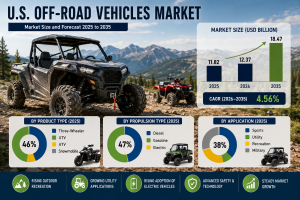
The U.S. off-road vehicles market is projected to grow from USD 12.37 billion in 2026 to approximately USD 18.47 billion by 2035, expanding at a CAGR of 4.56% during the forecast period. The market growth is primarily driven by the increasing demand for recreational vehicles, expanding agricultural and utility applications, and rising adoption of all-terrain vehicles (ATVs) and utility terrain vehicles (UTVs). Continuous technological advancements, the emergence of electric off-road vehicles, and growing investments in outdoor recreation infrastructure are further supporting market expansion across the United States.
Off-road vehicles have become indispensable across multiple industries, including agriculture, construction, forestry, defense, mining, and tourism. Along with their traditional recreational use, these vehicles are increasingly being adopted for commercial and industrial applications due to their durability, versatility, and ability to operate efficiently across rugged terrain. As manufacturers continue introducing advanced safety systems, connected technologies, and electrified powertrains, the U.S. off-road vehicles market is expected to witness steady growth throughout the forecast period.
U.S. Off-Road Vehicles Market Overview
Off-road vehicles are specially designed automobiles capable of operating efficiently on rough and uneven terrain, including dirt trails, rocky landscapes, muddy roads, forests, deserts, snow-covered regions, and mountainous areas. Unlike conventional road vehicles, off-road vehicles feature rugged tires, reinforced suspension systems, high ground clearance, four-wheel-drive capabilities, and durable chassis designs that allow them to navigate challenging environments safely and efficiently.
The U.S. off-road vehicles market includes a wide variety of vehicle categories such as all-terrain vehicles (ATVs), utility terrain vehicles (UTVs), side-by-side vehicles, snowmobiles, dirt bikes, and three-wheelers. These vehicles are extensively used across recreational activities, agriculture, forestry, mining, military operations, construction projects, hunting, tourism, and emergency response applications.
The market continues to evolve with increasing adoption of electric propulsion systems, connected vehicle technologies, GPS navigation, smart safety features, and advanced suspension systems. Growing consumer interest in outdoor adventure activities, expanding utility applications, and increasing investments in recreational infrastructure continue to create favorable opportunities for market participants. As manufacturers introduce lightweight materials, enhanced fuel efficiency, AI-powered navigation systems, and battery-electric off-road vehicles, the market is expected to remain highly competitive and innovation-driven.
U.S. Off-Road Vehicles Market Size & Forecast
| Year | Market Size (USD Billion) |
|---|---|
| 2025 | 11.82 |
| 2026 | 12.37 |
| 2035 | 18.47 |
CAGR (2026–2035): 4.56%
The U.S. off-road vehicles market is anticipated to experience steady growth over the forecast period owing to increasing participation in recreational sports, rising agricultural mechanization, infrastructure development, and expanding industrial applications. Increasing disposable income, favorable financing options, and continuous product innovations are expected to further support market expansion.
The growing popularity of utility terrain vehicles among commercial fleet operators, ranch owners, construction companies, and defense organizations is creating new opportunities for manufacturers. In addition, the increasing availability of electric off-road vehicles is opening new growth avenues within environmentally conscious consumer segments.
Download the Sample: https://www.precedenceresearch.com/sample/4099
What is the Role of AI in the U.S. Off-Road Vehicles Market?
- Artificial Intelligence (AI) is transforming the U.S. off-road vehicles market by enhancing vehicle performance, improving safety, enabling predictive maintenance, and delivering smarter navigation capabilities across challenging environments.
- Modern off-road vehicles increasingly utilize AI-powered systems to analyze terrain conditions, optimize suspension settings, monitor engine performance, and improve traction control in real time. AI algorithms continuously process data collected from onboard sensors, GPS systems, cameras, LiDAR, and telematics platforms to assist drivers in navigating difficult terrain more safely and efficiently.
- Machine learning technologies also enable predictive maintenance by identifying component wear, monitoring battery performance in electric off-road vehicles, and detecting potential mechanical failures before they occur. This reduces maintenance costs, minimizes downtime, and improves vehicle reliability.
- Fleet operators in agriculture, mining, forestry, and construction are increasingly adopting AI-enabled fleet management solutions that optimize route planning, monitor fuel consumption, track equipment utilization, and improve operational efficiency.
- Furthermore, AI supports autonomous and semi-autonomous off-road operations, allowing vehicles to perform repetitive agricultural, mining, and industrial tasks with greater precision while reducing labor requirements.
Key Applications of AI in Off-Road Vehicles
- Intelligent terrain recognition
- Adaptive suspension control
- Predictive maintenance
- Smart traction management
- Autonomous navigation assistance
- GPS route optimization
- Fleet management
- Fuel efficiency optimization
- Battery performance monitoring
- Driver safety assistance
- Obstacle detection
- Remote diagnostics
- Vehicle telematics
- AI-powered maintenance scheduling
- Real-time performance analytics
Key Growth Drivers Fueling Market Expansion
Rising Outdoor Recreational Activities
- Outdoor recreational activities such as trail riding, camping, hunting, off-road racing, rock crawling, dune riding, and adventure tourism continue gaining popularity throughout the United States. Increasing participation among younger consumers and families has significantly boosted demand for ATVs, UTVs, and side-by-side vehicles.
- Growing investments in off-road parks, recreational trails, and tourism infrastructure are creating favorable conditions for sustained market growth.
Expanding Agricultural Applications
- Farmers and ranch owners increasingly rely on off-road vehicles for transporting equipment, livestock management, crop monitoring, fencing operations, irrigation maintenance, and harvesting activities. Their ability to access difficult terrain while reducing labor costs makes them valuable assets across modern agricultural operations.
- The growing adoption of utility terrain vehicles in precision agriculture is expected to further strengthen demand over the coming years.
Growing Industrial and Commercial Usage
- Construction companies, mining operators, forestry organizations, utility providers, and oil & gas companies continue adopting off-road vehicles for material transportation, equipment hauling, maintenance operations, and workforce mobility.
- Their durability, maneuverability, and operational efficiency across rugged environments continue expanding commercial applications throughout the country.
Technological Advancements
- Manufacturers are continuously introducing advanced technologies including intelligent suspension systems, digital instrument clusters, smartphone connectivity, GPS navigation, AI-assisted safety systems, collision warning technologies, and enhanced powertrain efficiency.
- These innovations improve vehicle performance, comfort, safety, and fuel efficiency while attracting new customer segments.
Rising Adoption of Electric Off-Road Vehicles
- Electric ATVs and UTVs are gaining popularity due to lower operating costs, quieter operation, zero tailpipe emissions, and reduced maintenance requirements. Improvements in lithium-ion battery technology, charging infrastructure, and electric drivetrain performance continue accelerating market adoption.
- Several leading manufacturers are investing heavily in electric off-road vehicle development to meet evolving consumer preferences and environmental regulations.
Increasing Government Support for Outdoor Recreation
- Federal and state governments continue investing in public trail development, park infrastructure, wildlife conservation, and recreational tourism programs that encourage off-road vehicle usage.
- Improved access to designated riding areas and growing tourism initiatives continue supporting long-term industry growth.
Government Initiatives Supporting Market Growth
- Government initiatives continue to play a significant role in supporting the growth of the U.S. off-road vehicles market through investments in outdoor recreation, public land access, infrastructure development, sustainable mobility, and advanced vehicle technologies.
- Federal agencies such as the U.S. Forest Service (USFS), Bureau of Land Management (BLM), and the National Park Service (NPS) work alongside state governments to expand and maintain designated off-road vehicle trails, parks, and recreational areas. These programs encourage responsible off-road vehicle usage while improving tourism and supporting local economies.
- The U.S. Department of Agriculture (USDA) also promotes the use of utility vehicles in farming, forestry, and rural development projects through various agricultural modernization initiatives. Off-road vehicles have become essential equipment for livestock management, irrigation monitoring, land maintenance, and precision farming applications.
- In addition, increasing government support for electric mobility and clean transportation technologies is encouraging manufacturers to develop electric ATVs, UTVs, and side-by-side vehicles. Several federal and state incentive programs promoting battery-electric vehicles, charging infrastructure, and low-emission technologies are expected to accelerate adoption of electric off-road vehicles during the forecast period.
- Military modernization programs are also contributing to market expansion by increasing procurement of highly durable off-road tactical vehicles designed for surveillance, logistics, rescue missions, and rapid troop deployment across challenging terrains.
- Collectively, these initiatives are strengthening domestic manufacturing, encouraging technological innovation, improving recreational infrastructure, and creating favorable conditions for long-term market growth.
Major Trends Shaping the U.S. Off-Road Vehicles Market
Rising Adoption of Electric Off-Road Vehicles
- The off-road vehicle industry is witnessing a gradual shift toward electrification as manufacturers introduce battery-powered ATVs, UTVs, and side-by-side vehicles. Electric models offer lower operating costs, reduced maintenance requirements, quieter operation, and zero tailpipe emissions, making them attractive for recreational users, commercial operators, and environmentally conscious consumers.
Integration of Smart Connectivity Technologies
- Modern off-road vehicles increasingly feature GPS navigation, smartphone integration, Bluetooth connectivity, digital dashboards, wireless diagnostics, and cloud-based telematics. These technologies improve navigation, enhance user experience, and enable real-time vehicle monitoring for both individual users and commercial fleet operators.
Increasing Popularity of Adventure Tourism
- Adventure tourism continues expanding across the United States, with growing participation in trail riding, rock crawling, desert racing, dune adventures, hunting expeditions, and wilderness exploration. Tourism operators are increasingly investing in rental fleets of ATVs and UTVs to meet rising consumer demand.
Advanced Safety Features
- Manufacturers are placing greater emphasis on rider safety through the integration of rollover protection systems (ROPS), electronic stability control, improved braking systems, adaptive suspension technologies, collision warning systems, and enhanced occupant protection features.
- These innovations improve driver confidence while complying with evolving safety regulations.
Growing Demand for Utility Terrain Vehicles (UTVs)
- UTVs are becoming increasingly popular across agriculture, construction, mining, forestry, defense, and industrial sectors due to their versatility, cargo capacity, and ability to transport workers and equipment across difficult terrain.
- Commercial fleet operators are investing heavily in utility vehicles capable of handling demanding operational environments.
Lightweight Vehicle Design
- Manufacturers are utilizing lightweight materials such as aluminum alloys, composite materials, and high-strength steel to improve fuel efficiency, increase payload capacity, enhance maneuverability, and reduce maintenance costs without compromising durability.
U.S. Off-Road Vehicles Market Challenges
- High Manufacturing Costs: The integration of advanced suspension systems, intelligent electronics, improved safety equipment, and electric propulsion technologies has significantly increased manufacturing costs. Rising raw material prices and supply chain disruptions further contribute to higher vehicle prices, making premium off-road vehicles less affordable for some consumers.
- Economic Uncertainty: Off-road vehicles are considered discretionary purchases, making market demand highly sensitive to economic conditions. During periods of inflation, rising interest rates, or economic slowdown, consumers often postpone purchases of recreational vehicles, affecting market growth.
- Stringent Environmental Regulations: Increasing environmental regulations governing vehicle emissions, noise pollution, and land conservation require manufacturers to invest heavily in cleaner engine technologies, electrification, and regulatory compliance. While these measures promote sustainability, they also increase production costs.
- Safety Concerns: Off-road riding involves inherent risks associated with challenging terrain, high speeds, and unpredictable environmental conditions. Accident rates have encouraged regulators and manufacturers to strengthen safety standards through improved vehicle design, rider education, and protective equipment requirements.
- Battery Limitations in Electric Models: Although electric off-road vehicles are gaining popularity, battery charging infrastructure remains limited in remote recreational areas. Range anxiety, charging time, and battery replacement costs continue limiting widespread adoption, particularly among commercial users operating in isolated locations.
Why the U.S. Off-Road Vehicles Market is Growing
- The U.S. off-road vehicles market continues to expand as recreational lifestyles, outdoor tourism, agriculture, construction, and industrial operations increasingly rely on durable all-terrain transportation solutions.
- Growing consumer spending on outdoor experiences, increasing participation in adventure sports, rising agricultural mechanization, expanding utility applications, and technological advancements are driving sustained demand for ATVs, UTVs, and side-by-side vehicles.
- The rapid adoption of electric powertrains, AI-enabled navigation systems, connected vehicle technologies, and advanced safety features is transforming the industry while creating new opportunities for manufacturers and fleet operators.
- Furthermore, favorable government initiatives supporting outdoor recreation, infrastructure development, sustainable transportation, and domestic manufacturing continue strengthening the market outlook.
- As manufacturers expand product portfolios and introduce more efficient, intelligent, and environmentally friendly vehicles, the U.S. off-road vehicles market is expected to maintain steady growth through 2035.
Recent Developments in the U.S. Off-Road Vehicles Market
- 2025: Kandi Technologies commenced local manufacturing operations at its new Texas production facility, rolling out its first U.S.-assembled electric golf cart. The investment marks a significant milestone in the company’s expansion strategy within the North American off-road vehicle market. Local production is expected to reduce delivery times, improve product availability, and strengthen Kandi’s position in the growing electric off-road vehicle segment.
- 2025: Argus Research initiated coverage on Kandi Technologies, highlighting the company’s strategic transition toward electric off-road vehicles. The report emphasized strong growth opportunities driven by Kandi’s expanding portfolio of electric golf carts and utility terrain vehicles (UTVs), along with its NFL-branded product line available through Lowe’s retail stores. The company’s battery-swapping technology and expanding distribution network are expected to support long-term market growth.
- 2024: Toyota announced plans to introduce the Land Cruiser 250 Series, featuring a powerful turbocharged engine and a full-time four-wheel-drive system designed for superior off-road performance. The new model reflects the company’s continued investment in rugged utility vehicles capable of meeting increasing consumer demand for adventure and utility applications.
- 2024: Leading manufacturers continued investing in electric all-terrain vehicles (ATVs), side-by-side vehicles, and utility terrain vehicles (UTVs), integrating advanced battery technologies, connected vehicle platforms, intelligent suspension systems, and enhanced safety features to improve performance across recreational and commercial applications.
- 2024: Several U.S. rental companies expanded their fleets of ATVs and UTVs to support the rapid growth of adventure tourism, outdoor recreation, and guided off-road experiences across national parks, forests, and desert destinations.
Leading Companies Operating in the U.S. Off-Road Vehicles Market
Major companies include:
- Polaris Inc.
- Arctic Cat Inc.
- Yamaha Motor Corporation
- Honda Motor Co., Ltd.
- Kawasaki Motors Corp., U.S.A.
- Can-Am (BRP Inc.)
- Suzuki Motor Corporation
- John Deere
- Textron Inc.
- Kubota Corporation
- KYMCO
- CFMOTO
- Mahindra & Mahindra Limited
- Massimo Motor
- American Landmaster
These companies continue investing in product innovation, electrification, advanced safety technologies, connected mobility solutions, AI-powered vehicle diagnostics, and expanded dealer networks to strengthen their competitive positions in the U.S. market.
Read More: U.S. Vehicle-to-Grid Technology Market
Segments Covered in the Report
By Product Type
- All-Terrain Vehicle (ATV)
- Utility Terrain Vehicle (UTV)
- Snowmobile
- Three-Wheeler
By Propulsion Type
- Gasoline
- Diesel
- Electric
By Application
- Utility
- Sports
- Recreation
- Military
Future Outlook
The U.S. off-road vehicles market is expected to witness stable and sustained growth through 2035, supported by increasing consumer participation in outdoor recreation, expanding commercial applications, and continuous technological innovation. The growing popularity of ATVs, UTVs, side-by-side vehicles, and electric off-road vehicles will continue reshaping the industry as consumers seek vehicles that combine durability, versatility, safety, and environmental sustainability. Advances in battery technology, intelligent navigation systems, AI-powered diagnostics, connected mobility, and lightweight vehicle design are expected to further enhance product performance and user experience.
Commercial demand from agriculture, construction, forestry, mining, utilities, and defense sectors will remain a key growth driver, as these industries increasingly rely on rugged off-road vehicles for transportation, equipment hauling, inspection, and operational efficiency. In parallel, the continued expansion of adventure tourism, trail networks, and recreational parks across the United States will support rising demand for recreational off-road vehicles. Government initiatives promoting outdoor recreation, infrastructure development, and clean mobility solutions are also expected to encourage wider adoption of electric and low-emission off-road vehicles. Manufacturers are likely to accelerate investments in sustainable technologies while expanding product portfolios to meet evolving consumer expectations and regulatory requirements.
By 2035, the U.S. Off-Road Vehicles Market is projected to reach USD 18.47 billion, creating significant opportunities for vehicle manufacturers, component suppliers, technology providers, rental operators, dealers, fleet owners, and investors seeking to capitalize on the growing demand for advanced off-road mobility solutions.
You can place an order or ask any questions please feel free to contact us at:
📧 sales@precedenceresearch.com
