
The global cholestatic pruritus market is gaining momentum as healthcare providers and pharmaceutical companies focus on developing more effective treatments for chronic itching associated with liver diseases. Increasing awareness of cholestatic disorders, rising investments in rare disease research, and the emergence of innovative therapeutics are driving market expansion worldwide.
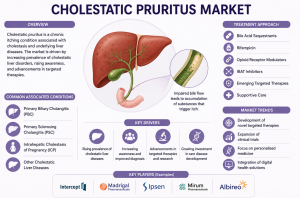
Cholestatic pruritus is a debilitating symptom commonly associated with chronic liver diseases such as primary biliary cholangitis (PBC), primary sclerosing cholangitis (PSC), intrahepatic cholestasis of pregnancy (ICP), and other cholestatic liver disorders. Persistent itching can significantly reduce patients’ quality of life, affecting sleep, mental health, and daily activities. As a result, the demand for effective and long-lasting treatment options continues to increase.
With ongoing clinical research, improved diagnostic capabilities, and regulatory support for orphan drugs, the cholestatic pruritus market is expected to witness sustained growth over the coming years.
What is the Cholestatic Pruritus Market Size in 2026?
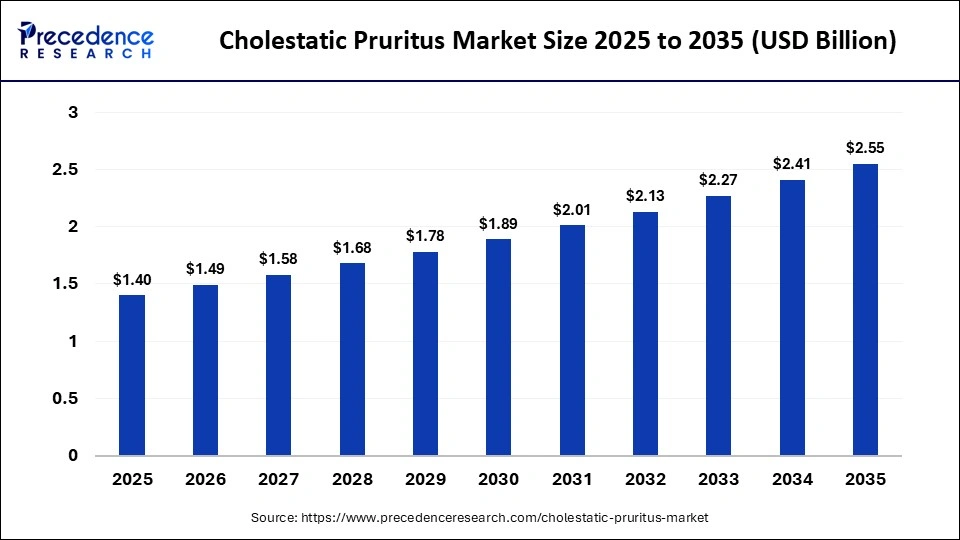
The global cholestatic pruritus market size accounted for USD 1.40 billion in 2025 and is predicted to increase from USD 1.49 billion in 2026 to approximately USD 2.55 billion by 2035, expanding at a CAGR of 6.20% from 2026 to 2035. The market is expanding due to the increasing prevalence of liver diseases such as ICP and PBS, improved diagnostic methods, and well-developed pipelines for the introduction of novel drugs.
Market Highlights
- North America held the largest market share of 35% in 2025.
- Europe is expected to witness the fastest CAGR during the foreseeable period.
- By treatment type, the pharmacological treatments segment held the largest market share of 75% in 2025.
- By treatment type, the non-pharmacological treatments segment is the second-largest shareholder and is expected to grow at a significant rate between 2026 and 2035.
- By disease type, the primary biliary cholangitis segment held the largest market share of 60% in 2025.
- By disease type, the cholestasis hepatic failure segment is the second-largest shareholder and is expected to grow at a significant rate between 2026 and 2035.
- By end use, the hospitals segment held the largest market share of 50% in 2025.
- By end use, the clinics segment is the second-largest shareholder and is expected to grow at a significant rate between 2026 and 2035.
Understanding Cholestatic Pruritus
Cholestatic pruritus is a severe itching condition caused by impaired bile flow, leading to the accumulation of substances in the bloodstream that trigger itch-related nerve pathways. Unlike common skin disorders, cholestatic pruritus often occurs without visible skin lesions, making diagnosis and management more challenging.
Treatment typically focuses on reducing itch severity while addressing the underlying liver condition. Conventional therapies include bile acid sequestrants, rifampicin, opioid receptor modulators, antihistamines, and supportive care. However, newer targeted therapies are showing promising clinical outcomes for patients with treatment-resistant symptoms.
Market Overview
The cholestatic pruritus market is experiencing steady growth due to increasing cases of chronic liver diseases, improved disease awareness, and expanding research into novel therapeutic mechanisms. Pharmaceutical companies are actively investing in innovative drug candidates that target bile acid metabolism, ileal bile acid transporters, and other biological pathways involved in itch signaling.
Advancements in precision medicine, biomarker research, and orphan drug development are further strengthening the market by enabling more personalized treatment approaches.
Market Scope
| Report Coverage | Details |
| Market Size in 2025 | USD 1.40 Billion |
| Market Size in 2026 | USD 1.49 Billion |
| Market Size by 2035 | USD 2.55 Billion |
| Market Growth Rate from 2026 to 2035 | CAGR of 6.20% |
| Dominating Region | North America |
| Fastest Growing Region | Asia Pacific |
| Base Year | 2025 |
| Forecast Period | 2026 to 2035 |
| Segments Covered | Treatment Type, Disease Type, End-Use, and Region |
| Regions Covered | North America, Europe, Asia-Pacific, Latin America, and Middle East & Africa |
Key Market Drivers
Rising Prevalence of Chronic Liver Diseases
The growing burden of liver disorders, including primary biliary cholangitis, primary sclerosing cholangitis, and non-alcoholic liver diseases, is increasing the number of patients experiencing cholestatic pruritus.
Increasing Focus on Rare Disease Research
Governments, academic institutions, and pharmaceutical companies are expanding investments in orphan drug development to address unmet medical needs associated with rare cholestatic disorders.
Advancements in Targeted Therapies
Innovative therapies targeting bile acid transport, opioid receptors, and other molecular pathways are improving treatment outcomes for patients who do not respond adequately to conventional medications.
Improved Diagnostic Technologies
Advances in liver imaging, laboratory diagnostics, and biomarker identification are supporting earlier diagnosis and more effective disease management.
Growing Healthcare Awareness
Educational initiatives by healthcare organizations and patient advocacy groups are increasing awareness of cholestatic diseases, encouraging earlier consultation and treatment.
Emerging Market Trends
Development of IBAT Inhibitors
Ileal bile acid transporter (IBAT) inhibitors have emerged as one of the most promising therapeutic classes for managing cholestatic pruritus by reducing circulating bile acids and improving symptom control.
Personalized Medicine
Researchers are increasingly exploring biomarker-driven treatment strategies to optimize therapy selection based on individual patient characteristics and disease progression.
Expansion of Clinical Trials
Numerous pharmaceutical companies are conducting clinical studies evaluating next-generation therapies aimed at improving efficacy, safety, and long-term symptom relief.
Digital Health Integration
Remote monitoring platforms, patient-reported outcome tools, and telemedicine services are improving long-term disease management and treatment adherence.
Market Challenges
Despite promising growth prospects, the cholestatic pruritus market faces several challenges.
The rarity of many cholestatic disorders can limit patient recruitment for clinical trials and delay product development. High treatment costs, limited disease awareness in certain regions, and complex regulatory pathways also present barriers to market expansion.
In addition, managing chronic itching remains challenging for patients who fail to respond to existing therapies, highlighting the need for continued innovation.
Opportunities
The market presents significant opportunities for pharmaceutical companies, biotechnology firms, contract research organizations, and specialty healthcare providers.
Increasing approvals of orphan drugs, expanding biologics research, strategic licensing agreements, and collaborations between industry and academic institutions are expected to accelerate therapeutic innovation.
Emerging markets are also creating new opportunities as healthcare infrastructure improves and access to specialty liver care expands.
Regional Analysis
North America remains a leading market due to advanced healthcare infrastructure, strong rare disease research, favorable reimbursement policies, and active pharmaceutical innovation.
Europe continues to witness significant growth supported by increasing clinical research, early adoption of innovative therapies, and government support for orphan drug development.
Asia Pacific is expected to register substantial growth owing to improving healthcare access, rising awareness of liver diseases, expanding pharmaceutical manufacturing, and growing investments in clinical research.
Latin America and the Middle East & Africa are gradually strengthening healthcare systems, creating opportunities for improved diagnosis and treatment of cholestatic disorders.
Competitive Landscape
The cholestatic pruritus market is characterized by continuous research and strategic collaborations among pharmaceutical companies focused on developing innovative therapies.
Leading market participants are investing in:
- Targeted antipruritic therapies
- IBAT inhibitors
- Orphan drug development
- Clinical trial expansion
- Precision medicine
- Strategic partnerships and licensing agreements
- Biomarker research
These initiatives are expected to strengthen treatment options and improve patient outcomes over the coming decade.
Get Sample Link : https://www.precedenceresearch.com/sample/8320
Future Outlook
The future of the cholestatic pruritus market appears promising as advances in liver disease research, targeted therapeutics, and precision medicine continue to improve treatment outcomes. Growing awareness among healthcare professionals, expanding orphan drug pipelines, and increasing investment in innovative drug development are expected to drive sustained market growth.
As new therapies gain regulatory approval and access to specialized care improves globally, the cholestatic pruritus market is well positioned to address a significant unmet medical need while creating substantial opportunities for healthcare providers, pharmaceutical companies, and investors.
Recent Developments
- In March 2026, the US FDA approved Lynavoy or Linerixibat for cholestatic pruritus in patients with primary biliary cholangitis symptoms to minimize various reasons of chronic itching. Lynavoy is renowned as an ileal bile acid transporter inhibitor, and is the first medicine approved in the U.S. for the treatment of cholestatic pruritus in patients with PBC. This approval was based on the positive GLISTEN phase III trial with regulatory reviews underway in Canada, the UK, China, and the EU.
- In November 2025, Maralixibat provides clinically meaningful pruritus reductions in PSC symptoms, which is a minimally absorbed ileal bile acid transporter inhibitor with many experiencing complete relief by using it. Maralixibat is proven to reduce enterohepatic bile acid recirculation, pruritus, and serum bile acids. It has led to its approval for the treatment of cholestatic pruritus in Alagille syndrome and progressive familial intrahepatic cholestasis.
Segments Covered in the Report
By Treatment Type
- Pharmacological Treatments
- Ursodeoxycholic Acid (UDCA)
- Antihistamines
- Opioid Antagonists
- Glucocorticoids
- Topical Steroids
- Others
- Non-pharmacological Treatments
- Phototherapy
- Plasmapheresis
- Liver Transplantation
By Disease Type
- Primary Biliary Cholangitis (PBC)
- Primary Sclerosing Cholangitis (PSC)
- Cholestasis due to Hepatic Failure
- Others
By End-Use
- Hospitals
- Clinics
- Ambulatory Surgery Centres
- Homecare Settings
By Region
- North America
- Latin America
- Europe
- Asia-pacific
- Middle and East Africa
Also Read Our Latest Article : Inflammatory Disease Market

- Cholestatic Pruritus Market: Advancements in Targeted Therapies Are Transforming Patient Care - June 30, 2026
- Inflammatory Disease Market: Biologic Therapies and Precision Medicine Are Reshaping Patient Care - June 30, 2026
- Retail Cloud Market: Driving the Future of Smart, Connected Retail Operations - June 30, 2026