
The global non-invasive prenatal testing market is projected to grow from USD 8.05 billion in 2026 to USD 20.89 billion by 2035, expanding at a CAGR of 11.27% during the forecast period. The market growth is driven by increasing maternal age, rising awareness of prenatal genetic screening, technological advancements in next-generation sequencing (NGS), and growing adoption of non-invasive diagnostic methods.
As prenatal healthcare continues to evolve, NIPT has become one of the most preferred prenatal screening tools because it enables early detection of fetal chromosomal abnormalities through a simple maternal blood test without the risks associated with invasive procedures such as amniocentesis.
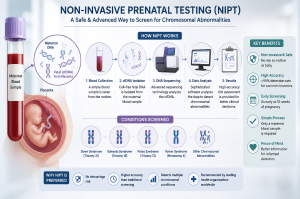
Non-Invasive Prenatal Testing Market Overview
Non-invasive prenatal testing (NIPT) is an advanced prenatal screening technique that analyzes cell-free fetal DNA (cfDNA) present in a pregnant woman’s bloodstream to assess the risk of chromosomal abnormalities in the developing fetus. Unlike conventional diagnostic procedures such as amniocentesis and chorionic villus sampling (CVS), NIPT requires only a simple maternal blood sample, making it a much safer alternative that eliminates the risk of procedure-related miscarriage. The technology has revolutionized prenatal care by enabling highly accurate detection of common chromosomal conditions, including Down syndrome (Trisomy 21), Edwards syndrome (Trisomy 18), Patau syndrome (Trisomy 13), Turner syndrome, and several other genetic abnormalities during the early stages of pregnancy. The increasing preference for early diagnosis allows healthcare providers and parents to make informed clinical decisions while preparing appropriate medical care if needed.
Continuous advancements in next-generation sequencing (NGS), molecular genetics, artificial intelligence, and bioinformatics have significantly enhanced the sensitivity and specificity of NIPT, making it one of the fastest-growing segments within prenatal diagnostics. Growing awareness among expectant parents, increasing maternal age, and expanding healthcare infrastructure worldwide continue to drive adoption across hospitals, diagnostic laboratories, and specialized prenatal clinics.
Non-Invasive Prenatal Testing Market Size & Forecast
| Year | Market Size (USD Billion) |
|---|---|
| 2025 | 7.18 |
| 2026 | 8.05 |
| 2035 | 20.89 |
CAGR (2026-2035): 11.27%
The market is expected to experience strong double-digit growth throughout the forecast period due to the rising demand for safer prenatal screening methods, growing awareness regarding fetal genetic disorders, and increasing integration of advanced sequencing technologies into routine prenatal care. Favorable reimbursement policies in developed countries, expanding healthcare expenditure, and growing investments in precision medicine are also expected to contribute significantly to market expansion. As healthcare providers increasingly recommend early prenatal genetic screening, NIPT is becoming an essential component of modern maternal healthcare worldwide.
Download the Sample: https://www.precedenceresearch.com/sample/3362
What is the Role of AI in the Non-Invasive Prenatal Testing Market?
Artificial Intelligence (AI) is transforming the global non-invasive prenatal testing market by significantly improving genomic data analysis, diagnostic accuracy, laboratory automation, and personalized prenatal care. Modern NIPT generates enormous volumes of genomic sequencing data that require rapid interpretation. AI-powered algorithms efficiently process these complex datasets to detect chromosomal abnormalities with greater precision while reducing human error and false-positive results.
Machine learning models continuously improve through large-scale genomic datasets, enabling faster identification of fetal genetic disorders and supporting clinicians with evidence-based recommendations. AI also automates sequencing workflows, accelerates report generation, and improves turnaround times for patients awaiting critical prenatal screening results.
Beyond laboratory operations, AI-powered clinical decision support systems assist genetic counselors by evaluating patient history, maternal age, family genetics, and screening outcomes to provide individualized risk assessments. Cloud-based AI platforms also facilitate remote data sharing among laboratories, hospitals, and healthcare providers, improving collaboration and enhancing patient care.
Key Applications of AI in Non-Invasive Prenatal Testing
- Automated genomic data interpretation
- Cell-free DNA sequence analysis
- Chromosomal abnormality detection
- Predictive risk assessment
- Clinical decision support
- Laboratory workflow automation
- Personalized genetic counseling
- Real-time reporting
- Bioinformatics optimization
- Cloud-enabled data management
- Quality control and validation
- Precision medicine integration
Key Growth Drivers Fueling Market Expansion
- Increasing Maternal Age: Women are increasingly choosing to have children later in life due to career advancement, higher education, and changing lifestyles. Advanced maternal age is associated with a greater risk of chromosomal abnormalities, making prenatal genetic screening increasingly important. Consequently, healthcare professionals are recommending NIPT more frequently as a first-line screening method for high-risk pregnancies.
- Growing Awareness of Prenatal Genetic Screening: Expectant parents today have greater access to healthcare information and genetic counseling services than ever before. Increased awareness regarding the importance of early fetal health assessment has encouraged more women to undergo prenatal screening during the first trimester. Educational campaigns by healthcare providers and government organizations continue supporting wider adoption.
- Technological Advancements in Genomic Sequencing: Continuous innovation in next-generation sequencing (NGS), bioinformatics software, and molecular diagnostics has significantly improved NIPT performance. Modern sequencing platforms deliver faster turnaround times, lower costs, improved sensitivity, and broader detection capabilities, making prenatal genetic testing more reliable and accessible.
- Rising Incidence of Genetic Disorders: The increasing prevalence of inherited genetic disorders and chromosomal abnormalities has intensified the demand for early prenatal diagnosis. NIPT enables early identification of potential fetal conditions, allowing physicians and families to make informed medical decisions while improving pregnancy management.
- Expanding Healthcare Infrastructure: Developing countries continue investing heavily in modern healthcare facilities, molecular diagnostic laboratories, and maternal healthcare services. These improvements are increasing access to advanced prenatal testing technologies across emerging economies.
- Growing Acceptance of Precision Medicine: Healthcare systems worldwide are increasingly embracing personalized medicine approaches that utilize genetic information for clinical decision-making. NIPT aligns closely with precision medicine initiatives by providing individualized fetal genetic information that supports more personalized prenatal care.
Government Initiatives Supporting Market Growth
- Governments across developed and emerging economies are investing substantially in improving maternal and child healthcare through national prenatal screening programs and genomic medicine initiatives. Public healthcare agencies continue expanding access to prenatal diagnostics while strengthening healthcare infrastructure and laboratory capabilities.
- Several countries have incorporated prenatal genetic screening into routine pregnancy care through public reimbursement programs and insurance coverage. Government funding for genomic research, maternal health awareness campaigns, and healthcare modernization is encouraging wider adoption of NIPT technologies.
- International organizations such as the World Health Organization (WHO) and various national healthcare authorities continue promoting early diagnosis of congenital disorders to improve pregnancy outcomes and reduce infant mortality rates. These initiatives create a favorable environment for continued market growth.
Major Trends Shaping the Non-Invasive Prenatal Testing Market
Growing Adoption of Early Prenatal Screening
- Healthcare providers increasingly recommend NIPT during the first trimester because earlier diagnosis allows better pregnancy management and timely clinical interventions. Early screening also reduces anxiety among expectant parents while improving pregnancy planning.
Expansion Beyond Common Chromosomal Disorders
- Modern NIPT platforms are evolving beyond traditional trisomy detection. New tests can identify microdeletions, sex chromosome abnormalities, single-gene disorders, and rare genetic mutations, expanding the clinical value of prenatal screening.
Artificial Intelligence Integration
- AI-powered genomic interpretation is improving diagnostic accuracy while reducing laboratory workload. Intelligent software platforms automatically analyze sequencing data and generate clinical reports, enabling faster and more consistent diagnoses.
Improved Accessibility Through Cost Reduction
- Technological innovation and increased market competition are lowering testing costs globally. Expanded insurance reimbursement and government healthcare support are making NIPT accessible to larger patient populations.
Rising Demand in Emerging Markets
- Countries across Asia Pacific, Latin America, and the Middle East are witnessing rapid growth due to rising healthcare expenditure, improved diagnostic infrastructure, increasing disposable incomes, and greater awareness regarding prenatal care.
Non-Invasive Prenatal Testing Market Challenges
- High Testing Costs
Although testing costs have gradually declined, NIPT remains relatively expensive in several developing countries. Advanced sequencing equipment, specialized laboratory infrastructure, and highly trained personnel contribute to higher pricing, limiting accessibility for some patients.
- Ethical and Privacy Concerns
The increasing availability of fetal genetic information raises ethical questions surrounding informed consent, genetic privacy, and potential misuse of genetic data. Governments and healthcare organizations continue developing regulations to ensure responsible clinical use.
- Requirement for Confirmatory Testing
Although NIPT demonstrates exceptionally high sensitivity and specificity, it remains a screening rather than a diagnostic test. Positive screening results often require confirmation through invasive diagnostic procedures such as amniocentesis or chorionic villus sampling.
- Uneven Reimbursement Policies
Insurance coverage varies considerably across countries and healthcare systems. Limited reimbursement in several regions continues restricting widespread adoption despite strong clinical benefits.
- Regulatory Compliance
Manufacturers must comply with increasingly stringent regulations governing genetic diagnostics, laboratory quality standards, clinical validation, and patient data protection. Maintaining regulatory compliance requires substantial ongoing investment.
Why the Non-Invasive Prenatal Testing Market is Growing
The market is expanding because healthcare providers increasingly prefer safer prenatal screening technologies that deliver accurate results without invasive procedures.
Growing maternal age, increasing awareness of fetal genetic disorders, technological advancements in sequencing, AI integration, expanding reimbursement coverage, and stronger healthcare infrastructure continue driving adoption worldwide.
As genomic medicine becomes increasingly integrated into prenatal care, NIPT is expected to become the standard screening method for pregnancies globally.
Recent Developments in the Non-Invasive Prenatal Testing Market
- August 2025: Natera launched Fetal Focus, a non-invasive prenatal test designed for inherited conditions using advanced cell-free DNA technology.
- June 2025: NHS England announced plans for broader newborn genomic sequencing supported by AI-driven healthcare initiatives.
- February 2025: Researchers reported successful prenatal treatment of Spinal Muscular Atrophy (SMA Type 1) using fetal gene-targeted therapy, highlighting the future role of prenatal precision medicine.
Leading Companies Operating in the Non-Invasive Prenatal Testing Market
Major companies include:
- Illumina Inc.
- Natera Inc.
- F. Hoffmann-La Roche Ltd.
- Quest Diagnostics
- Laboratory Corporation of America Holdings (Labcorp)
- Qiagen
- Eurofins LifeCodexx GmbH
- Genesis Genetics (CooperSurgical)
- Centogene N.V.
- MedGenome Labs Ltd.
- Myriad Women’s Health
- Progenity Inc.
These companies continue investing in genomic sequencing, AI-powered analytics, molecular diagnostics, strategic partnerships, and global expansion.
Read More: Water Purifier Market
Segments Covered in the Report
By Component
- Instruments
- Kits & Reagents
- Services
By Application
- Down Syndrome (Trisomy 21)
- Edwards Syndrome (Trisomy 18)
- Patau Syndrome (Trisomy 13)
- Turner Syndrome
- Other Applications
By End User
- Hospitals
- Diagnostic Laboratories
By Region
- North America
- Europe
- Asia Pacific
- Latin America
- Middle East & Africa
Future Outlook
The global non-invasive prenatal testing market is expected to experience robust growth through 2035 as prenatal genetic screening becomes a routine component of maternal healthcare worldwide.
Advancements in artificial intelligence, next-generation sequencing, cell-free DNA analysis, cloud computing, and precision medicine will continue improving testing accuracy, affordability, and accessibility. Increasing investments in maternal healthcare, expanding reimbursement policies, and growing awareness of genetic disorders will further accelerate adoption across developed and emerging markets.
By 2035, the global Non-Invasive Prenatal Testing Market is projected to surpass USD 20.89 billion, creating significant opportunities for diagnostic companies, biotechnology firms, healthcare providers, genomic research organizations, and investors across the precision medicine ecosystem.
You can place an order or ask any questions. Please feel free to contact us at sales@precedenceresearch.com | +1 804 441 9344
