360 Degree Camera Market Redefines Visual Intelligence with AI-Powered Innovation
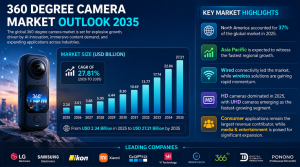
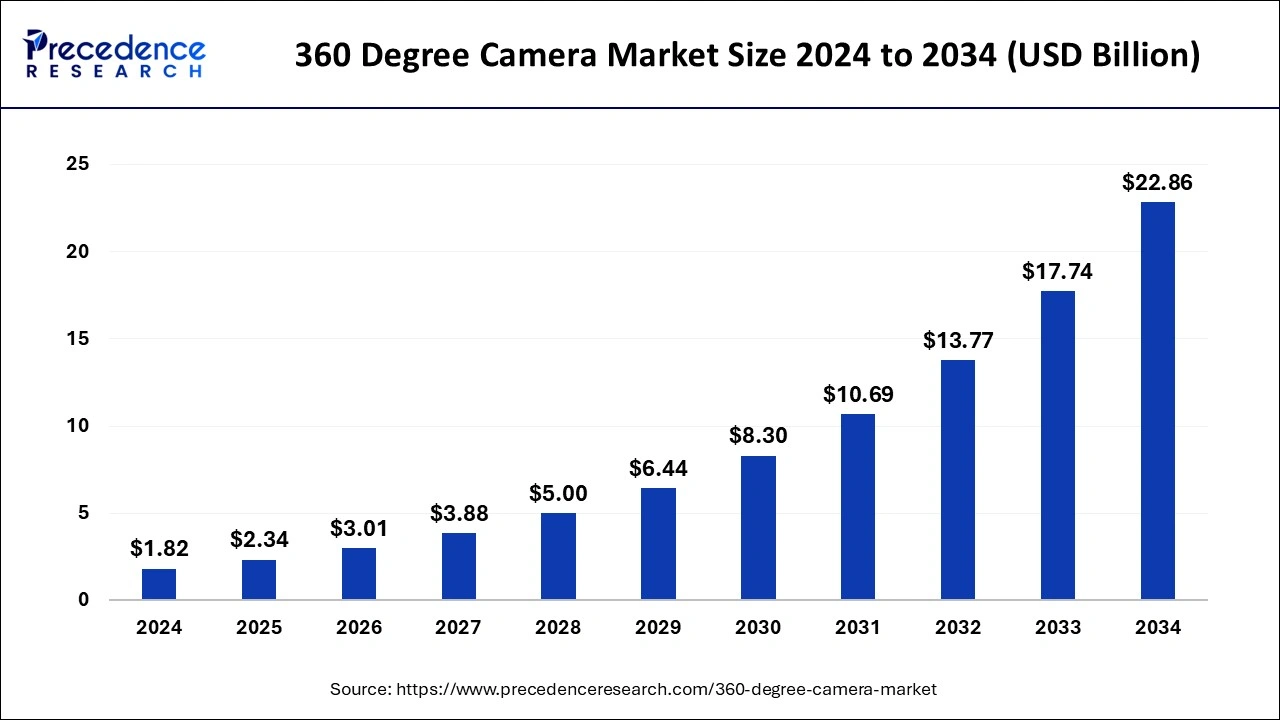
The global 360-degree camera market is entering a transformative growth phase as immersive content creation, virtual reality experiences, intelligent surveillance systems, and AI-powered imaging technologies become mainstream across industries. According to Precedence Research, the market size was valued at USD 2.34 billion in 2025 and is forecast to reach approximately USD 27.21 billion by 2035, growing at a remarkable CAGR of 27.81% from 2026 to 2035.
The growing adoption of 360-degree cameras in media and entertainment, tourism, real estate marketing, automotive safety systems, healthcare visualization, and industrial monitoring is accelerating market expansion. At the same time, rapid advancements in artificial intelligence, image processing, cloud analytics, and wireless connectivity are unlocking new commercial opportunities for camera manufacturers and software providers worldwide.
360-Degree Camera Market Key Insights
- The global 360-degree camera market was valued at USD 2.34 billion in 2025 and is expected to climb to USD 27.21 billion by 2035.
- North America emerged as the leading regional market, accounting for 37% of total revenue in 2025, supported by strong content creation ecosystems and early technology adoption.
- Asia Pacific is expected to register the fastest growth rate throughout the forecast period due to expanding VR gaming, digital commerce, and smartphone-connected imaging solutions.
- The wired connectivity segment dominated revenue generation in 2025 because of its reliability in professional broadcasting, surveillance, and cinematic applications.
- Wireless cameras are forecast to experience the fastest adoption due to increasing demand for mobility, convenience, and flexible deployment.
- High Definition (HD) cameras maintained the largest market share in 2025, while Ultra-High Definition (UHD) cameras are anticipated to witness the strongest growth.
- The consumer segment remained the largest end-use category, fueled by influencers, travel enthusiasts, and social media creators.
- Media and entertainment is projected to become the fastest-growing vertical as immersive storytelling and VR content production continue to expand globally.
- The United States accounted for approximately USD 610 million in market revenue during 2025 and is projected to surpass USD 7.2 billion by 2035.
360 Degree Camera Market Snapshot
| Metric | Value |
|---|---|
| Market Size 2025 | USD 2.34 Billion |
| Market Size 2026 | USD 3.01 Billion |
| Market Size 2035 | USD 27.21 Billion |
| CAGR (2026-2035) | 27.81% |
| Leading Region | North America |
| Fastest Growing Region | Asia Pacific |
| Base Year | 2025 |
| Forecast Period | 2026-2035 |
Why Are 360-Degree Cameras Becoming Essential Across Industries?
360-degree cameras have evolved from niche photography devices into powerful visualization tools used across numerous industries. These cameras capture a complete panoramic view of an environment, enabling immersive experiences that traditional cameras cannot deliver.
As organizations increasingly prioritize digital engagement, virtual experiences, and real-time monitoring, the value proposition of 360-degree imaging continues to strengthen. Businesses can now create interactive property tours, monitor large facilities with fewer devices, conduct remote inspections, improve vehicle safety systems, and deliver engaging entertainment experiences.
The growing popularity of virtual reality (VR), augmented reality (AR), digital twins, and spatial computing is further expanding the practical applications of 360-degree imaging technology.
How Is Artificial Intelligence Transforming the 360-Degree Camera Market?
Artificial intelligence has become a critical innovation driver in the 360-degree camera ecosystem. AI algorithms significantly enhance image stitching, object recognition, motion tracking, scene optimization, and panoramic video rendering, improving the quality and usability of captured content.
Modern AI-powered systems can automatically identify subjects, remove distortions, optimize exposure settings, and perform real-time stabilization. These capabilities simplify content creation for both professional users and everyday consumers.
AI is also enabling advanced industrial applications. Intelligent surveillance systems can automatically detect anomalies, monitor crowd movements, identify safety risks, and generate actionable insights from panoramic footage. As edge AI processing becomes more sophisticated, next-generation cameras will deliver faster analytics while reducing cloud processing requirements.
What Are the Key Forces Driving Market Growth?
Growing Demand for Immersive Media Experiences
The rapid rise of immersive content has fundamentally changed consumer expectations. Social media platforms increasingly support 360-degree videos and interactive experiences, encouraging creators to invest in advanced imaging equipment.
Content creators, influencers, travel bloggers, and digital marketers are leveraging panoramic imaging to differentiate their content and improve audience engagement.
Expansion of Virtual and Augmented Reality Ecosystems
The increasing adoption of VR headsets and AR-enabled applications is creating strong demand for immersive visual content. 360-degree cameras serve as essential content creation tools for virtual environments, making them a cornerstone of the expanding immersive technology market.
Rising Adoption in Automotive Applications
Automotive manufacturers are integrating surround-view camera systems to improve driver awareness and support autonomous driving capabilities. Tier-1 suppliers are actively collaborating with camera manufacturers to meet next-generation vehicle safety requirements.
Increasing Security and Surveillance Requirements
Organizations are deploying 360-degree cameras to monitor larger areas with fewer devices. The ability to capture complete environmental visibility enhances security operations while reducing infrastructure costs.
360 Degree Camera Market Emerging Opportunities
Automotive manufacturers increasingly require sophisticated surround-view systems to support advanced driver-assistance systems (ADAS) and autonomous driving technologies. This trend is creating substantial opportunities for camera module providers and software developers.
E-commerce platforms are integrating 360-degree product visualization capabilities, allowing consumers to examine products from every angle before purchasing. This trend is creating new demand for affordable and user-friendly camera solutions among online sellers.
Organizations are increasingly combining 360-degree cameras with cloud-based spatial analytics platforms to monitor construction projects, analyze customer movement patterns, optimize retail layouts, and manage industrial facilities. These applications create recurring software revenue opportunities beyond hardware sales.
Artificial intelligence is rapidly becoming a competitive differentiator. Companies capable of delivering superior AI-based stabilization, editing, object recognition, and automated content generation will likely gain a significant market advantage over the next decade.
360 Degree Camera Market Segmentation Analysis
Connectivity Type Analysis
Wired Segment Dominated the Market in 2025
The wired segment held the largest share of the 360-degree camera market in 2025 due to its reliable, low-latency performance and ability to deliver high-resolution video without interruptions. These cameras are widely preferred in professional applications such as broadcasting, filmmaking, and security, where continuous operation and stable connectivity are essential.
Wireless Segment to Witness the Fastest Growth
The wireless segment is expected to register the highest CAGR during the forecast period. Increasing demand for flexible, portable, and easy-to-install camera systems across residential and commercial applications is driving adoption. Wireless cameras are particularly popular for home security and remote monitoring due to their convenience and mobility.
Resolution Analysis
High Definition (HD) Segment Led the Market
The high-definition (HD) segment dominated the market in 2025 owing to its ability to provide improved image clarity, vibrant colors, and smoother motion. Advancements in image sensors, processors, and compression technologies have also made HD 360-degree cameras more affordable and accessible.
Ultra-High Definition Segment to Grow Rapidly
The ultra-high definition (UHD) segment is anticipated to expand at the fastest rate over the forecast period. Rising adoption of advanced surveillance technologies by government agencies, defense organizations, and critical infrastructure operators is supporting demand. Continuous improvements in imaging and detection technologies are further accelerating segment growth.
Vertical Analysis
Consumer Segment Held the Largest Share
The consumer segment accounted for the highest market share in 2025, supported by the growing affordability and ease of use of 360-degree cameras. Increasing adoption among content creators, vloggers, photographers, and travelers, along with the popularity of immersive social media content, continues to drive demand.
Media and Entertainment Segment to Expand Fastest
The media and entertainment segment is projected to record the fastest growth during the forecast period. Rising demand for immersive content across digital platforms and the growing use of 360-degree cameras for virtual production, live events, and interactive storytelling are contributing to market expansion.
Camera Type Analysis
Single Camera Segment Dominated the Market
The single-camera segment led the market in 2025 due to its affordability, compact design, and ease of use. Improved image quality, enhanced stabilization, and higher resolutions have made these cameras increasingly popular among consumers, travelers, and content creators.
Professional Camera Segment to Grow at the Highest CAGR
The professional camera segment is expected to witness the fastest growth throughout the forecast period. Increasing deployment in enterprise applications, virtual events, remote collaboration, security, and immersive entertainment is driving demand for high-performance professional camera systems.
360 Degree Camera Market Regional Analysis
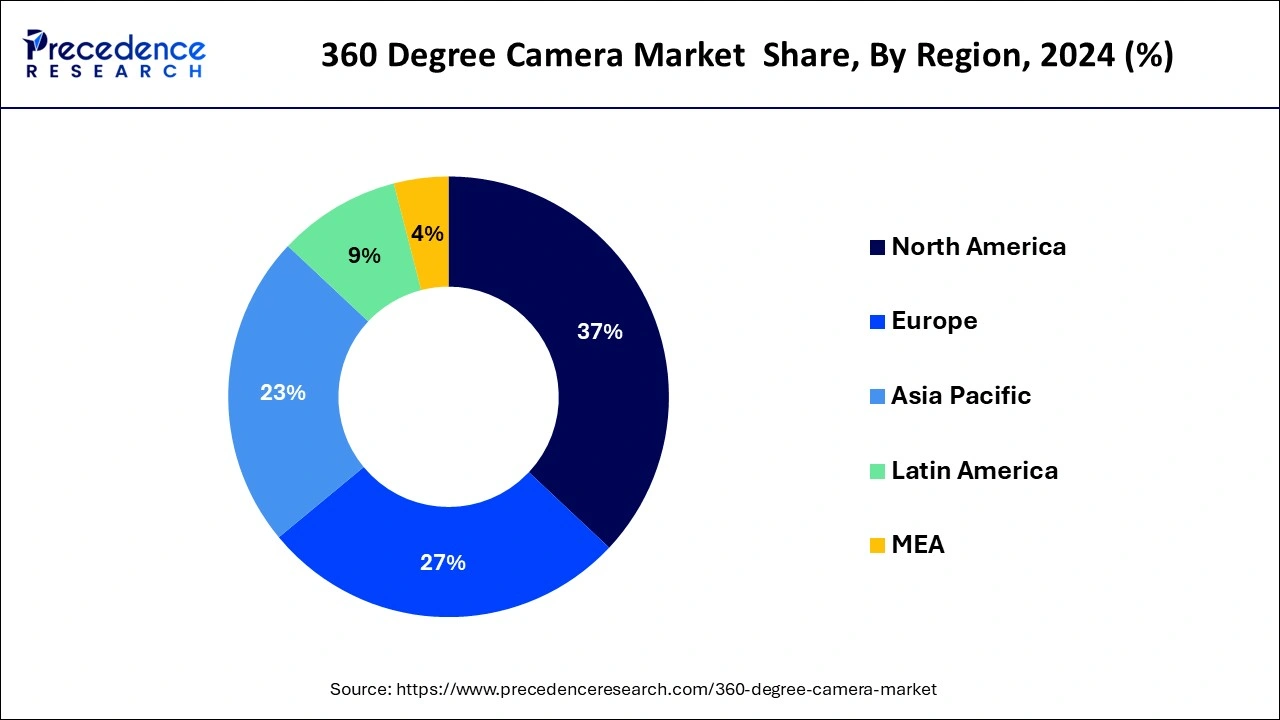
North America Led the Global Market
North America accounted for the largest market share in 2025, driven by early technology adoption, strong consumer demand for advanced imaging solutions, and the presence of leading camera manufacturers. Continuous product innovation and a well-established content creation industry further support regional growth.
The U.S. 360-degree camera market was valued at USD 610 million in 2025 and is projected to reach USD 7,203 million by 2035, expanding at a CAGR of 28% from 2026 to 2035. Growth is supported by the increasing popularity of social media content creation, continuous software innovation, and the country’s advanced filmmaking and digital media ecosystem.
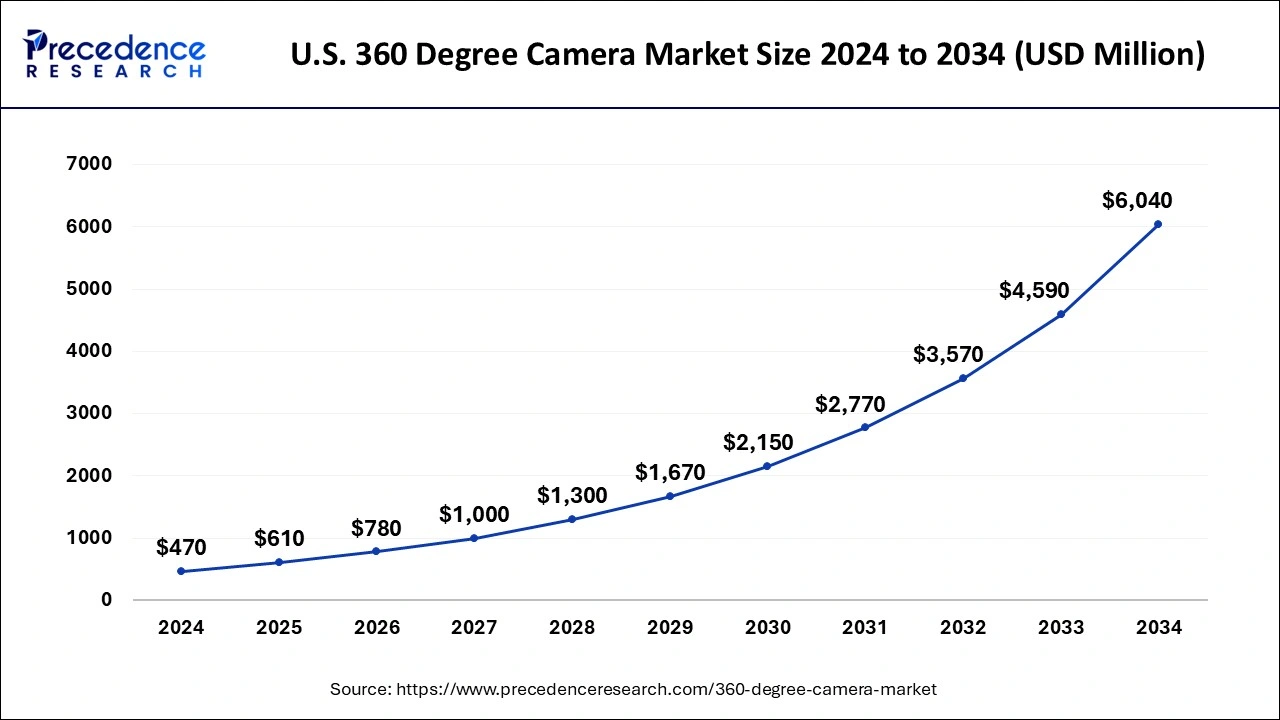
Asia-Pacific: Fastest-Growing Regional Market
Asia-Pacific is expected to offer the highest growth opportunities during the forecast period. Increasing adoption of virtual reality applications, expanding gaming industries, and rising consumer demand for immersive content are driving regional market growth.
China is emerging as a major market due to its focus on mass-market camera production and integration of advanced technologies such as AI-powered image processing and smartphone connectivity. Strong domestic demand and manufacturing capabilities are expected to create significant growth opportunities.
Europe: Strong Growth Driven by VR and AR Adoption
Europe is expected to experience substantial growth over the forecast period. Rising adoption of virtual reality (VR) and augmented reality (AR), coupled with increasing demand for engaging digital content, is encouraging wider use of 360-degree cameras across multiple industries.
Germany is witnessing increased adoption of 360-degree cameras integrated with drones for applications including construction, agriculture, and infrastructure inspection. These expanding industrial use cases continue to strengthen market growth.
Latin America: Growing Demand Across Digital Content and E-Commerce
Latin America is anticipated to witness steady market growth, driven by increasing social media usage and expanding e-commerce activities. Businesses are increasingly using 360-degree images and videos to deliver interactive shopping experiences and promotional content.
Brazil’s tourism industry is increasingly adopting 360-degree cameras to create virtual tours and immersive travel experiences. Hotels, travel agencies, and tour operators are investing in this technology to enhance customer engagement and destination marketing.
Middle East & Africa: Rising Adoption Across Smart Cities and Media
The Middle East & Africa region is expected to register notable growth during the forecast period. Growing investments in smart city projects, tourism promotion, sports broadcasting, and immersive digital experiences are supporting market expansion.
Saudi Arabia is witnessing increasing adoption of 360-degree cameras through smart city initiatives such as NEOM and The Line. Growing investments in surveillance, environmental monitoring, tourism marketing, and large-scale event broadcasting are creating new opportunities for market growth.
360 Degree Camera Market Top Companies
1. GoPro
GoPro is a core player in the consumer and prosumer 360 action-camera market.
-
Core Offering: GoPro MAX (and its predecessor, the GoPro Fusion).
-
Key Features: Dual-lens setup capturing 5.6K 360-degree video. It stands out for its robust action-camera build, Max HyperSmooth stabilization, spatial audio recording, and “Overcapture” software, which allows users to easily reframe 360 footage into a traditional flat video.
2. Samsung Electronics
Samsung entered the consumer 360 market during the early wave of virtual reality, aligning with their Gear VR ecosystem.
-
Core Offering: Gear 360 (Original spherical model and subsequent elongated second-generation model), along with the enterprise-level 360 Round.
-
Key Features: The consumer Gear 360 models featured dual fisheye lenses capturing up to 4K video. While the consumer line has largely been phased out from active hardware iterations, the Samsung 360 Round targeted the professional market with a 17-lens setup designed for high-end 3D/stereoscopic 360-degree livestreaming and production.
3. LG Electronics
Similar to Samsung, LG entered the market during the smartphone companion-device boom.
-
Core Offering: LG 360 CAM (part of the “LG Friends” module ecosystem for the LG G5).
-
Key Features: A highly compact, pocket-sized standalone device with two 13 MP wide-angle lenses capable of capturing 2K 360-degree video and 5.1-channel surround sound. LG has since shifted its focus away from personal 360 hardware to core display and enterprise solutions.
4. Nikon
Nikon brought its traditional imaging and optics expertise into the rugged action market.
-
Core Offering: KeyMission 360.
-
Key Features: A rugged, waterproof, and shockproof action camera equipped with dual electronic sensors and lenses. It captures true 4K UHD 360-degree video with automatic in-camera stitching, eliminating the need for post-production assembly.
5. Xiaomi
Xiaomi targets the high-value consumer market with affordable, high-resolution lifestyle cameras.
-
Core Offering: Mi Sphere Camera (and various home security omnidirectional lines like the Xiaomi Smart Camera 360).
-
Key Features: The Mi Sphere features an ultra-thin design with dual 190-degree fisheye lenses, capturing 3.5K video and 23.88 MP raw images. It is highly regarded for its pocketable form factor and electronic image stabilization (EIS).
6. YI Technology
YI Technology focuses on high-performance action cameras.
-
Core Offering: YI 360 VR.
-
Key Features: Notable for being one of the first accessible consumer cameras to offer 5.7K resolution video recording at 30 frames per second (fps). It features dual 220-degree lenses and supports in-camera stitching up to 4K resolution.
7. PANONO (Professional 360 GmbH)
Panono operates strictly in the high-end professional and enterprise market, specializing in ultra-high-resolution static panoramic imaging.
-
Core Offering: Panono 360° Pro Set.
-
Key Features: A distinct, ball-shaped throwable camera covered in 36 individual camera lenses. Instead of video, it is engineered to capture massive 108-megapixel panoramic photos. The individual files are stitched seamlessly via a cloud-based platform, making it a preferred tool for real estate, virtual tours, and industrial inspection.
8. 360fly
360fly pioneered a unique single-lens approach to the panoramic ecosystem, targeting action and power-sports markets.
-
Core Offering: 360fly HD, 360fly 4K, and 360fly 4K PRO.
-
Key Features: Unlike dual-lens cameras, 360fly utilizes a single upward-facing dome lens with a 360-degree horizontal and 240-degree vertical field of view. While it misses the absolute bottom slice of the frame, this design completely eliminates stitch lines, rendering smooth, high-frame-rate panoramic video.
9. Immervision
Immervision does not mass-produce retail consumer cameras; instead, they are an industry-leading B2B optical and software technology licensor.
-
Core Offering: Panomorph Lenses and Imaging Software Standards (ImmerVision Enables).
-
Key Features: They design wide-angle panoramic optics and data-embedding software pipelines. Their technology is licensed to smartphone manufacturers, automotive companies (for surround-view systems), drone developers, and advanced video surveillance brands to enable distortion-free 360-degree vision.
10. Digital Domain Productions
Digital Domain is a visual effects (VFX) studio that expanded into proprietary VR capture technology for major live events.
-
Core Offering: Zeus 360 / Zeus 3D (Proprietary broadcast camera system).
-
Key Features: A bespoke, enterprise-grade camera system designed for premium live-sports streaming and VR filmmaking. It outputs greater-than-8K RAW resolution footage at 75 fps and handles high-fidelity 4K 360-degree live streams, built specifically to capture massive public events like the Olympics.
Segments Covered in the Report
By Connectivity Type
- Wired
- Wireless
By Resolution
- High Definition (HD)
- Ultra-high Definition (UHD)
By Camera Type
- Single
- Professional
By Vertical
- Media & Entertainment
- Consumer
- Military & Defense
- Travel & Tourism
- Automotive
- Commercial
- Healthcare
- Others
By Region
- North America
- Europe
- Asia-Pacific
- Latin America
- Middle East & Africa
Read Also: Automotive Transmission Market Size Forecasted to Reach USD 287.55 Billion by 2035
Get this report to explore global market size, share, CAGR, and trends, featuring detailed segmental analysis and an insightful competitive landscape overview @ https://www.precedenceresearch.com/sample/1542
You can place an order or ask any questions. Please feel free to contact us at sales@precedenceresearch.com |+1 804 441 9344

- 360-Degree Camera Market Set for Explosive Growth, Reaching USD 27.21 Billion by 2035 as AI-Powered Imaging and Immersive Content Reshape Digital Experiences - June 30, 2026
- Automotive Transmission Market Size Forecasted to Reach USD 287.55 Billion by 2035 as Demand for Fuel-Efficient and Electrified Vehicles Accelerates - June 29, 2026
- From Memory Enhancement to Alzheimer’s Care: Brain Health Supplements and Therapeutics Market Set for Strong Growth Through 2035 - June 25, 2026