
The global Retail Cloud Market is experiencing remarkable growth as retailers increasingly adopt cloud-based technologies to enhance customer experiences, streamline operations, and improve business agility. The rapid expansion of e-commerce, omnichannel retailing, artificial intelligence (AI), and data analytics has accelerated the shift from traditional IT infrastructure to cloud-enabled retail ecosystems.
Cloud computing has become the foundation of modern retail by enabling businesses to manage inventory, process transactions, personalize customer interactions, and analyze large volumes of data in real time. From small retailers to multinational chains, organizations are leveraging cloud platforms to reduce operational costs, improve scalability, and remain competitive in an increasingly digital marketplace.
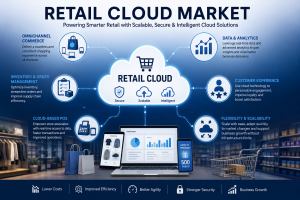
What is the Retail Cloud Market Size?
The global retail cloud market size accounted for USD 48.70 billion in 2025 and is predicted to increase from USD 57.08 billion in 2026 to approximately USD 238.17 billion by 2035, expanding at a CAGR of 17.20% from 2026 to 2035. Increasing digitization and disposable income are benefiting market growth.
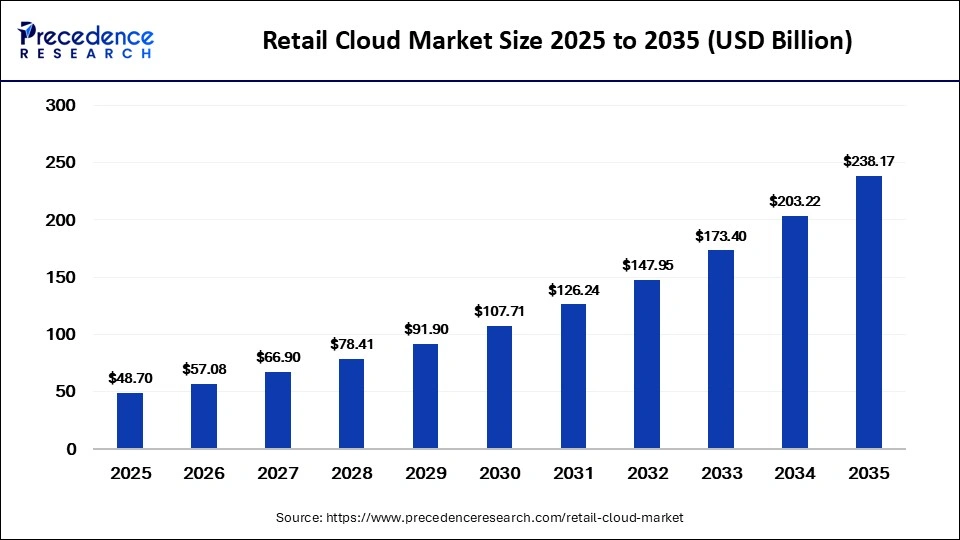
Market Highlight
- North America led the retail cloud market with a share of 39% in 2025.
- Asia-Pacific is expected to be the fastest-growing region with a CAGR of 21.4% in the forecasted duration.
- By solution, the software as a service (SaaS) segment held a dominant position in the market with a share of 58% in 2025 and is expected to grow at the fastest CAGR of 18.6% in the market between 2026 and 2035.
- By deployment mode, the public cloud segment accounted for a considerable revenue share of 54% in the market in 2025 and is expected to grow with the highest CAGR of 19.1% in the market during the studied years.
- By application, the customer relationship management (CRM) segment led the global market with a share of 20% in 2025.
- By application, the omnichannel commerce segment is expected to expand rapidly in the market with a CAGR of 20.1% in the coming years.
- By enterprise size, the large enterprises segment registered its dominance over the global retail cloud market with a share of 66% in 2025.
- By enterprise size, the small and medium enterprises (SMEs) segment is expected to witness the fastest growth in the market with a CAGR of 20.2% over the forecast period.
- By end use, the supermarkets and hypermarkets segment led the global market with a share of 24% in 2025.
- By end use, the e-commerce retailers segment is expected to expand rapidly in the market with a CAGR of 21.5% in the coming years.
What Is Retail Cloud?
Retail cloud refers to cloud computing solutions specifically designed for the retail industry. These solutions provide retailers with on-demand access to applications, data storage, analytics, customer relationship management (CRM), inventory management, and enterprise resource planning (ERP) through secure cloud infrastructure.
Unlike traditional on-premise systems, cloud-based retail platforms offer greater flexibility, allowing businesses to scale operations quickly while ensuring seamless access to critical business information across multiple locations.
Retail cloud solutions support physical stores, online marketplaces, mobile commerce, and omnichannel retail strategies, making them an essential component of modern retail transformation.
Market Overview
The Retail Cloud Market is witnessing steady expansion as businesses embrace digital transformation and prioritize customer-centric operations. Growing internet penetration, increasing smartphone usage, and rising consumer expectations for personalized shopping experiences are encouraging retailers to invest heavily in cloud technologies.
Cloud platforms enable retailers to integrate online and offline channels, automate business processes, optimize supply chain management, and gain valuable customer insights through advanced analytics.
The adoption of Software-as-a-Service (SaaS), Platform-as-a-Service (PaaS), and Infrastructure-as-a-Service (IaaS) models is further accelerating market growth by offering cost-effective and scalable solutions for retailers of all sizes.
Key Factors Driving the Retail Cloud Market
Growing Adoption of Omnichannel Retail
Consumers expect a seamless shopping experience across websites, mobile applications, social media, and physical stores. Retail cloud platforms enable businesses to synchronize inventory, pricing, promotions, and customer data across every sales channel.
This integrated approach enhances customer satisfaction while improving operational efficiency.
Rising Demand for Personalized Customer Experiences
Retailers are increasingly using cloud-based AI and analytics tools to understand customer preferences and purchasing behavior.
Cloud platforms help businesses deliver personalized product recommendations, targeted marketing campaigns, and customized shopping experiences that improve customer engagement and loyalty.
Expansion of E-commerce
The rapid growth of online shopping has significantly increased the demand for cloud infrastructure capable of handling fluctuating website traffic, secure payment processing, and real-time inventory management.
Retail cloud solutions allow businesses to scale their digital operations efficiently without major investments in physical IT infrastructure.
Advanced Data Analytics
Modern retailers generate enormous amounts of customer and operational data every day.
Cloud computing enables businesses to collect, store, and analyze this data in real time, helping decision-makers improve pricing strategies, inventory planning, demand forecasting, and marketing performance.
Cost Optimization
Cloud deployment reduces capital expenditure by eliminating the need for expensive hardware, maintenance, and infrastructure upgrades.
Retailers benefit from flexible subscription-based pricing models while improving business continuity and disaster recovery capabilities.
Emerging Trends in the Retail Cloud Market
Artificial Intelligence Integration
Artificial intelligence is becoming an integral part of retail cloud platforms. AI-powered chatbots, recommendation engines, customer service automation, fraud detection, and predictive analytics are helping retailers improve operational efficiency while enhancing customer experiences.
Edge Computing
Retailers are increasingly adopting edge computing alongside cloud infrastructure to process data closer to stores and customers.
This reduces latency and enables faster transaction processing, inventory updates, and personalized in-store experiences.
Internet of Things (IoT)
Connected devices such as smart shelves, RFID systems, digital price tags, and inventory sensors are generating valuable real-time data.
Retail cloud platforms integrate IoT devices to improve stock visibility, reduce product shortages, and optimize supply chain operations.
Cloud-Based Point-of-Sale Systems
Cloud-enabled POS solutions are replacing traditional systems by providing centralized transaction management, inventory synchronization, and customer analytics across multiple store locations.
These solutions also support mobile payments and contactless transactions.
Cybersecurity Enhancement
As retailers store increasing volumes of sensitive customer information, cloud providers continue strengthening data encryption, identity management, and compliance capabilities to protect against cyber threats.
Market Scope
| Report Coverage | Details |
| Market Size in 2025 | USD 48.70 Billion |
| Market Size in 2026 | USD 57.08 Billion |
| Market Size by 2035 | USD 238.17 Billion |
| Market Growth Rate from 2026 to 2035 | CAGR of 17.20% |
| Dominating Region | North America |
| Fastest Growing Region | Asia Pacific |
| Base Year | 2025 |
| Forecast Period | 2026 to 2035 |
| Segments Covered | Solution, Deployment Mode, Application, Enterprise Size, End-Use, and Region |
| Regions Covered | North America, Europe, Asia-Pacific, Latin America, and Middle East & Africa |
Challenges Facing the Market
Despite its strong growth potential, the Retail Cloud Market faces several challenges.
Data privacy and cybersecurity remain significant concerns as retailers handle confidential customer information and payment data.
Integration with legacy systems can also be complex for organizations transitioning from traditional IT infrastructure to cloud-based environments.
Additionally, maintaining regulatory compliance across different countries requires continuous monitoring and updates to cloud security frameworks.
However, ongoing investments in cloud security technologies and managed services are helping businesses overcome these challenges.
Market Opportunities
The Retail Cloud Market presents significant opportunities across multiple retail segments.
Fashion retailers are leveraging cloud analytics to optimize inventory and personalize marketing campaigns.
Grocery chains use cloud solutions for demand forecasting, supply chain optimization, and automated replenishment.
Luxury brands utilize cloud platforms to deliver premium omnichannel experiences and improve customer engagement.
Retail cloud technologies are also supporting convenience stores, supermarkets, consumer electronics retailers, pharmacies, and direct-to-consumer brands as they modernize business operations.
The growing adoption of AI, machine learning, augmented reality, and digital commerce is expected to create additional opportunities for cloud solution providers in the coming years.
Regional Analysis
North America remains one of the leading markets due to early adoption of cloud computing, advanced retail infrastructure, and strong investments in digital technologies.
Europe continues expanding through increasing cloud adoption, strict data protection regulations, and growing omnichannel retail strategies.
Asia Pacific is expected to witness the fastest growth as countries such as China, India, Japan, and South Korea experience rapid digitalization, increasing smartphone penetration, and expanding e-commerce industries.
Meanwhile, Latin America and the Middle East & Africa are gradually adopting cloud-based retail solutions as businesses modernize their operations and improve customer experiences.
Competitive Landscape
The Retail Cloud Market is highly competitive, with global technology companies, cloud service providers, and retail software vendors continuously introducing innovative solutions.
Key market participants focus on:
- Artificial intelligence integration
- Advanced analytics capabilities
- Cloud-native retail applications
- Strategic partnerships and acquisitions
- Hybrid and multi-cloud deployment models
- Enhanced cybersecurity solutions
Continuous investment in research and development is helping companies deliver more intelligent, scalable, and secure cloud platforms tailored to evolving retail needs.
Future Outlook
The future of the Retail Cloud Market looks highly promising as retailers continue embracing digital transformation and customer-first business strategies.
Emerging technologies such as generative AI, machine learning, predictive analytics, edge computing, and IoT will further enhance cloud capabilities across the retail ecosystem.
Businesses that invest in cloud infrastructure today will be better positioned to improve operational efficiency, reduce costs, enhance customer satisfaction, and respond quickly to changing market demands.
As global retail becomes increasingly data-driven and digitally connected, cloud technology will remain a critical enabler of innovation, resilience, and sustainable business growth.
Get Sample Link : https://www.precedenceresearch.com/sample/8526
Recent Developments
- In April 2026, Cognizant introduced Agentic Retail CX, an AI-powered contact center solution built on Google Cloud’s Gemini Enterprise for Customer Experience (CX). Tailored for retailers, the platform enables brands to deliver personalized, omnichannel customer journeys while lowering operational costs, boosting employee productivity, and speeding up the adoption of agentic AI across the retail value chain.
- In January 2026, Google Cloud introduced Gemini Enterprise for Customer Experience, a platform that unifies shopping and customer service in a single interface and orchestrates multiple AI agents across the customer journey. Aimed at retailers and restaurants, the solution offers prebuilt and configurable agents powered by Google’s Gemini models, enabling businesses to deploy AI-driven experiences in just a few days.
Segments Covered in the Report
By Solution
- Software as a Service (SaaS)
- Platform as a Service (PaaS)
- Infrastructure as a Service (IaaS)
By Deployment Mode
- Public Cloud
- Private Cloud
- Hybrid Cloud
By Application
- Customer Relationship Management (CRM)
- Supply Chain Management
- Inventory and Warehouse Management
- Omnichannel Commerce
- Point of Sale (POS)
- Data Analytics and Business Intelligence
By Enterprise Size
- Large Enterprises
- Small and Medium Enterprises (SMEs)
By End-Use
- Supermarkets and Hypermarkets
- Department Stores
- Specialty Stores
- E-commerce Retailers
By Region
- North America
- Latin America
- Europe
- Asia-pacific
- Middle and East Africa
Also Read Our Latest Article : Ambient IoT Market

- Cholestatic Pruritus Market: Advancements in Targeted Therapies Are Transforming Patient Care - June 30, 2026
- Inflammatory Disease Market: Biologic Therapies and Precision Medicine Are Reshaping Patient Care - June 30, 2026
- Retail Cloud Market: Driving the Future of Smart, Connected Retail Operations - June 30, 2026