
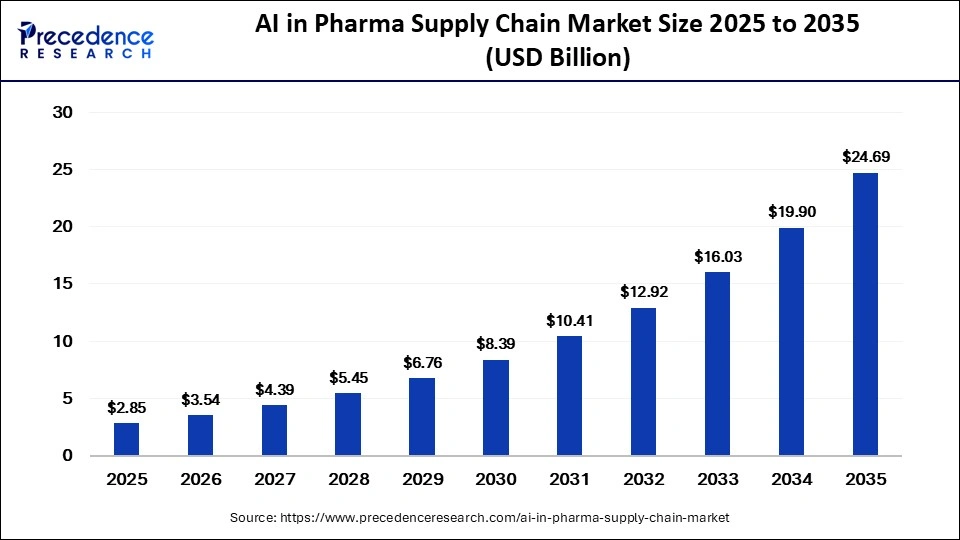
The global AI in pharma supply chain market is projected to grow from USD 3.54 billion in 2026 to USD 24.69 billion by 2035 at a CAGR of 24.10%. Explore market trends, drivers, opportunities, regional insights, key players, and future outlook.
Introduction
Artificial intelligence (AI) is transforming the pharmaceutical supply chain industry by improving operational efficiency, reducing drug shortages, optimizing inventory management, and enhancing logistics visibility. As pharmaceutical manufacturers continue to face challenges related to regulatory compliance, demand volatility, cold chain logistics, and global disruptions, AI-powered supply chain solutions are emerging as a critical technology investment.
The growing adoption of machine learning, predictive analytics, robotic process automation (RPA), and natural language processing (NLP) is helping pharmaceutical companies streamline procurement, forecasting, warehouse automation, and risk management. AI is also enabling real-time decision-making and predictive maintenance across pharmaceutical distribution networks.
According to Precedence Research, the global AI in pharma supply chain market size was valued at USD 2.85 billion in 2025 and is expected to rise from USD 3.54 billion in 2026 to approximately USD 24.69 billion by 2035, expanding at a CAGR of 24.10% during the forecast period.
Read Also: Multilingual LLM Market
Market Overview
The pharmaceutical supply chain is highly complex and involves raw material sourcing, manufacturing, storage, transportation, compliance monitoring, and final delivery to healthcare providers and patients. Traditional supply chain systems often struggle with inefficiencies, data silos, and sudden disruptions.
AI technologies are addressing these challenges by introducing automation, predictive intelligence, and advanced analytics into pharmaceutical operations. Modern AI systems can forecast demand fluctuations, optimize stock levels, identify transportation risks, and improve cold chain management for temperature-sensitive drugs.
The COVID-19 pandemic accelerated digital transformation in pharmaceutical logistics and exposed vulnerabilities in global healthcare supply chains. Since then, pharmaceutical companies have increasingly invested in AI-enabled solutions to improve resilience and operational agility.
Key Market Statistics
- The AI in pharma supply chain market is forecast to grow at a CAGR of 24.10% between 2026 and 2035.
- North America accounted for 41% of the global market share in 2025.
- The market is expected to reach USD 24.69 billion by 2035.
- AI adoption in pharmaceutical logistics is increasingly shifting from reactive monitoring to predictive intelligence systems.
- Industry studies suggest AI can reduce early-stage pharmaceutical development timelines and costs by nearly 50% in some applications.
Major Growth Drivers
Rising Need for Demand Forecasting and Inventory Optimization
One of the biggest challenges in pharmaceutical supply chains is balancing inventory availability with cost efficiency. Overstocking leads to waste and expiry issues, while understocking creates critical medicine shortages.
AI-powered demand forecasting systems analyze historical sales data, prescription trends, weather patterns, epidemiological data, and seasonal demand fluctuations to improve forecast accuracy. This allows pharmaceutical companies to optimize stock levels and reduce supply chain disruptions.
Advanced predictive analytics also helps healthcare organizations maintain adequate inventory of life-saving medications and vaccines during emergencies.
Growing Adoption of Pharma 4.0 Technologies
The rise of Pharma 4.0 is significantly accelerating AI deployment across pharmaceutical manufacturing and logistics operations. Pharma 4.0 integrates AI, IoT, cloud computing, robotics, and blockchain technologies into pharmaceutical production and distribution systems.
Research studies indicate that emerging technologies are improving pharmaceutical supply chain performance, resilience, and operational visibility.
Smart warehouses, AI-enabled robotic systems, and autonomous logistics management platforms are increasingly becoming part of pharmaceutical supply chain modernization strategies.
Increasing Focus on Cold Chain Monitoring
Many pharmaceutical products, including biologics, vaccines, and specialty drugs, require strict temperature-controlled transportation and storage conditions.
AI-driven cold chain monitoring systems use IoT sensors and predictive algorithms to detect temperature deviations, equipment failures, and shipment risks in real time. This minimizes product spoilage and ensures regulatory compliance.
Industry reports highlight that cold chain logistics remains one of the most active areas for AI investment in pharmaceutical supply chains.
Expansion of Cloud-Based AI Platforms
Cloud computing is making AI solutions more accessible for pharmaceutical companies of all sizes. Cloud-based AI platforms reduce infrastructure costs and enable real-time collaboration across global supply chain networks.
These platforms support centralized data management, predictive analytics, automated workflows, and remote monitoring capabilities.
Market Restraints
High Implementation Costs
Despite its advantages, AI adoption in pharmaceutical supply chains requires substantial investment in software infrastructure, data integration, employee training, and cybersecurity systems.
Small and medium-sized pharmaceutical companies may struggle to afford advanced AI implementation projects.
Data Quality and Integration Challenges
AI systems depend heavily on accurate and structured datasets. However, pharmaceutical supply chains often operate with fragmented legacy systems and inconsistent data sources.
Industry discussions on supply chain AI repeatedly emphasize the “garbage in, garbage out” problem, where poor-quality data reduces AI effectiveness.
Integrating AI with older enterprise resource planning (ERP) systems also remains technically challenging.
Regulatory and Compliance Concerns
The pharmaceutical industry operates under strict regulatory standards regarding product safety, data privacy, and supply chain traceability.
AI algorithms used in supply chain operations must comply with regulations from authorities such as the FDA, EMA, and other healthcare agencies. Companies also face concerns related to AI transparency, explainability, and cybersecurity risks.
Emerging Opportunities
Predictive Risk Management
AI is increasingly being used for proactive risk assessment in pharmaceutical logistics networks. Predictive AI systems can identify supplier disruptions, geopolitical risks, transportation bottlenecks, and inventory vulnerabilities before they impact operations.
AI-based supply chain risk management tools are expected to become a major growth segment in the coming years.
Integration of Agentic AI Systems
The next evolution in supply chain AI involves “agentic AI,” where systems not only predict disruptions but also autonomously execute corrective actions.
Emerging discussions in the supply chain industry suggest agentic AI could automate replenishment cycles, shipment rerouting, procurement decisions, and warehouse management.
This transition could significantly improve pharmaceutical supply chain efficiency and responsiveness.
AI-Powered Sustainability Initiatives
Pharmaceutical companies are increasingly adopting AI to support sustainability goals. AI can reduce waste, optimize transportation routes, lower carbon emissions, and improve energy efficiency across logistics operations.
Sustainable supply chain practices are expected to become an important competitive advantage in the pharmaceutical industry.
Regional Analysis
North America
North America dominated the AI in pharma supply chain market in 2025 with a 41% market share.
The region benefits from advanced healthcare infrastructure, high AI adoption rates, strong pharmaceutical manufacturing capabilities, and significant investments in digital transformation.
The United States remains a major hub for AI innovation in healthcare and pharmaceutical logistics. Leading pharmaceutical companies are actively investing in AI-driven automation, predictive analytics, and intelligent manufacturing systems.
Europe
Europe is witnessing strong growth due to increasing regulatory emphasis on pharmaceutical traceability, supply chain resilience, and digital healthcare transformation.
Countries such as Germany, the United Kingdom, and Switzerland are investing heavily in AI-powered pharmaceutical technologies. Recent developments include the launch of new AI and machine learning centers focused on pharmaceutical research and operational efficiency.
Asia-Pacific
Asia-Pacific is expected to register the fastest growth during the forecast period due to expanding pharmaceutical manufacturing activities, rising healthcare investments, and rapid adoption of digital technologies.
Countries such as China, India, Japan, and South Korea are increasingly implementing AI-based logistics and warehouse automation systems to improve pharmaceutical distribution efficiency.
Growing demand for affordable healthcare and increasing pharmaceutical exports are further driving market expansion in the region.
Latin America and Middle East & Africa
These regions are gradually adopting AI technologies in pharmaceutical logistics to improve medicine availability, reduce operational inefficiencies, and strengthen healthcare infrastructure.
Government initiatives supporting digital healthcare transformation are expected to create future growth opportunities.
Key Companies in the AI in Pharma Supply Chain Market
Several technology companies and pharmaceutical solution providers are actively investing in AI-driven supply chain innovations. Major players include:
- IBM
- Oracle
- SAP
- Kinaxis
- Microsoft
- Google Cloud
- Amazon Web Services
- Johnson & Johnson
- Boehringer Ingelheim
Future Outlook
The future of the AI in pharma supply chain market looks highly promising as pharmaceutical companies prioritize operational resilience, automation, and data-driven decision-making.
AI technologies will continue to play a critical role in improving inventory optimization, predictive forecasting, cold chain management, supplier risk assessment, and warehouse automation. The integration of AI with IoT, blockchain, robotics, and cloud computing is expected to further accelerate digital transformation across pharmaceutical supply chains.
As AI systems become more sophisticated, the industry is likely to witness greater adoption of autonomous supply chain management platforms capable of real-time decision-making and self-correcting operations.
Growing investments in Pharma 4.0, increasing healthcare digitization, and rising global demand for efficient pharmaceutical logistics are expected to sustain long-term market growth.
Get a Sample Copy: https://www.precedenceresearch.com/sample/8408
For inquiries regarding discounts, bulk purchases, or customization requests, please contact us at sales@precedenceresearch.com
