
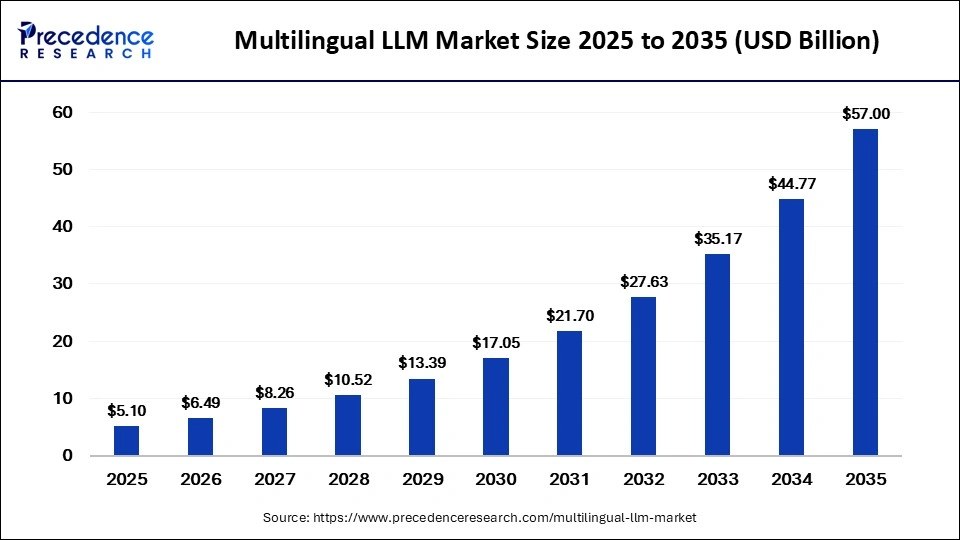
The global multilingual LLM market is projected to reach USD 57 billion by 2035, driven by AI localization, multilingual customer support, sovereign AI initiatives, RAG adoption, and rising demand for non-English generative AI applications.
Multilingual LLM Market Overview
The global multilingual LLM market is witnessing explosive growth as businesses, governments, and digital platforms increasingly demand AI systems capable of understanding and generating content across multiple languages. According to Precedence Research, the market size was valued at USD 5.10 billion in 2025 and is projected to grow from USD 6.49 billion in 2026 to approximately USD 57.00 billion by 2035, expanding at a CAGR of 27.30% during the forecast period.
Multilingual large language models (LLMs) are transforming how organizations communicate with global audiences by enabling AI-powered translation, localization, multilingual customer support, content generation, and conversational intelligence. These models are becoming essential as digital economies outside English-speaking regions continue expanding rapidly across Asia-Pacific, Latin America, the Middle East, and Africa.
The rise of generative AI, Retrieval-Augmented Generation (RAG), multimodal AI systems, and sovereign AI initiatives is further accelerating market adoption. Enterprises increasingly require AI systems capable of understanding cultural nuances, dialects, regional context, and industry-specific terminology while maintaining accuracy across multiple languages.
Read Also: AI Explainability and Transparency Market
What are Multilingual LLMs?
Multilingual LLMs are advanced artificial intelligence models trained to process, understand, and generate text across multiple languages simultaneously. Unlike traditional translation systems, multilingual LLMs can interpret context, tone, idiomatic expressions, and cultural subtleties.
These models support applications such as:
- AI-powered translation and localization
- Multilingual chatbots
- Global customer support
- Cross-border e-commerce
- AI content generation
- Voice assistants
- Enterprise knowledge management
- Real-time multilingual communication
Modern multilingual models increasingly integrate text, voice, video, and image processing to deliver more natural and interactive user experiences.
Key Market Drivers
Rapid Growth of Non-English Digital Economies
One of the primary factors driving the multilingual LLM market is the rapid expansion of non-English internet ecosystems. Regions such as India, China, Southeast Asia, the Middle East, and Latin America are generating massive demand for localized AI experiences.
Businesses increasingly require AI systems capable of serving users in native languages to improve customer engagement, accessibility, and digital inclusion. Multinational companies are prioritizing multilingual AI solutions to expand into emerging markets efficiently.
Governments are also supporting local-language AI initiatives. India’s Bhashini project, for example, aims to strengthen sovereign AI capabilities by developing language technologies tailored to regional languages and dialects.
Enterprise Adoption of Generative AI
The growing adoption of generative AI across enterprises is significantly accelerating demand for multilingual LLMs. Organizations increasingly use AI systems for content creation, customer support, marketing automation, and enterprise workflows across global markets.
Businesses now expect AI systems to deliver the same quality of interaction in Japanese, Hindi, Arabic, Spanish, and other languages as they do in English. This has made multilingual capability a core requirement for enterprise AI deployments.
The content generation segment accounted for 20% of the market share in 2025 and is projected to grow at a CAGR of 30.5% through 2035.
Increasing Demand for Translation and Localization
Translation and localization remain the dominant application segment in the market, accounting for approximately 28% of the market share in 2025.
Multilingual LLMs enable enterprises to automatically generate culturally relevant content, localized product descriptions, marketing campaigns, and multilingual customer interactions at scale. These capabilities help businesses reduce localization costs while improving customer engagement across regions.
AI-powered localization is becoming particularly important for:
- E-commerce platforms
- Streaming services
- Gaming companies
- Global SaaS providers
- International customer support operations
Growth of Retrieval-Augmented Generation (RAG)
Retrieval-Augmented Generation is emerging as one of the fastest-growing technologies within the multilingual LLM ecosystem. The RAG segment is projected to expand at a CAGR of 31.5% through 2035.
RAG systems improve AI accuracy by retrieving real-time information from external knowledge bases before generating responses. This significantly reduces hallucinations and enhances trustworthiness, especially in regulated industries such as healthcare, finance, and legal services.
Enterprises increasingly use multilingual RAG systems to support multilingual enterprise search, customer support automation, and internal knowledge management.
Market Restraints
High Computational and Infrastructure Costs
Despite rapid growth opportunities, multilingual LLM development requires enormous computational resources and high-quality multilingual datasets.
Training AI systems across dozens of languages dramatically increases infrastructure costs, GPU requirements, data acquisition expenses, and model optimization complexity. Smaller organizations often struggle to compete with hyperscalers and large AI providers due to these financial barriers.
Data Quality and Language Complexity Challenges
Many languages remain underrepresented in AI training datasets, creating performance gaps between high-resource and low-resource languages.
Experts within the AI community emphasize that multilingual generation involves more than simple translation. Differences in terminology, grammar, tone, and cultural context require specialized prompt engineering and localized training approaches.
Ensuring consistent output quality across languages remains one of the major technical challenges facing the industry.
Hallucination and Reliability Concerns
AI hallucinations and inconsistent multilingual responses remain significant concerns, particularly for enterprise deployments.
A recent enterprise AI translation discussion noted that over 20% of organizations experienced quality incidents or regressions after implementing AI translation workflows.
Organizations operating in regulated sectors require strong governance, human oversight, and validation systems to ensure accuracy and compliance.
Emerging Opportunities
Rise of Sovereign AI Models
Countries increasingly seek to develop sovereign AI ecosystems capable of supporting local languages, cultural values, and regulatory frameworks.
Governments and enterprises are investing in region-specific multilingual models to reduce dependence on Western-centric AI systems. This trend is creating major opportunities for localized AI providers and open-source multilingual model developers.
Growth of Domain-Specific Multilingual Models
Domain-specific multilingual LLMs are becoming increasingly popular across industries such as healthcare, finance, legal services, and cybersecurity.
These specialized models provide better accuracy, fewer hallucinations, and improved compliance compared to general-purpose AI systems. Organizations increasingly fine-tune multilingual models on proprietary datasets to improve performance for industry-specific use cases.
Expansion of Multimodal AI
The market is rapidly evolving toward multimodal AI systems capable of processing text, audio, images, and video simultaneously.
Multimodal multilingual assistants are expected to transform customer support, education, media, healthcare, and enterprise collaboration platforms over the next decade.
Segment Analysis
Cloud-Based Deployment Dominates the Market
Cloud deployment dominated the multilingual LLM market with an 85% revenue share in 2025.
Cloud infrastructure enables organizations to access advanced AI hardware and scalable model deployment capabilities without significant upfront investments. Cloud-native AI services also support rapid experimentation and enterprise scalability.
Meanwhile, the on-premise segment is projected to grow steadily as enterprises seek stronger control over sensitive data and regulatory compliance.
Transformer Models Lead Technology Segment
Transformer-based architectures accounted for 40% of the market share in 2025 due to their ability to process massive multilingual datasets efficiently.
Self-attention mechanisms within transformer models allow AI systems to understand contextual relationships across languages, enabling more accurate multilingual reasoning and generation.
Translation & Localization Leads Applications
The translation and localization segment dominated the market with a 28% share in 2025.
Customer support and chatbots accounted for 22% of the market share, while content generation is expected to witness the fastest growth during the forecast period.
IT and Telecom Sector Holds Largest Share
The IT and telecom segment accounted for approximately 30% of the market share in 2025 due to increasing enterprise AI adoption and multilingual customer engagement initiatives.
Retail and e-commerce sectors are also rapidly adopting multilingual AI systems to improve localization, customer service, and global expansion strategies.
Regional Analysis
North America Leads the Global Market
North America held the largest market share of 42% in 2025 due to strong AI infrastructure, major hyperscalers, and substantial enterprise AI investments.
The United States remains the dominant regional market, supported by rapid adoption of multilingual AI systems across customer support, automation, and content generation applications.
The U.S. multilingual LLM market is projected to reach nearly USD 18.29 billion by 2035.
Asia Pacific Emerges as the Fastest-Growing Region
Asia-Pacific is projected to grow at the fastest CAGR of 32.5% through 2035.
The region benefits from massive language diversity, expanding internet penetration, rising AI adoption, and strong government support for sovereign AI initiatives.
Countries such as India and China are rapidly becoming global hubs for multilingual AI innovation.
Europe Maintains Strong Growth Momentum
Europe accounted for 22% of the market share in 2025 due to increasing demand for multilingual enterprise communication and strict data governance requirements.
European organizations increasingly prioritize AI systems capable of supporting cross-border communication while complying with stringent privacy regulations.
Competitive Landscape
The multilingual LLM market is highly competitive, with hyperscalers, AI startups, open-source communities, and regional AI providers investing heavily in multilingual capabilities.
Key Companies Operating in the Market
Major players include:
- OpenAI
- Microsoft
- Meta
- Anthropic
- Amazon Web Services
- Alibaba Cloud
- DeepSeek
- Mistral AI
- Cohere
Recent Industry Developments
Recent developments demonstrate accelerating innovation across the multilingual AI ecosystem:
- Companies are increasingly integrating multimodal capabilities into multilingual AI systems to support text, voice, and video interactions simultaneously.
- Open-source multilingual frameworks are gaining popularity due to flexibility, lower costs, and growing enterprise demand for customization.
- Chinese AI companies such as DeepSeek and Moonshot AI are rapidly improving multilingual capabilities across Asian and global languages.
- Enterprises increasingly deploy multi-model AI architectures to improve localization quality, operational resilience, and governance control.
Future Outlook
The future of the multilingual LLM market appears exceptionally strong as AI adoption expands beyond English-speaking markets into truly global ecosystems.
The convergence of generative AI, multimodal intelligence, RAG systems, and sovereign AI initiatives will continue reshaping enterprise communication, customer engagement, and digital accessibility over the next decade.
Demand for culturally aware, industry-specific, and highly accurate multilingual AI systems is expected to accelerate across healthcare, finance, education, government, and e-commerce sectors. Organizations capable of delivering trustworthy, scalable, and localized AI experiences will gain a significant competitive advantage in the evolving AI economy.
Get a Sample Copy: https://www.precedenceresearch.com/sample/8407
For inquiries regarding discounts, bulk purchases, or customization requests, please contact us at sales@precedenceresearch.com
