
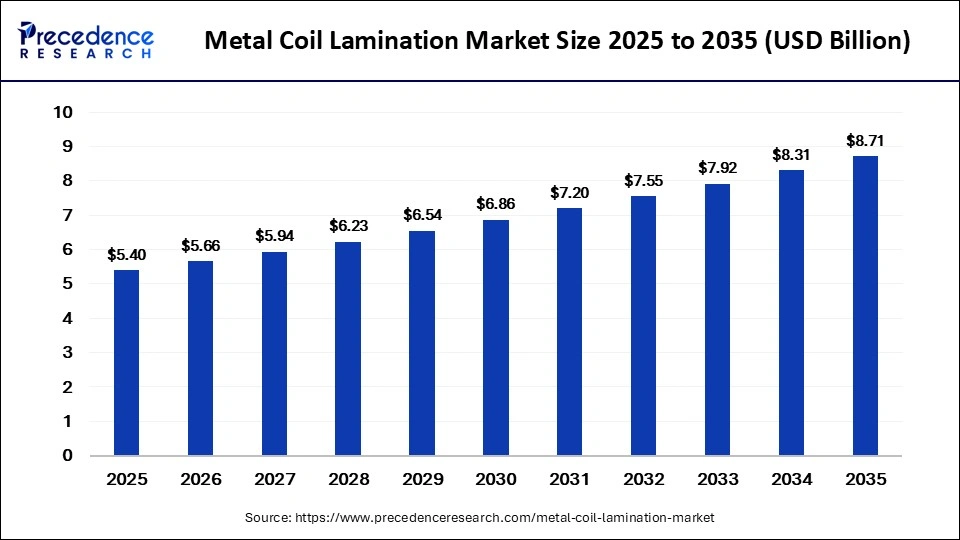
The global metal coil lamination market is projected to grow from USD 5.66 billion in 2026 to USD 8.71 billion by 2035 at a CAGR of 4.90%. Explore key trends, market drivers, regional insights, opportunities, and major industry players.
Introduction
The global metal coil lamination market is witnessing steady growth due to increasing demand for lightweight, corrosion-resistant, and aesthetically enhanced metal products across construction, automotive, appliance, and industrial sectors. Metal coil lamination technology improves surface durability, thermal resistance, weather protection, and product appearance, making laminated metal coils highly suitable for modern manufacturing applications.
The growing focus on energy-efficient infrastructure, rapid industrialization, and expansion of smart appliance manufacturing are accelerating the adoption of laminated metal coils globally. Additionally, advancements in coating technologies and automation in industrial production processes are creating new opportunities for manufacturers.
According to Precedence Research, the global metal coil lamination market size was valued at USD 5.40 billion in 2025 and is expected to increase from USD 5.66 billion in 2026 to approximately USD 8.71 billion by 2035, expanding at a CAGR of 4.90% during the forecast period.
Read Also: AI in Pharma Supply Chain Market
Metal Coil Lamination Market Overview
Metal coil lamination involves applying protective or decorative laminated films and coatings onto metal surfaces such as steel, aluminum, stainless steel, and copper. These laminated coils are widely used in roofing systems, automotive body parts, home appliances, industrial equipment, packaging materials, and architectural applications.
The technology offers several benefits, including enhanced corrosion resistance, UV protection, thermal insulation, moisture resistance, and improved product lifespan. Manufacturers are increasingly adopting advanced lamination techniques to meet rising consumer demand for premium finishes and sustainable construction materials.
The growing popularity of pre-coated and laminated metals in commercial infrastructure projects and electric vehicle manufacturing is further driving market expansion.
Market Size and Key Statistics
The metal coil lamination market is experiencing consistent expansion due to rising investments in infrastructure development and industrial manufacturing.
Key Market Highlights
- The market is projected to grow at a CAGR of 4.90% from 2026 to 2035.
- Asia-Pacific accounted for 46% of the global market share in 2025.
- The steel segment dominated the market with a 52% share in 2025.
- Thermal lamination held 40% market share in 2025.
- Building and construction applications represented 38% of total market demand in 2025.
- The 0.3–1 mm thickness segment led the market with a 46% share in 2025.
- The automotive segment is expected to grow at the fastest CAGR of 6.2% during the forecast period.
Key Market Drivers
Increasing Demand for Durable and Lightweight Materials
The growing need for lightweight yet durable materials across automotive, aerospace, and appliance industries is significantly driving the metal coil lamination market.
Manufacturers are increasingly using laminated aluminum and steel coils to reduce product weight while maintaining structural strength and corrosion resistance. These materials are widely utilized in electric vehicles, industrial equipment, and smart appliances.
The expansion of energy-efficient building projects and modern infrastructure development is also increasing demand for laminated metal roofing and cladding systems.
Rapid Growth in Construction Activities
Urbanization and infrastructure investments are fueling the adoption of laminated metal coils in commercial and residential construction projects.
Laminated coils provide excellent weather resistance, thermal insulation, and aesthetic appeal, making them ideal for roofing panels, wall systems, and decorative architectural applications.
The construction segment accounted for approximately 36% of the market share in 2025 due to increasing investments in industrial buildings and smart city projects.
Expansion of Automotive Manufacturing
The automotive industry is emerging as one of the fastest-growing application segments for metal coil lamination.
Automotive manufacturers are increasingly utilizing laminated metal components to improve corrosion resistance, durability, and visual appearance while reducing vehicle weight.
The rapid growth of electric vehicle production globally is further supporting demand for lightweight laminated aluminum and steel materials. The automotive application segment is expected to grow at a CAGR of 6.2% through 2035.
Advancements in Coating Technologies
Technological innovations in lamination and coating solutions are enhancing the performance of laminated metal products.
Manufacturers are increasingly developing UV-resistant, anti-corrosion, heat-resistant, and moisture-resistant coatings to improve product longevity and environmental sustainability.
PVDF and polyurethane coatings are gaining popularity due to their superior durability and chemical resistance.
Market Trends
Rising Demand for Premium Finishes and Customization
Consumers and industries are increasingly demanding aesthetically appealing laminated metal surfaces with customized textures, colors, and finishes.
Architectural and automotive sectors are particularly driving demand for decorative laminated metal products that combine visual appeal with high durability.
Manufacturers are investing in advanced lamination technologies to offer premium surface finishes for export markets and luxury construction projects.
Growing Adoption of Smart and Energy-Efficient Applications
The expansion of smart appliances and energy-efficient buildings is boosting demand for laminated metal coils with thermal insulation and enhanced performance characteristics.
Laminated metals are increasingly being used in modern electronics, HVAC systems, refrigerators, and smart industrial equipment due to their lightweight and protective properties.
Integration of Artificial Intelligence in Manufacturing
Artificial intelligence is improving quality control and operational efficiency in metal finishing and lamination processes.
AI-powered visual inspection systems equipped with machine learning algorithms can detect surface defects and coating inconsistencies with greater accuracy and speed.
Manufacturers are increasingly adopting AI-driven automation to reduce waste, improve productivity, and optimize coating applications.
Market Restraints
Complex Manufacturing and Coating Challenges
Applying consistent laminated coatings on metal coils involves highly complex manufacturing processes.
Extreme temperatures, vibrations, and harsh environmental conditions can lead to coating cracks and reduced product performance, especially in aerospace and automotive applications.
Manufacturers must continuously invest in advanced process control systems and quality assurance technologies to maintain product reliability.
Volatility in Raw Material Prices
Fluctuating prices of steel, aluminum, copper, and specialty coating materials can significantly impact manufacturing costs and profit margins.
Global supply chain disruptions and geopolitical uncertainties continue to create pricing volatility for metal producers and laminated coil manufacturers.
Environmental and Regulatory Challenges
Stringent environmental regulations related to emissions, waste management, and chemical coatings are increasing compliance costs for manufacturers.
Companies are increasingly adopting low-emission, water-based, and sustainable coating technologies to meet environmental standards.
Emerging Opportunities
Sustainable and Low-Emission Coating Solutions
Growing demand for eco-friendly construction materials and sustainable industrial solutions is creating new opportunities in the metal coil lamination market.
Manufacturers are investing in water-based and high-solid coating technologies that reduce VOC emissions and energy consumption.
The shift toward carbon-neutral infrastructure development is expected to accelerate adoption of environmentally sustainable laminated metal products.
Increasing Use in Electric Vehicles
Electric vehicle manufacturers are increasingly utilizing lightweight laminated aluminum and coated steel components to improve energy efficiency and durability.
The expansion of EV production facilities worldwide is expected to create strong long-term demand for advanced laminated metal materials.
Smart Infrastructure and Industrial Automation
The growth of smart cities, industrial automation, and modern manufacturing facilities is supporting increased use of high-performance laminated metals.
Laminated metal products are becoming essential in energy-efficient buildings, smart appliances, and advanced industrial systems.
Segmental Analysis
By Material Type
Steel Segment Dominance
The steel segment dominated the market with a 52% share in 2025 due to its extensive use in construction and industrial manufacturing applications.
Steel offers excellent strength, durability, and cost efficiency, making it the preferred material for structural and infrastructure projects.
Aluminum Segment Growth
The aluminum segment is projected to grow at the fastest CAGR of 6.5% during the forecast period.
Its lightweight properties, corrosion resistance, and recyclability make aluminum highly suitable for automotive and energy-efficient building applications.
By Lamination Type
Thermal Lamination Leadership
Thermal lamination accounted for 40% of the market share in 2025 due to its strong adhesion properties and cost-effective production process.
Extrusion Lamination Expansion
Extrusion lamination is expected to witness the fastest growth due to increasing demand for moisture-resistant and multilayer protective coatings in industrial and packaging applications.
By Coating Type
Polyester Coating Dominance
Polyester coating led the market with 34% share in 2025 due to its affordability and strong weather resistance properties.
PVDF Coating Growth
PVDF coating is projected to grow at the fastest CAGR of 6% owing to its superior UV resistance, chemical protection, and long-term durability.
Regional Analysis
Asia-Pacific
Asia-Pacific dominated the global metal coil lamination market with a 46% share in 2025 and is expected to remain the fastest-growing region.
Rapid industrialization, infrastructure expansion, and strong steel and aluminum production capacities in China, India, Japan, and South Korea are driving regional growth.
The expansion of automotive manufacturing and export-oriented industrial activities further strengthens the market in the region.
North America
North America is witnessing steady market growth due to increasing investments in advanced construction technologies and automotive manufacturing.
The region is also focusing on sustainable building materials and energy-efficient infrastructure development.
Europe
Europe accounted for 24% of the market share in 2025.
Strong demand for lightweight materials, sustainable coatings, and premium architectural applications is supporting market expansion across Germany, France, Italy, and the United Kingdom.
Latin America and Middle East & Africa
These regions are gradually adopting laminated metal technologies for infrastructure development, industrial manufacturing, and commercial construction projects.
Government investments in urban development and industrial expansion are expected to support future market growth.
Key Companies in the Metal Coil Lamination Market
Major companies operating in the market include:
- Baowu Steel Group
- Ansteel Group
- Shougang Group
- Nippon Steel Corporation
- ArcelorMittal
- Tata Steel
- POSCO
- JSW Steel
- NLMK Group
- ThyssenKrupp
These companies are focusing on advanced coating technologies, sustainable manufacturing processes, and expansion of production capacities to strengthen their market positions.
Get a Sample Copy: https://www.precedenceresearch.com/sample/8409
