
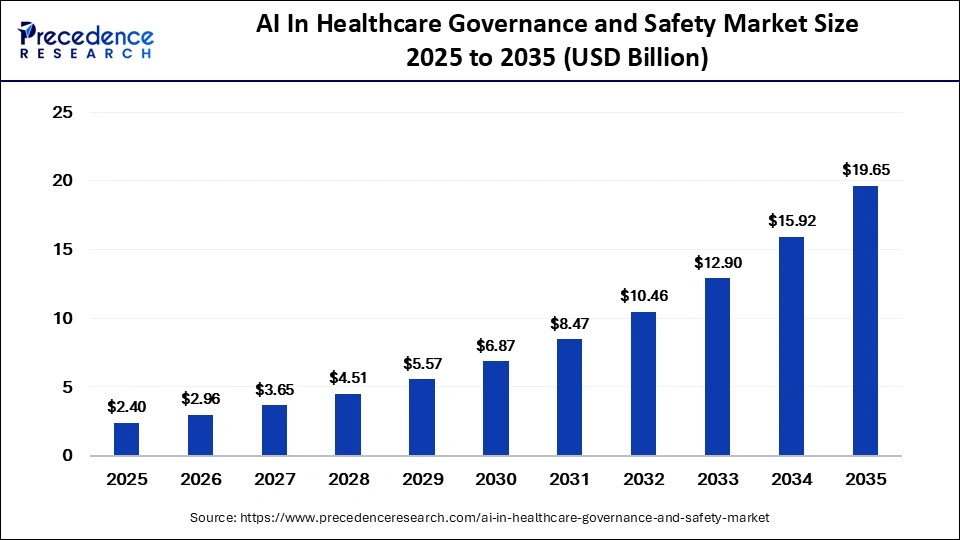
The global AI in healthcare governance and safety market is projected to grow from USD 2.96 billion in 2026 to USD 19.65 billion by 2035 at a CAGR of 23.40%. Explore market trends, growth drivers, regional analysis, key companies, and future opportunities.
Introduction
Artificial intelligence is rapidly transforming healthcare systems worldwide, enabling improved diagnostics, predictive analytics, patient monitoring, and operational efficiency. However, the growing deployment of AI-powered clinical systems has also increased the need for governance frameworks, safety monitoring, regulatory oversight, and ethical AI implementation.
Healthcare organizations are increasingly investing in AI governance and safety platforms to ensure transparency, accountability, compliance, cybersecurity, and patient safety. These systems help hospitals and healthcare providers monitor algorithm performance, identify bias, secure sensitive patient data, and maintain regulatory compliance across AI-enabled healthcare operations.
According to Precedence Research, the global AI in healthcare governance and safety market size was valued at USD 2.40 billion in 2025 and is expected to increase from USD 2.96 billion in 2026 to approximately USD 19.65 billion by 2035, expanding at a CAGR of 23.40% during the forecast period.
Read Also: Injection Molding Market
AI in Healthcare Governance and Safety Market Overview
AI governance and safety solutions in healthcare focus on ensuring responsible deployment and monitoring of artificial intelligence systems used in hospitals, diagnostic centers, pharmaceutical companies, and healthcare agencies.
These platforms enable healthcare organizations to oversee algorithmic decision-making, maintain audit trails, monitor model drift, detect cybersecurity threats, and comply with evolving healthcare regulations such as HIPAA, FDA guidelines, and the EU AI Act.
The growing adoption of AI-powered diagnostics, electronic health records (EHRs), predictive analytics, and generative AI tools is significantly accelerating demand for governance infrastructure and healthcare AI safety systems. Over 1,000 AI-enabled medical devices had been approved by the U.S. FDA by the end of 2024, highlighting the rapid integration of AI technologies into healthcare operations.
Key Market Statistics
Major Market Highlights
- The market is projected to grow at a CAGR of 23.40% from 2026 to 2035.
- North America accounted for 43% of the global market share in 2025.
- Europe represented 29% of market share in 2025 and is expected to witness strong future growth.
- The software segment dominated with 72% share in 2025.
- Cloud-based deployment accounted for 70% of the market share in 2025.
- Machine learning represented 28% of total technology adoption in 2025.
- Clinical risk management held 24% application share in 2025.
- Hospitals contributed 38% of end-use market share in 2025.
Key Market Drivers
Increasing Adoption of AI in Clinical Decision-Making
Healthcare providers are increasingly implementing AI-powered clinical decision support systems to improve patient outcomes, streamline workflows, and reduce operational inefficiencies.
As AI adoption expands across diagnostics, radiology, telemedicine, and patient monitoring systems, the need for governance infrastructure to ensure safe and ethical deployment is growing rapidly.
AI governance frameworks help healthcare organizations monitor model performance, detect bias, validate clinical outputs, and maintain accountability in high-risk healthcare environments.
Growing Regulatory Pressure and Compliance Requirements
Governments and healthcare regulators worldwide are introducing stricter policies governing AI use in healthcare applications.
Regulations such as the EU AI Act, FDA AI guidance frameworks, HIPAA compliance requirements, and cybersecurity standards are compelling healthcare organizations to adopt AI governance solutions.
The regulatory compliance segment accounted for 22% market share in 2025 and is expected to grow significantly during the forecast period.
Rising Healthcare Cybersecurity Threats
Healthcare systems are becoming increasingly vulnerable to cyberattacks due to growing digitization and cloud-based data management.
AI governance platforms help organizations strengthen healthcare cybersecurity by monitoring suspicious activity, managing access controls, securing patient records, and detecting anomalies in real time.
The increasing number of healthcare data breaches globally is accelerating investments in AI-based security and governance systems.
Expansion of Explainable AI (XAI)
Healthcare organizations are increasingly prioritizing explainable AI systems that provide transparent and interpretable decision-making processes.
Explainable AI enables clinicians and regulators to understand how AI models generate predictions or recommendations, improving trust and reducing regulatory risks.
The explainable AI segment is expected to grow at a CAGR of 29.5% during the forecast period.
Market Trends
Rise of AI Governance Frameworks in Hospitals
Hospitals worldwide are establishing AI governance committees and enterprise oversight systems to manage AI deployment safely and responsibly.
Nearly 70% of U.S. health systems implemented AI governance frameworks in 2025, compared to approximately 40% in 2024.
Healthcare organizations are increasingly focusing on AI monitoring, incident response, algorithm auditing, and compliance validation to support safe AI integration.
Growth of AI Safe Zones
Healthcare providers are creating “AI safe zones” where approved AI applications can be tested under controlled environments before full-scale deployment.
These controlled environments help organizations evaluate AI performance, reduce operational risks, and improve regulatory readiness.
Expansion of Agentic AI Governance
Healthcare organizations are beginning to deploy agentic AI systems capable of autonomous task execution and workflow management.
However, this expansion also introduces governance challenges related to accountability, permissions, lifecycle management, and audit readiness.
Emerging governance frameworks now focus on AI lifecycle management, runtime policy enforcement, audit logging, and kill-switch mechanisms to safely scale agentic AI in healthcare environments.
Market Restraints
High Implementation Costs
Deploying enterprise-grade AI governance infrastructure requires substantial investment in software platforms, cloud infrastructure, compliance systems, cybersecurity tools, and workforce training.
Smaller healthcare organizations may struggle to implement advanced governance solutions due to financial and technical limitations.
Limited AI Governance Expertise
Many healthcare institutions still lack dedicated AI governance teams and regulatory expertise.
Industry surveys indicate that only 45% of organizations have formal AI risk evaluation processes, while many continue prioritizing rapid AI deployment over governance readiness.
The shortage of AI governance professionals and limited organizational training remain major barriers to adoption.
Data Privacy and Ethical Challenges
AI systems in healthcare rely heavily on sensitive patient information, increasing concerns related to privacy, consent, algorithmic bias, and ethical decision-making.
Researchers continue to highlight gaps in healthcare AI governance related to ethics auditing, deployment oversight, and safety monitoring.
Emerging Opportunities
AI Model Governance and Monitoring
AI model governance is emerging as one of the fastest-growing segments within the healthcare governance ecosystem.
Healthcare organizations increasingly require continuous monitoring systems capable of identifying model drift, performance degradation, and unsafe outputs.
The AI model governance segment is expected to grow at a CAGR of 30.5% during the forecast period.
Integration of Predictive Analytics
Predictive analytics systems are helping healthcare organizations proactively manage patient safety risks, operational disruptions, and compliance vulnerabilities.
The predictive analytics segment is expected to grow at a CAGR of 24.5% through 2035.
These technologies enable early risk detection and support data-driven healthcare decision-making.
Expansion of Cloud-Based Governance Platforms
Cloud-native governance solutions are becoming increasingly popular because of scalability, flexibility, and centralized monitoring capabilities.
The cloud-based segment accounted for 70% market share in 2025 and is projected to witness the fastest growth over the forecast period.
Segmental Analysis
By Component
Software Segment Dominance
The software segment dominated the market with a 72% share in 2025 due to increasing demand for governance platforms, compliance management tools, and AI monitoring systems.
Healthcare providers are increasingly adopting software-based governance ecosystems to improve transparency and regulatory oversight.
Services Segment Growth
The services segment accounted for 28% share in 2025 and continues growing due to rising demand for consulting, compliance validation, model auditing, and cybersecurity support services.
By Deployment Mode
Cloud-Based Leadership
Cloud-based deployment dominated the market with 70% share in 2025 and is expected to grow at a CAGR of 28.5%.
Cloud platforms support scalable governance systems across distributed healthcare environments.
On-Premise Deployment
On-premise deployment remains relevant for organizations requiring higher customization, internal data control, and enhanced security.
By Technology
Machine Learning
Machine learning accounted for 28% market share in 2025 and remains central to healthcare AI governance systems.
Natural Language Processing (NLP)
NLP represented 22% market share and is increasingly used for medical reporting automation and EHR management.
Explainable AI (XAI)
XAI is projected to witness the fastest growth due to increasing demand for transparent AI decision-making systems in clinical environments.
Regional Analysis
North America
North America dominated the AI in healthcare governance and safety market with 43% share in 2025.
The region benefits from strong healthcare infrastructure, rapid AI adoption, supportive regulatory frameworks, and high investments in digital healthcare transformation.
Major U.S. healthcare systems including Mayo Clinic, Cleveland Clinic, and Stanford Medicine are significantly increasing investments in AI governance and explainable AI systems.
Europe
Europe accounted for 29% market share in 2025 and is expected to witness strong future growth.
The EU AI Act and stringent healthcare data regulations are accelerating adoption of governance and compliance solutions across European healthcare systems.
Asia-Pacific
Asia-Pacific is expected to experience rapid growth due to expanding healthcare digitization, increasing AI adoption, and rising government investments in healthcare infrastructure.
Countries such as China, Japan, South Korea, and India are increasingly investing in healthcare AI governance systems and ethical AI frameworks.
Latin America and Middle East & Africa
These regions are gradually adopting AI governance technologies as healthcare systems modernize and digital health infrastructure expands.
Growing awareness regarding cybersecurity and patient safety is expected to support future market growth.
Key Companies in the AI in Healthcare Governance and Safety Market
Major market participants include:
- IBM
- Microsoft
- Oracle
- Google Cloud
- Amazon Web Services
- SAS Institute
- NVIDIA
- Philips Healthcare
- GE HealthCare
- Epic Systems
These companies are focusing on explainable AI, healthcare cybersecurity, predictive analytics, governance automation, and compliance management solutions.
Get a Sample Copy: https://www.precedenceresearch.com/sample/8411
For inquiries regarding discounts, bulk purchases, or customization requests, please contact us at sales@precedenceresearch.com
