
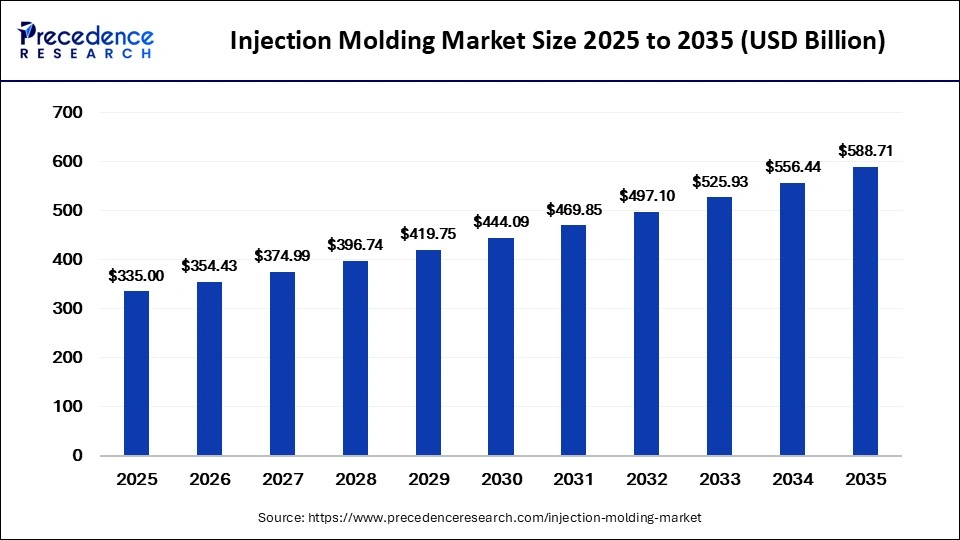
The global injection molding market is projected to grow from USD 354.43 billion in 2026 to USD 588.71 billion by 2035 at a CAGR of 5.80%. Explore market trends, drivers, regional insights, key players, and future opportunities.
Introduction
The global injection molding market is experiencing strong growth due to increasing demand for lightweight, durable, and cost-efficient components across industries such as automotive, packaging, electronics, healthcare, and consumer goods. Injection molding technology has become one of the most widely adopted manufacturing processes because of its ability to produce complex components with high precision, scalability, and low material waste.
Manufacturers worldwide are increasingly investing in advanced injection molding systems, automation technologies, and sustainable production practices to improve operational efficiency and meet evolving industry requirements. The growing adoption of electric vehicles (EVs), smart consumer electronics, medical devices, and recyclable packaging materials is further accelerating market expansion.
According to Precedence Research, the global injection molding market size was valued at USD 335.00 billion in 2025 and is expected to increase from USD 354.43 billion in 2026 to approximately USD 588.71 billion by 2035, expanding at a CAGR of 5.80% during the forecast period.
Read Also: Metal Coil Lamination Market
Injection Molding Market Overview
Injection molding is a manufacturing process used to produce components by injecting molten material into a mold cavity under high pressure. The process is extensively used for manufacturing plastic, metal, rubber, and ceramic products in large volumes with high dimensional accuracy and consistency.
Injection molding offers several advantages, including reduced production costs, high repeatability, fast cycle times, minimal waste generation, and the ability to create highly complex product designs. These benefits make the technology highly suitable for mass production applications across automotive, medical, electronics, packaging, and industrial sectors.
The growing focus on lightweight materials, precision engineering, and sustainable manufacturing practices is significantly driving the adoption of advanced injection molding technologies worldwide.
Key Market Statistics
Major Market Highlights
- The injection molding market is expected to grow at a CAGR of 5.80% from 2026 to 2035.
- Asia-Pacific accounted for 48% of the global market share in 2025.
- The plastic material segment held 72% of the market share in 2025.
- Hydraulic injection molding machines dominated with 45% share in 2025.
- Thermoplastic injection molding represented 68% of the market in 2025.
- Packaging applications accounted for 28% of market demand in 2025.
- Healthcare applications are expected to grow at the fastest CAGR of 7.5% during the forecast period.
Key Market Drivers
Rising Demand for Lightweight Automotive Components
The automotive industry is one of the major growth drivers for the injection molding market. Manufacturers are increasingly using lightweight plastic and composite components to improve fuel efficiency and reduce vehicle emissions.
Injection molding is widely used for producing dashboards, bumpers, lighting systems, door panels, connectors, and under-the-hood automotive components. The growing production of electric vehicles is further increasing demand for lightweight molded parts.
The automotive application segment accounted for 24% of market share in 2025 and is expected to grow steadily throughout the forecast period.
Expansion of Sustainable Packaging Solutions
The packaging industry continues to be a major consumer of injection molded products. Rising global demand for lightweight, durable, and recyclable packaging materials is driving adoption of advanced injection molding technologies.
Manufacturers are increasingly using recyclable plastics, bioplastics, and eco-friendly molding processes to comply with environmental regulations and sustainability goals.
The packaging segment dominated the market with a 28% share in 2025 due to strong demand from food, beverage, pharmaceutical, and FMCG industries.
Growth in Medical and Healthcare Applications
Injection molding plays a critical role in manufacturing disposable medical devices, diagnostic components, surgical instruments, and pharmaceutical packaging products.
The healthcare segment is projected to grow at the fastest CAGR of 7.5% owing to increasing healthcare infrastructure investments, rising demand for medical disposables, and stringent hygiene standards.
Micro injection molding technologies are also gaining popularity for producing highly precise medical components and wearable healthcare devices.
Technological Advancements and Industry 4.0 Integration
Manufacturers are increasingly integrating artificial intelligence, robotics, IoT sensors, and predictive analytics into injection molding operations.
AI-powered monitoring systems help optimize machine parameters such as temperature, pressure, material flow, and cooling times. These technologies improve operational efficiency, reduce downtime, and minimize material waste.
The adoption of smart manufacturing and Industry 4.0 practices is expected to significantly enhance production quality and productivity over the coming years.
Market Trends
Increasing Adoption of Electric Injection Molding Machines
Electric injection molding machines are becoming increasingly popular due to their energy efficiency, precision, lower maintenance costs, and reduced emissions.
The electric machines segment accounted for 35% of the market share in 2025 and is expected to grow at the fastest CAGR of 8.5% during the forecast period.
Industries such as electronics, medical devices, and precision packaging are rapidly adopting electric molding systems for high-accuracy production applications.
Growing Use of Recyclable and Biodegradable Materials
Environmental concerns and regulatory pressure regarding plastic waste are encouraging manufacturers to adopt recyclable plastics and biodegradable materials.
Companies are investing in sustainable injection molding technologies that reduce energy consumption and support circular economy initiatives.
Expansion of Micro Injection Molding
Micro injection molding is emerging as a high-growth segment due to increasing demand for miniature and highly precise components in healthcare, electronics, and telecommunications industries.
The technology enables manufacturers to produce small and complex parts with excellent dimensional accuracy and minimal material waste.
Market Restraints
High Initial Capital Investment
Injection molding facilities require significant investment in advanced machinery, automation systems, molds, tooling, and quality control technologies.
Small and medium-sized enterprises often face financial barriers when adopting modern injection molding systems. Industry discussions consistently highlight high capital expenditure as a major challenge for market expansion.
Environmental Concerns Regarding Plastic Waste
Growing environmental concerns related to plastic pollution and waste management remain major challenges for the industry.
Governments worldwide are implementing stricter regulations on single-use plastics and industrial emissions, forcing manufacturers to adopt sustainable production methods.
Fluctuating Raw Material Prices
Volatility in prices of plastics, resins, metals, and specialty polymers can significantly impact manufacturing costs and profit margins.
Global supply chain disruptions and geopolitical uncertainties continue to create pricing instability across raw material markets.
Segmental Analysis
By Material
Plastic Segment Dominance
The plastic segment dominated the injection molding market with a 72% share in 2025 due to increasing demand for lightweight, corrosion-resistant, and cost-effective components.
Plastic injection molding is extensively used in packaging, automotive, electronics, and consumer goods manufacturing.
Metal Injection Molding Growth
The metal segment held 15% market share in 2025 and is expected to grow at the fastest CAGR of 7% during the forecast period.
Metal injection molding is increasingly used for producing complex, high-strength components for aerospace, automotive, and medical applications.
By Machine Type
Hydraulic Injection Molding Machines
Hydraulic machines accounted for 45% of market share in 2025 due to their strong clamping force and cost-effectiveness.
These systems remain widely used in automotive, heavy industrial, and packaging applications.
Electric Injection Molding Machines
Electric machines are witnessing rapid adoption because of their high precision, energy efficiency, and reduced operational costs.
By Process
Thermoplastic Injection Molding
Thermoplastic injection molding dominated the market with a 68% share in 2025.
Thermoplastics are highly recyclable, durable, and suitable for mass production applications.
Liquid Silicone Rubber Injection Molding
Liquid silicone rubber injection molding is expected to grow at the fastest CAGR of 8.2% due to rising demand for biocompatible and flexible materials in medical and wearable devices.
Regional Analysis
Asia-Pacific
Asia-Pacific dominated the injection molding market with 48% market share in 2025 and is expected to maintain the fastest growth rate during the forecast period.
Rapid industrialization, strong manufacturing infrastructure, low labor costs, and increasing demand from automotive and electronics industries are driving regional growth.
China, India, Japan, and South Korea remain key manufacturing hubs for injection molded products.
North America
North America is expected to witness strong growth due to increasing adoption of advanced manufacturing technologies, electric vehicles, and healthcare devices.
The region is also experiencing rising investments in sustainable packaging and Industry 4.0 automation systems.
Europe
Europe continues to be a significant market due to strong automotive manufacturing, strict environmental regulations, and increasing demand for recyclable materials.
Germany, France, Italy, and the United Kingdom are major contributors to regional market growth.
Latin America and Middle East & Africa
These regions are gradually adopting injection molding technologies for industrial manufacturing, consumer goods production, and healthcare infrastructure development.
Increasing urbanization and industrialization are expected to support future market growth.
Key Companies in the Injection Molding Market
Major companies operating in the global injection molding market include:
- ARBURG GmbH + Co KG
- Engel Austria GmbH
- Haitian International Holdings Limited
- Husky Injection Molding Systems Ltd.
- KraussMaffei Group
- Milacron LLC
- Nissei Plastic Industrial Co., Ltd.
- Sumitomo (SHI) Demag Plastics Machinery GmbH
- The Japan Steel Works, Ltd. (JSW)
- Toshiba Machine Co., Ltd.
These companies are focusing on automation technologies, energy-efficient systems, AI integration, and sustainable manufacturing innovations to strengthen their competitive positions.
Get a Sample Copy: https://www.precedenceresearch.com/sample/8410
For inquiries regarding discounts, bulk purchases, or customization requests, please contact us at sales@precedenceresearch.com
