
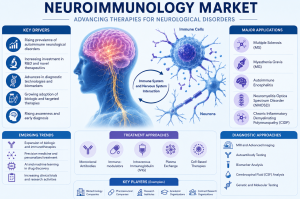
The neuroimmunology market is gaining significant momentum as researchers continue to uncover the complex relationship between the nervous system and the immune system. Neuroimmunology, an interdisciplinary field combining neuroscience and immunology, plays a critical role in understanding and treating neurological disorders that involve immune system dysfunction. Conditions such as multiple sclerosis, neuromyelitis optica spectrum disorder (NMOSD), myasthenia gravis, autoimmune encephalitis, and chronic inflammatory neuropathies have become major areas of focus for healthcare providers and pharmaceutical companies.
The growing prevalence of autoimmune neurological disorders, increasing investments in research and development, and the emergence of targeted immunotherapies are driving the expansion of the neuroimmunology market. As precision medicine and biologic therapies continue to evolve, the market is expected to witness sustained growth over the coming years.
What is the Neuroimmunology Market Size?
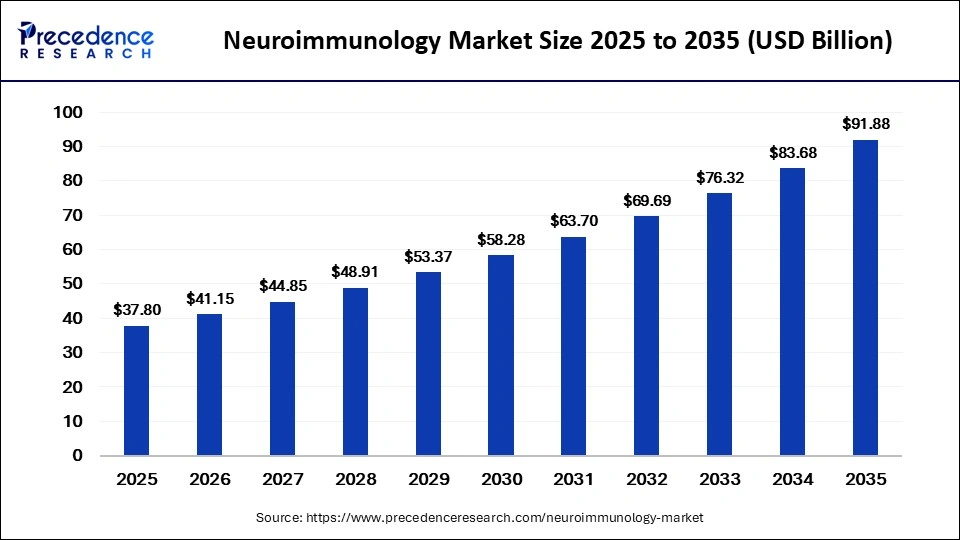
The global neuroimmunology market size accounted for USD 37.80 billion in 2025 and is predicted to increase from USD 41.15 billion in 2026 to approximately USD 91.88 billion by 2035, expanding at a CAGR of 8.90% from 2026 to 2035. The market is driven by the surging global incidence of neurological and autoimmune disorders, such as multiple sclerosis, Alzheimer’s, and Parkinson’s, combined with breakthroughs in targeted drug discovery and advanced diagnostic imaging.
Market Insights
- North America dominated the global neuroimmunology market with a share of 39% in 2025.
- Asia-Pacific is expected to grow at the fastest CAGR of 13.5% during the forecast period.
- By disease type, the multiple sclerosis segment led the global market with a share of 36% in 2025.
- By disease type, the neuroinflammatory disorders segment held 9% of the market share in 2025 and is expected to grow at the fastest CAGR of 12.5% between 2026 and 2035.
- By treatment type, the monoclonal antibodies segment accounted for a revenue share of 30% in the market in 2025.
- By treatment type, the cell-based therapies segment is expected to grow at the highest CAGR of 18.5% between 2026 and 2035.
- By mechanism of action, the B-cell targeting therapies segment accounted for the highest revenue share of 28% in the market in 2025.
- By mechanism of action, the complement inhibition segment is expected to grow at the fastest CAGR of 14.5% between 2026 and 2035.
Understanding Neuroimmunology
Neuroimmunology studies how the immune system interacts with the central and peripheral nervous systems. While the immune system protects the body from infections, abnormal immune responses can mistakenly attack healthy nerve cells, resulting in inflammation and neurological damage.
Advancements in molecular biology, genetics, and diagnostic technologies have significantly improved the understanding of these disorders, enabling earlier diagnosis and more personalized treatment strategies.
Key Factors Driving the Neuroimmunology Market
Rising Prevalence of Autoimmune Neurological Disorders
The growing incidence of diseases such as multiple sclerosis, myasthenia gravis, autoimmune encephalitis, and Guillain-Barré syndrome is creating substantial demand for advanced diagnostic tools and effective treatment options. Earlier diagnosis and improved disease awareness are further supporting market growth.
Growing Investment in Research and Drug Development
Pharmaceutical and biotechnology companies are investing heavily in the development of biologics, monoclonal antibodies, cell-based therapies, and next-generation immunomodulatory drugs. Continuous clinical research is expanding treatment possibilities for patients with complex neurological diseases.
Increasing Adoption of Precision Medicine
Personalized medicine is transforming neuroimmunology by enabling physicians to select therapies based on individual patient characteristics, genetic profiles, and disease biomarkers. This approach improves treatment outcomes while minimizing adverse effects.
Advances in Diagnostic Technologies
Innovations in MRI imaging, cerebrospinal fluid analysis, biomarker testing, next-generation sequencing, and autoimmune antibody detection are improving diagnostic accuracy and allowing earlier intervention.
Emerging Market Trends
Expansion of Biologic Therapies
Biologic drugs have become one of the fastest-growing treatment categories in neuroimmunology. Targeted therapies that specifically regulate immune system activity are improving disease management while reducing long-term complications.
Artificial Intelligence in Neurological Research
Artificial intelligence is increasingly being used to analyze complex clinical data, identify disease biomarkers, accelerate drug discovery, and support clinical decision-making. AI-driven research is expected to shorten development timelines for new neuroimmunology therapies.
Increasing Clinical Trials
Healthcare companies and academic research institutions continue to expand clinical trials focused on innovative therapies for autoimmune neurological disorders. The growing pipeline of investigational drugs reflects strong confidence in the market’s long-term potential.
Improved Patient Awareness
Patient advocacy organizations and healthcare initiatives are increasing awareness of neurological autoimmune diseases, encouraging earlier diagnosis and improving access to specialized treatment centers.
Market Scope
| Report Coverage | Details |
| Market Size in 2025 | USD 37.80 Billion |
| Market Size in 2026 | USD 41.15 Billion |
| Market Size by 2035 | USD 91.88 Billion |
| Market Growth Rate from 2026 to 2035 | CAGR of 8.90% |
| Dominating Region | North America |
| Fastest Growing Region | Asia Pacific |
| Base Year | 2025 |
| Forecast Period | 2026 to 2035 |
| Segments Covered | Disease Type, Treatment Type, Mechanism of Action, Route of Administration, End-User, and Region |
| Regions Covered | North America, Europe, Asia-Pacific, Latin America, and Middle East & Africa |
Challenges Facing the Market
Despite strong growth opportunities, the neuroimmunology market faces several challenges. Developing advanced biologic therapies requires substantial investment, lengthy clinical trials, and complex regulatory approvals. High treatment costs can also limit accessibility in some regions.
In addition, many neuroimmune disorders remain difficult to diagnose due to overlapping symptoms with other neurological conditions. Continued investment in biomarker research and diagnostic innovation will be essential to overcome these challenges.
Regional Market Insights
North America continues to lead the neuroimmunology market due to advanced healthcare infrastructure, strong pharmaceutical research capabilities, favorable reimbursement policies, and widespread adoption of innovative therapies.
Europe maintains a significant market share supported by increasing neurological disease awareness, government-funded healthcare systems, and active clinical research programs.
Asia-Pacific is expected to experience the fastest growth during the forecast period as healthcare spending increases, neurological care improves, and pharmaceutical companies expand research activities across countries such as China, Japan, India, and South Korea.
Latin America and the Middle East & Africa are gradually strengthening their healthcare infrastructure, creating new opportunities for neuroimmunology diagnostics and therapies.
Competitive Landscape
The neuroimmunology market is highly competitive, with leading pharmaceutical and biotechnology companies focusing on biologics, monoclonal antibodies, immunotherapies, and precision medicine solutions. Companies continue to invest in strategic partnerships, mergers, acquisitions, and clinical research to strengthen their product portfolios and expand their global presence.
Neuroimmunology Market Leading Key Players
- Biogen Inc
- F. Hoffmann-La Roche Ltd
- Novartis AG
- Sanofi S.A.
- Bristol Myers Squibb
- Merck KGaA
- Alexion Pharmaceuticals
- AbbVie Inc.
- UCB Pharma
- Eli Lilly and Company
- Teva Pharmaceutical Industries Ltd.
- Mitsubishi Tanabe Pharma Corporation
- Takeda Pharmaceutical Company Limited
- AstraZeneca PLC
- Johnson & Johnson
Future Outlook
The future of the neuroimmunology market appears highly promising as scientific understanding of immune-mediated neurological disorders continues to improve. Advances in immunotherapy, biomarker discovery, precision medicine, and artificial intelligence are expected to transform disease diagnosis and treatment.
With rising healthcare investments, increasing patient awareness, and a robust pipeline of innovative therapies, the neuroimmunology market is well positioned for long-term growth. As research progresses, patients can expect more effective, targeted, and personalized treatment options that improve both clinical outcomes and quality of life.
Get Sample Link : https://www.precedenceresearch.com/sample/8446
Recent Developments
- In February 2026, researchers from WashU Medicine and Weizmann Institute of Science engineered CAR-T cells to target amyloid beta plaques in the brain, offering a promising approach to treating the condition. The study showed positive results in mice, reducing harmful amyloid plaques and improving the overall brain tissue health.
- In October 2025, Nilo Therapeutics announced the completion of its Series A funding round worth $101 million to support the establishment of Nilo’s research labs in New York City, expand its interdisciplinary R&D team, and accelerate the development of its preclinical programs.
Segments Covered in the Report
By Disease Type
- Multiple Sclerosis
- Neuromyelitis Optica Spectrum Disorder (NMOSD)
- Myasthenia Gravis
- Autoimmune Encephalitis
- Guillain-Barré Syndrome (GBS)
- Chronic Inflammatory Demyelinating Polyneuropathy
- Neuroinflammatory Disorders
- Other Neuroimmune Disorders
By Treatment Type
- Immunomodulators
- Immunosuppressants
- Monoclonal Antibodies
- Corticosteroids
- Intravenous Immunoglobulin (IVIG)
- Plasma Exchange (PLEX)
- Cell-based Therapies
- Other Biologic Therapies
By Mechanism of Action
- B-cell Targeting Therapies
- T-cell Modulation
- Complement Inhibition
- Cytokine Inhibition
- Neuroprotection
- Anti-inflammatory Therapy
By Route of Administration
- Oral
- Injectable
- Intravenous (IV)
- Subcutaneous
By End-user
- Hospitals
- Specialty Neurology Clinics
- Research & Academic Institutes
- Homecare Settings
- Rehabilitation Centers
By Region
- North America
- Latin America
- Europe
- Asia-pacific
- Middle and East Africa
Also Read Our Latets Article : Sevoflurane Market

- Cholestatic Pruritus Market: Advancements in Targeted Therapies Are Transforming Patient Care - June 30, 2026
- Inflammatory Disease Market: Biologic Therapies and Precision Medicine Are Reshaping Patient Care - June 30, 2026
- Retail Cloud Market: Driving the Future of Smart, Connected Retail Operations - June 30, 2026