
What is the Ligation Device Market Size in 2026?
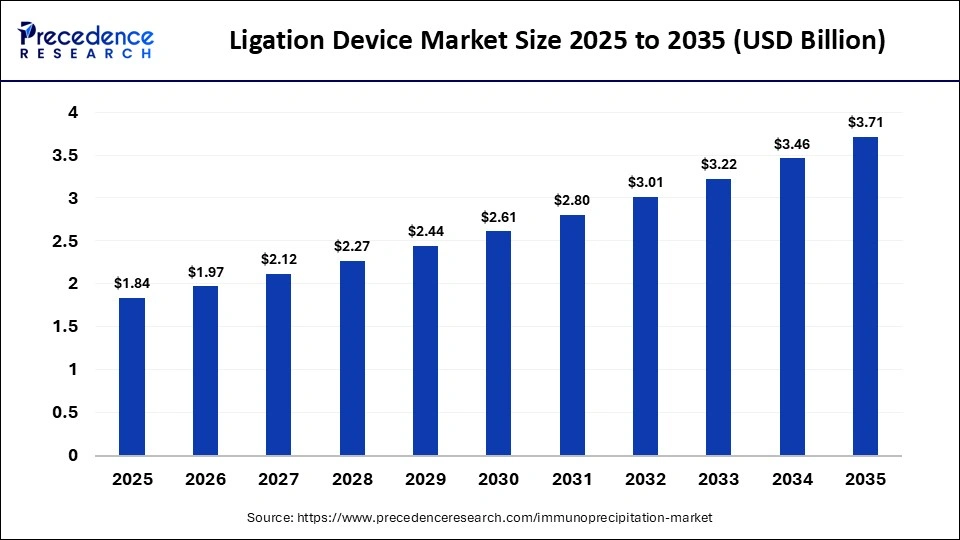
The global ligation device market size was calculated at USD 1.84 billion in 2025 and is predicted to increase from USD 1.97 billion in 2026 to approximately USD 3.71 billion by 2035, expanding at a CAGR of 7.26% from 2026 to 2035. The ligation device market is expected to grow rapidly due to the increasing demand for minimally invasive surgical procedures among patients and healthcare providers for effective results and improved recovery. The growing number of surgical procedures globally for different health issues is another major factor propelling the market.
Key Takeaways
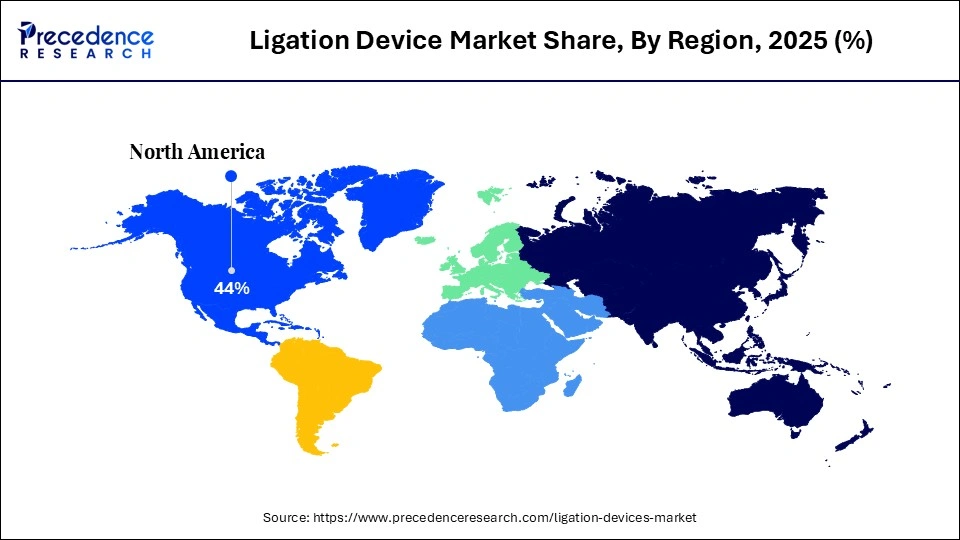
- North America dominated the global ligation device market with the largest market share of 44% in 2025.
- Asia Pacific is observed to be the fastest-growing region with the highest CAGR in the forecast period.
- By application, the gastrointestinal and abdominal surgery segment held a biggest market share of 31% in 2025.
- By application, the cardiothoracic segment is expected to grow at the fastest CAGR in the foreseen period.
- By procedure type, the minimally invasive surgery (MIS) segment accounted for a considerable market share of 81% in 2025.
- By procedure type, the open surgery segment is expected to grow at a significant CAGR in the market during the studied years.
- By end use, the hospital segment contributed the major market share of 72% in 2025.
- By end use, the ambulatory surgical centers (ASCs) segment is expected to expand notably in the market in the coming years.
Ligation Device Market Overview
The ligation device market comprises medical instruments used to securely seal blood vessels, ducts, and tissues during surgical procedures to prevent bleeding and ensure effective tissue management. These devices are widely used in both open and minimally invasive surgeries, offering a faster and more reliable alternative to traditional suturing techniques.
Ligation devices include clips, bands, loops, and applicators that are commonly used in procedures involving small to medium-sized arteries and veins, bile ducts, fallopian tubes, and hemorrhoids. They play a critical role in various surgical specialties, including urology, gynecology, and general surgery.
The growing preference for minimally invasive procedures, along with advancements in surgical technologies, is significantly driving the adoption of ligation devices across healthcare settings.
Impact of Artificial Intelligence on the Ligation Device Market
- Artificial intelligence (AI) is transforming the ligation device market by enhancing surgical precision, improving patient safety, and enabling advanced automation in operating rooms.
- Real-Time Surgical Guidance: AI-powered systems can analyze live surgical video feeds to help surgeons identify critical anatomical structures and determine optimal ligation points, reducing the risk of accidental damage.
- Robotic-Assisted Surgical Automation: AI-integrated robotic systems are enabling higher levels of precision and automation in tasks such as dissection and ligation. This reduces human error and improves outcomes in complex surgical procedures.
- Enhanced Safety and Monitoring: AI-driven sensors and IoT-enabled devices can detect incomplete closures or improper placement of ligation devices, providing real-time alerts to surgeons and ensuring consistent results.
- Advanced Imaging and Decision Support: Deep learning algorithms support better visualization by distinguishing between tissues and surgical instruments. These technologies can also assist in procedures such as cancer excision by generating heat maps and improving surgical accuracy.
Ligation Device Market Trends
- Rising Demand for Minimally Invasive Surgeries: The increasing preference for minimally invasive procedures is a key driver of market growth. These procedures offer reduced surgical trauma, faster recovery times, and lower risk of complications, making them highly desirable among patients and healthcare providers.
- Growing Adoption of Disposable Accessories: There is a rising demand for single-use ligation devices and accessories, such as disposable clips and applicators. These products help improve infection control, enhance patient safety, and comply with stringent healthcare regulations.
- Increasing Geriatric Population: The growing global geriatric population is leading to a higher number of surgical procedures, thereby increasing the demand for ligation devices. Aging populations are more prone to chronic conditions that often require surgical intervention, further driving market expansion.
Market Scope
| Report Coverage | Details |
| Market Size in 2025 | USD 1.84 Billion |
| Market Size in 2026 | USD 1.97 Billion |
| Market Size by 2035 | USD 3.71 Billion |
| Market Growth Rate from 2026 to 2035 | CAGR of 7.26% |
| Dominating Region | North America |
| Fastest Growing Region | Asia Pacific |
| Base Year | 2025 |
| Forecast Period | 2026 to 2035 |
| Segments Covered | Application, Procedure Type , End-Use, and Region |
| Regions Covered | North America, Europe, Asia-Pacific, Latin America, and Middle East & Africa |
Regional Insights
North America holds the largest share of the ligation device market, driven by advanced healthcare infrastructure, high surgical volumes, and early adoption of minimally invasive surgical techniques. The United States leads the region due to strong presence of leading medical device manufacturers, high healthcare spending, and increasing prevalence of chronic diseases requiring surgical intervention. Additionally, the rapid integration of robotic-assisted surgeries and AI-based surgical tools is further boosting market growth.
Europe represents a significant portion of the global ligation device market, supported by well-established healthcare systems and strict regulatory standards for surgical safety and infection control. Countries such as Germany, the UK, and France are key contributors, with growing adoption of advanced surgical technologies and minimally invasive procedures. The region also benefits from an aging population, which increases the demand for surgical treatments.
Asia Pacific is the fastest-growing region in the ligation device market, fueled by expanding healthcare infrastructure, rising population, and increasing awareness of advanced surgical procedures. Countries like China, India, and Japan are witnessing strong growth due to increasing hospital investments, medical tourism, and government initiatives to improve healthcare access. The growing adoption of minimally invasive surgeries is a major factor driving regional demand.
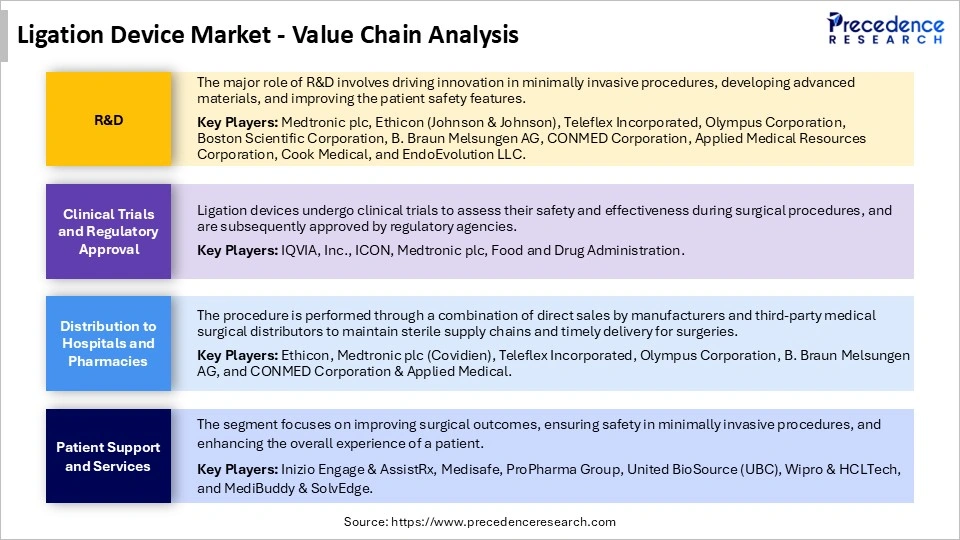
Ligation Device Market Value Chain Analysis
Ligation Device Market Key Players
- Medtronic
- Johnson & Johnson, Inc .
- The Cooper Companies, Inc.
- CONMED Corporation
- B. Braun SE
- Teleflex Inc.
- Olympus Corporation
- Smith & Nephew plc
- Applied Medical
- Stryker Corporation
Recent Developments
- In December 2025, Olympus Corporation announced a voluntary medical device corrective action for its Single Use Ligating Device (“PolyLoop”) following identification of a potential safety issue. The PolyLoop device is designed for use with Olympus endoscopes to deliver a nylon loop snare intended to prevent or control bleeding following polypectomy of pedunculated polyps.
- In July 2024, Asensus Surgical announced that the U.S. FDA approved an expanded indication of the Senhance Surgical System for use in adult and pediatric patients undergoing urologic procedures. The system is a digital laparoscopic system designed for visualization and endoscopic manipulation of tissue, including grasping, cutting, dissection, ligation, and mobilization.
Segments Covered in the Report
By Application
- Gastrointestinal and Abdominal Surgery
- Gynecological Surgery
- Cardiothoracic Surgery
- Urological Surgery
- Bariatric
- Vascular
- Other
By Procedure Type
- MIS
- Open surgery
By End-Use
- Hospitals
- Ambulatory Surgical Centers
By Region
- North America
- Latin America
- Europe
- Asia-pacific
Middle and East Africa
Get Sample Link: https://www.precedenceresearch.com/sample/8210

- Cholestatic Pruritus Market: Advancements in Targeted Therapies Are Transforming Patient Care - June 30, 2026
- Inflammatory Disease Market: Biologic Therapies and Precision Medicine Are Reshaping Patient Care - June 30, 2026
- Retail Cloud Market: Driving the Future of Smart, Connected Retail Operations - June 30, 2026