
What is the In Vehicle AI Robot Market Size in 2026?
The global in vehicle AI robot market size was valued at USD 103.02 million in 2025 and is predicted to increase from USD 130.11 million in 2026 to approximately USD 1,064.03 million by 2035, expanding at a CAGR of 26.30% from 2026 to 2035. The market growth is attributed to the increasing integration of artificial intelligence and robotics technologies in next-generation intelligent and autonomous vehicles.
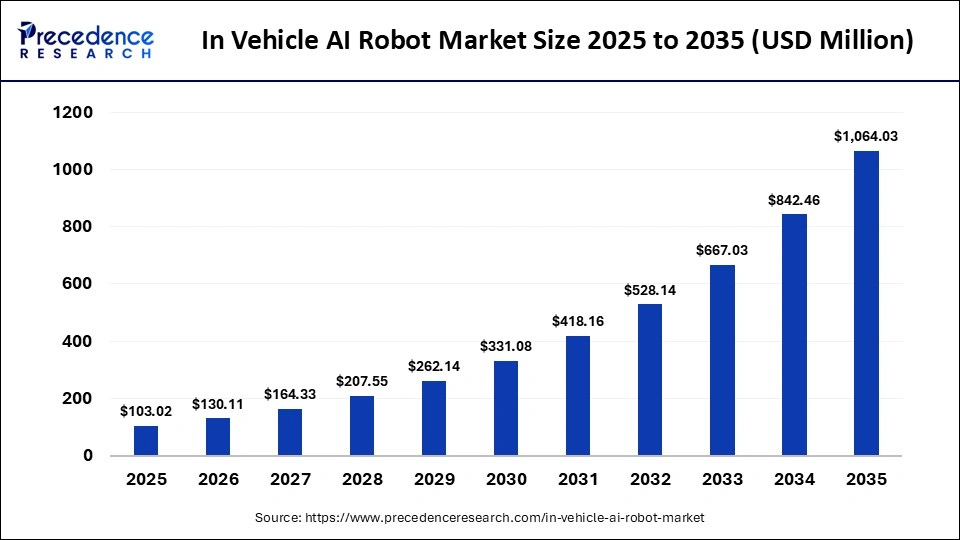
Key Takeaways
- Asia-Pacific dominated the market with 38.7% of the market share in 2025.
- North America is expected to grow at the fastest CAGR between 2026 and 2035.
- By robot type, the passenger companion AI robot segment contributed the highest in vehicle AI robot market share of 34.7% in 2025.
- By robot type, the autonomous taxi cabin AI robot segment is expected to grow at a strong CAGR of 28.8% between 2026 and 2035.
- By component, the hardware segment held a major market share of 46.8% in 2025.
- By component, the software segment is expected to expand at the fastest CAGR of 24.6% from 2026 to 2035.
- By AI capability, the voice interaction and conversational AI segment captured the highest market share of 33.4% in 2025.
- By AI capability, the emotional and behavioral AI segment is poised to grow at a healthy CAGR of 28.4% between 2026 and 2035.
- By application, the passenger infotainment assistance segment generated the biggest market share of 31.8% in 2025.
- By application, the mobility assistance for elderly or disabled users segment is expected to expand at the fastest CAGR of 29.1% between 2026 and 2035.
- By end use, the private vehicle owners segment accounted for the largest market share of 46.7% in 2025.
- By end use, the shared autonomous mobility services segment is projected to grow at a solid CAGR of 26.9% between 2026 and 2035.
Key Factors Driving the In-Vehicle AI Robot Market
The in-vehicle AI robot market is rapidly expanding due to the increasing demand for safer, smarter, and more intelligent transportation systems. In-vehicle AI robots are advanced systems embedded within vehicles that combine artificial intelligence, robotics, sensors, computer vision, and high-performance computing to enable functionalities such as autonomous driving, vehicle monitoring, voice interaction, and real-time decision-making.
According to the National Highway Traffic Safety Administration (NHTSA), nearly 94% of serious road accidents are caused by human error. This highlights the critical role of AI-driven automation in significantly reducing accident rates and improving road safety. As a result, the global push toward autonomous and intelligent mobility solutions continues to be a major growth driver for this market.
In-Vehicle AI Robot Market Growth Factors
- Expansion of Autonomous Vehicle Testing Programs: The rapid increase in autonomous vehicle trials across global markets is accelerating the adoption of in-vehicle AI robotics. Governments and private players are investing heavily in testing infrastructure, enabling faster development and deployment of AI-powered mobility solutions.
- Rising Demand for Advanced In-Vehicle Experiences: Consumers are increasingly expecting intelligent digital features such as voice assistants, smart cockpit systems, and personalized automation. This growing demand is driving the integration of AI-powered robotics into modern vehicles, enhancing user experience and comfort.
In-Vehicle AI Robot Market Trends
- Expansion of Robotaxi and Autonomous Mobility Services: Automotive manufacturers and technology companies are increasingly launching robotaxi pilot programs and autonomous ride-hailing services in major urban areas. These initiatives are accelerating real-world adoption of in-vehicle AI robotics and strengthening the intelligent mobility ecosystem.
- Emergence of Strategic AI Mobility Ecosystems: Collaborations between automotive companies, technology providers, and mobility platforms are creating integrated AI-driven ecosystems. These partnerships are enabling faster innovation, improving scalability, and opening new opportunities for deploying in-vehicle AI robotic systems across both consumer and commercial transportation sectors.
Market Scope
| Report Coverage | Details |
| Market Size in 2025 | USD 103.02 Million |
| Market Size in 2026 | USD 130.11 Million |
| Market Size by 2035 | USD 1,064.03 Million |
| Market Growth Rate from 2026 to 2035 | CAGR of 26.30% |
| Dominating Region | Asia Pacific |
| Fastest Growing Region | North America |
| Base Year | 2025 |
| Forecast Period | 2026 to 2035 |
| Segments Covered | Robot Type, Component, AI Capability, Application,End Use, and Region |
| Regions Covered | North America, Europe, Asia-Pacific, Latin America, and Middle East & Africa |
In Vehicle AI Robot Market Dynamics
Driver
Rising Safety Needs
Growing demand for intelligent driver assistance systems is anticipated to strengthen the integration of AI-powered robotics inside modern vehicles. The growing level of safety awareness and regulatory requirements has also contributed to the level of adoption that is being witnessed in global markets. This trend is hence bound to increase the use of in-vehicle AI robotic technologies.
Restraint
High Development and Integration Costs
High development and integration costs are expected to slow the widespread adoption of in-vehicle AI robotics technologies across cost-sensitive automotive segments. Carmakers are under mounting pressure to reconcile innovation and affordability, particularly in new markets. These pricing advantages are constraining high rates of scaling in the mid-range and entry-level categories. The high financial needs are thus expected to hinder general market penetration.
Opportunity
Surging Investments in Automotive AI Research
Surging investments in automotive AI research are projected to create immense opportunities for the market in the coming years. Automotive EMS and technology firms are dedicating substantial resources to AI chips, perception, and self-driving software. Continuous improvements in machine learning models and computing platforms are allowing vehicles to become intelligent robots. Large-scale pilot deployments and commercialization strategies are also being supported by these investments.
Regional Insights
North America holds the largest share of the in-vehicle AI robot market, driven by its advanced automotive ecosystem and strong technological innovation. The region benefits from the presence of leading tech companies and automakers actively investing in autonomous driving and AI-based mobility solutions. Favorable regulatory frameworks and extensive testing programs for self-driving vehicles further accelerate adoption. Additionally, North America contributes significantly to market growth, accounting for nearly 35% of global expansion during the forecast period.
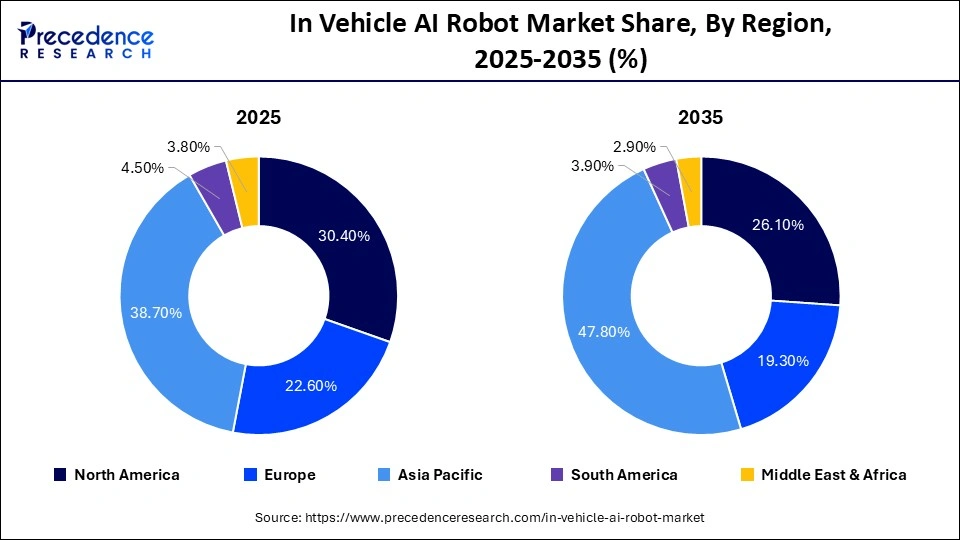
Europe represents a significant market driven by strict safety regulations and a strong focus on sustainable and intelligent mobility. Countries such as Germany, the UK, and France are investing heavily in autonomous driving technologies and smart transportation infrastructure. The region’s well-established automotive industry, combined with increasing collaborations between OEMs and AI technology providers, is supporting steady market growth.
Asia Pacific is the fastest-growing region in the in-vehicle AI robot market due to rapid advancements in automotive manufacturing and AI technology adoption. Countries like China, Japan, and South Korea are leading innovation in autonomous driving and intelligent mobility. Government initiatives, large-scale pilot programs, and expanding smart city projects are accelerating deployment. The region is also emerging as a global hub for autonomous vehicle testing and AI mobility solutions, significantly boosting demand.
In Vehicle AI Robot Market Value Chain Analysis
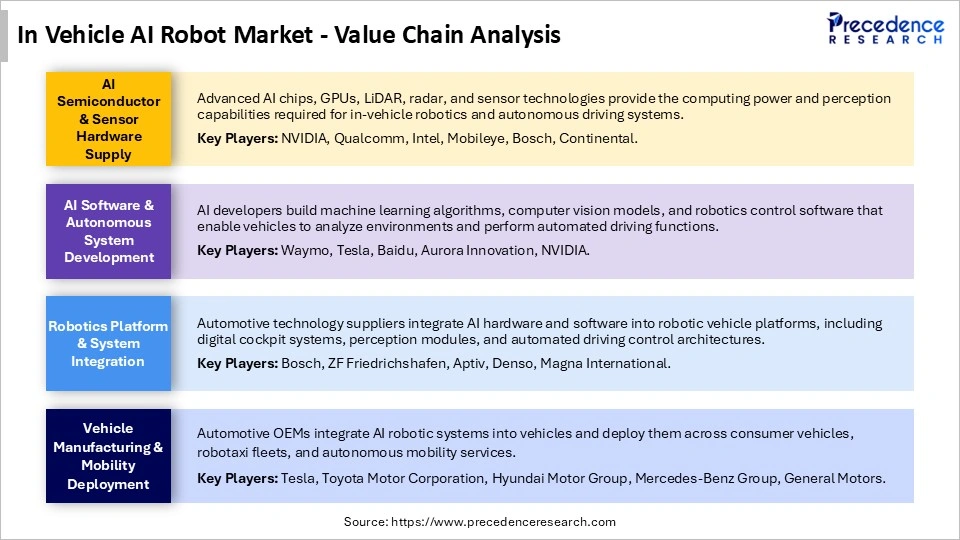
In Vehicle AI Robot Market Key Players
- Tesla
- Toyota Motor Corporation
- Hyundai Motor Company
- Honda Motor Company
- BYD Company
- Baidu
- NIO
- XPeng
- NVIDIA
- Qualcomm
- Bosch
- Continental AG
- Denso Corporation
- LG Electronics
- Samsung Electronics
Recent Developments
- In March 2026, Hyundai Motor Company and Kia Corporation expanded their partnership with NVIDIA to accelerate autonomous driving innovation. The collaboration integrated SDV capabilities with advanced AI platforms to strengthen next-generation vehicle intelligence. The initiative is expected to support the large-scale deployment of autonomous mobility ecosystems globally.
- In March 2026, NVIDIA reported rapid adoption of its DRIVE Hyperion platform by automakers including BYD, Geely, Isuzu, and Nissan. The standardized architecture integrates compute, sensors, and safety systems to accelerate validation and deployment cycles. This expansion reflects increasing momentum toward scalable and safe autonomous vehicle development.
Segments Covered in the Report
By Robot Type
- Driver Assistance AI Robot
- Passenger Companion AI Robot
- Service and Mobility Support: An AI Robot
- Safety Monitoring AI Robot
- Autonomous Taxi Cabin AI Robot
By Component
- Hardware
- Software
- Services
By AI Capability
- Voice Interaction and Conversational AI
- Computer Vision and Gesture Recognition
- Emotional and Behavioral AI
- Autonomous Decision Assistance AI
- Navigation and Route Optimization AI
By Application
- Driver Monitoring
- Passenger Infotainment Assistance
- Safety and Emergency Assistance
- Vehicle Control and Automation Support
- Mobility Assistance for Elderly or Disabled Users
By End Use
- Private Vehicle Owners
- Ride-Hailing Fleets
- Shared Autonomous Mobility Services
- Logistics and Commercial Fleet Operators
By Region
- North America
- Latin America
- Europe
- Asia-pacific
- Middle and East Africa
Get Free Sample : https://www.precedenceresearch.com/sample/8199
Also Read : https://www.businesswebwire.com/robotic-platform-market/

- Cholestatic Pruritus Market: Advancements in Targeted Therapies Are Transforming Patient Care - June 30, 2026
- Inflammatory Disease Market: Biologic Therapies and Precision Medicine Are Reshaping Patient Care - June 30, 2026
- Retail Cloud Market: Driving the Future of Smart, Connected Retail Operations - June 30, 2026