
What is the Genetic Toxicology Testing Market Size in 2026?
The global genetic toxicology testing market size accounted for USD 2.26 billion in 2025 and is predicted to increase from USD 2.49 billion in 2026 to approximately USD 5.97 billion by 2035, expanding at a CAGR of 10.20% from 2026 to 2035. Increasing regulatory focus on safety, advancements in testing technology, and the integration of artificial intelligence are key drivers of market growth.
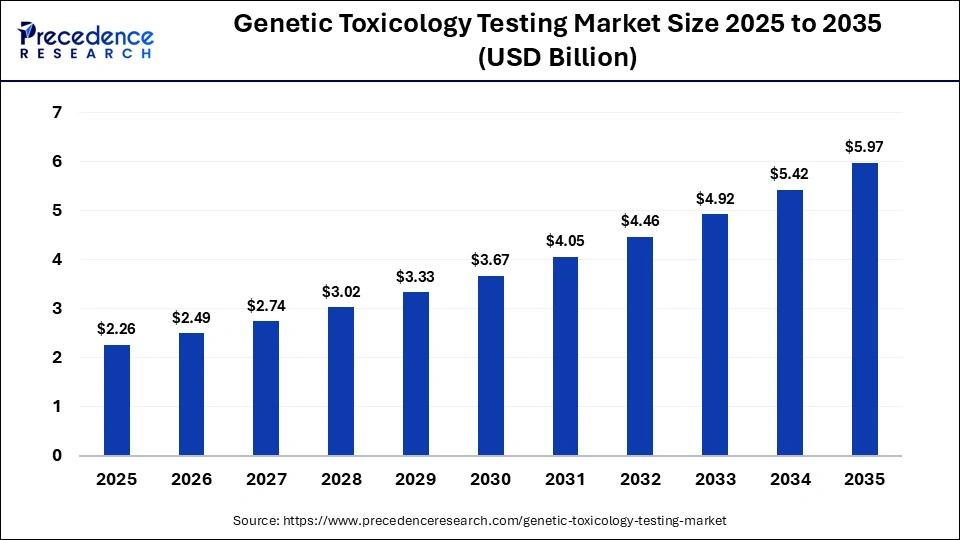
Key Takeaways
- North America led the genetic toxicology testing market in 2025 with approximately 39% share.
- Asia-Pacific is expected to be the fastest-growing region in the forecasted period, with a CAGR of nearly 10.5%.
- By product, the services segment dominated the market with approximately 48% share in 2025.
- By product, the reagents and consumables segment is expected to grow at the fastest CAGR of 8.5% in the market between 2026 and 2035.
- By test type, the in vitro testing segment held a dominant position in the market with a share of approximately 62% in 2025.
- By test type, the in vivo testing segment is expected to grow with the highest CAGR of 8.8% in the market during the studied years.
- By assay type, the comet assay segment registered its dominance over the global genetic toxicology testing market with a share of 41% in 2025.
- By assay type, the genetic mutation test segment is expected to expand rapidly in the market with a CAGR of 9.0% in the coming years.
- By application, the pharmaceutical and biotechnology segment held the largest revenue share of 50% in the market in 2025.
- By application, the food safety testing segment is expected to witness the fastest growth in the market with a CAGR of 9.4% over the forecast period.
- By end-user, the pharmaceutical and biotechnology companies segment contributed the biggest revenue share of 45% in the market in 2025.
- By end-user, the contract research organizations (CROs) segment is expected to gain the highest market share with a CAGR of 9.2% between 2026 and 2035.
Market Overview
Genetic toxicology testing is a critical scientific approach used to evaluate the potential of chemicals, pharmaceuticals, food additives, and environmental substances to cause damage to genetic material, including DNA and chromosomes. These tests are designed to detect mutations, chromosomal aberrations, and other genetic alterations that may lead to cancer or hereditary disorders.
The application of genetic toxicology testing spans across drug development, chemical safety evaluation, and regulatory approval processes. Industries such as pharmaceuticals, biotechnology, food and beverages, and cosmetics rely heavily on these assessments to ensure product safety, regulatory compliance, and consumer protection in accordance with global standards.
Impact of Artificial Intelligence on Genetic Toxicology Testing
Artificial intelligence (AI) is significantly transforming genetic toxicology by enabling faster, more accurate, and cost-effective testing methodologies. The integration of AI into drug discovery and safety assessment processes allows organizations to streamline workflows while aligning with global efforts to reduce animal testing.
Advanced computational and statistical models are increasingly being utilized in this domain. Techniques such as k-nearest neighbors (KNN) help classify chemicals based on similarity to known compounds, while multiple linear regression models predict outcomes using multiple variables. Additionally, the Naïve Bayes classifier applies probabilistic approaches to evaluate toxicity by assuming independence among molecular descriptors.
The primary goal of incorporating AI into genetic toxicology is to enhance predictive accuracy, improve data quality, reduce testing time and costs, and minimize reliance on animal-based studies ultimately enabling more ethical and efficient research practices.
Genetic Toxicology Testing Market Trends
- Rising Demand for Food Safety Assessments: Food safety is emerging as a major focus area within genetic toxicology testing. Increasing consumer demand for clean-label, additive-free, and allergen-free products is driving the need for rigorous testing to ensure that food ingredients do not pose genetic health risks.
- AI-Assisted Predictive Toxicology: The adoption of AI-driven predictive tools and advanced analytical platforms is accelerating across pharmaceutical and biotechnology research. Technologies such as in silico modeling, bioinformatics based screening, and automated assay analysis systems are enhancing the accuracy, efficiency, and reliability of toxicity assessments.
- Environmental Genotoxicity Assessment: Growing concerns over environmental pollution and its impact on human health are driving the application of genetic toxicology testing in environmental monitoring. Techniques such as the micronucleus test are widely used to detect DNA damage caused by industrial chemicals, heavy metals, radiation, and air pollutants. Increasing regulatory focus on environmental safety is further supporting market growth in this segment.
Market Scope
| Report Coverage | Details |
| Market Size in 2025 | USD 2.26 Billion |
| Market Size in 2026 | USD 2.49 Billion |
| Market Size by 2035 | USD 5.97 Billion |
| Market Growth Rate from 2026 to 2035 | CAGR of 10.20% |
| Dominating Region | North America |
| Fastest Growing Region | Asia Pacific |
| Base Year | 2025 |
| Forecast Period | 2026 to 2035 |
| Segments Covered | Product, Assay Type, Application, End-User, and Region |
| Regions Covered | North America, Europe, Asia-Pacific, Latin America, and Middle East & Africa |
Regional Insights
North America holds the largest share of the genetic toxicology testing market, driven by a well-established pharmaceutical and biotechnology industry, along with stringent regulatory frameworks. The United States leads the region with strong adoption of advanced testing methods and early integration of AI-based toxicology solutions. High R&D investments, presence of leading CROs (contract research organizations), and strict safety regulations from agencies such as the FDA are key growth drivers.
Europe represents a significant market, supported by strict regulatory standards for chemical and product safety. Regulations such as REACH (Registration, Evaluation, Authorisation and Restriction of Chemicals) drive the demand for genetic toxicology testing across industries. Countries like Germany, the UK, and France are actively investing in alternative testing methods, including in vitro and AI-based approaches, particularly to reduce animal testing. The region also benefits from strong academic and research collaborations.
Asia-Pacific is the fastest-growing region in the genetic toxicology testing market, fueled by expanding pharmaceutical manufacturing, increasing clinical research activities, and rising awareness of product safety. Countries such as China, India, and Japan are witnessing strong growth due to cost-effective testing services, growing outsourcing trends, and supportive government initiatives. The region’s large population and increasing demand for safe food and healthcare products further accelerate market expansion.
Genetic Toxicology Testing Market Key Players
- Thermo Fisher Scientific
- Charles River Laboratories
- Eurofins Scientific
- SGS SA
- Syngene International
- Inotiv
- Gentronix
- Creative Bioarray
- Toxys
- Xenometrix AG
- MB Research Laboratories
- Nelson Laboratories
- BioRad Laboratories
- Danaher Corporation
- Merck KGaA
Recent Developments
- In January 2026, Variant Bio, a private biotechnology company, introduced an AI-driven platform that analyzed genetic data to identify new drug candidates for advancement into human clinical trials.
- In October 2025, AIG Hospitals introduced a DNA-based drug response test, marking a significant step forward in precision medicine in India. In collaboration with GenepoweRx, the hospital had launched the country’s first affordable pharmacogenomics test, a genetic screening tool that helped doctors identify which medications were likely to be most effective for each patient based on their DNA profile.
- In April 2025, Shed, a wellness solutions company, launched a new line of at-home genetic testing kits designed to provide personalized health insights based on an individual’s DNA analysis. These kits focused on how genetics influenced responses to nutrition, fitness, sleep, and stress management.
Segment Covered in the Report
By Product
- Services
- Assay Kits
- Reagents & Consumables
By Test Type
- In Vitro Testing
- In Vivo Testing
By Assay Type
- Comet Assay
- Micronucleus Assay
- Chromosomal Aberration Test
- Genetic Mutation Test
- Others
By Application
- Pharmaceutical & Biotechnology
- Food Safety Testing
- Cosmetics Safety Testing
- Chemical & Environmental Testing
- Others
By End-User
- Pharmaceutical & Biotechnology Companies
- Contract Research Organizations (CROs)
- Academic & Research Institutes
- Regulatory & Testing Laboratories
By Region
- North America
- Latin America
- Europe
- Asia-pacific
- Middle and East Africa
Get Sample Link: https://www.precedenceresearch.com/sample/8186
Also Read : https://www.businesswebwire.com/ai-in-endoscopy-market/

- Cholestatic Pruritus Market: Advancements in Targeted Therapies Are Transforming Patient Care - June 30, 2026
- Inflammatory Disease Market: Biologic Therapies and Precision Medicine Are Reshaping Patient Care - June 30, 2026
- Retail Cloud Market: Driving the Future of Smart, Connected Retail Operations - June 30, 2026