
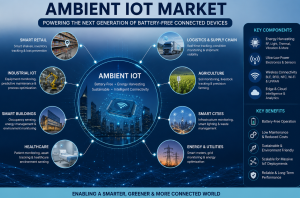
The global is entering a new phase of innovation as industries increasingly adopt battery-free, energy-harvesting devices to support smarter and more sustainable operations. Ambient Internet of Things (Ambient IoT) technology enables connected devices to capture energy from surrounding sources such as radio frequency (RF) signals, light, heat, or motion, eliminating or significantly reducing the need for conventional batteries.
As businesses seek cost-effective, low-maintenance, and environmentally friendly IoT solutions, Ambient IoT is becoming an attractive alternative for applications ranging from retail inventory management and logistics tracking to healthcare monitoring and smart buildings. The technology is expected to reshape the next generation of connected ecosystems by making billions of devices easier to deploy, maintain, and scale.
Ambient IoT Market Size and Forecast 2026 to 2035
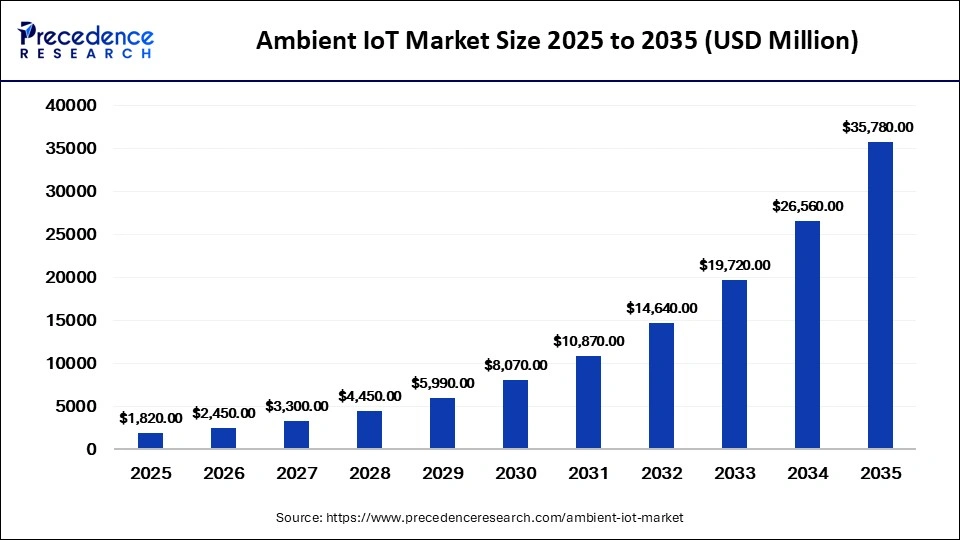
The global ambient IoT market size accounted for USD 1,820.00 million in 2025 and is predicted to increase from USD 2,450.00 million in 2026 to approximately USD 35,780.00 million by 2035, expanding at a CAGR of 34.70% from 2026 to 2035. The market is driven by the need for battery-less energy harvesting, which removes the financial and environmental costs of traditional batteries.
Market Highlights
- North America accounted for the highest revenue share of 39% in the ambient IoT market in 2025.
- Asia-Pacific is expected to grow at the fastest CAGR of 40.6% between 2026 and 2035.
- By device type, the ambient IoT tags segment dominated the market with a share of 42% in 2025 and is expected to grow at the fastest CAGR of 36.8% in the coming years.
- By device type, the ambient IoT sensors segment held the second-largest market share of 31% in 2025.
- By communication technology, the RAIN RFID segment dominated the market with a share of 34% in 2025 and is expected to grow at the fastest CAGR of 38.1% in the coming years.
- By communication technology, the bluetooth low energy (BLE) segment held the second-largest market share of 26% in 2025.
- By power source, the RF energy harvesting segment dominated the ambient IoT market with a share of 38% in 2025 and is expected to grow at the fastest CAGR of 37.2% in the coming years.
- By power source, the solar energy harvesting segment held the second-largest market share in 24% in 2025.
- By application, the asset tracking and monitoring segment held the largest market share of 27% in 2025.
- By application, the retail inventory management segment is expected to grow at the fastest 37.5% CAGR between 2026 and 2035.
- By end-use industry, the retail and e-commerce segment accounted for the highest revenue share of 26% in the market in 2025 and is expected to grow at the highest CAGR of 37.1% during the forecast period.
- By end-use industry, the logistics and transportation segment held the second-largest market share of 22% in 2025.
What Is Ambient IoT?
Ambient IoT refers to a network of ultra-low-power connected devices that operate by harvesting energy from their surrounding environment instead of relying solely on batteries. These devices remain connected for extended periods while consuming minimal energy, making them ideal for large-scale deployments where replacing batteries would be expensive and impractical.
Unlike traditional IoT devices that require regular battery replacement or wired power, Ambient IoT sensors can function autonomously, reducing maintenance costs and improving operational efficiency.
Market Overview
The Ambient IoT market is witnessing significant momentum as organizations accelerate their digital transformation initiatives. Increasing investments in smart infrastructure, industrial automation, and connected supply chains are creating favorable conditions for market expansion.
Advancements in semiconductor technology, ultra-low-power chipsets, wireless communication protocols, and energy-harvesting technologies are making Ambient IoT devices more reliable and commercially viable. In addition, growing sustainability goals are encouraging enterprises to reduce battery waste while improving the efficiency of connected systems.
Governments and technology companies are also investing in smart city projects and intelligent infrastructure, creating additional opportunities for Ambient IoT adoption across transportation, utilities, and public services.
Key Factors Driving the Ambient IoT Market
Rising Demand for Battery-Free IoT Devices
One of the primary drivers of the Ambient IoT market is the growing demand for maintenance-free connected devices. Battery replacement becomes costly and time-consuming when millions of sensors are deployed across warehouses, factories, retail stores, and transportation networks. Ambient IoT addresses this challenge by enabling devices to harvest energy from the surrounding environment.
Growth of Smart Retail
Retailers are increasingly adopting smart labels and connected inventory systems to improve stock visibility and customer experience. Ambient IoT enables real-time tracking of products throughout the supply chain while reducing operational costs associated with battery-powered tracking devices.
Expansion of Industrial Automation
Manufacturing companies are integrating Ambient IoT sensors into production lines to monitor equipment health, temperature, humidity, vibration, and machine performance. Continuous monitoring helps improve predictive maintenance, reduce downtime, and enhance operational efficiency.
Increasing Focus on Sustainability
Organizations worldwide are prioritizing environmentally responsible technologies. Ambient IoT supports sustainability initiatives by minimizing battery consumption, reducing electronic waste, and lowering the environmental impact of large-scale IoT deployments.
Advancements in Wireless Connectivity
The evolution of wireless communication technologies, including Bluetooth Low Energy (BLE), RFID, NFC, Wi-Fi, and emerging 5G networks, is enabling Ambient IoT devices to communicate efficiently while consuming minimal power.
Emerging Market Trends
AI-Powered Edge Intelligence
Artificial intelligence is increasingly being integrated into Ambient IoT devices, allowing sensors to process data locally before transmitting only relevant information. This improves response times while reducing bandwidth and cloud processing costs.
Digital Supply Chain Transformation
Companies are leveraging Ambient IoT to improve product visibility throughout the supply chain. Smart tracking solutions enable real-time monitoring of goods during manufacturing, transportation, and storage, reducing losses and improving inventory accuracy.
Smart Packaging
Manufacturers are developing intelligent packaging equipped with Ambient IoT sensors that can monitor temperature, humidity, freshness, and handling conditions during transportation. These innovations are particularly valuable in pharmaceuticals, food, and healthcare industries.
Smart Buildings
Ambient IoT sensors are helping optimize lighting, HVAC systems, occupancy monitoring, and energy management within commercial buildings. These technologies contribute to improved operational efficiency and lower energy consumption.
Market Challenges
Despite its strong growth potential, the Ambient IoT market faces several challenges.
Standardization remains an ongoing concern as manufacturers continue to develop different communication protocols and energy-harvesting technologies. Achieving interoperability across devices and platforms will be essential for widespread adoption.
Security is another important consideration. As billions of devices become interconnected, protecting sensitive data and ensuring secure communication will remain a top priority for technology providers.
In addition, energy availability may vary depending on deployment environments, making it necessary to optimize device performance under different operating conditions.
Opportunities for Industry Participants
- The Ambient IoT market offers significant opportunities across multiple industries.
- Healthcare providers can deploy battery-free wearable sensors for patient monitoring and asset tracking.
- Retail companies can improve inventory accuracy through smart shelf monitoring and intelligent product labeling.
- Logistics providers can enhance shipment visibility using real-time tracking devices.
- Manufacturers can strengthen predictive maintenance strategies with autonomous industrial sensors.
- Agriculture can benefit from energy-efficient environmental monitoring systems that support precision farming and resource optimization.
- As technology continues to mature, new business models and innovative applications are expected to emerge across both consumer and enterprise markets.
Regional Insights
North America continues to play a leading role in Ambient IoT innovation due to strong investments in semiconductor technology, industrial automation, cloud computing, and smart infrastructure.
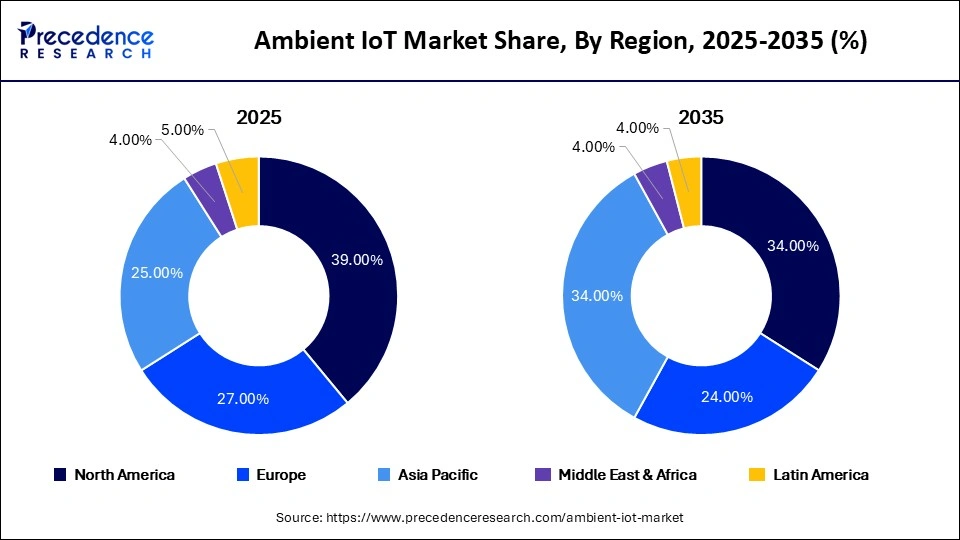
Europe is experiencing steady adoption as governments promote sustainable digital technologies and energy-efficient infrastructure across manufacturing and public services.
Asia Pacific is expected to witness substantial growth, driven by rapid industrialization, expanding electronics manufacturing, smart city initiatives, and increasing deployment of connected devices in countries such as China, Japan, South Korea, and India.
Latin America and the Middle East & Africa are gradually embracing Ambient IoT solutions as organizations modernize logistics, utilities, and industrial operations.
Competitive Landscape
The Ambient IoT market is characterized by continuous innovation and strategic collaborations among semiconductor companies, wireless technology providers, cloud platform developers, and IoT solution providers.
Leading market participants are investing in research and development to improve energy-harvesting capabilities, wireless connectivity, AI integration, and device miniaturization. Partnerships between hardware manufacturers and software companies are accelerating commercialization across multiple industries.
Product launches, acquisitions, and ecosystem collaborations remain common strategies as companies compete to expand their Ambient IoT portfolios and strengthen their global presence.
Ambient IoT Market Companies
- Impinj
- NXP Semiconductors
- Infineon Technologies
- STMicroelectronics
- Texas Instruments
- Nordic Semiconductor
- EM Microelectronic
- Wiliot
- Axzon
- Identiv
- Murata Manufacturing
- Alien Technology
- AMS OSRAM
- Sony Semiconductor Solutions
- Atmosic Technologies
Future Outlook
The future of the Ambient IoT market appears highly promising as organizations increasingly embrace intelligent, battery-free connected technologies. Continued advances in energy harvesting, artificial intelligence, wireless communication, and semiconductor design are expected to unlock new applications across healthcare, retail, logistics, manufacturing, agriculture, and smart cities.
As enterprises continue their digital transformation journeys, Ambient IoT will play an essential role in building scalable, sustainable, and intelligent connected environments. Companies that invest early in Ambient IoT technologies are likely to gain long-term advantages through improved operational efficiency, reduced maintenance costs, enhanced data visibility, and stronger sustainability performance.
Get Our Sample Link : https://www.precedenceresearch.com/sample/8527
Recent Developments
- In January 2026, Afero declared a collaboration with Texas Instruments (TI), the largest analog and embedded-processing semiconductor producer in the U.S., to create a seamless and secure IoT platform for smart home products.
- In January 2026, Tageos announced a strategic partnership with Wiliot, an ambient IoT pioneer, to launch a new passive Bluetooth Low Energy (BLE) inlay, the EOS-654 BLE G3. The inlay was developed to support the large-scale deployment of Wiliot’s Gen3 IoT Pixel sensor and the Wiliot Intelligence Platform.
Segments Covered in the Report
By Device Type
- Ambient IoT Tags
- Ambient IoT Sensors
- Ambient IoT Beacons
- Ambient IoT Gateways
By Communication Technology
- Bluetooth Low Energy (BLE)
- RAIN RFID
- NFC
- Wi-Fi
- LPWAN (LoRa, NB-IoT, LTE-M)
By Power Source
- RF Energy Harvesting
- Solar Energy Harvesting
- Thermal Energy Harvesting
- Piezoelectric Energy Harvesting
- Hybrid Energy Harvesting
By Application
- Asset Tracking and Monitoring
- Supply Chain and Logistics
- Retail Inventory Management
- Smart Buildings
- Industrial Monitoring
- Healthcare Asset Monitoring
By End-use Industry
- Retail and E-commerce
- Logistics and Transportation
- Manufacturing
- Healthcare
- Consumer Electronics
- Automotive
- Others
By Region
- North America
- Latin America
- Europe
- Asia-pacific
- Middle and East Africa
Also Read Our Latest Article : Metabolic Testing Equipment Market

- Cholestatic Pruritus Market: Advancements in Targeted Therapies Are Transforming Patient Care - June 30, 2026
- Inflammatory Disease Market: Biologic Therapies and Precision Medicine Are Reshaping Patient Care - June 30, 2026
- Retail Cloud Market: Driving the Future of Smart, Connected Retail Operations - June 30, 2026