
The global 3D printing medical devices market size is calculated at USD 5.59 billion in 2025 and is predicted to increase from USD 6.60 billion in 2026 to approximately USD 28.07 billion by 2035, expanding at a CAGR of 17.51% from 2026 to 2035.
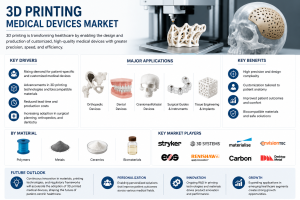
3D Printing Medical Devices Market Overview
The global 3D printing medical devices market is experiencing robust growth as healthcare providers increasingly seek customized, cost-effective, and technologically advanced treatment solutions. The technology is being used across various medical specialties including orthopedics, dentistry, cardiology, craniofacial reconstruction, and surgical planning.
Medical professionals are leveraging 3D printing to create patient-specific implants, prosthetics, dental restorations, hearing aids, surgical instruments, anatomical models, and even bioengineered tissues. As regulatory frameworks become more supportive and material technologies continue to improve, the commercialization of
Get Sample Link: https://www.precedenceresearch.com/sample/3098
3D Printing Medical Devices Market Growth
The market continues to witness significant expansion due to increasing demand for personalized medicine and minimally invasive surgical procedures. Traditional manufacturing methods often struggle to produce customized medical devices quickly and economically. In contrast, 3D printing enables rapid prototyping and low-volume production with exceptional precision, making it particularly valuable for individualized patient care.
Healthcare providers are also recognizing the economic benefits of additive manufacturing. Hospitals can produce surgical models and customized devices on-site, reducing dependency on external suppliers and shortening treatment timelines. As healthcare systems prioritize efficiency, quality, and patient satisfaction, the adoption of 3D printing technologies is expected to grow steadily across both developed and emerging markets.
Key Market Trends
Rise of Personalized Medical Devices: Personalized healthcare has become one of the strongest trends driving market growth. Using patient imaging data from CT and MRI scans, manufacturers can create implants and prosthetics that perfectly match an individual’s anatomy. This customization improves surgical outcomes, reduces complications, and enhances patient comfort.
Increasing Adoption of AI-Powered Design: Artificial intelligence is transforming the design process by automatically optimizing medical device structures for strength, weight, and functionality. AI algorithms can generate highly efficient implant geometries while minimizing material consumption and production time.
Expansion of Hospital-Based 3D Printing Centers: Many hospitals are establishing in-house additive manufacturing laboratories that enable clinicians to produce surgical guides, anatomical models, and customized implants within healthcare facilities. This point-of-care manufacturing approach significantly shortens production cycles and improves collaboration between surgeons and engineers.
3D-printed medical devices is accelerating worldwide.
Benefits of 3D Printing Medical Devices
- Improved Patient Outcomes: Customized devices provide better anatomical fit, increasing treatment effectiveness while reducing complications and improving long-term performance.
- Faster Production: Medical devices can be designed, modified, and manufactured within days instead of weeks or months, accelerating patient treatment.
- Cost Efficiency: Reduced material waste, elimination of expensive tooling, and localized manufacturing lower production costs, particularly for customized products.
- Enhanced Surgical Planning: Anatomical models improve surgical precision, reduce operating room time, and enhance physician confidence during complex procedures.
How 3D Printing is Transforming Personalized Medicine
Personalized medicine focuses on delivering treatments that are tailored to the unique anatomy, genetics, and medical needs of each patient. Traditional manufacturing methods often produce standardized medical devices that may not provide the ideal fit for every individual. In contrast, 3D printing enables the creation of patient-specific implants, prosthetics, surgical guides, and anatomical models using digital imaging data from CT scans, MRI scans, and 3D imaging technologies. This customized approach improves device accuracy, enhances patient comfort, and increases the likelihood of successful treatment outcomes.
The impact of 3D printing extends across multiple medical specialties. Orthopedic surgeons can use customized bone implants that precisely match a patient’s skeletal structure, while dentists can produce crowns, bridges, dentures, and orthodontic aligners with exceptional precision. In reconstructive surgery, patient-specific facial and cranial implants help restore both function and appearance. Additionally, surgeons increasingly rely on 3D-printed anatomical models to rehearse complex procedures before entering the operating room, reducing surgical risks, shortening operation times, and improving patient safety. As personalized healthcare continues to evolve, 3D printing is becoming a key technology in delivering more effective, efficient, and patient-centered medical care.
The Role of Artificial Intelligence in 3D-Printed Medical Devices
Artificial intelligence (AI) is transforming the design, manufacturing, and quality assurance processes of 3D-printed medical devices. AI-powered software analyzes medical imaging data to generate highly accurate digital models of patient anatomy. It can automatically optimize implant designs by improving structural strength, reducing weight, and ensuring a perfect anatomical fit. This reduces the time engineers spend on manual design while increasing precision and manufacturing efficiency.
AI also enhances production quality through predictive analytics and automated quality inspection. Machine learning algorithms monitor printing parameters such as temperature, layer consistency, and material flow to detect defects before they affect the final product. AI-driven predictive maintenance helps manufacturers minimize equipment downtime and maintain consistent production quality. Furthermore, AI integration with cloud-based manufacturing platforms enables faster collaboration between hospitals, designers, and production facilities, allowing customized medical devices to be developed and delivered more quickly. As AI technologies continue to mature, they are expected to play an even greater role in advancing personalized healthcare and accelerating innovation in additive manufacturing.
Advantages of 3D Printing Over Traditional Medical Device Manufacturing
Compared to conventional manufacturing methods such as injection molding, machining, and casting, 3D printing offers significant advantages in flexibility, speed, and customization. One of its greatest strengths is the ability to manufacture highly complex designs without requiring specialized molds or tooling. This reduces production costs for customized and low-volume medical devices while significantly shortening development timelines.
Another major advantage is rapid prototyping. Manufacturers can quickly produce and test multiple design iterations before final production, allowing faster product development and regulatory evaluation. Because additive manufacturing builds objects layer by layer, it minimizes raw material waste compared to subtractive manufacturing processes that remove excess material. Hospitals also benefit from on-demand production of surgical guides, anatomical models, and customized implants, reducing inventory costs and improving treatment efficiency. These advantages make 3D printing an increasingly attractive manufacturing solution for healthcare providers seeking personalized, high-quality, and cost-effective medical devices.
Sustainability in Medical Device Manufacturing Through 3D Printing
Sustainability has become an important priority across the healthcare industry, and 3D printing supports environmentally responsible manufacturing in several ways. Unlike traditional manufacturing methods that often generate significant material waste, additive manufacturing uses only the material required to build the final product. This efficient use of resources reduces waste while lowering overall production costs.
Localized manufacturing further contributes to sustainability by enabling hospitals and regional production centers to manufacture medical devices closer to patients. This reduces transportation requirements, lowers carbon emissions, and shortens supply chains. In addition, ongoing research into biodegradable polymers, recyclable materials, and bio-based printing materials is helping manufacturers reduce their environmental footprint. Advances in energy-efficient 3D printers and optimized production workflows are also improving sustainability without compromising product quality. As healthcare organizations increasingly adopt green manufacturing practices, 3D printing is expected to play a significant role in supporting more sustainable medical device production.
Recent Innovations in 3D Printing Medical Devices (2025–2026)
The 3D printing medical devices industry has experienced significant technological advancements during 2025 and 2026. One of the most notable developments is the growing adoption of AI-integrated design platforms that automatically optimize implant geometry, reduce material consumption, and improve manufacturing accuracy. These intelligent systems enable faster production of customized devices while maintaining high quality standards.
Another major innovation is the expansion of point-of-care manufacturing, where hospitals establish in-house 3D printing facilities to produce anatomical models, surgical guides, and patient-specific devices on demand. Multi-material printing technologies now allow manufacturers to combine different materials within a single medical device, improving mechanical performance and functionality. Researchers are also advancing bioprinting technologies capable of producing increasingly complex tissue structures for regenerative medicine and pharmaceutical research. In addition, metal additive manufacturing has achieved higher precision, enabling the production of durable orthopedic and dental implants with improved surface quality and strength. These innovations are accelerating the adoption of 3D printing across healthcare systems worldwide.
Impact of Robotics and Automation on Medical 3D Printing
Robotics and automation are enhancing every stage of the medical 3D printing workflow, from design preparation to final device production. Automated systems streamline material handling, printer calibration, post-processing, cleaning, and quality inspection, reducing manual intervention and improving production consistency. Robotics also minimizes the risk of human error while increasing manufacturing efficiency and scalability.
In advanced manufacturing facilities, robotic systems work alongside AI-powered software to monitor printing conditions in real time and automatically adjust production parameters when necessary. Automated inspection technologies use computer vision to detect microscopic defects and verify dimensional accuracy before devices reach healthcare providers. Robotics also supports sterile manufacturing environments, particularly for implantable medical devices that require strict contamination control. As automation technologies continue to evolve, they are expected to reduce production costs, improve regulatory compliance, and enable large-scale manufacturing of highly customized medical devices, making advanced healthcare solutions more accessible worldwide.
Read More: Cholestatic Pruritus Market
Applications of 3D Printing Medical Devices
The versatility of 3D printing has enabled its adoption across nearly every medical specialty.
Orthopedic surgeons use patient-specific implants that closely match bone structures, improving implant stability and reducing recovery time. In dentistry, crowns, bridges, dentures, orthodontic aligners, and surgical guides are routinely manufactured using additive manufacturing technologies with exceptional accuracy.
Surgeons also utilize 3D-printed anatomical models for preoperative planning. These realistic models help physicians visualize complex anatomy, practice difficult procedures, and improve communication with patients.
3D Printing Medical Devices Market Regional Analysis
North America
North America dominates the market due to advanced healthcare infrastructure, high healthcare spending, widespread adoption of digital technologies, and strong presence of leading medical device manufacturers. Significant research funding and favorable regulatory developments continue supporting innovation across the region.
Europe
Europe represents another major market driven by increasing investment in medical research, supportive government initiatives, and widespread adoption of personalized healthcare. Countries such as Germany, the United Kingdom, France, Italy, and the Netherlands are expanding additive manufacturing capabilities within hospitals and research institutions.
Asia-Pacific
Asia-Pacific is expected to witness the fastest growth owing to rapidly improving healthcare infrastructure, growing medical tourism, rising healthcare expenditures, and increasing investments in advanced manufacturing technologies. China, Japan, South Korea, India, and Singapore are becoming important centers for medical 3D printing research and commercialization.
Latin America
Healthcare modernization, expanding private healthcare services, and growing awareness of advanced medical technologies are gradually increasing adoption across Latin America. Brazil and Mexico remain the leading contributors to regional growth.
Middle East & Africa
The Middle East and Africa region is steadily adopting additive manufacturing technologies through investments in smart hospitals, digital healthcare initiatives, and specialized medical centers. Government efforts to improve healthcare quality are expected to create new opportunities over the coming years.
3D Printing Medical Devices Market Competitive Landscape
The market is highly competitive, with companies focusing on product innovation, strategic collaborations, mergers and acquisitions, and expansion of material portfolios. Manufacturers are investing heavily in research and development to improve printing speed, accuracy, material compatibility, and regulatory compliance.
Collaboration between hospitals, universities, software developers, and medical device companies is accelerating innovation and enabling faster commercialization of advanced 3D-printed healthcare solutions.
3D Printing Medical Devices Market Future Outlook
The future of the 3D printing medical devices market appears exceptionally promising. Continued advances in artificial intelligence, robotics, digital imaging, biomaterials, and cloud manufacturing will further improve production efficiency and device performance. Point-of-care manufacturing is expected to become increasingly common, allowing hospitals to produce customized medical devices directly within healthcare facilities.
Bioprinting is likely to emerge as one of the most transformative areas of healthcare innovation, with future applications extending beyond tissue models to functional organs and regenerative therapies. As regulatory pathways mature and production costs decline, 3D printing is expected to become a mainstream manufacturing technology across the global medical device industry.
𝐘𝐨𝐮 𝐜𝐚𝐧 𝐩𝐥𝐚𝐜𝐞 𝐚𝐧 𝐨𝐫𝐝𝐞𝐫 𝐨𝐫 𝐚𝐬𝐤 𝐚𝐧𝐲 𝐪𝐮𝐞𝐬𝐭𝐢𝐨𝐧𝐬, 𝐩𝐥𝐞𝐚𝐬𝐞 𝐟𝐞𝐞𝐥 𝐟𝐫𝐞𝐞 𝐭𝐨 𝐜𝐨𝐧𝐭𝐚𝐜𝐭 𝐮𝐬 𝐚𝐭 𝐬𝐚𝐥𝐞𝐬@𝐩𝐫𝐞𝐜𝐞𝐝𝐞𝐧𝐜𝐞𝐫𝐞𝐬𝐞𝐚𝐫𝐜𝐡.𝐜𝐨𝐦
