
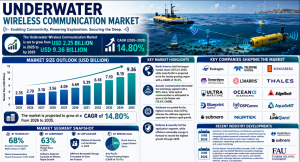
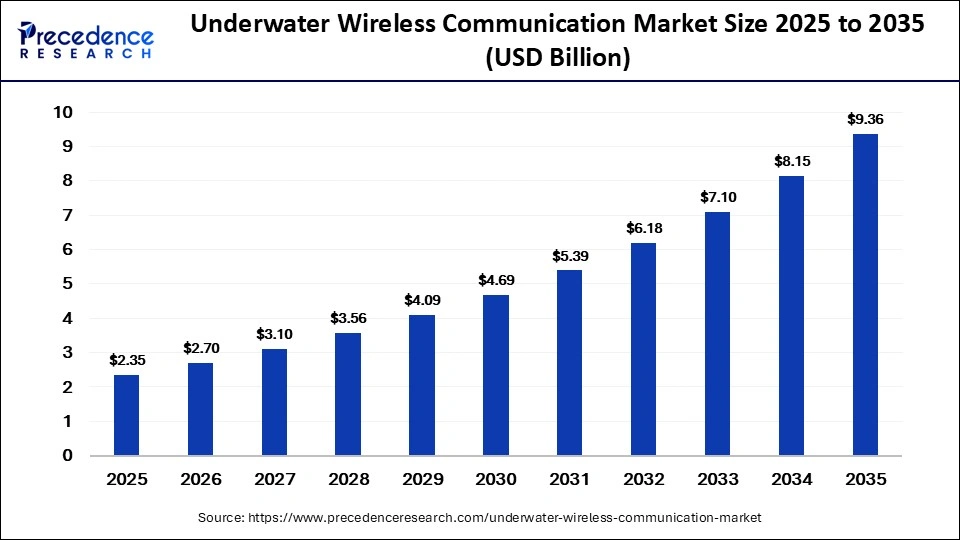
The global underwater wireless communication market size was valued at USD 2.35 billion in 2025 and is projected to increase from USD 2.70 billion in 2026 to approximately USD 9.36 billion by 2035, registering a robust CAGR of 14.80% during the forecast period from 2026 to 2035. The market is witnessing remarkable growth due to the increasing demand for real-time underwater data transmission, growing deployment of autonomous underwater vehicles (AUVs), rising defense modernization initiatives, and expanding offshore energy exploration activities.
Underwater wireless communication has become a critical technology for naval operations, oceanographic studies, subsea infrastructure monitoring, offshore wind farms, and environmental surveillance. Governments, defense agencies, energy companies, and marine research organizations are investing heavily in advanced communication networks capable of delivering secure and reliable connectivity beneath the ocean surface.
Underwater Wireless Communication Market Key Highlights
- The global underwater wireless communication market was valued at USD 2.35 billion in 2025 and is expected to reach USD 9.36 billion by 2035.
- The market is anticipated to expand at a CAGR of 14.80% between 2026 and 2035.
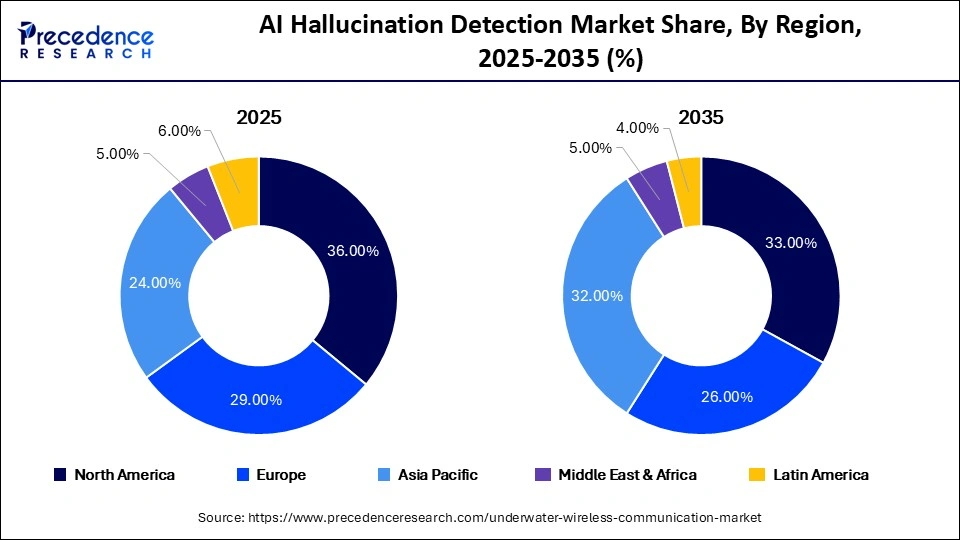
- North America dominated the global market and accounted for 36% of total revenue in 2025.
- Asia Pacific is expected to emerge as the fastest-growing regional market, expanding at a CAGR of 18.4% through 2035.
- Acoustic communication remained the leading technology segment and captured 68% of market revenue in 2025.
- Optical communication is projected to witness the fastest growth, recording a CAGR of 19.8% during the forecast period.
- Hardware solutions generated 63% of the total market revenue in 2025 due to increasing deployment of underwater modems, sensors, and communication equipment.
- Underwater sensor networks represented the largest network type segment with a 34% market share in 2025.
- Defense and security applications accounted for 28% of total market revenue in 2025.
- Defense and military remained the largest end-use industry segment, contributing 32% of global revenue.
Underwater Wireless Communication Market Snapshot
| Metric | Value |
|---|---|
| Market Size 2025 | USD 2.35 Billion |
| Market Size 2026 | USD 2.70 Billion |
| Forecast Market Size 2035 | USD 9.36 Billion |
| CAGR (2026-2035) | 14.80% |
| Dominant Region | North America |
| Fastest Growing Region | Asia Pacific |
| Leading Technology | Acoustic Communication |
| Largest Application | Defense & Security |
| Largest End-Use Industry | Defense & Military |
How is Artificial Intelligence Transforming the Underwater Wireless Communication Market?
Artificial intelligence is rapidly reshaping underwater communication systems by enabling smarter, more energy-efficient, and adaptive communication networks. AI-powered communication protocols can optimize signal transmission, reduce power consumption, and improve network reliability even in harsh underwater environments where signal attenuation and interference remain major challenges.
AI is also supporting the development of intelligent underwater sensor networks capable of autonomous decision-making and real-time data processing. These capabilities are particularly valuable in marine wildlife monitoring, underwater surveillance, offshore asset management, and deep-sea exploration missions. As AI and machine learning technologies mature, they are expected to become fundamental components of next-generation underwater communication infrastructures.
Underwater Wireless Communication Market Growth Drivers
Growing Demand for Advanced Underwater Communication Infrastructure
The growing need for secure and reliable underwater communication systems is one of the primary factors driving market growth. Governments and private organizations are increasingly utilizing underwater communication technologies for naval defense, offshore oil and gas operations, environmental monitoring, and scientific research.
The expansion of underwater robotics and autonomous underwater vehicles is creating additional demand for advanced communication networks capable of supporting long-range and real-time data transmission.
Rising Investments in Defense and Maritime Security
Maritime nations across the globe are strengthening naval capabilities and underwater surveillance systems to address evolving geopolitical threats. Underwater wireless communication plays a crucial role in anti-submarine warfare, autonomous naval systems, and secure underwater intelligence operations.
Expansion of Offshore Energy Projects
The rapid growth of offshore wind farms, subsea cable networks, and deep-water oil and gas exploration activities is accelerating demand for reliable underwater connectivity solutions. Operators require continuous monitoring and communication systems to improve operational efficiency and reduce maintenance costs.
Underwater Wireless Communication Market Opportunities
Ongoing research into 6G communication technologies is creating new possibilities for underwater connectivity. Researchers are exploring advanced networking architectures that can seamlessly integrate underwater, terrestrial, and satellite communication systems. These developments could significantly improve communication speed, reliability, and coverage in underwater environments.
The emergence of underwater Internet of Things (IoT) ecosystems is expected to transform ocean monitoring and maritime operations. Smart oceans powered by interconnected sensors, underwater drones, and AI-enabled communication networks will create significant opportunities across marine research, environmental monitoring, and offshore energy sectors.
The increasing deployment of AUVs for defense reconnaissance, subsea inspection, environmental monitoring, and scientific exploration is expected to generate substantial demand for high-performance underwater communication systems over the next decade.
Underwater Wireless Communication Market Trends
Advanced Signal Processing Technologies Gain Momentum
Market participants are increasingly adopting advanced modulation formats such as OFDM-QAM combinations, adaptive beamforming, forward error correction, and intelligent signal processing techniques to improve communication reliability in complex underwater environments.
Swarm AUV Networks are Becoming Reality
The integration of swarm AUVs with underwater IoT platforms is emerging as a major technological trend. These collaborative autonomous systems are enabling more efficient exploration, surveillance, and underwater monitoring missions.
Electromagnetic Communication Systems Gain Defense Interest
Defense agencies are exploring electromagnetic communication technologies to enhance submarine-to-command-center connectivity and secure underwater communication networks.
Underwater Wireless Communication Market Segmentation
Technology Insights
The acoustic communication segment accounted for 68% of the market share in 2025 due to its reliable long-range underwater communication capabilities and widespread adoption in defense applications. Growing deployment of ocean monitoring systems and underwater sensor networks further strengthened the segment’s leadership.
The optical communication segment held 21% of the market share in 2025 and is projected to grow at the fastest CAGR of 19.8% from 2026 to 2035. High-speed data transmission, increasing use in underwater robotics, and rising demand for real-time video communication are driving its growth.
The radio frequency communication segment represented 11% of the market in 2025 and is expected to expand at a CAGR of 11.1%. Demand for short-range underwater communication, shallow-water applications, and hybrid communication systems continues to support market growth.
Component Insights
The hardware segment dominated the market with 63% of the revenue share in 2025. Increasing deployment of underwater modems, sensor networks, autonomous underwater vehicles (AUVs), remotely operated vehicles (ROVs), and offshore communication infrastructure fueled its growth.
The software segment captured 18% of the market share in 2025 and is expected to register the highest CAGR of 17.4%. Growth is driven by AI-powered communication optimization, underwater data analytics, and advanced network management platforms.
The services segment accounted for 19% of the market in 2025 and is projected to grow at a CAGR of 15.8%. Rising demand for system integration, subsea network maintenance, and lifecycle support services is boosting adoption.
Network Type Insights
Underwater sensor networks held the largest market share of 34% in 2025. Increasing investments in environmental monitoring, offshore surveillance, disaster prevention, and smart ocean initiatives are driving segment growth.
The AUV communication segment represented 27% of the market in 2025 and is forecast to grow at a CAGR of 18.3%. Rising deployment of autonomous marine systems for defense, offshore inspection, and deep-sea exploration supports its expansion.
The ROV communication segment captured 23% of the market share in 2025 and is expected to grow at a CAGR of 13.1%. Growth is supported by offshore oil and gas inspections, subsea maintenance, and underwater infrastructure projects.
Application Insights
The defense and security segment accounted for 28% of the market share in 2025. Increasing naval modernization programs, underwater surveillance requirements, and anti-submarine warfare capabilities continue to drive demand.
The oil and gas exploration segment held 24% of the market in 2025 and is projected to grow at a CAGR of 11.6%. Offshore exploration, subsea asset monitoring, and deepwater developments remain key growth drivers.
The offshore renewable energy segment accounted for 8% of the market share in 2025 and is expected to expand at the highest CAGR of 20.1%. Rapid offshore wind development and increasing subsea cable monitoring are accelerating market growth.
End-Use Industry Insights
The defense and military segment dominated with 32% of the market share in 2025. Rising naval communication modernization, maritime surveillance, and underwater defense initiatives continue to strengthen market demand.
The oil and gas segment captured 26% of the market share in 2025 and is expected to grow at a CAGR of 11.9%. Increasing offshore exploration and demand for reliable subsea monitoring systems support segment growth.
The energy and utilities segment held 11% of the market in 2025 and is projected to grow at the fastest CAGR of 19.3%. Expansion of offshore renewable energy projects and increasing subsea infrastructure monitoring are key growth drivers.
Underwater Wireless Communication Market Regional Analysis
North America Dominated the Global Market
North America accounted for 36% of the global market share in 2025. Strong investments in naval modernization, underwater sensor networks, offshore energy infrastructure, and marine research continue to support regional leadership.
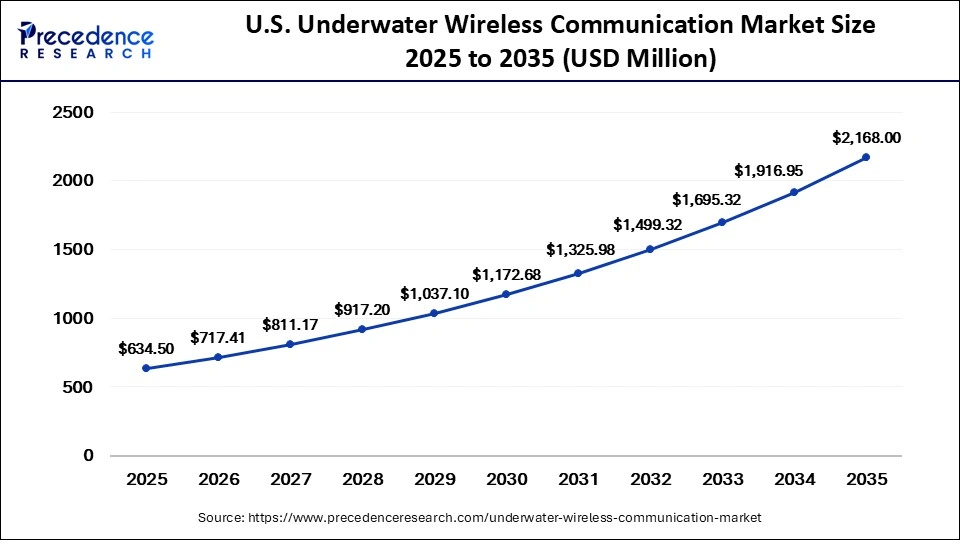
The U.S. market was valued at USD 634.50 million in 2025 and is projected to reach USD 2,168.00 million by 2035, growing at a CAGR of 13.1%. Advanced digital infrastructure, strong defense investments, and widespread adoption of underwater communication technologies are driving growth.
Asia-Pacific to Register the Fastest Growth
Asia-Pacific held 24% of the market share in 2025 and is expected to grow at the fastest CAGR of 18.4%. Rising defense spending, offshore oil and gas exploration, underwater drone deployment, and marine research investments are fueling regional expansion.
China remains a key contributor, supported by increasing investments in autonomous technologies, AI-enabled systems, and advanced marine communication infrastructure.
Europe Shows Steady Growth
Europe accounted for 29% of the market share in 2025 and is expected to grow at a CAGR of 13.8% through 2035. Offshore wind projects, maritime surveillance initiatives, and oceanographic research investments continue to drive demand.
Germany is witnessing steady growth due to strong R&D activities, the presence of leading industry players, and increasing deployment of subsea monitoring technologies.
Middle East & Africa Witnesses Growing Adoption
The Middle East & Africa represented 5% of the market in 2025 and is projected to grow at a CAGR of 14.5%. Offshore hydrocarbon exploration, subsea infrastructure monitoring, and naval security investments are supporting market expansion.
The UAE is experiencing notable growth, driven by offshore energy developments, rising adoption of underwater communication technologies, and supportive government initiatives.
Latin America Continues to Expand
Latin America accounted for 6% of the market share in 2025 and is expected to grow at a CAGR of 13.7%. Increasing offshore oil field development, marine environmental monitoring, and subsea communication projects are contributing to regional growth.
Brazil remains a leading regional market, supported by expanding oceanographic research activities and increasing demand for underwater inspection and monitoring solutions.
Key Companies in the Underwater Wireless Communication Market: 2025 Revenue and Offerings
EvoLogics
Estimated 2025 Revenue: USD 25–35 Million
EvoLogics provides advanced underwater acoustic modems, underwater wireless communication networks, S2C (Sweep-Spread Carrier) communication technology, subsea positioning systems, autonomous underwater vehicle (AUV) communication solutions, and marine IoT connectivity platforms for offshore and research applications.
Teledyne Marine
Estimated 2025 Revenue: USD 1.8–2.0 Billion
Teledyne Marine provides acoustic communication modems, underwater navigation and positioning systems, subsea data transmission technologies, autonomous underwater vehicle communication solutions, sonar-integrated communication platforms, and marine monitoring systems for defense, offshore energy, and oceanographic research.
Kongsberg Maritime
Estimated 2025 Revenue: USD 4.5–5.0 Billion (Maritime Segment)
Kongsberg Maritime offers underwater acoustic communication systems, subsea positioning technologies, autonomous underwater vehicle communication platforms, offshore digital communication infrastructure, and ocean monitoring solutions that support subsea operations and maritime autonomy.
Sonardyne International
Estimated 2025 Revenue: USD 180–250 Million
Sonardyne International provides underwater acoustic modems, long-range subsea communication systems, underwater positioning technologies including USBL and LBL systems, marine telemetry solutions, and underwater sensor networking platforms for offshore and defense applications.
L3Harris Technologies
Estimated 2025 Revenue: USD 21–22 Billion
L3Harris Technologies provides military-grade underwater communication systems, secure acoustic networking technologies, autonomous maritime communication platforms, naval sonar communication solutions, and advanced subsea wireless communication systems for defense and security missions.
Thales
Estimated 2025 Revenue: USD 23–24 Billion
Thales offers underwater communication systems for naval and defense applications, sonar-enabled communication technologies, underwater surveillance networks, secure acoustic communication solutions, and subsea data transmission systems designed for maritime security operations.
Ultra Maritime
Estimated 2025 Revenue: USD 1.1–1.3 Billion
Ultra Maritime provides underwater acoustic communication systems, submarine communication technologies, anti-submarine warfare communication solutions, sonar-integrated networking systems, and underwater data links that support naval and defense missions.
OceanAlpha
Estimated 2025 Revenue: USD 120–180 Million
OceanAlpha provides communication systems for autonomous surface and underwater vehicles, marine wireless networking technologies, environmental monitoring communication platforms, and connectivity solutions that enable unmanned marine operations.
EdgeTech
Estimated 2025 Revenue: USD 40–60 Million
EdgeTech offers underwater acoustic telemetry systems, sonar communication interfaces, subsea survey communication technologies, and integrated underwater monitoring solutions that facilitate data transfer and marine exploration activities.
Blueprint Subsea
Estimated 2025 Revenue: USD 20–35 Million
Blueprint Subsea provides SeaTrac acoustic modems, underwater wireless communication systems, diver communication technologies, acoustic positioning solutions, and subsea tracking systems used in offshore, scientific, and defense applications.
DSPComm
Estimated 2025 Revenue: USD 5–10 Million
DSPComm provides underwater acoustic modems, subsea wireless data communication devices, low-power acoustic telemetry systems, and customized marine communication solutions designed for underwater monitoring and research operations.
AquaSeNT
Estimated 2025 Revenue: USD 3–8 Million
AquaSeNT offers compact underwater acoustic modems, subsea communication systems, underwater sensor network connectivity solutions, and autonomous vehicle communication technologies that enable reliable underwater data exchange.
Subnero
Estimated 2025 Revenue: USD 5–15 Million
Subnero provides underwater wireless sensor networks, acoustic communication modems, underwater Internet of Things (IoUT) platforms, autonomous marine communication systems, and subsea data networking technologies for smart ocean applications.
Nortek
Estimated 2025 Revenue: USD 120–180 Million
Nortek offers acoustic Doppler technologies integrated with underwater telemetry systems, oceanographic data communication solutions, subsea monitoring platforms, and marine research equipment that supports underwater data collection and transmission.
LinkQuest
Estimated 2025 Revenue: USD 5–12 Million
LinkQuest provides underwater acoustic modems, acoustic telemetry systems, underwater wireless networking solutions, subsea sensor communication technologies, and autonomous underwater vehicle communication systems for scientific, commercial, and defense applications.
Recent Industry Developments
HydroSurv and Subnero Partnership (June 2026)
HydroSurv and Subnero partnered to demonstrate autonomous subsea communication networks combining unmanned surface vessels with advanced acoustic networking technologies.
Florida Atlantic University Receives AUKUS Funding (June 2026)
Florida Atlantic University secured a USD 1 million award through the AUKUS Maritime Innovation Challenge to develop next-generation underwater communication systems capable of enabling faster, more secure communication among autonomous underwater platforms.
Segments Covered in the Report
By Technology
- Acoustic Communication
- Optical Communication
- Radio Frequency Communication
By Component
- Hardware
- Software
- Services
By Network Type
- Underwater Sensor Networks
- Autonomous Underwater Vehicle (AUV) Communication
- Remotely Operated Vehicle (ROV) Communication
- Diver Communication Systems
By Application
- Environmental Monitoring
- Oil & Gas Exploration
- Defense & Security
- Scientific Research
- Offshore Renewable Energy
- Underwater Robotics & Inspection
By End-use Industry
- Defense & Military
- Oil & Gas
- Marine Research Institutes
- Energy & Utilities
- Commercial Marine
- Others
By Region
- North America
- Latin America
- Europe
- Asia-pacific
- Middle and East Africa
Read Also: Wind Turbine Market Size to Attain USD 339.43 Billion by 2035
Get this report to explore global market size, share, CAGR, and trends, featuring detailed segmental analysis and an insightful competitive landscape overview @ https://www.precedenceresearch.com/sample/8509
You can place an order or ask any questions. Please feel free to contact us at sales@precedenceresearch.com |+1 804 441 9344

- Underwater Wireless Communication Market Expands at 14.80% CAGR Amid Rising Investments in Naval Security, Marine Research, Autonomous Underwater Vehicles, and Offshore Renewable Energy - June 23, 2026
- Implantable Sensor Orthopedic Market Size to Reach USD 13.17 Billion by 2035 as AI-Powered Smart Implants Transform Orthopedic Care - June 19, 2026
- U.S. Pharmaceutical Excipients Market Size to Reach USD 5.58 Billion by 2035 Amid Rising Demand for Biologics and Advanced Drug Formulations - June 18, 2026