
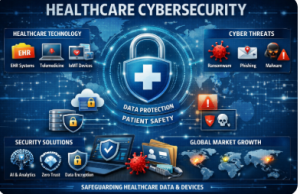
The global healthcare cybersecurity market was valued at USD 31.90 billion in 2025 and is projected to reach approximately USD 142.45 billion by 2035, growing at a CAGR of 16.12% from 2026 to 2035. Market growth is being driven by increasing regulatory compliance requirements, rising cyber threats, and the rapid adoption of Internet of Medical Things (IoMT) devices and cloud-based healthcare solutions.
What is Healthcare Cybersecurity?
Healthcare cybersecurity refers to the technologies, strategies, and practices used to protect healthcare systems, networks, medical devices, and patient information from cyber threats. As hospitals, clinics, pharmaceutical companies, and healthcare providers increasingly rely on digital technologies, cybersecurity has become a critical part of healthcare operations.
Healthcare organizations manage vast amounts of sensitive data, including patient medical records, insurance information, financial details, and personal identification data. This information is highly valuable and often targeted by cybercriminals. Healthcare cybersecurity helps prevent unauthorized access, data breaches, ransomware attacks, and other cyber incidents that can disrupt healthcare services and compromise patient privacy
Get Sample Link: https://www.precedenceresearch.com/sample/1739
Why Healthcare Needs Strong Cybersecurity
The healthcare industry is one of the most targeted sectors for cyberattacks. Unlike many other industries, healthcare organizations store highly sensitive personal and medical information that can be exploited for identity theft, insurance fraud, and financial crimes. As healthcare systems become more digital, the risks associated with cyber threats continue to grow.
Strong cybersecurity is essential because cyberattacks can have serious consequences beyond financial losses. A successful attack can prevent doctors and nurses from accessing patient records, delay medical procedures, disrupt hospital operations, and even affect patient safety. In emergency situations, uninterrupted access to healthcare systems can be a matter of life and death.
Digital Healthcare and New Security Challenges
Digital healthcare solutions have transformed how healthcare providers interact with patients. Telemedicine platforms allow remote consultations, wearable devices continuously monitor patient health, and cloud-based systems enable seamless access to medical information.
While these innovations improve healthcare delivery, they also expand the number of potential entry points for cyberattacks. Every connected device, application, and cloud platform increases the attack surface that security teams must protect.
One major challenge is the rapid growth of the Internet of Medical Things (IoMT). Connected devices such as infusion pumps, heart monitors, imaging systems, and wearable sensors often operate on complex networks. Many older medical devices were not originally designed with strong cybersecurity protections, making them vulnerable to attacks.
Benefits of Investing in Healthcare Cybersecurity
Investing in healthcare cybersecurity offers numerous benefits for healthcare providers, patients, and other stakeholders. One of the most important advantages is the protection of sensitive patient information. Strong cybersecurity measures reduce the likelihood of data breaches and help maintain patient privacy.
Cybersecurity investments also improve operational resilience. Healthcare organizations with strong security frameworks are better prepared to prevent attacks, minimize disruptions, and recover quickly from incidents. This helps ensure that healthcare services remain available when patients need them most.
The Role of Artificial Intelligence in Cybersecurity
Artificial intelligence is transforming cybersecurity across the healthcare industry. Traditional security systems often struggle to keep pace with sophisticated cyber threats, but AI-powered solutions can analyze vast amounts of data and identify unusual patterns in real time.
Machine learning algorithms continuously learn from network activity and user behavior. This allows AI systems to recognize anomalies that may indicate ransomware attacks, compromised accounts, or insider threats.
Read Also: Medical Device Testing Market
How Technology is Improving Healthcare Security
Technology is playing a vital role in strengthening healthcare cybersecurity.
Cloud Security Solutions: As healthcare organizations migrate applications and patient data to the cloud, cloud security has become a major investment area. Market analysts expect cloud security to be among the fastest-growing segments of the healthcare cybersecurity market.
Cloud security platforms provide:
- Data encryption
- Identity management
- Continuous monitoring
- Threat detection
- Access control
Multi-Factor Authentication (MFA): MFA requires users to verify their identity through multiple methods before accessing systems. This simple but effective security measure significantly reduces unauthorized access risks.
Advanced Threat Detection: Modern cybersecurity platforms continuously monitor healthcare networks and identify suspicious activities in real time. These systems help organizations respond quickly to potential threats before they cause significant damage.
Regional Market Analysis
North America
North America dominates the healthcare cybersecurity market, accounting for approximately 41% of global market revenue. Strong healthcare IT infrastructure, strict regulations, and rising cyberattack incidents contribute to the region’s leadership position.
Europe
Europe continues to experience strong market growth due to GDPR compliance requirements, increasing healthcare digitization, and growing investments in cybersecurity infrastructure.
Asia-Pacific
Asia-Pacific is expected to be the fastest-growing regional market. Rapid adoption of digital healthcare systems, telemedicine services, and cloud technologies is driving demand for cybersecurity solutions across the region.
Future of Cybersecurity in Healthcare
The future of healthcare cybersecurity will be shaped by continued digital transformation, technological innovation, and evolving cyber threats. As healthcare organizations adopt more connected devices, cloud-based systems, and AI-powered applications, cybersecurity will become even more important.
Future security strategies are expected to rely heavily on artificial intelligence, predictive analytics, and automated threat response technologies. These tools will help organizations identify risks before attacks occur and respond more effectively to emerging threats.
𝐘𝐨𝐮 𝐜𝐚𝐧 𝐩𝐥𝐚𝐜𝐞 𝐚𝐧 𝐨𝐫𝐝𝐞𝐫 𝐨𝐫 𝐚𝐬𝐤 𝐚𝐧𝐲 𝐪𝐮𝐞𝐬𝐭𝐢𝐨𝐧𝐬, 𝐩𝐥𝐞𝐚𝐬𝐞 𝐟𝐞𝐞𝐥 𝐟𝐫𝐞𝐞 𝐭𝐨 𝐜𝐨𝐧𝐭𝐚𝐜𝐭 𝐮𝐬 𝐚𝐭 𝐬𝐚𝐥𝐞𝐬@𝐩𝐫𝐞𝐜𝐞𝐝𝐞𝐧𝐜𝐞𝐫𝐞𝐬𝐞𝐚𝐫𝐜𝐡.𝐜𝐨𝐦
