
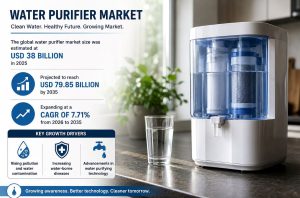
The global water purifier market is projected to grow from USD 40.96 billion in 2026 to approximately USD 79.85 billion by 2035, expanding at a CAGR of 7.71% during the forecast period. Rising concerns regarding water pollution, increasing prevalence of water-borne diseases, rapid urbanization, and continuous technological advancements in purification systems are driving the growth of the global market.
Water purification has become a critical component of modern healthcare and household safety. Increasing awareness about safe drinking water, government initiatives to improve water quality, growing industrialization, and the expansion of smart purification technologies are accelerating the adoption of advanced water purification systems across residential, commercial, and industrial sectors.
Water Purifier Market Overview
Water purifiers are advanced filtration systems designed to remove harmful contaminants, sediments, heavy metals, chemicals, bacteria, viruses, and other microorganisms from drinking water. These systems improve water quality, taste, and odor while ensuring safe consumption for households, commercial establishments, and industrial facilities. Modern water purification technologies utilize multiple purification methods including Reverse Osmosis (RO), Ultraviolet (UV), Ultrafiltration (UF), Activated Carbon Filtration, Nano Filtration, and gravity-based purification systems. These technologies work together to eliminate physical, chemical, and biological contaminants while preserving essential minerals required for healthy drinking water.
The increasing deterioration of natural water resources due to industrial pollution, agricultural runoff, aging water infrastructure, and rapid urbanization has significantly increased the demand for advanced water purification solutions worldwide. Consumers are becoming more conscious of the long-term health risks associated with contaminated drinking water, encouraging greater investment in home and commercial water purification systems.
Water Purifier Market Size & Forecast
| Year | Market Size (USD Billion) |
|---|---|
| 2025 | 38.00 |
| 2026 | 40.96 |
| 2035 | 79.85 |
CAGR (2026-2035): 7.71%
The market is expected to witness steady growth throughout the forecast period due to increasing awareness regarding water quality, expanding urban populations, rising disposable incomes, growing investments in smart home technologies, and stringent government regulations promoting access to safe drinking water.
Download the Sample: https://www.precedenceresearch.com/sample/2975
What is the Role of AI in the Water Purifier Market?
- Artificial Intelligence (AI) is transforming the global water purifier market by enabling smarter, more efficient, and highly automated purification systems. AI-powered water purifiers continuously monitor water quality using advanced sensors that analyze Total Dissolved Solids (TDS), pH levels, turbidity, temperature, pressure, and contaminant concentrations in real time.
- Machine learning algorithms enable purification systems to automatically adjust filtration intensity based on incoming water quality. This ensures optimal purification while reducing unnecessary energy consumption and minimizing water wastage.
- AI also enhances predictive maintenance by monitoring filter performance and identifying wear before system failures occur. Intelligent notification systems automatically remind users when filters require replacement or servicing, improving overall system reliability and extending equipment lifespan.
- Furthermore, AI-powered mobile applications provide consumers with real-time insights into water quality, purification performance, daily water consumption, and maintenance schedules. Cloud-based monitoring allows manufacturers and service providers to deliver remote diagnostics and faster customer support.
- As smart home adoption continues to increase globally, AI-enabled purification systems are expected to become a standard feature within premium residential and commercial water treatment solutions.
Key Applications of AI in Water Purification
- Real-time water quality monitoring
- Automated filtration optimization
- Predictive maintenance and filter replacement alerts
- Smart leak detection
- Water usage analytics
- IoT-enabled remote monitoring
- Energy consumption optimization
- Contaminant detection and classification
- Automated system diagnostics
- Mobile application integration
- Cloud-based performance management
- Personalized purification settings
- Intelligent maintenance scheduling
Key Growth Drivers Fueling Market Expansion
- Rising Water Pollution Levels: Rapid industrialization, mining activities, agricultural runoff, and urban expansion continue to contaminate freshwater resources worldwide. Heavy metals, pesticides, industrial chemicals, pharmaceutical residues, and biological contaminants have significantly increased demand for advanced water purification technologies capable of delivering safe drinking water.
- Growing Health Awareness: Consumers are becoming increasingly aware of the health risks associated with contaminated water, including gastrointestinal infections, cholera, typhoid, hepatitis, dysentery, and other waterborne diseases. This growing awareness has encouraged households to invest in advanced purification systems that provide cleaner and healthier drinking water.
- Increasing Urbanization: Rapid urban population growth is placing enormous pressure on municipal water infrastructure. Aging pipelines, inconsistent water quality, and rising pollution levels are encouraging urban households and businesses to install reliable water purification systems.
- Rising Disposable Income: Economic growth across emerging economies has significantly increased household purchasing power. Consumers are increasingly investing in premium home appliances, including technologically advanced water purification systems equipped with smart monitoring and energy-efficient features.
- Expansion of Commercial Applications: Hotels, hospitals, restaurants, educational institutions, corporate offices, manufacturing facilities, and healthcare organizations are increasingly deploying commercial water purification systems to comply with stringent water quality regulations and ensure public health and safety.
Government Initiatives Supporting Market Growth
- Governments across the globe continue to implement large-scale initiatives aimed at improving drinking water quality, sanitation infrastructure, and public health.
- Programs promoting universal access to safe drinking water, wastewater recycling, groundwater conservation, and sustainable water management are creating favorable conditions for market growth.
- Several countries are investing heavily in upgrading aging water infrastructure, expanding rural water supply networks, and strengthening regulations governing industrial wastewater discharge. These initiatives are encouraging households, municipalities, and businesses to adopt advanced purification technologies.
- International organizations such as the United Nations continue supporting Sustainable Development Goal (SDG 6), which focuses on ensuring universal access to clean water and sanitation by promoting investments in water purification infrastructure and innovative treatment technologies.
Major Trends Shaping the Water Purifier Market
Smart Water Purification Systems
- Manufacturers are increasingly launching IoT-enabled water purifiers capable of monitoring purification performance, filter life, water consumption, and water quality through connected smartphone applications.
Multi-Stage Filtration Technologies
- Consumers increasingly prefer purification systems combining Reverse Osmosis, UV sterilization, Ultrafiltration, Activated Carbon, and Mineral Enhancement technologies to achieve superior purification performance.
Sustainable Water Purification
- Manufacturers are developing environmentally friendly purification systems that minimize wastewater generation, reduce electricity consumption, and utilize recyclable filter materials to support global sustainability objectives.
Growing Adoption of Countertop and Compact Systems
- Urban consumers increasingly prefer compact purification systems that require minimal installation space while delivering high-performance water treatment capabilities.
Integration with Smart Homes
- Water purifiers are becoming integral components of connected smart homes, integrating seamlessly with digital assistants, home automation platforms, and cloud-based monitoring systems for improved convenience and energy management.
Water Purifier Market Challenges
Despite robust growth prospects, the global water purifier market faces several challenges that may affect widespread adoption and long-term market expansion.
High Maintenance and Replacement Costs
- One of the primary barriers to market growth is the recurring cost of maintenance. Most water purification systems require periodic replacement of filters, membranes, UV lamps, and other consumable components to maintain purification efficiency. Reverse osmosis (RO) systems, in particular, involve higher maintenance expenses due to membrane replacement and regular servicing. These ongoing costs can discourage adoption among price-sensitive consumers, especially in developing economies.
Water Wastage in RO Systems
- Traditional RO water purifiers generate a significant amount of wastewater during the purification process. Growing concerns regarding water conservation have led consumers and regulators to question the sustainability of conventional RO technologies. Manufacturers are therefore under pressure to develop water-saving purification systems with higher recovery rates.
Limited Consumer Awareness in Rural Areas
- Although awareness regarding clean drinking water has improved significantly, many rural and underserved communities still lack adequate knowledge about advanced purification technologies and their long-term health benefits. Limited purchasing power and insufficient distribution networks also restrict product penetration in these regions.
Counterfeit and Low-Quality Products
- The availability of low-cost, counterfeit, and uncertified water purifiers in several developing markets creates challenges for established manufacturers. Inferior products often fail to deliver effective purification, affecting consumer confidence and market credibility.
Regulatory Compliance
- Manufacturers must comply with evolving international and regional regulations related to water quality standards, product safety, environmental sustainability, and energy efficiency. Adapting to changing certification requirements often increases production and compliance costs.
Benefits of Using a Water Purifier
A water purifier helps provide safe drinking water by removing harmful contaminants such as bacteria, viruses, heavy metals, chlorine, pesticides, and other impurities. Advanced purification technologies like Reverse Osmosis (RO), Ultraviolet (UV), and Activated Carbon filtration improve water quality while enhancing its taste and odor. Drinking purified water can reduce the risk of waterborne diseases, support better digestion, strengthen the immune system, and promote overall health for people of all ages.
In addition to health benefits, water purifiers offer convenience and long-term cost savings compared to regularly purchasing bottled water. Modern smart water purifiers also feature real-time water quality monitoring, filter replacement alerts, and energy-efficient operation, making them easy to maintain and use. As awareness of clean drinking water continues to grow, water purifiers have become an essential appliance for homes, offices, schools, hospitals, and commercial establishments worldwide.
Water Purifier Market Opportunities
The market continues to offer substantial opportunities for manufacturers, technology providers, investors, and service companies.
- Expansion of Smart Water Purification: The growing popularity of connected homes is creating significant opportunities for AI-powered and IoT-enabled water purification systems. Smart monitoring, predictive maintenance, and mobile connectivity are becoming important purchasing considerations for consumers worldwide.
- Growing Demand in Emerging Economies: Rapid urbanization, rising disposable incomes, and expanding middle-class populations across Asia Pacific, Latin America, the Middle East, and Africa are generating strong demand for affordable and technologically advanced water purification systems.
- Industrial Water Treatment: Industrial sectors including pharmaceuticals, food & beverage, electronics, chemicals, power generation, and manufacturing require highly purified water for production processes. Increasing industrial water treatment investments are opening attractive opportunities for commercial purification solution providers.
- Sustainable Water Management: Governments and industries are investing heavily in sustainable water management solutions, creating opportunities for energy-efficient purification technologies, water recycling systems, and environmentally friendly filtration materials.
- Subscription and Service-Based Business Models: Several manufacturers are introducing subscription-based maintenance services, annual maintenance contracts (AMCs), filter replacement programs, and rental-based purification models that improve customer retention while generating recurring revenue.
Why the Water Purifier Market is Growing
The water purifier market is growing due to increasing concerns about water pollution, rising cases of waterborne diseases, and greater awareness of the importance of safe drinking water. Rapid urbanization, industrial pollution, and aging water infrastructure have affected water quality in many regions, encouraging households and businesses to invest in reliable purification systems. Governments are also promoting clean water initiatives and improving water safety standards, further supporting market growth.
Technological advancements are another major factor driving the market. Modern water purifiers now feature smart technologies such as AI-based monitoring, IoT connectivity, real-time water quality tracking, and energy-efficient filtration systems. In addition, rising disposable incomes, growing health consciousness, and the expanding demand for clean water in residential, commercial, and industrial sectors are accelerating the adoption of advanced water purification solutions worldwide.
Recent Developments in the Water Purifier Market
- February 2026: Samsung introduced its Bespoke AI Series Water Purifier, featuring artificial intelligence, touchscreen controls, integrated Bixby functionality, smart monitoring, and automatic ice dispensing capabilities.
- May 2026: Xiaomi expanded its smart home portfolio by launching the Mi Home Water Purifier 2 (1600G), offering higher flow rates, improved purification efficiency, and permanent installation for modern connected homes.
- May 2025: SK Magic introduced the SK Magic X PSG Ultra-Compact Direct Water Purifier, developed in collaboration with Paris Saint-Germain Football Club, combining premium aesthetics with advanced purification technology.
- May 2025: Xiaomi launched the Mijia Water Purifier S1 (1000G) featuring a high-flow reverse osmosis system capable of delivering approximately 2.78 liters of purified water per minute for high-demand households.
- May 2025: JIMMY unveiled the R9 Countertop RO Water Purifier, designed with intelligent purification features and compact countertop installation for modern residential kitchens.
- September 2024: LG Electronics expanded its product portfolio in India by introducing nine new water purifier models featuring airtight stainless-steel storage tanks, advanced hygiene protection, and enhanced purification performance.
Leading Companies Operating in the Water Purifier Market
Major companies operating in the global market include:
- Tata Chemicals Ltd.
- SUEZ Water Technologies & Solutions
- Panasonic Corporation
- LG Electronics
- Kent RO Systems Ltd.
- HaloSource Inc.
- Eureka Forbes Limited
- Best Water Technology (BWT)
- A. O. Smith Corporation
- Amway Corporation
- Brita
- Pentair Plc.
These companies continue investing in advanced filtration technologies, AI-powered monitoring systems, IoT integration, sustainable purification solutions, product innovation, and strategic partnerships to strengthen their market position worldwide.
Read More: U.S. Concierge Medicine Market
Segments Covered in the Report
By Product Type
- Activated Carbon Filters
- UV Water Purifier
- RO Water Purifier
By End-User
- Residential
- Commercial
By Region
- North America
- Europe
- Asia Pacific
- Latin America
- Middle East & Africa
Future Outlook
The global water purifier market is expected to witness strong and sustained growth through 2035, driven by increasing concerns regarding water quality, rising health awareness, expanding urban populations, and rapid technological advancements in purification systems. Artificial intelligence, Internet of Things (IoT), predictive maintenance, cloud-based monitoring, and smart sensor technologies are expected to redefine the next generation of water purification systems. Future products will deliver greater automation, improved purification efficiency, lower operating costs, enhanced sustainability, and superior user experience.
Increasing investments in smart homes, commercial infrastructure, healthcare facilities, hospitality, manufacturing, and industrial water treatment will continue creating substantial opportunities for market participants. Growing government initiatives focused on clean drinking water, environmental sustainability, wastewater recycling, and water conservation are expected to further strengthen global demand.
By 2035, the global water purifier market is projected to surpass USD 79.85 billion, creating significant opportunities for manufacturers, technology developers, component suppliers, investors, and service providers across the global water treatment ecosystem.
You can place an order or ask any questions. Please feel free to contact us at sales@precedenceresearch.com | +1 804 441 9344

- Water Purifier Market Size to Reach USD 79.85 Billion by 2035 - June 25, 2026
- U.S. Concierge Medicine Market Size to Reach USD 12.75 Billion by 2035 - June 24, 2026
- Whey Protein Market Size to Reach USD 24.72 Billion by 2035 - June 24, 2026