
The hip reconstruction devices market is witnessing significant growth as the global burden of orthopedic disorders continues to rise. Hip reconstruction procedures have become increasingly common for patients suffering from osteoarthritis, rheumatoid arthritis, traumatic injuries, avascular necrosis, and age-related joint degeneration. With improvements in implant technology and surgical techniques, hip replacement surgeries are delivering better clinical outcomes, faster recovery, and enhanced quality of life.
The growing aging population, increasing incidence of obesity, and rising participation in sports activities have contributed to a higher number of hip-related injuries and degenerative joint diseases. These factors, coupled with technological advancements in orthopedic implants, are creating strong growth opportunities for the global hip reconstruction devices market.
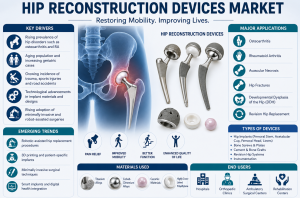
What is the Hip Reconstruction Devices Market Size?
The global hip reconstruction devices market size accounted for USD 9.30 billion in 2025 and is predicted to increase from USD 9.90 billion in 2026 to approximately USD 17.29 billion by 2035, expanding at a CAGR of 6.40% from 2026 to 2035. The hip reconstruction devices market is driven by the rising prevalence of osteoarthritis and an aging population, which are increasing the demand for joint replacement procedures worldwide.
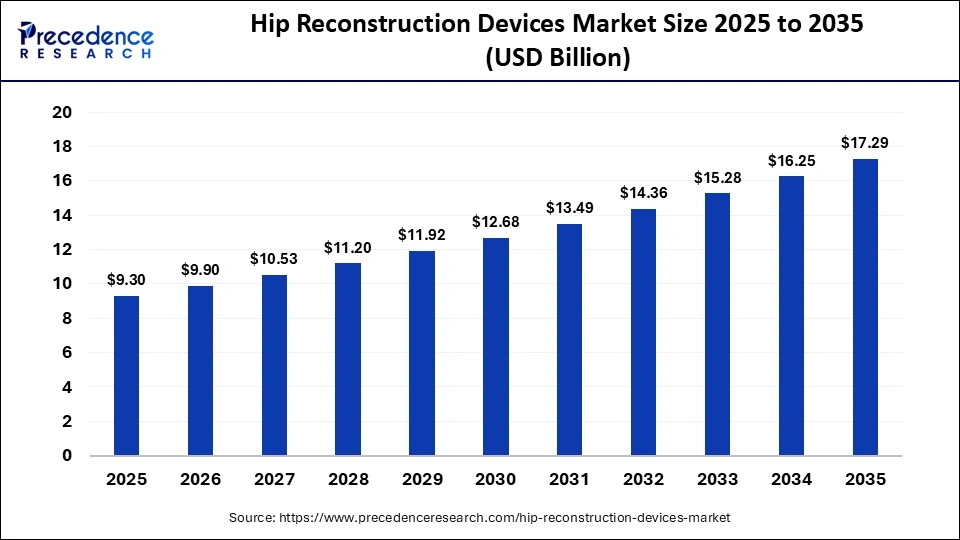
Market Highlights
- North America led the hip reconstruction devices market in 2025 with a 40% revenue share.
- Asia Pacific is expected to expand at the fastest CAGR of 9% between 2026 and 2035.
- By device type, the hip arthroplasty (total hip replacement) segment led the market with a 65% share in 2025.
- By device type, the hip revision surgery devices segment is expected to grow at the fastest CAGR of 7.5% in the upcoming period.
- By material type, the metal-on-polyethylene (MoP) segment led the global market in 2025 with a 45% share.
- By material type, the ceramic-on-ceramic (CoC) segment is expected to grow at the fastest CAGR of 8.5% during the forecast period.
- By surgery type, the primary hip replacement surgery segment led the global market with a 75% share in 2025.
- By surgery type, the robotic-assisted hip surgery segment is observed to grow at the fastest CAGR of 15% in the coming years.
- By end-use, the hospitals segment led the global market in 2025 with a 65% share.
- By end-use, the specialty orthopedic clinics segment is expected to expand at the fastest CAGR of 7.2% in the coming years.
Market Overview
Hip reconstruction devices are medical implants designed to replace or repair damaged hip joints. These devices help restore mobility, reduce chronic pain, and improve daily functioning for patients with severe hip conditions. They are widely used in total hip replacement, partial hip replacement, and revision hip replacement procedures.
Modern hip implants are manufactured using advanced materials such as titanium alloys, cobalt-chromium alloys, ceramic components, and highly cross-linked polyethylene, offering improved durability, biocompatibility, and long-term performance.
Key Factors Driving the Hip Reconstruction Devices Market
Growing Aging Population
The world’s aging population is one of the primary factors fueling demand for hip reconstruction devices. Older adults are more susceptible to degenerative joint diseases and osteoporosis, increasing the need for hip replacement surgeries.
Rising Incidence of Osteoarthritis
Osteoarthritis remains one of the leading causes of hip joint deterioration. As its prevalence increases globally, healthcare providers are performing a greater number of hip reconstruction procedures to improve patient mobility and reduce pain.
Increasing Sports Injuries and Trauma Cases
Road accidents, sports-related injuries, and workplace trauma frequently result in hip fractures and joint damage. The growing number of such cases is driving demand for advanced reconstruction devices capable of restoring normal joint function.
Technological Advancements in Orthopedic Implants
Manufacturers continue to introduce innovative implant designs featuring improved wear resistance, enhanced fixation, robotic-assisted surgical compatibility, and personalized implant solutions. These innovations are improving surgical precision and long-term implant performance.
Emerging Market Trends
Robotic-Assisted Hip Replacement Surgery
Robotic-assisted orthopedic procedures are becoming increasingly popular due to their ability to improve implant positioning, reduce surgical errors, and enhance patient outcomes. Hospitals are investing in robotic platforms to support minimally invasive joint replacement procedures.
Personalized and 3D-Printed Implants
Advances in 3D printing technology allow manufacturers to produce patient-specific implants that match individual anatomy. Customized implants improve fit, stability, and postoperative recovery while reducing complications.
Growth of Minimally Invasive Surgery
Orthopedic surgeons are increasingly adopting minimally invasive surgical techniques that require smaller incisions, reduce blood loss, shorten hospital stays, and accelerate rehabilitation.
Smart Orthopedic Technologies
The integration of digital health technologies, surgical navigation systems, and artificial intelligence into orthopedic procedures is transforming joint replacement surgery. These innovations support better surgical planning and postoperative monitoring.
Market Scope
| Report Coverage | Details |
| Market Size in 2025 | USD 9.30 Billion |
| Market Size in 2026 | USD 9.90 Billion |
| Market Size by 2035 | USD 17.29 Billion |
| Market Growth Rate from 2026 to 2035 | CAGR of 6.40% |
| Dominating Region | North America |
| Fastest Growing Region | Asia Pacific |
| Base Year | 2025 |
| Forecast Period | 2026 to 2035 |
| Segments Covered | Device Type, Material, Surgery Type, End-Use, and Region |
| Regions Covered | North America, Europe, Asia-Pacific, Latin America, and Middle East & Africa |
Challenges Facing the Market
Despite strong growth prospects, the market faces several challenges. Hip replacement procedures remain expensive in many countries, limiting patient access in developing regions. Regulatory requirements for implant approval are also becoming more stringent, increasing product development timelines.
In addition, implant failures, revision surgeries, and postoperative infections remain important concerns, encouraging manufacturers to invest in next-generation materials and improved implant designs.
Regional Market Insights
North America continues to dominate the hip reconstruction devices market due to its advanced healthcare infrastructure, high procedure volume, strong reimbursement systems, and early adoption of innovative orthopedic technologies.
Europe represents another significant market, supported by an aging population, increasing orthopedic procedures, and continuous investments in healthcare modernization.
Asia-Pacific is expected to register the fastest growth during the forecast period. Rising healthcare expenditure, expanding hospital infrastructure, increasing medical tourism, and growing awareness of joint replacement procedures are driving demand across countries such as China, India, Japan, and South Korea.
Latin America and the Middle East & Africa are also experiencing steady growth as access to orthopedic care improves and healthcare investments continue to rise.
Competitive Landscape
The hip reconstruction devices market is highly competitive, with global medical device manufacturers focusing on product innovation, robotic-assisted surgery platforms, advanced biomaterials, and strategic collaborations. Companies are investing in research and development to improve implant longevity, reduce revision rates, and expand their presence in emerging healthcare markets.
Hip Reconstruction Devices Market Key Players
- Zimmer Biomet Holdings, Inc.
- Stryker Corporation
- DePuy Synthes (Johnson & Johnson)
- Smith & Nephew plc
- Wright Medical Group N.V. (Acquired by Stryker)
- MicroPort Scientific Corporation
- B. Braun Melsungen AG
- Exactech, Inc.
- DJO Global (part of Colfax Corporation)
- Arthrex, Inc.
- Medtronic plc
- Corin Group
- Omni Life Science, Inc.
- Hapatec GmbH
- Cerapedics, Inc
Future Outlook
The future of the hip reconstruction devices market looks promising as demand for orthopedic procedures continues to increase worldwide. Technological advancements in implant materials, robotic-assisted surgery, minimally invasive techniques, and personalized orthopedic solutions are expected to reshape the industry over the next decade.
As healthcare providers continue to prioritize patient outcomes and faster recovery, hip reconstruction devices will remain a vital component of modern orthopedic care. Continuous innovation, expanding healthcare access, and growing investments in musculoskeletal health are expected to support long-term market growth.
Get Sample Link : https://www.precedenceresearch.com/sample/8331
Recent Developments
- In March 2026, Maxx Orthopedics, Inc., a rapidly growing global orthopedic device company, announced the launch of the Libertas Keystone™ Hip System, a short, metaphyseal fit-and-fill hip stem.
- In March 2026, with support from the European Union, French company ImpacTell began preparing to commercialize its instrumented hammer, a device that provides orthopedic surgeons with objective and reliable measurements of implant stability. The EU-funded Impactor project was established to develop this instrumented hammer, a medical device designed to help surgeons assess the stability of orthopaedic implants used in hip replacement surgery.
Segments Covered in the Report
By Device Type
- Hip Arthroplasty (Total Hip Replacement)
- Hip Resurfacing Devices
- Partial Hip Replacement Devices
- Hip Revision Surgery Devices
- Others (Impingement Devices, etc.)
By Material
- Metal-on-Polyethylene (MoP)
- Metal-on-Metal (MoM)
- Ceramic-on-Polyethylene (CoP)
- Ceramic-on-Ceramic (CoC)
- Hybrid (Ceramic on Metal, etc.)
By Surgery Type
- Primary Hip Replacement Surgery
- Hip Revision Surgery
- Minimally Invasive Hip Surgery
- Robotic-assisted Hip Surgery
By End-Use
- Hospitals
- Ambulatory Surgical Centers (ASCs)
- Specialty Orthopedic Clinics
By Region
- North America
- Latin America
- Europe
- Asia-pacific
- Middle and East Africa
Also Read Our Latest Article : Neuroimmunology Market

- Electrophoresis Reagents Market: Advancing Molecular Research and Clinical Diagnostics - June 29, 2026
- Hip Reconstruction Devices Market: Driving Innovation in Joint Replacement and Orthopedic Care - June 29, 2026
- Neuroimmunology Market: Advancing the Future of Neurological Disease Treatment - June 29, 2026