
U.S. Healthcare Cloud Computing Market Expands at 17.46% CAGR Amid Rising Adoption of EHRs, Telehealth Platforms, AI Analytics, and Interoperable Healthcare Systems
The U.S. healthcare cloud computing market is experiencing unprecedented growth as healthcare organizations accelerate their transition toward digital-first care delivery models. The market size reached USD 23.58 billion in 2025 and is projected to grow from USD 27.74 billion in 2026 to approximately USD 117.90 billion by 2035, registering a robust CAGR of 17.46% during the forecast period from 2026 to 2035.
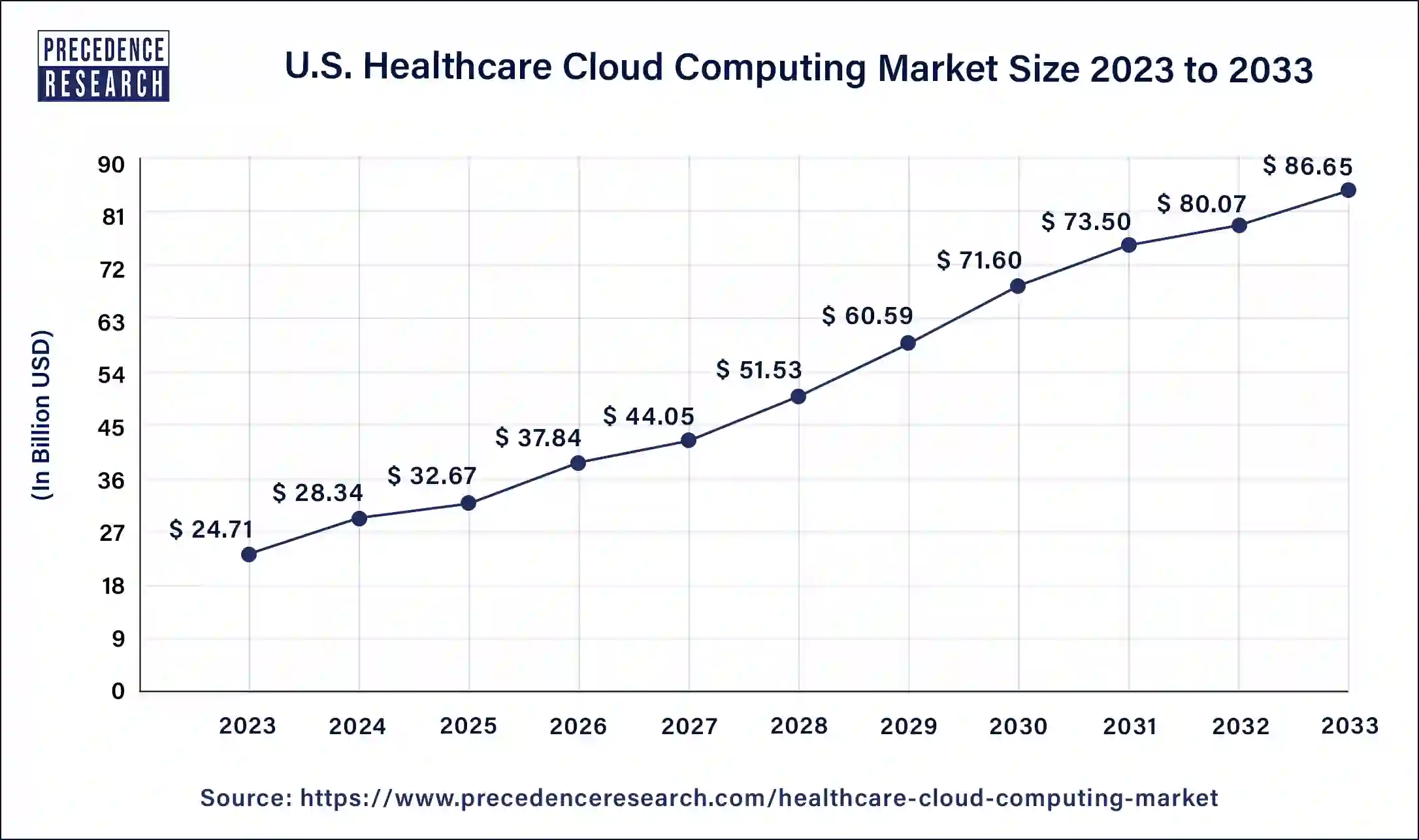
The rapid expansion of cloud technologies across the healthcare ecosystem is reshaping the way hospitals, clinics, payers, pharmaceutical companies, and healthcare networks manage data, deliver care, and improve operational efficiencies. Growing volumes of patient information, increasing telehealth utilization, rising cybersecurity requirements, and the demand for AI-driven healthcare analytics are among the major factors driving market growth.
Healthcare organizations are increasingly replacing traditional on-premise IT infrastructures with scalable cloud-based solutions that provide enhanced flexibility, cost efficiency, interoperability, and regulatory compliance. As healthcare continues its digital transformation journey, cloud computing is becoming the backbone of modern healthcare delivery across the United States.
US Healthcare Cloud Computing Market Key Highlights
- The U.S. healthcare cloud computing market was valued at USD 23.58 billion in 2025.
- The market is forecast to reach USD 117.90 billion by 2035.
- The industry is expected to expand at a CAGR of 17.46% between 2026 and 2035.
- Healthcare provider solutions emerged as the leading product segment in 2025.
- Healthcare payer solutions are anticipated to witness the fastest growth during the forecast period.
- Private cloud deployment dominated the market in 2025 due to stringent healthcare security and compliance requirements.
- Hybrid cloud deployment is projected to grow at the highest CAGR through 2035.
- Non-clinical information systems accounted for the largest application share in 2025.
- Clinical information systems are expected to demonstrate the strongest growth trajectory.
- Software as a Service (SaaS) remained the dominant service model in 2025.
- Platform as a Service (PaaS) is forecast to experience substantial expansion over the next decade.
- Healthcare providers represented the largest end-user category in 2025.
- Healthcare payers are expected to register the fastest growth among end users.
- Amazon Web Services (AWS), Microsoft, Google, IBM, and Oracle remain the leading technology providers shaping the competitive landscape.
US Healthcare Cloud Computing Market Revenue Snapshot
| Metric | Value |
|---|---|
| Market Size 2025 | USD 23.58 Billion |
| Market Size 2026 | USD 27.74 Billion |
| Forecast Market Size 2035 | USD 117.90 Billion |
| CAGR (2026-2035) | 17.46% |
| Base Year | 2025 |
| Forecast Period | 2026-2035 |
How Is Artificial Intelligence Transforming the U.S. Healthcare Cloud Computing Market?
Artificial intelligence has become one of the strongest catalysts behind healthcare cloud adoption across the United States. Cloud environments provide the scalable computational power needed to process massive healthcare datasets, enabling healthcare providers to deploy machine learning algorithms, predictive analytics platforms, and generative AI applications without investing heavily in expensive on-premise infrastructure.
AI-powered cloud platforms are helping hospitals automate repetitive administrative functions such as appointment scheduling, claims management, revenue cycle operations, and supply chain optimization. These technologies reduce operational burdens, allowing clinicians to dedicate more time to patient care while improving organizational efficiency.
In clinical settings, AI-enabled cloud infrastructure is supporting real-time patient monitoring through wearable devices and connected Internet of Medical Things (IoMT) systems. By continuously analyzing patient vitals, healthcare providers can predict deterioration risks earlier and intervene proactively. Furthermore, AI-driven clinical decision support tools can summarize electronic health records, improve diagnostic accuracy, and provide evidence-based treatment recommendations, ultimately enhancing patient outcomes.
What Is Driving Growth in the U.S. Healthcare Cloud Computing Market?
Growing Demand for AI-Powered Healthcare Operations
Healthcare organizations are increasingly leveraging cloud-based AI solutions to support predictive diagnostics, genomics research, personalized medicine, and drug discovery. Cloud environments provide the computational resources required to process complex healthcare datasets while facilitating collaboration across institutions.
Rising Adoption of Electronic Health Records
The widespread implementation of electronic health records (EHRs) and electronic medical records (EMRs) continues to generate enormous volumes of patient information. Cloud platforms enable secure storage, accessibility, and interoperability of these records, making them indispensable for modern healthcare systems.
Expansion of Telehealth and Remote Care
Telemedicine adoption has surged significantly over recent years. Cloud computing provides the foundation for virtual consultations, remote patient monitoring, and digital health applications, ensuring scalability and uninterrupted service delivery.
Growing Need for Cost Optimization
Healthcare organizations face constant pressure to reduce operational expenditures while improving service quality. Cloud solutions eliminate the need for costly on-site servers and IT maintenance, allowing providers to achieve greater efficiency with lower infrastructure costs.
US Healthcare Cloud Computing Market Opportunities
Precision medicine requires healthcare providers to analyze large volumes of genomic, clinical, and behavioral data. Cloud computing platforms offer the infrastructure needed to aggregate and analyze these datasets, enabling highly personalized treatment plans and improving patient outcomes.
The healthcare industry is rapidly transitioning from fee-for-service models toward value-based care. Cloud technologies enable providers and payers to track patient outcomes, manage population health, and optimize care coordination through real-time data sharing and analytics.
The implementation of Fast Healthcare Interoperability Resources (FHIR) standards is encouraging healthcare institutions to adopt interoperable cloud architectures. These systems facilitate seamless data exchange between providers, payers, laboratories, and patients, significantly improving healthcare delivery.
How Are Government Initiatives Supporting Market Expansion?
Federal agencies continue to play a vital role in accelerating healthcare cloud adoption throughout the United States.
Programs such as the CMS Interoperability and Patient Access Rule, the Trusted Exchange Framework and Common Agreement (TEFCA), and initiatives led by the Office of the National Coordinator for Health Information Technology are encouraging healthcare organizations to modernize their IT infrastructures.
Additionally, incentives under the Medicare and CHIP Reauthorization Act (MACRA) support investments in cloud-based EHR systems and interoperability frameworks. These initiatives are helping providers meet evolving regulatory requirements while improving patient access to healthcare information.
US Healthcare Cloud Computing Market Segment Analysis
Product Analysis
The healthcare provider solutions segment accounted for the largest share of the U.S. healthcare cloud computing market in 2025. This leadership was driven by the growing adoption of electronic health records (EHR/EMR), telehealth platforms, and clinical information systems across hospitals and healthcare facilities. Increased digitization of healthcare workflows, regulatory requirements for patient data management, and the need for seamless interoperability further supported segment growth.
The healthcare payer solutions segment is anticipated to witness the fastest growth during the forecast period. Rising adoption of cloud-based claims management, fraud detection tools, and payment automation platforms is driving demand. Health insurers are increasingly utilizing cloud technologies to improve operational efficiency, reduce costs, strengthen analytics capabilities, and support value-based care initiatives.
Application Analysis
The non-clinical information systems segment dominated the market in 2025 due to widespread adoption of cloud-based revenue cycle management, financial management, supply chain management, and administrative solutions. Healthcare organizations are increasingly focusing on operational efficiency, cost optimization, and streamlined workflows, which has accelerated the migration of back-office functions to the cloud.
The clinical information systems segment is projected to expand at the fastest rate over the forecast period. Growth is fueled by increasing implementation of EHR/EMR platforms, telehealth services, and advanced diagnostic applications. The demand for real-time patient data access, improved care coordination, and greater interoperability is encouraging healthcare providers to move clinical operations to cloud environments.
Deployment Analysis
The private cloud segment captured the largest market share in 2025, owing to its superior data security, regulatory compliance, and control over sensitive healthcare information. Dedicated cloud environments enable healthcare organizations to maintain reliable performance while ensuring compliance with strict healthcare regulations and protecting patient data.
The hybrid cloud segment is expected to grow at the highest CAGR during the forecast period. By combining private and public cloud capabilities, hybrid models offer enhanced security, scalability, and cost efficiency. Healthcare organizations can securely store sensitive patient information while leveraging public cloud resources for non-core operations and reducing infrastructure expenses.
Services Analysis
The Software as a Service (SaaS) segment led the market in 2025 due to its affordability, rapid deployment, and minimal IT infrastructure requirements. SaaS solutions are widely used for revenue cycle management, scheduling, billing, and patient engagement applications. These platforms also support remote healthcare services, including online appointment scheduling and virtual consultations.
The Platform as a Service (PaaS) segment is projected to experience the fastest growth in the coming years. Healthcare providers are increasingly using PaaS solutions to develop and deploy custom patient portals, telehealth applications, and digital health platforms. The integration of artificial intelligence, machine learning, and advanced analytics is further accelerating demand for PaaS offerings.
End-User Analysis
Healthcare providers represented the largest end-user segment in 2025 due to their central role in patient care and healthcare data generation. Hospitals and healthcare facilities rely on cloud technologies to store and manage vast volumes of electronic health records, medical imaging, and genomic data while ensuring secure and real-time access to information.
The healthcare payer segment is expected to grow rapidly during the forecast period. Cloud-based platforms enable insurers to automate claims processing, eligibility verification, and member enrollment while improving fraud detection and population health management. The transition toward value-based care models is further increasing cloud adoption among payers.
US Healthcare Cloud Computing Market: Country-Level Analysis
Rising Adoption of EHRs and Telehealth
The growing use of electronic health records and telemedicine services is accelerating cloud adoption across the United States. Leading states such as California, New York, and Texas continue to invest heavily in digital healthcare infrastructure and remote patient monitoring technologies.
Expansion of AI-Driven Healthcare Solutions
Major cloud providers are expanding their healthcare-focused offerings to support AI-powered analytics, predictive healthcare models, and genomics research. Innovation hubs across the country are driving advancements in cloud-enabled healthcare technologies.
Strategic Partnerships Enhancing Interoperability
Healthcare organizations, pharmaceutical companies, and cloud service providers are increasingly forming partnerships to improve clinical trial management and healthcare data interoperability. These collaborations help address complex data-sharing and integration challenges.
Growing Investments in Hospital Infrastructure
The expansion of hospital networks and healthcare facilities is generating greater demand for cloud-based data management solutions. New and expanding medical centers are leveraging cloud technologies to efficiently manage growing patient data volumes.
Government Support Strengthening Digital Healthcare
Federal initiatives aimed at improving healthcare digitization and unified health records continue to support market growth. At the same time, healthcare organizations are prioritizing cloud solutions that comply with HIPAA and HITECH regulations to ensure robust data security and privacy protection.
Leading Companies Operating in the Market
- Amazon Web Services (AWS)
- Microsoft
- IBM
- Oracle
These organizations are heavily investing in healthcare-specific cloud offerings, advanced analytics capabilities, machine learning integration, cybersecurity enhancements, and interoperability solutions to strengthen their market positions.
Emerging companies including Cohere Health, CloudMedx, and Athelas are also gaining traction by focusing on AI-driven diagnostics, telehealth solutions, and automated clinical decision-making platforms.
Latest Industry Development
How Is GE HealthCare Expanding Cloud-Based Healthcare Innovation?
In March 2025, GE HealthCare introduced its Genesis portfolio, a cloud-based enterprise imaging Software-as-a-Service (SaaS) suite designed to enhance healthcare operations.
The platform integrates edge computing, storage solutions, vendor-neutral archive capabilities, and data migration tools. By streamlining workflows and improving operational efficiency, Genesis supports healthcare providers in optimizing IT resources while enhancing clinical precision and patient outcomes.
Segments Covered in the Report
By Product
- Healthcare Provider Solutions
- Clinical Information Systems
- EHR/EMR
- Telehealth Solutions
- PACS/VNA
- PHM Solutions
- LIS
- PIS
- RIS
- Non-clinical Information Systems
- RCM Solutions
- HIE Solutions
- Financial Management Solutions
- SCM Solutions
- Billings and Account Management Solutions
- Clinical Information Systems
- Healthcare Payer Solutions
- Claims Management Solutions
- Payment Management Solutions
- Provider Network Management Solutions
- Fraud Management Solutions
- CMR Solutions
By Deployment
- Public
- Private
- Hybrid
By Application
- Clinical Information System
- Telehealth Solutions
- Computerized Physician Order Entry
- Population Health Management (PHM) Solutions
- Electronic Medical Records
- Pharmacy Information System
- Radiology Information System
- Others
- Non-clinical Information System
- Revenue Cycle Management (RCM)
- Billing & Accounts Management Solutions
- Claims Management
- Others
By Service
- Platform as a service (Paas)
- Infrastructure as a service (Iaas)
- Software as a service (Saas)
By End Users
- Healthcare Providers
- Healthcare Payers
Read Also: Tau Protein Targeting Therapeutics Market Size to Attain USD 6.53 Billion by 2035
Get this report to explore global market size, share, CAGR, and trends, featuring detailed segmental analysis and an insightful competitive landscape overview @ https://www.precedenceresearch.com/sample/8458
You can place an order or ask any questions. Please feel free to contact us at [email protected] |+1 804 441 9344

- 360-Degree Camera Market Set for Explosive Growth, Reaching USD 27.21 Billion by 2035 as AI-Powered Imaging and Immersive Content Reshape Digital Experiences - June 30, 2026
- Automotive Transmission Market Size Forecasted to Reach USD 287.55 Billion by 2035 as Demand for Fuel-Efficient and Electrified Vehicles Accelerates - June 29, 2026
- From Memory Enhancement to Alzheimer’s Care: Brain Health Supplements and Therapeutics Market Set for Strong Growth Through 2035 - June 25, 2026