
Agriculture is undergoing a digital transformation as farmers increasingly adopt technology to improve productivity, reduce costs, and make informed decisions. Among the most significant innovations supporting this shift is farm management software, a digital solution that helps farmers monitor, plan, and optimize every aspect of their operations. From crop planning and livestock management to financial tracking and precision farming, farm management software is becoming an essential tool for modern agriculture.
The Farm Management Software Market is experiencing strong growth as the global agriculture industry embraces digitalization. Rising food demand, labor shortages, climate change, and the growing need for sustainable farming practices are encouraging farmers to adopt intelligent software platforms. Combined with technologies such as artificial intelligence (AI), the Internet of Things (IoT), satellite imaging, drones, and cloud computing, farm management software is enabling data-driven farming that improves efficiency and profitability.
Farm Management Software Market Size and Forecast 2026 to 2035
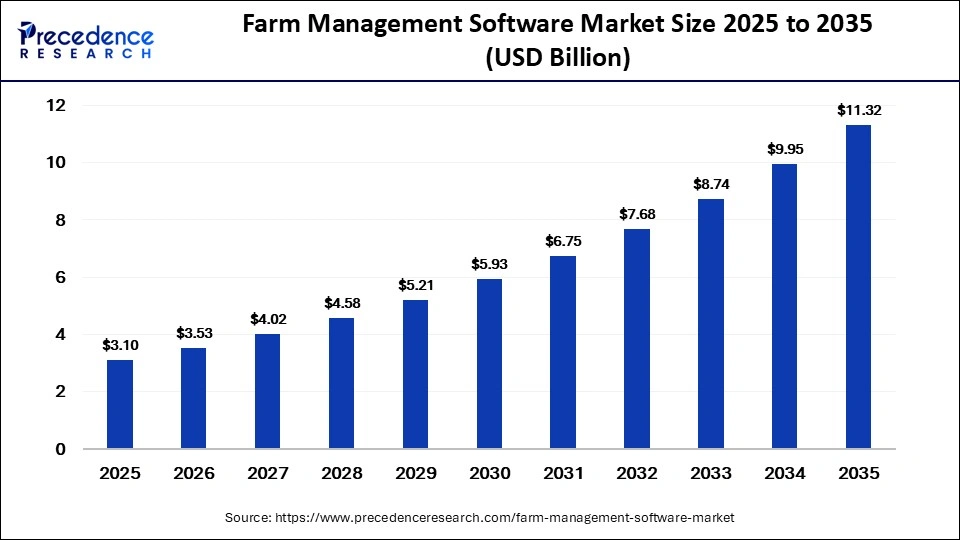
The global farm management software market size accounted for USD 3.10 billion in 2025 and is predicted to increase from USD 3.53 billion in 2026 to approximately USD 11.32 billion by 2035, expanding at a CAGR of 13.80% from 2026 to 2035. Increasing digitization in agriculture is a key driver of growth in the market.
Market Highlights
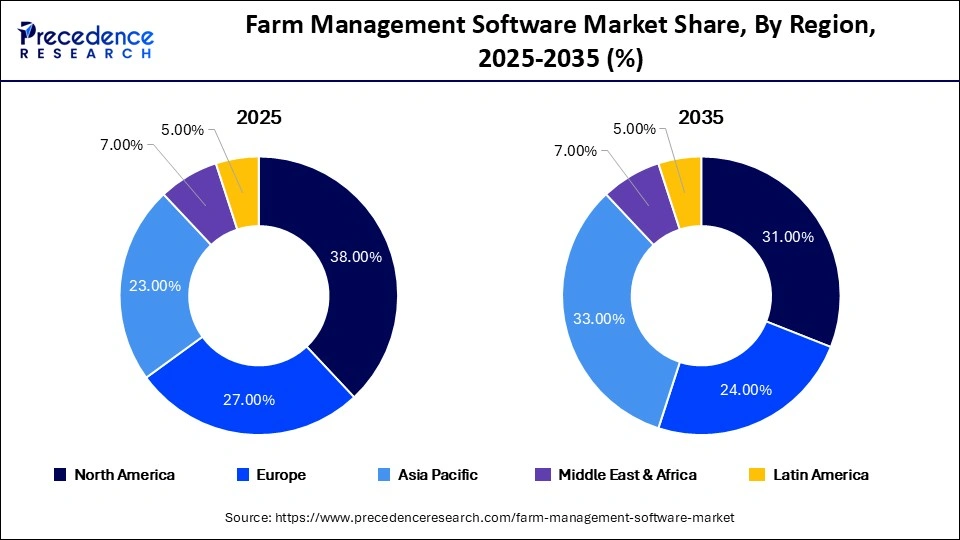
- North America led the farm management software market with a share of 38% in 2025.
- Asia-Pacific is expected to be the fastest-growing region with a CAGR of 17.5% in the forecasted duration.
- By agriculture type, the precision farming segment held a dominant position in the market with a share of 66% in 2025
- By agriculture, the smart greenhouse is expected to grow at the fastest CAGR of 16.2% in the market between 2026 and 2035.
- By deployment model, the cloud-based segment accounted for a considerable revenue share of 56% in the market in 2025 and is expected to grow with the highest CAGR of 17% in the market during the years studied.
- By deployment model, the web-based/on-premise segment held the second-largest market share of 44% in 2025.
- By technology, the IoT and sensor integration segment led the global market with a share of 34% in 2025.
- By technology, the AI and predictive analytics segment is expected to expand rapidly in the market with a CAGR of 19.5% in the coming years.
Understanding the Farm Management Software Market
Farm management software is a digital platform designed to help farmers organize, monitor, and manage agricultural activities through a centralized system. These solutions collect data from various sources, including farm equipment, weather stations, sensors, GPS devices, drones, and satellite imagery, providing real-time insights that support better decision-making.
Modern farm management software enables users to monitor crop health, schedule irrigation, manage fertilizer applications, track livestock, oversee machinery maintenance, monitor inventory, and analyze financial performance. By integrating these functions into a single platform, farmers can improve operational efficiency while reducing waste and production costs.
As agriculture becomes increasingly data-driven, software solutions are evolving from simple record-keeping tools into intelligent farm management platforms capable of supporting precision agriculture.
Why Is the Farm Management Software Market Growing?
Several factors are driving the rapid expansion of the farm management software market worldwide.
One of the primary growth drivers is the increasing global demand for food. With the world’s population continuing to grow, farmers must produce higher yields using limited natural resources. Farm management software helps optimize crop production while improving resource utilization.
Climate change is another major factor influencing market growth. Unpredictable weather conditions, water scarcity, and changing growing seasons require farmers to make timely and informed decisions. Digital platforms provide weather forecasts, soil analysis, and crop recommendations that help reduce production risks.
The shortage of skilled agricultural labor is encouraging greater automation across farming operations. Software platforms simplify farm management by automating record-keeping, scheduling tasks, monitoring equipment, and generating operational reports.
Government initiatives promoting precision agriculture and smart farming technologies are also supporting software adoption. Many countries are investing in digital agriculture programs that encourage farmers to modernize their operations through technology.
How Is Artificial Intelligence Transforming Farm Management Software?
Artificial intelligence is becoming one of the most valuable technologies in modern agriculture.
AI-powered farm management software analyzes large volumes of agricultural data to provide actionable insights that improve productivity and sustainability. Machine learning algorithms evaluate weather conditions, soil quality, crop growth, pest activity, and historical farming data to recommend optimal planting, irrigation, fertilization, and harvesting schedules.
Computer vision technologies are helping farmers identify crop diseases, nutrient deficiencies, and weed infestations using images captured by drones, smartphones, and field cameras. Early detection enables timely intervention, reducing crop losses and improving yields.
Predictive analytics allows farmers to anticipate production challenges before they occur. AI models can forecast crop yields, estimate water requirements, predict disease outbreaks, and optimize harvesting times based on environmental conditions.
Natural language AI assistants are also becoming increasingly common, allowing farmers to access farm data, receive recommendations, and generate reports using simple voice or text commands.
Emerging Trends in the Farm Management Software Market
The agriculture industry continues to adopt innovative technologies that are reshaping farm management.
One of the most important trends is the increasing adoption of cloud-based farm management platforms. Cloud solutions allow farmers to access farm information from smartphones, tablets, and computers while enabling real-time collaboration with agronomists, consultants, and equipment suppliers.
The integration of IoT sensors is another significant trend. Connected soil sensors, weather stations, irrigation systems, and livestock monitoring devices continuously collect field data that improves operational decision-making.
Drone technology is becoming increasingly valuable for monitoring crop health, mapping fields, identifying irrigation issues, and applying crop protection products with greater precision.
Blockchain technology is also gaining attention for improving food traceability and supply chain transparency, allowing consumers and regulators to track agricultural products from farm to market.
Sustainability is another key focus area, with software solutions helping farmers reduce water usage, optimize fertilizer application, lower greenhouse gas emissions, and improve environmental compliance.
Market Scope
| Report Coverage | Details |
| Market Size in 2025 | USD 3.10 Billion |
| Market Size in 2026 | USD 3.53 Billion |
| Market Size by 2035 | USD 11.32 Billion |
| Market Growth Rate from 2026 to 2035 | CAGR of 13.80% |
| Dominating Region | North America |
| Fastest Growing Region | Asia Pacific |
| Base Year | 2025 |
| Forecast Period | 2026 to 2035 |
| Segments Covered | Agriculture Type, Deployment Model, Technology, and Region |
| Regions Covered | North America, Europe, Asia-Pacific, Latin America, and Middle East & Africa |
Market Challenges
Despite its growing popularity, the farm management software market faces several challenges.
The initial investment required for software implementation, connected devices, and precision agriculture equipment may discourage adoption among small-scale farmers, particularly in developing countries.
Limited internet connectivity in rural regions can also affect the effectiveness of cloud-based farming platforms.
Many farmers require training to effectively utilize digital technologies, making education and technical support important factors for successful implementation.
Data security and privacy concerns are becoming increasingly important as agricultural businesses collect large volumes of operational and financial information through digital platforms.
Integration with older farming equipment can also present technical challenges for farms that have not yet modernized their machinery.
Regional Outlook
North America currently leads the Farm Management Software Market due to its advanced agricultural infrastructure, high adoption of precision farming technologies, and strong government support for digital agriculture.
Europe remains a significant market, driven by sustainability initiatives, smart farming programs, and increasing investments in agricultural technology. Countries such as Germany, France, the Netherlands, and the United Kingdom continue promoting digital farming practices.
Asia Pacific is expected to witness the fastest growth during the forecast period. Rising agricultural modernization, increasing smartphone penetration, government support for digital agriculture, and growing awareness of precision farming are creating substantial opportunities across China, India, Japan, and Southeast Asia.
Latin America is also experiencing increased adoption, particularly in large-scale commercial farming operations producing soybeans, sugarcane, coffee, and grains.
The Middle East & Africa are gradually embracing digital agriculture as governments focus on improving food security, water management, and sustainable farming practices.
Competitive Landscape
The Farm Management Software Market is highly competitive, with technology companies, agricultural equipment manufacturers, and agri-tech startups continuously introducing innovative digital farming solutions.
Market participants are investing in artificial intelligence, cloud computing, IoT integration, remote sensing, and predictive analytics to enhance software capabilities. Strategic collaborations with equipment manufacturers, research organizations, and agricultural cooperatives are helping companies expand their market presence.
Software providers are also focusing on user-friendly mobile applications, multilingual interfaces, and customizable dashboards that meet the needs of farms of different sizes and production systems.
As competition intensifies, companies are increasingly offering subscription-based cloud platforms that make advanced farm management solutions more accessible to small and medium-sized farms.
Future Outlook
The future of the Farm Management Software Market looks promising as digital transformation continues to reshape global agriculture.
Artificial intelligence, automation, robotics, satellite monitoring, autonomous tractors, and connected farming ecosystems will further improve productivity while reducing operational costs and environmental impact.
Future software platforms are expected to provide even more personalized recommendations by combining real-time weather data, satellite imagery, machine learning, and predictive analytics into integrated farm intelligence systems.
As global agriculture moves toward greater sustainability, precision farming, and climate resilience, farm management software will become an indispensable tool for improving food production while protecting natural resources.
Conclusion
The Farm Management Software Market is transforming modern agriculture by enabling farmers to make smarter, faster, and more informed decisions. Through artificial intelligence, IoT connectivity, cloud computing, and precision farming technologies, digital farm management platforms are improving productivity, sustainability, and profitability across the agricultural sector.
As the demand for efficient food production continues to grow, investment in intelligent farm management solutions is expected to accelerate. Companies that focus on innovation, user-friendly technology, and data-driven farming will play a vital role in shaping the future of global agriculture.
Top Companies in the Farm Management Software Market
- Deere & Company
- Trimble Inc.
- Topcon Positioning Systems
- AGCO Corporation
- Raven Industries
- Farmers Edge
- Ag Leader Technology
- AGRIVI
- Conservis
- AgJunction
- CropX
- Granular
- Agworld
- SST Software
- Climate LLC
Get Sample Link : https://www.precedenceresearch.com/sample/8528
Recent Developments
- In June 2026, Kinze Manufacturing and Yetter Manufacturing partnered to introduce the Falcon SF700 strip-till tool, which pairs Yetter’s 2984 Strip Freshener CC row units with Kinze’s 5700 toolbar platform to create a cleaner, more uniform, planting-ready strip. Built for corn and soybean operations using strip-till systems, the Falcon SF700 is designed to effectively manage residue and establish an optimal seedbed.
- In February 2026, the Union Minister for Agriculture & Farmers’ Welfare and Rural Development launched ‘Bharat-VISTAAR’ in Jaipur, a new AI-based digital companion for farmers nationwide. The platform delivers weather updates, market prices, pest and disease alerts, soil and crop advice, and information on government schemes through phone calls, chatbots, and eventually a dedicated app.
Segments Covered in the Report
By Agriculture Type
- Precision Farming
- Livestock Monitoring
- Smart Greenhouse
- Others
By Deployment Model
- Cloud-Based
- Web-Based/On-Premise
By Technology
- IoT & Sensor Integration
- AI & Predictive Analytics
- GIS/GPS Mapping
- Mobile Farm Management Platforms
By Region
- North America
- Latin America
- Europe
- Asia-pacific
- Middle and East Africa
Also Read Our Latest Article : AI in CGT Manufacturing Market

- Farm Management Software Market: Digital Agriculture Driving Smarter and More Sustainable Farming - July 9, 2026
- AI in CGT Manufacturing Market: Artificial Intelligence Accelerating the Future of Cell and Gene Therapy Production - July 9, 2026
- 3T MRI System Market: Advanced Imaging Technology Transforming Modern Diagnostics - July 9, 2026