
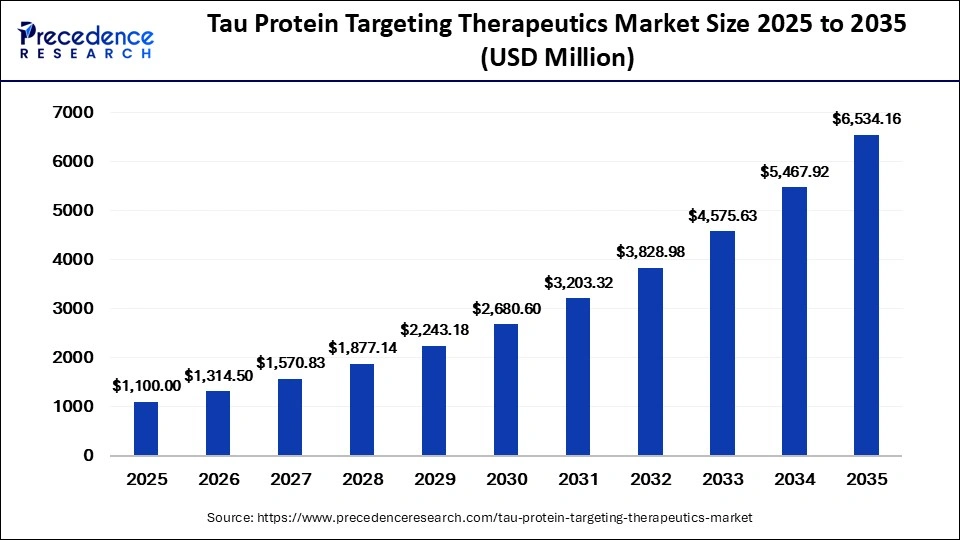
The global tau protein targeting therapeutics market is entering a transformative growth phase as pharmaceutical innovators intensify efforts to combat Alzheimer’s disease and other tauopathies through advanced disease-modifying therapies. The market size was valued at USD 1,100.00 million in 2025 and is projected to rise from USD 1,314.50 million in 2026 to approximately USD 6,534.16 million by 2035, expanding at a robust CAGR of 19.50% from 2026 to 2035.
The growing prevalence of neurodegenerative disorders worldwide, combined with rising healthcare expenditure, advancements in biomarker technologies, and increasing investments in tau-targeted clinical trials, is significantly accelerating market momentum. Researchers and biotechnology companies are now shifting focus toward therapies capable of slowing disease progression rather than only managing symptoms, creating a strong commercial pathway for tau aggregation inhibitors, monoclonal antibodies, vaccines, and gene therapies.
Tau proteins play a critical role in stabilizing neuronal microtubules, but abnormal tau modifications and aggregation are strongly associated with neurodegenerative diseases such as Alzheimer’s disease, frontotemporal dementia, progressive supranuclear palsy, and corticobasal degeneration. As scientific understanding of tau pathology expands, the market is witnessing unprecedented innovation in targeted neurological therapeutics.
Tau Protein Targeting Therapeutics Market Key Highlights
- The global tau protein targeting therapeutics market is expected to reach USD 6,534.16 million by 2035 from USD 1,314.50 million in 2026, growing at a CAGR of 19.50%.
- North America dominated the global market in 2025 with a 44% revenue share due to strong neurological research infrastructure and rising clinical trial activity.
- Asia-Pacific is anticipated to witness the fastest growth during the forecast period with a CAGR of 24%, supported by increasing investments in neurodegenerative research across China and Japan.
- Monoclonal antibodies emerged as the leading therapeutic segment in 2025, accounting for 42% of total market revenue.
- Gene therapies are projected to register the fastest growth rate of 28% CAGR through 2035 due to advancements in antisense oligonucleotide technologies and RNA-based therapeutics.
- Alzheimer’s disease remained the dominant indication segment with 58% market share in 2025 and is expected to maintain strong growth momentum.
- Tau aggregation inhibition represented the leading mechanism of action segment with a 34% market share in 2025.
- Intravenous administration dominated the market with 48% share due to extensive use of biologic and monoclonal antibody therapies.
- Hospitals accounted for the highest end-use share of 40% in 2025 owing to rising patient admissions for neurodegenerative disease treatment.
Market Key Metrics
| Market Metric | Details |
|---|---|
| Market Size 2025 | USD 1,100.00 Million |
| Market Size 2026 | USD 1,314.50 Million |
| Forecast Market Size 2035 | USD 6,534.16 Million |
| CAGR (2026–2035) | 19.50% |
| Dominating Region | North America |
| Fastest Growing Region | Asia-Pacific |
| Leading Therapeutic Type | Monoclonal Antibodies |
| Leading Indication | Alzheimer’s Disease |
How is Artificial Intelligence Transforming the Tau Protein Targeting Therapeutics Market?
Artificial intelligence is becoming a cornerstone technology in neurodegenerative drug discovery, particularly in identifying and optimizing tau-targeting compounds. AI-powered virtual screening tools are accelerating the discovery of tau aggregation inhibitors by analyzing extensive molecular databases and predicting therapeutic efficacy with higher accuracy and lower research costs.
Advanced AI platforms are also supporting the development of next-generation nanobody engineering and single-domain antibodies targeting intrinsically disordered tau proteins. Companies are increasingly integrating machine learning algorithms to identify toxic beta-amyloid interactions, predict disease progression, and design personalized therapeutic interventions.
Furthermore, AI-driven predictive analytics are improving biomarker identification, patient selection for clinical trials, and early diagnosis of tauopathies. These advancements are expected to reduce clinical failure rates while significantly improving the efficiency of neurological drug development pipelines.
What is Driving the Rapid Growth of the Tau Protein Targeting Therapeutics Market?
Rising Demand for Disease-Modifying Therapies is Fueling Market Expansion
The increasing global prevalence of Alzheimer’s disease and related neurodegenerative disorders is one of the primary drivers of market growth. Aging populations worldwide are contributing to a substantial rise in dementia-related conditions, intensifying the demand for therapies capable of slowing or halting disease progression.
Pharmaceutical companies are rapidly expanding their investments in disease-modifying therapies focused on tau pathology. Unlike traditional symptomatic treatments, tau-targeted therapeutics aim to intervene at the molecular level, offering the possibility of long-term neurological protection.
Growing public awareness, improved diagnostic capabilities, and supportive healthcare policies are further strengthening research initiatives and clinical development activities.
Why are Tau Antibody Therapeutics Gaining Strong Market Attention?
Tau antibody therapeutics are emerging as a highly promising strategy in neurodegenerative disease management due to their ability to limit the spread of tau proteins between neurons. Clinical studies increasingly suggest that passive immunotherapy approaches can reduce pathological tau accumulation and potentially slow disease progression.
Biotechnology companies are aggressively pursuing anti-tau monoclonal antibodies as they offer highly targeted mechanisms with improved therapeutic specificity. The success of several late-stage clinical programs is expected to enhance confidence among investors and healthcare providers.
Can Preventive Neurology Become the Next Big Trend in Tau Research?
Preventive neurology is gaining traction as researchers explore the relationship between lifestyle factors and tau deposition. Recent scientific findings indicating that higher midlife vitamin D levels may correlate with reduced tau accumulation later in life are generating significant interest.
This evolving research direction is encouraging healthcare organizations to investigate preventive therapeutic strategies alongside disease-modifying interventions. As preventive neuroscience becomes more mainstream, the market may witness the development of combined therapeutic and preventive treatment models.
What Challenges are Restricting Market Growth?
Complex Tau Pathology Continues to Create Development Barriers
Despite substantial scientific progress, tau-targeted drug development remains highly complex. Tau proteins exist in multiple isoforms and exhibit varying pathological behaviors across neurodegenerative diseases, making therapeutic standardization difficult.
Clinical trials for tau therapeutics also face challenges related to patient selection, biomarker validation, disease staging, and long-term efficacy measurement. The absence of universally accepted diagnostic biomarkers continues to slow regulatory approvals and commercialization efforts.
Moreover, neurological drug development involves high research costs, extended timelines, and elevated clinical failure risks, placing financial pressure on smaller biotechnology firms.
Tau Protein Targeting Therapeutics Market Segment Analysis
Therapeutic Type Analysis
The monoclonal antibodies segment led the tau protein targeting therapeutics market with a 42% share in 2025 (USD 462.00M), driven by anti-tau antibody therapies and passive immunotherapies. The segment is expected to grow at a CAGR of 18.8%, reaching USD 2,613.66M by 2035, with market share slightly reducing to 40%.
The small molecule inhibitors segment represented 28% of the market in 2025 (USD 308.00M), growing at a CAGR of 16.5% due to oral therapeutics targeting tau aggregation. By 2035, this segment is projected to reach USD 1,698.88M, with a market share of 26%.
The vaccines segment accounted for 18% in 2025 (USD 198.00M), projected to grow at a CAGR of 22.5%, reaching USD 1,306.83M by 2035, with share increasing to 20%, driven by active immunotherapy and peptide-based vaccines.
The gene therapies segment held 12% in 2025 (USD 132.00M), expected to be the fastest-growing with a CAGR of 28%, reaching USD 914.79M by 2035, increasing market share to 14%, due to ASO and RNA-based therapeutic advancements.
Indication Analysis
The Alzheimer’s Disease segment dominated with 58% in 2025 (USD 638.00M), growing at a CAGR of 20%, reaching USD 3,920.50M by 2035, driven by high prevalence and tau pathology targeting.
The Frontotemporal Dementia (FTD) segment had 14% in 2025 (USD 154.00M), growing at 15.5% CAGR, reaching USD 849.44M by 2035.
The Progressive Supranuclear Palsy (PSP) segment accounted for 10% in 2025 (USD 110.00M), projected at 14% CAGR, reaching USD 588.08M by 2035.
The Corticobasal Degeneration (CBD) segment held 7% in 2025 (USD 77.00M), growing at 12.5% CAGR, reaching USD 392.05M by 2035.
The Chronic Traumatic Encephalopathy (CTE) segment was 6% in 2025 (USD 66.00M), projected at 18% CAGR, reaching USD 457.39M by 2035.
The Other Tauopathies segment was 5% in 2025 (USD 55.00M), growing at 11% CAGR, remaining at USD 326.71M by 2035.
Mechanism of Action Analysis
The Tau Aggregation Inhibition segment led with 34% in 2025 (USD 374.00M), growing at 17% CAGR, reaching USD 2,090.93M by 2035, driven by aggregation-blocking compounds.
The Tau Phosphorylation Inhibition segment accounted for 24% in 2025 (USD 264.00M), growing at 16% CAGR, reaching USD 1,503.48M by 2035.
The Microtubule Stabilization segment was 16% in 2025 (USD 176.00M), projected at 13.5% CAGR, reaching USD 981.00M by 2035.
The Tau Clearance Enhancement segment captured 18% in 2025 (USD 198.00M), fastest-growing at 24% CAGR, reaching USD 1,437.52M by 2035.
The Neuroinflammation Modulation segment was 8% in 2025 (USD 88.00M), growing at 15% CAGR, reaching USD 522.73M by 2035.
Route of Administration Analysis
The Intravenous (IV) segment dominated with 48% in 2025 (USD 528.00M), growing at 17.5% CAGR, reaching USD 2,875.03M by 2035, slightly declining in share to 44%.
The Oral segment held 24% in 2025 (USD 264.00M), growing at 18% CAGR, reaching USD 1,633.54M by 2035, share increasing to 25%.
The Intrathecal segment was 18% in 2025 (USD 198.00M), fastest-growing at 23% CAGR, reaching USD 1,306.83M by 2035, share rising to 20%.
The Subcutaneous segment accounted for 10% in 2025 (USD 110.00M), growing at 19.5% CAGR, reaching USD 718.76M by 2035, share increasing to 11%.
End-Use Analysis
The Hospitals segment led with 40% in 2025 (USD 440.00M), growing at 17% CAGR, reaching USD 2,352.30M by 2035, share slightly declining to 36%.
The Specialty Neurology Clinics segment held 22% in 2025 (USD 242.00M), growing at 20% CAGR, reaching USD 1,568.20M by 2035, share increasing to 24%.
The Academic & Research Institutes segment was 20% in 2025 (USD 220.00M), growing at 16% CAGR, reaching USD 1,176.26M by 2035, share declining slightly to 18%.
The Pharmaceutical & Biotechnology Companies segment captured 18% in 2025 (USD 198.00M), fastest-growing at 25% CAGR, reaching USD 1,437.52M by 2035, share increasing to 22%.
Tau Protein Targeting Therapeutics Market Regional Analysis
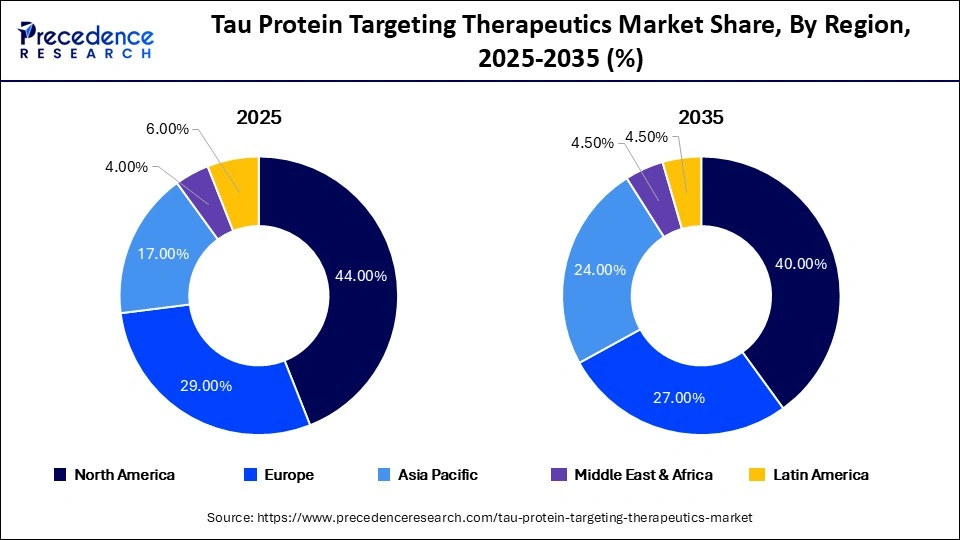
North America dominated the tau protein targeting therapeutics market with a 44% share (USD 484.0 million in 2025), largely due to a robust research ecosystem focused on neurodegenerative diseases. There has been a notable increase in clinical trials targeting tau proteins, complemented by substantial investments in Alzheimer’s disease drug development and the presence of major biotechnology and pharmaceutical companies, all of which are propelling market growth. The United States contributed USD 363.0 million in 2025, projected to reach USD 1,967.0 million by 2035 with a CAGR of 18.59%. Canada and Mexico together accounted for the remaining USD 121.0 million in 2025, with each country valued at USD 60.5 million, projected to reach USD 310.0 million by 2035.
North America Market Size
| Region | 2025 Value | 2035 Value | CAGR |
|---|---|---|---|
| North America | USD 484 Million | USD 2,639 Million | 18.5% |
| United States | USD 363 Million | USD 1,967 Million | 18.59% |
Asia-Pacific held 17% of the market share (USD 187.0 million in 2025) and is expected to be the fastest-growing region with a CAGR of 24%. China, leading the region, had a market size of USD 65.45 million in 2025, projected to reach USD 491.8 million by 2035. Japan, India, and Australia share the remaining USD 121.55 million, with each country valued at USD 40.52 million in 2025, projected to grow to USD 304.1 million by 2035. Growth is driven by an aging population, rising neurological research investments, and biotechnology innovation hubs.
Europe held 29% of the market share (USD 319.0 million in 2025) and is expected to grow at a CAGR of 17.8%. Germany had a market size of USD 63.8 million in 2025, projected to reach USD 318.0 million by 2035, supported by research initiatives and collaborations with healthcare authorities. UK, France, Italy, and Spain share the remaining USD 255.2 million in 2025, each projected to reach USD 318.0 million by 2035.
Middle East & Africa accounted for USD 44.0 million in 2025, split equally among South Africa, UAE, and Saudi Arabia, with each country valued at USD 14.67 million, projected to reach USD 98.01 million by 2035 at a CAGR of 19.5%.
Latin America held USD 66.0 million in 2025, divided equally among Brazil, Argentina, and Chile, with each country valued at USD 22.0 million, projected to grow to USD 98.01 million by 2035 at a CAGR of 15.3%.
Tau Protein Targeting Therapeutics Market Competitive Landscape
- Biogen Inc.
- F. Hoffmann-La Roche Ltd.
- Eli Lilly and Company
- AbbVie Inc.
- Johnson & Johnson
- Novartis AG
- TauRx Pharmaceuticals
- AC Immune SA
- Ionis Pharmaceuticals
- Alzheon Inc.
- UCB Pharma
- Eisai Co., Ltd.
- Pfizer Inc.
- Bristol Myers Squibb
- Vaxxinity Inc.
Recent Industry Developments
- In April 2026, AC Immune SA expanded its collaboration with Eli Lilly and Company to accelerate research and development of tau aggregation inhibitor small molecules for Alzheimer’s disease and other neurodegenerative disorders.
- In December 2025, Arrowhead Pharmaceuticals initiated a Phase 1/2a clinical study for ARO-MAPT targeting Alzheimer’s disease and multiple tauopathies, signaling growing momentum in RNA-based neurological therapeutics.
Segments Covered in the Report
By Therapeutic Type
- Monoclonal Antibodies
- Anti-tau Antibodies
- Passive Immunotherapies
- Small Molecule Inhibitors
- Tau Aggregation Inhibitors
- Kinase Inhibitors
- Vaccines
- Active Immunotherapies
- Peptide-based Vaccines
- Gene Therapies
- Antisense Oligonucleotides (ASOs)
- RNA-based Therapies
By Indication
- Alzheimer’s Disease
- Frontotemporal Dementia (FTD)
- Progressive Supranuclear Palsy (PSP)
- Corticobasal Degeneration (CBD)
- Chronic Traumatic Encephalopathy (CTE)
- Other Tauopathies
By Mechanism of Action
- Tau Aggregation Inhibition
- Tau Phosphorylation Inhibition
- Microtubule Stabilization
- Tau Clearance Enhancement
- Neuroinflammation Modulation
By Route of Administration
- Intravenous
- Oral
- Intrathecal
- Subcutaneous
By End-Use
- Hospitals
- Specialty Neurology Clinics
- Academic & Research Institutes
- Pharmaceutical & Biotechnology Companies
By Region
- North America
- Latin America
- Europe
- Asia-pacific
- Middle and East Africa
Read Also: Hematopoietic Stem Cell Transplantation Market Surges Toward USD 24.32 Billion by 2035
Get this report to explore global market size, share, CAGR, and trends, featuring detailed segmental analysis and an insightful competitive landscape overview @ https://www.precedenceresearch.com/sample/8423
You can place an order or ask any questions. Please feel free to contact us at [email protected] |+1 804 441 9344

- 360-Degree Camera Market Set for Explosive Growth, Reaching USD 27.21 Billion by 2035 as AI-Powered Imaging and Immersive Content Reshape Digital Experiences - June 30, 2026
- Automotive Transmission Market Size Forecasted to Reach USD 287.55 Billion by 2035 as Demand for Fuel-Efficient and Electrified Vehicles Accelerates - June 29, 2026
- From Memory Enhancement to Alzheimer’s Care: Brain Health Supplements and Therapeutics Market Set for Strong Growth Through 2035 - June 25, 2026