
The global aviation mission computer system market is projected to reach USD 9.84 billion by 2035, fueled by defense modernization, UAV adoption, and AI-powered avionics.
Introduction
The global aviation mission computer system market is experiencing robust growth as modern military aircraft increasingly rely on advanced computing platforms for mission-critical operations. Mission computers serve as the core processing units, enabling real-time data fusion, navigation, communication, and combat decision-making.
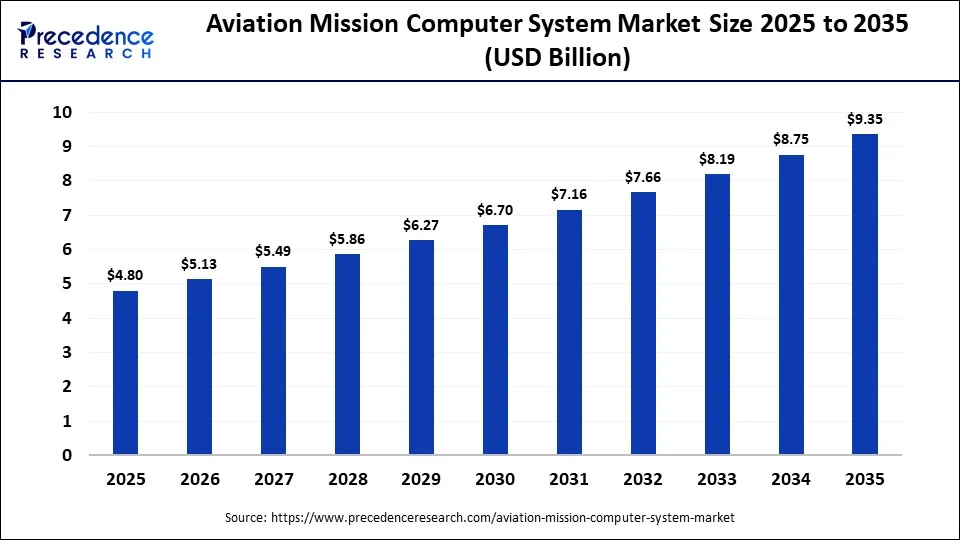
The market is projected to expand from USD 5.12 billion in 2026 to approximately USD 9.84 billion by 2035, registering a CAGR of 7.50%. Growth is primarily driven by rising defense modernization programs, increased procurement of advanced fighter jets, and the integration of artificial intelligence (AI) in avionics systems.
Read Also: Aviation Test Equipment Market
What is an Aviation Mission Computer System?
An aviation mission computer system is a high-performance embedded computing platform that integrates data from multiple onboard systems such as radar, sensors, navigation, and communication equipment. It enables aircraft operators to process large volumes of data in real time and execute complex missions efficiently.
Key capabilities include:
- Multi-sensor data fusion
- Real-time situational awareness
- Navigation and flight management
- Target tracking and mission execution
- Communication system integration
These systems are critical for both manned and unmanned military aircraft.
Key Market Insights
The aviation mission computer system market was valued at USD 4.80 billion in 2025 and is expected to reach USD 9.84 billion by 2035.
North America dominates the market due to high defense spending and advanced aerospace capabilities.
Asia Pacific is expected to grow at the fastest rate, driven by increasing military budgets and indigenous aircraft development programs.
The military aviation segment holds the largest share, highlighting the importance of mission computing in defense applications.
Open architecture systems are gaining traction due to their flexibility, scalability, and cost efficiency.
Role of AI in Mission Computer Systems
Artificial intelligence is transforming mission computer systems by enabling faster, smarter, and more adaptive decision-making. AI algorithms analyze vast amounts of sensor data in real time, improving threat detection, navigation accuracy, and mission execution.
Additionally, AI supports autonomous operations, predictive analytics, and advanced combat strategies. Integration with machine learning enhances system performance over time, making mission computers more intelligent and efficient.
Market Growth Drivers
Defense Modernization Programs
Governments worldwide are investing in upgrading military aircraft and avionics systems, driving demand for advanced mission computers.
Growing Adoption of UAVs
The increasing use of unmanned aerial vehicles (UAVs) in surveillance and combat missions is boosting demand for compact and efficient mission computing systems.
Advancements in Avionics
Modern aircraft require high-performance computing platforms to manage complex avionics and sensor integration.
Shift Toward Network-Centric Warfare
The evolution of interconnected warfare systems is increasing the need for robust and secure mission computing platforms.
Opportunities and Trends
Are Open Architecture Systems the Future of Mission Computing?
Yes, open architecture systems enable easier upgrades, interoperability, and reduced lifecycle costs, making them highly attractive for defense applications.
How is AI Driving Next-Generation Aviation Systems?
AI integration is enabling autonomous operations, enhanced situational awareness, and faster decision-making in complex combat environments.
Is Cybersecurity Becoming a Strategic Priority?
As mission systems become more connected, ensuring cybersecurity and data integrity is becoming critical for defense organizations.
Market Segmentation
By Component
Hardware dominates due to the need for ruggedized processors and high-performance computing units, while software is rapidly growing with increasing AI integration.
By Platform
Fighter aircraft hold the largest share, followed by UAVs and transport aircraft. UAVs are expected to grow at the fastest rate.
By End-Use
Military aviation leads the market, while commercial aviation is gradually adopting mission computing technologies.
Regional Analysis
North America
North America leads the market due to strong defense investments and advanced aerospace infrastructure.
Europe
Europe holds a significant share, supported by collaborative defense programs and technological innovation.
Asia Pacific
Asia Pacific is the fastest-growing region, driven by increasing defense budgets and indigenous aircraft development.
Competitive Landscape
Key players in the aviation mission computer system market include:
- Lockheed Martin Corporation
- Northrop Grumman Corporation
- BAE Systems plc
- Thales Group
- Raytheon Technologies Corporation
- General Dynamics Corporation
- Leonardo S.p.A.
- Elbit Systems Ltd.
These companies are focusing on AI integration, open architecture solutions, and advanced computing technologies to enhance mission performance.
Challenges in the Market
The market faces challenges such as high development costs, complex system integration, and stringent certification requirements. Additionally, cybersecurity threats pose significant risks to mission-critical systems.
Case Study: AI-Enabled Mission Systems in Modern Fighter Jets
Modern fighter jets equipped with AI-powered mission computers can process vast amounts of sensor data in real time, enabling pilots to make faster and more accurate decisions. This has significantly improved mission success rates, operational efficiency, and situational awareness.
Conclusion
The aviation mission computer system market is a cornerstone of modern aerospace and defense operations. As military strategies evolve toward data-driven and autonomous systems, mission computers will play an increasingly critical role.
With strong growth projections, continuous innovation, and increasing defense investments, the market is poised for sustained expansion in the coming years.
Get Sample Link: https://www.precedenceresearch.com/sample/8366
For inquiries regarding discounts, bulk purchases, or customization requests, please contact us at sales@precedenceresearch.com
