
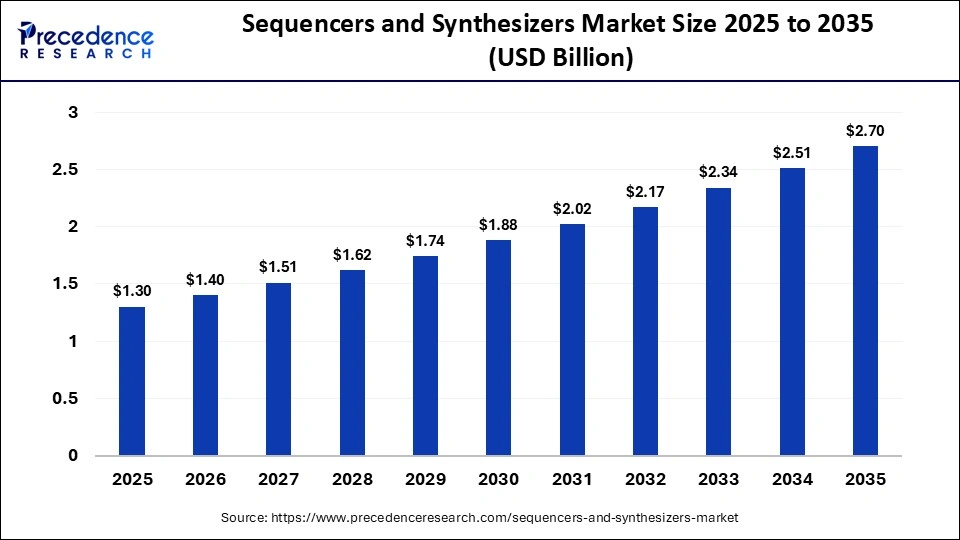
The global sequencers and synthesizers market is witnessing steady growth, fueled by the rapid transformation of the music industry through digital technologies. Valued at USD 1.30 billion in 2025, the market is projected to reach approximately USD 2.70 billion by 2035, expanding at a CAGR of 7.60% during the forecast period.
The growing popularity of electronic music, increasing number of independent creators, and advancements in artificial intelligence (AI) are redefining how music is produced and consumed. Sequencers and synthesizers, once limited to professional studios, are now widely used by hobbyists, DJs, and content creators worldwide.
Read Also: Model Evaluation and Benchmarking Tools Market
What Are Sequencers and Synthesizers?
Sequencers and synthesizers are electronic tools used in music production:
- Synthesizers generate sound by creating audio signals.
- Sequencers arrange and trigger sounds in a structured format.
Together, they enable artists to create complex compositions, layered soundscapes, and dynamic audio experiences.
Market Growth Drivers
1. Expansion of Digital Music Production
The rise of digital audio workstations (DAWs) and affordable music production tools has made it easier for individuals to produce high-quality music. This democratization of music creation is significantly boosting demand for sequencers and synthesizers.
2. Growth of Live Performances and DJ Culture
Music festivals, concerts, and DJ events are gaining popularity worldwide. These events rely heavily on advanced sound equipment, including synthesizers and sequencers, for real-time audio manipulation.
3. Rise of Independent Artists
Streaming platforms and social media have enabled independent artists to reach global audiences. As a result, there is increasing demand for accessible and versatile music production tools.
4. Increasing Internet Penetration
The global reach of digital platforms has expanded the music audience, encouraging experimentation with new sounds and genres.
Role of Artificial Intelligence in Music Production
Artificial intelligence is transforming the sequencers and synthesizers market by introducing automation and intelligent sound design.
AI-powered tools can:
- Generate melodies and beats
- Assist in composition
- Analyze patterns and suggest improvements
These innovations are reducing production time and enabling artists to focus more on creativity. AI is also making music production accessible to beginners by simplifying complex processes.
Market Trends
Shift Toward Software-Based Solutions
Software synthesizers integrated with DAWs are gaining popularity due to their affordability and flexibility. They allow users to create and edit music seamlessly.
Rise of Hybrid Synthesizers
Hybrid synthesizers, which combine analog and digital features, are becoming increasingly popular among professionals seeking both warmth and precision in sound.
Increasing Demand for Portable Devices
Compact and portable synthesizers are enabling on-the-go music creation, attracting modern creators who value mobility.
By Product Type: Which Segment Leads the Market?
The market is broadly segmented into hardware sequencers, software sequencers, and hybrid systems.
Hardware sequencers currently dominate the market, accounting for the largest revenue share. These devices are widely preferred by professional musicians and live performers due to their reliability, tactile control, and superior performance in real-time environments. Hardware-based setups are often used in concerts and studio recordings where precision and stability are critical.
On the other hand, software sequencers are emerging as the fastest-growing segment. Their integration with digital audio workstations (DAWs), affordability, and ease of use make them highly attractive to independent artists, beginners, and home studio users. With the rise of subscription-based software models, accessibility has significantly improved.
Hybrid systems, combining both hardware and software capabilities, are gaining traction among professionals who seek flexibility, advanced control, and seamless workflow integration. These systems represent the future of music production, offering the best of both worlds.
By Synthesizer Type: Why Are Analog Synthesizers Still Dominant?
The synthesizer market is segmented into analog, digital, and hybrid synthesizers.
Analog synthesizers continue to lead due to their warm, rich, and organic sound quality, which is highly valued in genres such as electronic, ambient, and experimental music. Many artists prefer analog systems for their authenticity and unique tonal characteristics.
Digital synthesizers, while slightly behind in market share, are widely used for their versatility, compact design, and advanced features. They allow users to replicate a wide range of sounds and are often more affordable than analog systems.
Hybrid synthesizers are witnessing the fastest growth. By combining analog sound generation with digital processing capabilities, they provide enhanced sound design flexibility, making them increasingly popular among modern producers.
By Application: Where is Demand Highest?
Based on application, the market is categorized into music production, DJing & live performance, and others (including film, gaming, and media production).
Music production holds the largest share, driven by the growing number of independent artists, content creators, and music studios. The accessibility of digital tools has significantly expanded this segment.
The DJing and live performance segment is growing rapidly due to the increasing popularity of music festivals, concerts, and electronic dance music (EDM) culture. Sequencers and synthesizers are essential for live sound manipulation and performance enhancement.
Additionally, the film and gaming industries are emerging as important users, utilizing these tools for background scores, sound effects, and immersive audio experiences.
By End-Use Industry: Who Are the Major Users?
The key end-use industries include music & entertainment, education, and others.
The music and entertainment industry dominates the market, accounting for the largest share. This includes recording studios, production houses, DJs, and live performers who rely heavily on these tools.
The education sector is witnessing increasing adoption, particularly in music schools, universities, and training institutes. As music production becomes more digital, educational institutions are incorporating sequencers and synthesizers into their curricula.
Other sectors, including media, advertising, and gaming, are also contributing to market growth by using advanced sound design tools for content creation.
Regional Analysis
North America
North America leads the market, accounting for the largest share due to its established music industry and high adoption of advanced technologies.
Asia Pacific
Asia Pacific is the fastest-growing region, driven by increasing digital adoption, rising disposable income, and a growing base of content creators.
Europe
Europe maintains a strong presence due to its rich music culture and increasing adoption of digital production tools.
Competitive Landscape
Key players in the market include:
- Yamaha Corporation
- Roland Corporation
- Korg Inc.
- Moog Music Inc.
- Arturia
- Akai Professional
- Pioneer DJ
These companies are focusing on innovation, including AI integration, hybrid technologies, and portable solutions to stay competitive.
Challenges in the Market
Despite steady growth, the market faces several challenges:
- High cost of advanced hardware
- Complexity of professional tools
- Learning curve for beginners
However, ongoing technological advancements are expected to address these barriers.
Future Opportunities
The market presents significant opportunities, including:
- Growth of AI-powered music tools
- Expansion of home studios
- Increasing adoption in education
- Rising demand for personalized sound creation
These factors are expected to drive long-term market growth.
Conclusion
The sequencers and synthesizers market is evolving as a key component of the global music industry. With advancements in AI, growing digital adoption, and the rise of independent creators, the market is set for sustained growth.
As technology continues to redefine creativity, sequencers and synthesizers will remain at the forefront of music innovation—empowering artists to explore new possibilities and shape the future of sound.
Get Sample Link: https://www.precedenceresearch.com/sample/8338
For inquiries regarding discounts, bulk purchases, or customization requests, please contact us at [email protected]
