
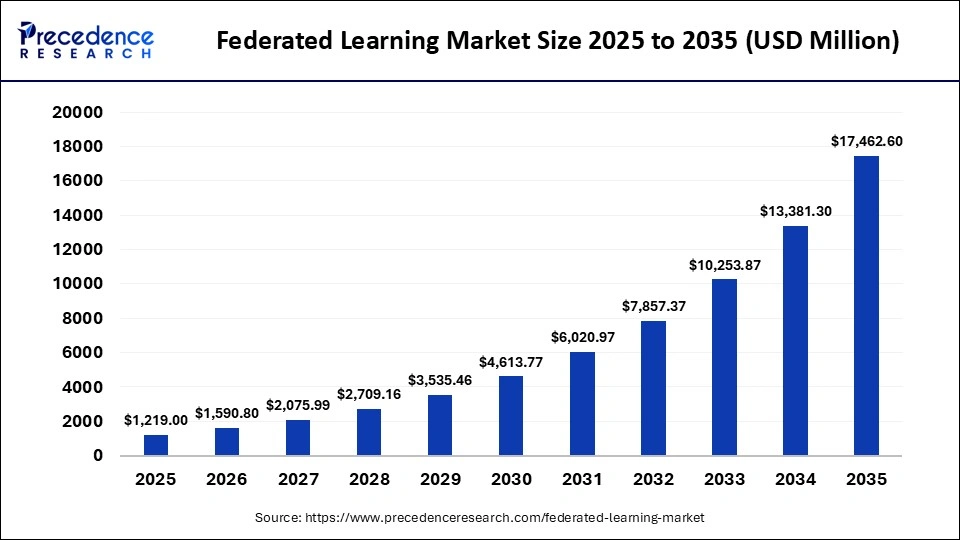
The global federated learning market is witnessing exponential growth as organizations increasingly prioritize data privacy, security, and decentralized AI capabilities. The market size was valued at USD 1,219.00 million in 2025 and is projected to reach approximately USD 17,462.60 million by 2035, expanding at a remarkable CAGR of 30.50% during the forecast period.
Federated learning is emerging as a breakthrough technology that enables organizations to train machine learning models across decentralized data sources without transferring sensitive data to a central server. This approach is gaining significant traction across industries such as healthcare, BFSI, telecommunications, and automotive.
Read Also: Sequencers and Synthesizers Market
What is Federated Learning?
Federated learning is a machine learning approach that allows multiple devices or organizations to collaboratively train a shared model while keeping data localized. Instead of sending raw data to a central system, only model updates are shared, ensuring enhanced privacy and security.
This method is particularly valuable in environments where data sensitivity, regulatory compliance, and data sovereignty are critical.
Market Growth Drivers
1. Rising Demand for Privacy-Preserving AI
With increasing concerns over data breaches and strict regulations such as GDPR and HIPAA, organizations are adopting federated learning to ensure compliance while leveraging AI capabilities.
2. Growth of Edge Computing and IoT
The rapid expansion of IoT devices and edge computing infrastructure is driving demand for decentralized AI solutions. Federated learning enables real-time processing and decision-making at the edge, reducing latency and improving efficiency.
3. Increasing Adoption Across Industries
Industries such as healthcare and finance are leveraging federated learning to enable secure collaboration and improve predictive analytics without compromising sensitive data.
4. Data Localization and Sovereignty Requirements
Governments worldwide are implementing data localization laws, making federated learning an ideal solution for organizations operating across multiple regions.
Role of Artificial Intelligence in Federated Learning
Artificial intelligence is at the core of federated learning, enabling decentralized model training and intelligent data processing. AI algorithms are designed to learn from distributed datasets while maintaining data privacy.
Advanced AI techniques such as differential privacy, secure multi-party computation, and homomorphic encryption are enhancing the effectiveness of federated learning systems. These innovations ensure that data remains secure while improving model accuracy and performance.
Furthermore, AI integration is enabling real-time decision-making, particularly in applications such as autonomous systems, healthcare diagnostics, and financial risk analysis.
Market Trends
Shift Toward Decentralized AI
Organizations are moving away from centralized data models toward decentralized architectures that prioritize security and scalability.
Integration with Edge AI
Federated learning is increasingly being integrated with edge computing, enabling faster data processing and reducing reliance on centralized infrastructure.
Adoption of Advanced Security Techniques
The use of encryption technologies and privacy-enhancing methods is becoming a key trend, ensuring secure model training and data protection.Segment Analysis
By Model Type
Deep learning models dominate the market, accounting for the largest share due to their ability to handle complex datasets. These models are widely used in applications such as image recognition and natural language processing.
Reinforcement learning models are expected to grow at the fastest rate, driven by their application in real-time decision-making systems such as robotics and autonomous vehicles.
By Application
The healthcare and life sciences segment leads the market, driven by the need for secure data sharing in medical research and diagnostics. Federated learning enables collaboration without exposing sensitive patient data.
The BFSI sector is another major contributor, using federated learning for fraud detection, risk assessment, and compliance management.
By Deployment Mode
Cloud-based solutions dominate the market due to their scalability and flexibility. However, hybrid deployment models are gaining popularity as they offer a balance between security and performance.
By End-User
Healthcare providers and pharmaceutical companies are the largest end-users, followed by financial institutions and telecommunications companies. These industries require secure and efficient data processing solutions.
Regional Analysis
North America
North America leads the global market, accounting for approximately 40% share, driven by strong AI adoption, advanced infrastructure, and the presence of major technology companies.
Europe
Europe holds a significant share due to strict data protection regulations and increasing focus on ethical AI.
Asia Pacific
Asia Pacific is the fastest-growing region, supported by rapid digital transformation, increasing AI adoption, and expanding cloud infrastructure in countries such as China, India, and Japan.
Competitive Landscape
Key players in the federated learning market include:
- Google LLC
- Apple Inc.
- IBM Corporation
- Microsoft Corporation
- Intel Corporation
- NVIDIA Corporation
- Huawei Technologies Co., Ltd.
- Cisco Systems, Inc.
- Samsung Electronics
- Qualcomm Technologies, Inc.
- Accenture Plc
- Alibaba Cloud
These companies are investing heavily in research and development to enhance federated learning capabilities and expand their market presence.
Challenges in the Market
Despite its strong growth potential, the federated learning market faces several challenges:
- Data heterogeneity across distributed systems
- High implementation costs
- Lack of standardization and interoperability
- Technical complexity
Addressing these challenges will be crucial for widespread adoption.
Future Opportunities
The market presents significant growth opportunities, including:
- Expansion of edge AI and IoT applications
- Increasing adoption in healthcare and finance
- Development of advanced privacy-preserving technologies
- Growth of decentralized data ecosystems
Get Sample Link: https://www.precedenceresearch.com/sample/8339
For inquiries regarding discounts, bulk purchases, or customization requests, please contact us at [email protected]
