
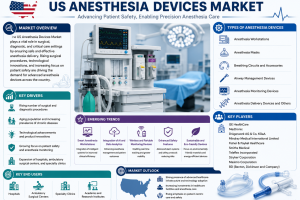
The US anesthesia devices market is an essential component of the healthcare industry, supporting millions of surgical, diagnostic, and emergency procedures performed each year. Anesthesia devices help healthcare professionals administer anesthetic agents safely while continuously monitoring patient conditions during medical interventions. As healthcare providers focus on improving patient safety and surgical outcomes, the demand for advanced anesthesia technologies continues to rise across the United States.
Growing surgical volumes, increasing prevalence of chronic diseases, and continuous innovation in medical technologies are driving the adoption of modern anesthesia equipment. Healthcare facilities are increasingly investing in sophisticated anesthesia delivery systems, monitoring devices, and airway management solutions to enhance procedural efficiency and patient care.
What is the US Anesthesia Devices Market Size?
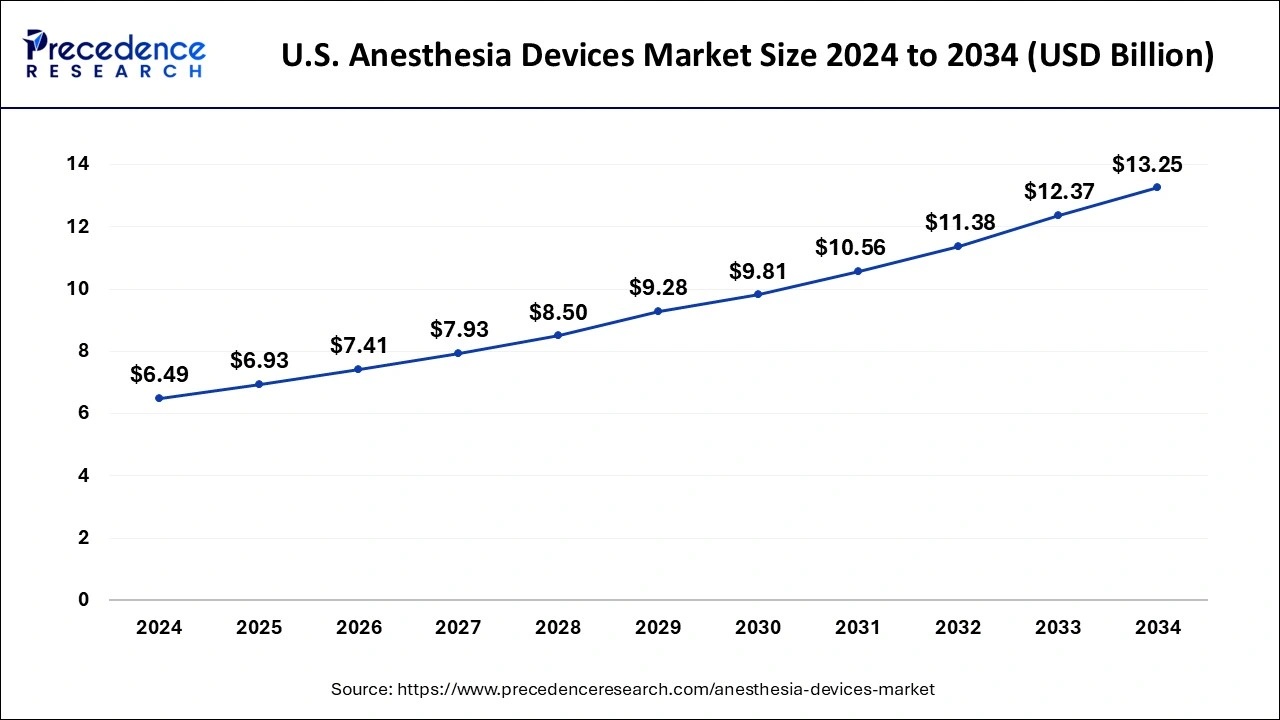
The US anesthesia devices market size was calculated at USD 6.93 billion in 2025 and is predicted to increase from USD 7.41 billion in 2026 to approximately USD 14.20 billion by 2035, expanding at a CAGR of 7.44% from 2026 to 2035. The market growth is attributed to increasing surgical procedure volumes, expanding ambulatory care infrastructure, and continuous advancements in anesthesia delivery and patient monitoring technologies.
Market Highlights
- By product, the anesthesia delivery machine segment held the largest market share in 2025.
- By product, the anesthesia disposables and accessories segment is expected to expand with the highest CAGR during the forecast period.
- By type, the general anesthesia segment held the largest share of the market in 2025.
- By type, the local anesthesia segment is expected to grow with the highest CAGR between 2026 and 2035.
- By application, the cardiology segment held the highest share of the market in 2025.
- By application, the ophthalmology segment is expected to grow with the highest CAGR during the forecast period.
- By end user, the hospitals segment held the highest share of the market in 2025.
- By end user, the ambulatory service centers segment is expected to grow with the highest CAGR during the forecast period.
Market Overview
Anesthesia devices are used to administer anesthesia before, during, and after medical procedures. These devices include anesthesia workstations, anesthesia delivery systems, monitoring equipment, ventilators, breathing circuits, vaporizers, and airway management devices.
The market is benefiting from the increasing number of surgical procedures performed in hospitals, ambulatory surgical centers, and specialty clinics. The growing emphasis on patient safety and precision medicine is further encouraging healthcare organizations to adopt technologically advanced anesthesia solutions.
Key Factors Driving Market Growth
Rising Number of Surgical Procedures
The increasing volume of surgical procedures remains one of the primary drivers of the market. As the aging population grows and chronic disease cases rise, the need for surgical interventions continues to increase, creating sustained demand for anesthesia equipment.
Growing Focus on Patient Safety
Healthcare providers are placing greater emphasis on minimizing anesthesia-related complications and improving patient outcomes. Modern anesthesia devices offer enhanced monitoring capabilities, automated safety features, and real-time data analysis that support safer clinical practices.
Technological Advancements
Continuous innovation is transforming anesthesia care. Smart anesthesia workstations, integrated monitoring systems, wireless connectivity, and digital health solutions are improving workflow efficiency and clinical decision-making.
Expansion of Ambulatory Surgical Centers
The growing popularity of outpatient procedures is increasing demand for portable and efficient anesthesia devices. Ambulatory surgical centers require compact, user-friendly equipment that supports high-quality care while maintaining operational efficiency.
Impact of Artificial Intelligence on the Market
Artificial intelligence is emerging as a valuable tool in anesthesia management. AI-powered systems can analyze patient data, predict potential complications, and assist anesthesiologists in optimizing anesthesia delivery.
Machine learning algorithms are being integrated into monitoring platforms to provide real-time insights into patient conditions during surgery. These technologies help clinicians make informed decisions, improve safety, and reduce the risk of adverse events.
AI is also supporting predictive analytics, enabling healthcare providers to personalize anesthesia plans based on individual patient characteristics and medical histories.
Emerging Market Trends
- Smart Anesthesia Workstations: Modern anesthesia workstations are incorporating advanced software, automation capabilities, and integrated monitoring features to improve operational efficiency and patient care.
- Portable Monitoring Solutions: Healthcare facilities are increasingly adopting portable anesthesia monitoring devices that offer flexibility and real-time patient tracking across various clinical settings.
- Integration of Digital Healthcare Technologies: The convergence of digital health platforms and anesthesia equipment is enabling seamless data sharing, remote monitoring, and enhanced clinical workflows.
- Sustainable Medical Equipment: Manufacturers are focusing on environmentally friendly anesthesia devices that reduce waste, improve energy efficiency, and support sustainability initiatives within healthcare systems.
Market Report Coverage and Key Metrics
| Report Coverage | Details |
| Market Size in 2025 | USD 6.93 Billion |
| Market Size in 2026 | USD 7.41 Billion |
| Market Size by 2035 | USD 14.20 Billion |
| Market Growth Rate from 2026 to 2035 | CAGR of 7.44% |
| Base Year | 2025 |
| Forecast Period | 2026 to 2035 |
| Segments Covered | Product, Type, Application, and End User |
Opportunity
Surging Technological Advancements in Anesthesia Workstations
Surging technological advancements in anesthesia workstations are estimated to create immense opportunities for the players competing in the market. There is a growing trend in the healthcare industry towards implementing connected systems that work in unison with other systems, such as EMRs and perioperative management software. Furthermore, the High demand for minimally invasive and complex surgical procedures is likely to strengthen investment in advanced anesthesia equipment.
U.S. Anesthesia Devices Market Value Chain Analysis
- Raw Material & Electronic Component Sourcing
Medical-grade plastics, sensors, semiconductors, valves, circuit boards, and precision metal components form the foundation of anesthesia device manufacturing.
Key Players: TE Connectivity, Honeywell, Amphenol, Molex, DuPont.
- Device Manufacturing & System Integration
Manufacturers assemble anesthesia workstations, ventilators, vaporizers, and monitoring systems under stringent quality and regulatory standards.
Key Players: GE HealthCare, Dräger, Philips, Mindray, Getinge.
- Distribution & Healthcare Procurement
Completed devices move through distributors and direct sales networks to hospitals, clinics, and ambulatory surgical centers.
Key Players: Cardinal Health, Medline Industries, McKesson, Owens & Minor.
- Clinical Deployment & Aftermarket Services
Healthcare facilities deploy systems for surgical procedures while manufacturers provide maintenance, software upgrades, and technical support.
Key Players: GE HealthCare, Dräger, Philips, Mindray, Baxter International.
Competitive Landscape
The market is characterized by strong competition among medical device manufacturers focused on innovation, product development, and strategic partnerships. Companies are investing in advanced monitoring technologies, AI-powered solutions, and next-generation anesthesia workstations to strengthen their market presence.
Leading players are also expanding their product portfolios to address the growing demand for integrated anesthesia management solutions across healthcare facilities.
U.S. Anesthesia Devices Market Companies
- aXcent medical
- BPL Medical Technologies
- Drägerwerk AG & Co. KGaA
- GE Healthcare
- Getinge AB
- Heal Force Bio-Meditech Holdings Limited
- Koninklijke Philips N.V.
- Medtronic
- Mindray Bio-Medical Electronics Co., Ltd.
- Penlon
Get Sample Link: https://www.precedenceresearch.com/sample/8517
Future Outlook
The future of the US anesthesia devices market will be shaped by technological innovation, increasing surgical demand, and the growing integration of artificial intelligence into clinical workflows. As healthcare providers continue to prioritize patient safety, precision medicine, and operational efficiency, demand for advanced anesthesia technologies is expected to remain strong.
With continuous advancements in monitoring capabilities, digital connectivity, and smart anesthesia systems, the market is well-positioned to support the evolving needs of modern healthcare and improve patient outcomes across the country.
Segments Covered in the Report
By Product
- Anesthesia Delivery Machine
- Anesthesia Disposables & Accessories
- Laryngoscopes
- HME
- Anesthesia Circuits
- Anesthesia Masks
- Others
- Anesthesia Monitors
- Anesthesia Information Management Systems (AIMS)
By Type
- General Anesthesia
- Local Anesthesia
By Application
- Cardiology
- Neurology
- Urology
- Orthopedics
- Dental
- Ophthalmology
- Others
By End User
- Clinics
- Ambulatory Service Centers
- Hospitals
Also Read Our Latest Article : US Pathology Laboratories Market

- US Peptide Therapeutics Market: Revolutionizing Targeted Treatment and Precision Medicine - June 25, 2026
- US Anesthesia Devices Market: Advancing Patient Safety and Precision in Surgical Care - June 25, 2026
- US Pathology Laboratories Market: Transforming Diagnostics Through Innovation and Precision Medicine - June 25, 2026