
The global inorganic scintillators market is steadily expanding as demand rises for advanced radiation detection and high-precision imaging systems. The market was valued at USD 780.00 million in 2025 and is projected to grow from USD 833.82 million in 2026 to approximately USD 1,520.10 million by 2035, registering a CAGR of 6.90% during the forecast period.
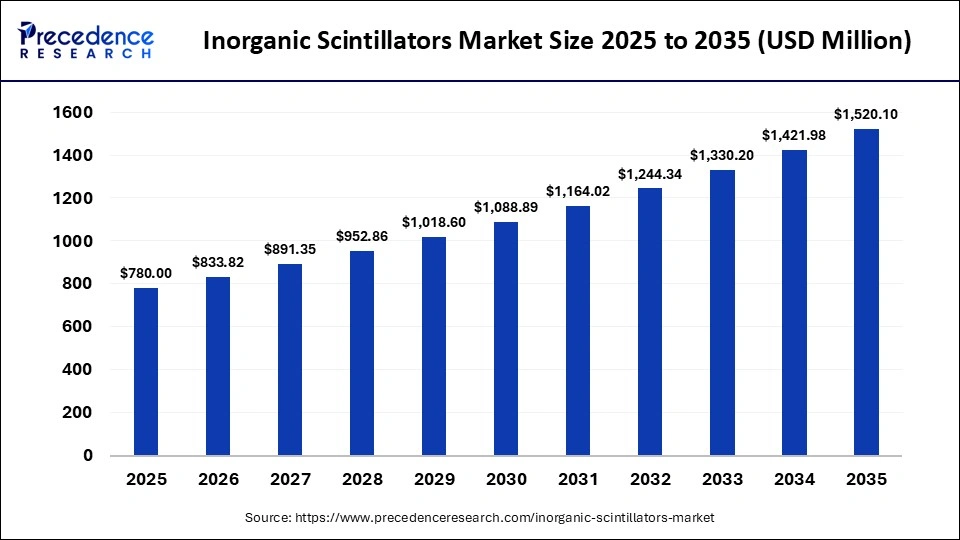
This growth is driven by increasing applications in medical imaging, nuclear power, homeland security, and high-energy physics research. As industries demand higher sensitivity, faster response times, and improved accuracy, inorganic scintillators are becoming indispensable components in modern detection technologies.
Read Also: Sovereign AI Infrastructure Market
Quick Insights: Market Highlights
- The market is expected to nearly double in value by 2035, reflecting stable long-term demand.
- North America dominates with a 38% market share in 2025.
- Healthcare & diagnostics lead end-use with a 45% share.
- Medical imaging dominates applications with a 40% share.
- Sodium iodide (NaI) leads material segment with a 35% share.
- SiPM-based detection systems are fastest-growing with ~9.5% CAGR.
What are Inorganic Scintillators and Why Are They Important?
Inorganic scintillators are crystalline materials that convert high-energy radiation (such as X-rays and gamma rays) into visible light, enabling detection and measurement.
They play a crucial role in:
- Medical imaging systems like PET, CT, and SPECT
- Nuclear radiation monitoring
- Security scanning systems
- Scientific research in particle physics
Their ability to deliver high sensitivity, durability, and precision makes them essential in applications where accurate radiation detection is critical.
Market Dynamics: What is Driving Growth?
Rising Demand in Medical Imaging
The increasing use of diagnostic imaging technologies such as CT scans and PET imaging is a major growth driver. Rising chronic diseases and demand for early diagnosis are accelerating adoption.
Growing Need for Radiation Detection
Governments and industries are investing heavily in radiation detection systems for nuclear safety, environmental monitoring, and homeland security applications.
Expansion of Nuclear Energy and Security Infrastructure
The expansion of nuclear power plants and increased global security concerns are boosting demand for reliable scintillation detectors.
Role of AI in the Inorganic Scintillators Market
Artificial intelligence is increasingly influencing the inorganic scintillators ecosystem by enhancing both performance and application efficiency.
AI-driven imaging systems are improving diagnostic accuracy by optimizing signal processing and reducing noise in scintillation-based detectors. This leads to clearer imaging results and better clinical outcomes.
Additionally, AI is being used in material research to accelerate the development of next-generation scintillator materials with improved sensitivity, faster response times, and enhanced durability. This is expected to unlock new capabilities in high-energy physics and medical diagnostics.
Key Market Trends
Shift Toward High-Performance Materials
Advanced materials such as lutetium-based scintillators (LSO/LYSO) are gaining traction due to superior resolution and faster response times.
Rise of Silicon Photomultiplier (SiPM) Technology
SiPM-based detection systems are rapidly replacing traditional PMT systems due to their compact size and higher efficiency.
Increasing Demand in Healthcare Applications
Healthcare remains the largest application area, with growing adoption of advanced imaging technologies.
Expansion in Defense and Security
Scintillators are increasingly used in border security, airport screening, and nuclear threat detection systems.
Regional Analysis
North America — Market Leader
North America dominates due to advanced healthcare infrastructure, strong research capabilities, and high adoption of imaging technologies.
Asia Pacific — Fastest Growing
Asia Pacific is projected to grow at the fastest CAGR of 8.8%, driven by expanding healthcare systems and increasing investments in nuclear energy and security.
Europe — Strong Research Ecosystem
Europe maintains steady growth due to strong research institutions and increasing adoption of advanced detection technologies.
Competitive Landscape
Key Companies
- Saint-Gobain Crystals
- Hamamatsu Photonics
- Dynasil Corporation
- Hitachi Metals
- Toshiba Materials
- Radiation Monitoring Devices
- Scionix Holland
- EPIC Crystal Company
These companies are focusing on material innovation, detector efficiency, and strategic partnerships to strengthen their market position.
Challenges: What’s Limiting Market Growth?
- High manufacturing and material costs
- Performance limitations such as temperature sensitivity
- Complex production processes
- Limited scalability for certain applications
Opportunities: Where is the Market Heading?
How Are Advanced Materials Driving Growth?
New scintillator materials with higher sensitivity and faster response times are opening new application areas.
Why is Healthcare the Biggest Opportunity?
Rising demand for advanced diagnostic imaging is creating strong growth potential.
What Role Does Innovation Play?
Continuous R&D is expected to enhance performance and reduce costs, driving broader adoption.
Case Study: Scintillators in PET Imaging
A leading hospital integrated advanced lutetium-based scintillators into PET imaging systems, achieving higher resolution imaging and faster scan times. This significantly improved diagnostic accuracy and patient throughput, highlighting the real-world impact of innovation.
Get a Sample Copy: https://www.precedenceresearch.com/sample/8322
For inquiries regarding discounts, bulk purchases, or customization requests, please contact us at [email protected]
