
The rapid expansion of artificial intelligence (AI), cloud computing, and high-performance computing (HPC) is transforming the way data centers are designed and operated. As modern processors become more powerful, they generate significantly more heat than traditional air-cooling systems can efficiently manage. This shift has accelerated the adoption of liquid cooling technologies, making liquid cooling manifolds an essential component of next-generation data center infrastructure.
The Data Center Liquid Cooling Manifolds Market is gaining strong momentum as hyperscale operators, cloud service providers, and enterprise data centers seek reliable cooling solutions that improve energy efficiency, reduce operating costs, and support increasingly dense computing environments. As organizations deploy AI clusters and GPU-intensive workloads, liquid cooling manifolds are becoming critical to maintaining system performance and long-term operational reliability.
What is the Data Center Liquid Cooling Manifolds Market Size?
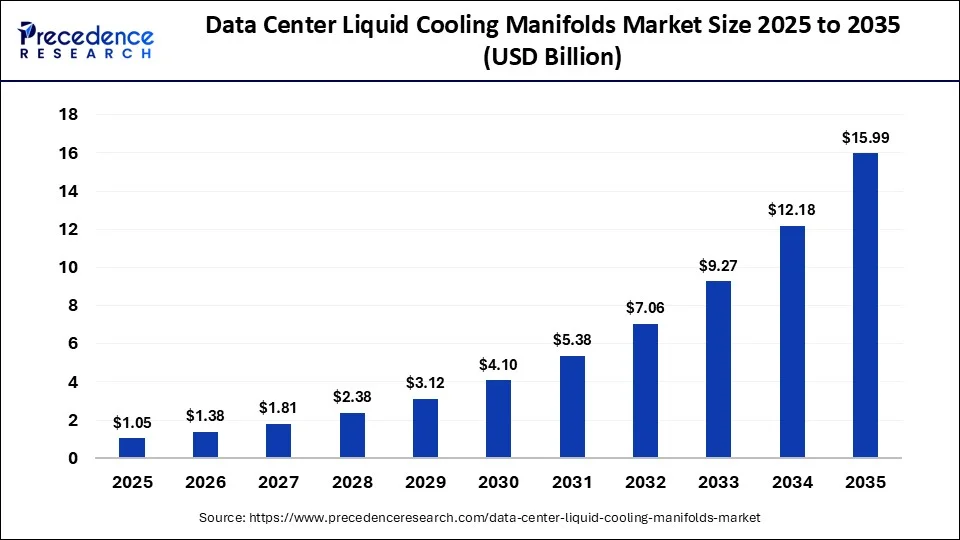
The global data center liquid cooling manifolds market size accounted for USD 1.05 billion in 2025 and is predicted to increase from USD 1.38 billion in 2026 to approximately USD 15.99 billion by 2035, expanding at a CAGR of 31.30% from 2026 to 2035. The market growth is attributed to the rising adoption of direct liquid cooling technologies and the increasing demand for energy-efficient thermal management solutions that support high-density computing infrastructure.
Market Highlights
- North America dominated the data center liquid cooling manifolds market with 41% of the market share in 2025.
- Asia-Pacific is expected to register a rapid growth of 35.7% CAGR during 2026 and 2035.
- By manifold type, the supply manifolds segment contributed the highest market share of 38% in 2025.
- By manifold type, the integrated supply and return manifolds segment is expected to grow at the fastest CAGR of 34.8% between 2026 and 2035.
- By cooling technology, the direct-to-chip liquid cooling segment held a major market share of 58% in 2025.
- By cooling technology, the immersion cooling segment is expected to register the fastest growth of 39.8% CAGR during 2026 and 2035.
- By material, the stainless steel segment contributed the highest data center liquid cooling manifolds market share of 46% in 2025.
- By material, the engineering plastics and composites segment is estimated to grow at a strong CAGR of 37.2% over the projected period.
- By application, the AI and high-performance computing (HPC) segment held a 46% share of the market in 2025 and is expected to grow at a rapid CAGR of 36.8% between 2026 and 2035.
- By application, cloud computing held the second-largest market share of 28% during 2026 and 2035.
- By end user, the cloud service providers segment contributed the highest market share of 41% in 2025 and is expected to grow at the highest CAGR of 35.9% between 2026 and 2035.
- By end user, colocation operators held the second-largest market share of 26% in 2025.
What Are Data Center Liquid Cooling Manifolds?
A liquid cooling manifold is a distribution unit that regulates and directs coolant to multiple servers, racks, or cooling loops within a data center. Instead of relying solely on air circulation, manifolds ensure that coolant flows efficiently through cold plates or direct-to-chip cooling systems, removing heat from high-performance processors.
These systems help maintain optimal operating temperatures while supporting consistent performance across mission-critical IT infrastructure.
Why Is the Data Center Liquid Cooling Manifolds Market Growing?
Several technology and infrastructure trends are driving market expansion.
Rising AI Workloads
Artificial intelligence applications require powerful GPUs and accelerators that consume far more energy than traditional CPUs. As heat generation increases, liquid cooling becomes a practical solution for maintaining stable operating conditions.
Expansion of Hyperscale Data Centers
Global cloud providers continue investing in large-scale facilities equipped with thousands of high-performance servers. Liquid cooling manifolds allow operators to efficiently distribute coolant across extensive rack deployments while maintaining reliability and scalability.
Higher Rack Power Density
Modern server racks often operate at much higher power densities than previous generations. Traditional air cooling struggles to dissipate this level of heat, encouraging greater adoption of liquid cooling infrastructure.
Increasing Focus on Energy Efficiency
Cooling systems account for a substantial portion of data center energy consumption. Liquid cooling manifolds help improve thermal efficiency, reduce cooling power requirements, and lower overall energy usage.
How Liquid Cooling Manifolds Work
Liquid cooling manifolds function as centralized coolant distribution systems.
A typical system includes:
- Coolant supply and return lines
- Flow control valves
- Pressure monitoring components
- Leak detection mechanisms
- Quick-disconnect connectors
- Temperature sensors
- Distribution headers
The manifold delivers coolant directly to servers or cold plates, absorbs heat generated by processors, and returns the warmed coolant to heat exchangers or cooling units before recirculation.
This closed-loop process enables efficient thermal management with minimal coolant loss.
Key Benefits of Liquid Cooling Manifolds
Organizations adopting liquid cooling solutions benefit in several ways.
- Improved Thermal Performance: Liquid transfers heat much more efficiently than air, allowing servers to maintain optimal operating temperatures even under intensive AI workloads.
- Greater Energy Efficiency: Efficient cooling reduces the need for large air-conditioning systems and lowers overall power consumption.
- Higher Computing Density: Data centers can deploy more computing power within the same physical space without exceeding thermal limits.
- Reduced Operating Costs: Lower energy consumption, improved cooling efficiency, and reduced equipment failures contribute to long-term cost savings.
- Enhanced Equipment Reliability: Maintaining stable temperatures helps extend server lifespan while minimizing unexpected downtime.
Major Technology Trends
The market continues evolving through several important innovations.
- Direct-to-Chip Liquid Cooling: Direct-to-chip cooling delivers coolant directly to CPUs and GPUs using specialized cold plates, significantly improving heat removal efficiency.
- Rear Door Heat Exchangers: Rear door cooling systems complement liquid cooling manifolds by removing residual heat before it enters the data center environment.
- Intelligent Cooling Management: Modern cooling infrastructure increasingly incorporates sensors and software capable of monitoring coolant flow, pressure, temperature, and equipment performance in real time.
- Sustainable Cooling Solutions: As organizations pursue environmental goals, manufacturers are developing cooling systems that reduce water usage, improve energy efficiency, and support low-carbon data center operations.
- Applications Across Industries: Liquid cooling manifolds are increasingly used across multiple sectors.
- Hyperscale Cloud Providers: Large cloud operators rely on advanced cooling systems to support AI training clusters and high-density server deployments.
Challenges Facing the Market
Despite significant growth opportunities, several challenges remain.
- High Initial Investment: Liquid cooling infrastructure requires greater upfront investment than conventional air cooling systems.
- Complex Installation: Implementing liquid cooling demands specialized engineering, plumbing, and maintenance expertise.
- Compatibility Considerations: Existing facilities may require infrastructure upgrades before adopting advanced liquid cooling technologies.
- Leak Prevention: Manufacturers continue improving connector designs, monitoring systems, and safety mechanisms to minimize leakage risks.
Regional Market Outlook
North America remains a leading market due to expanding AI infrastructure, cloud computing investments, and hyperscale data center construction.
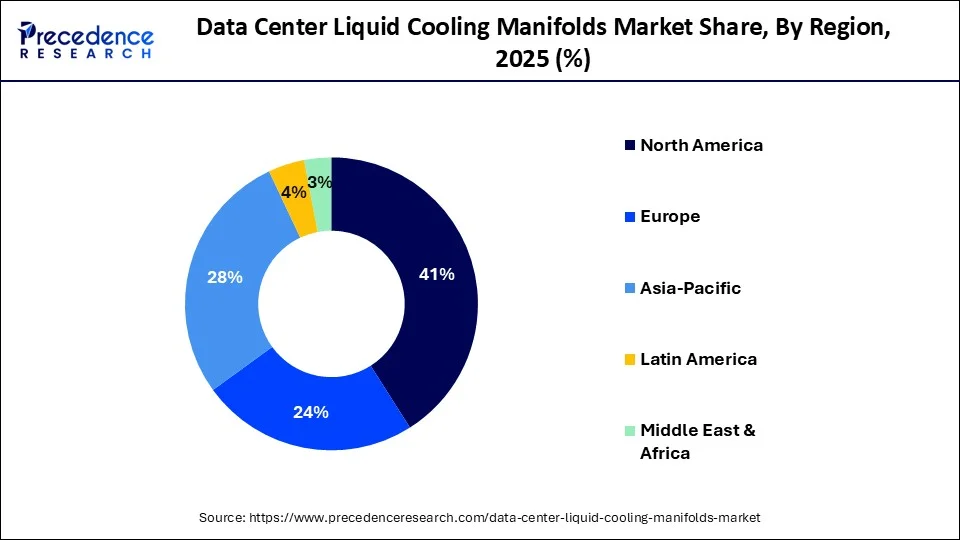
European countries continue investing in sustainable and energy-efficient data center technologies, encouraging adoption of liquid cooling solutions.
Asia-Pacific is expected to experience rapid growth as countries including China, India, Japan, South Korea, and Singapore continue expanding digital infrastructure and AI capabilities.
Competitive Landscape
The Data Center Liquid Cooling Manifolds Market features established cooling technology providers alongside emerging innovators focused on advanced thermal management solutions.
Leading companies continue investing in:
- AI-ready cooling infrastructure
- Modular manifold systems
- Intelligent monitoring software
- High-performance coolant distribution
- Sustainable cooling technologies
- Strategic partnerships with hyperscale cloud providers
Innovation remains the primary competitive differentiator as customer requirements continue evolving.
Future Outlook
The future of the Data Center Liquid Cooling Manifolds Market appears highly promising.
- Growing AI adoption, GPU-intensive computing, edge data center expansion, and sustainability initiatives are expected to accelerate demand for advanced liquid cooling infrastructure.
- As server power densities continue increasing, liquid cooling manifolds will become a standard component of modern data center design rather than a specialized technology reserved for high-performance computing.
- Manufacturers investing in intelligent thermal management, modular system architectures, and energy-efficient designs will be well positioned to capitalize on long-term market growth.
Get Sample Link : https://www.precedenceresearch.com/sample/8536
Recent Developments
- In June 2026, JetCool, a Flex company, announced a liquid-cooled version of the Dell PowerEdge XE7745 server. This integrated solution includes deployment, maintenance services, and unified warranty coverage, reducing complexity for enterprise customers. JetCool offers a streamlined approach for adopting cost-effective, high-density AI infrastructure.
- In June 2026, Google launched Brazos, a rack-mounted liquid cooling system that allows data centers to support high-power AI and HPC chips exceeding 1000 watts without the need for facility upgrades. Brazos enables the use of liquid-cooled equipment within existing air-cooled data centers.
Segments Covered in the Report
By Manifold Type
- Supply Manifolds
- Return Manifolds
- Integrated Supply & Return Manifolds
By Cooling Technology
- Direct-to-Chip Liquid Cooling
- Immersion Cooling
- Single-phase Immersion Cooling
- Two-phase Immersion Cooling
- Rear Door Heat Exchanger
- Cold Plate Cooling
By Material
- Stainless Steel
- Aluminum
- Copper
- Engineering Plastics and Composites
By Number of Ports
- Up to 8 Ports
- 9-16 Ports
- Above 16 Ports
By Mounting Type
- Rack-mounted Manifolds
- Cabinet-mounted Manifolds
- Floor-mounted Manifolds
By Flow Rate
- Below 50 LPM
- 50-150 LPM
- Above 150 LPM
By Data Center Type
- Enterprise Data Centers
- Colocation Data Centers
- Hyperscale Data Centers
- Edge Data Centers
By Application
- AI and High-Performance Computing (HPC)
- Cloud Computing
- Enterprise IT
- Scientific Computing
- Telecommunications
By End User
- Cloud Service Providers
- Colocation Operators
- Enterprises
- Government and Defense
- Research Institutions
- Telecom Operators
By Distribution Channel
- Direct Sales (OEM)
- System Integrators
- Value-Added Resellers (VARs)
- Industrial Distributors
By Region
- North America
- Latin America
- Europe
- Asia-pacific
- Middle and East Africa
Also Read Our Latets Article : Data Center Battery Market

- Polymer Foams Market: Driving Innovation Across Packaging, Automotive, Construction, and Healthcare - July 7, 2026
- Data Center Liquid Cooling Manifolds Market: Enabling the Future of High-Density AI Computing - July 7, 2026
- Data Center Battery Market: Powering the Future of AI-Driven Digital Infrastructure - July 7, 2026