
The global CAD (Computer-Aided Detection) mammography market is experiencing steady growth as healthcare systems increasingly adopt advanced imaging technologies for early cancer detection. The market was valued at USD 1.10 billion in 2025 and is projected to grow from USD 1.20 billion in 2026 to approximately USD 2.70 billion by 2035, expanding at a CAGR of 9.40% during the forecast period.
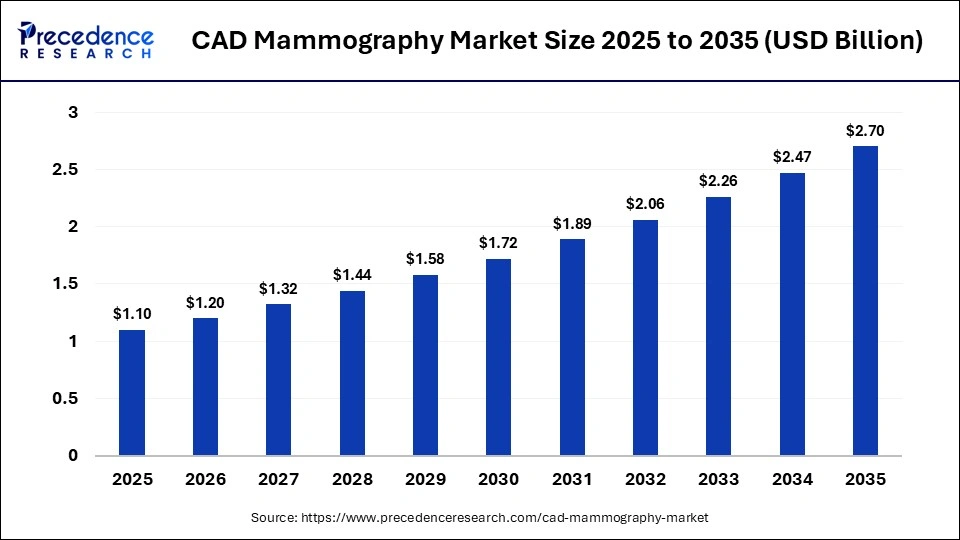
This growth is primarily driven by the rising global burden of breast cancer, increasing screening programs, and the integration of artificial intelligence (AI) into diagnostic imaging. CAD systems are enhancing radiologists’ ability to detect abnormalities earlier and more accurately, improving patient outcomes.
Read Also: Data Labeling and Annotation Tools Market
What is CAD Mammography?
CAD mammography is an advanced imaging technology that uses AI algorithms and machine learning to assist radiologists in identifying suspicious patterns in mammograms. These systems act as a second reader, highlighting potential areas of concern and improving diagnostic accuracy.
By reducing human error and increasing efficiency, CAD mammography plays a crucial role in modern breast cancer screening programs.
Market Growth Drivers
1. Rising Global Burden of Breast Cancer
Breast cancer remains one of the most common cancers worldwide, with over 2.3 million new cases annually. The growing need for early detection is significantly driving demand for advanced mammography systems.
2. Expansion of Screening Programs
Governments and healthcare organizations are expanding breast cancer screening initiatives, increasing the adoption of CAD-enabled imaging systems.
3. Increasing Workload on Radiologists
The rising volume of diagnostic imaging is placing pressure on radiologists, creating demand for automated tools that improve efficiency and accuracy.
4. Advancements in Imaging Technologies
Continuous innovation in digital imaging and AI is enhancing the performance of CAD systems, making them more reliable and widely adopted.
Role of Artificial Intelligence in CAD Mammography
Artificial intelligence is revolutionizing CAD mammography by improving the detection and interpretation of breast cancer signs. AI-powered systems can analyze mammograms in real time, assisting radiologists in making faster and more accurate decisions.
Additionally, AI enables advanced features such as automatic breast density analysis and personalized risk assessment, improving screening outcomes across diverse patient populations. These capabilities are helping healthcare providers manage increasing imaging volumes while maintaining high diagnostic standards.
Segment Analysis
By Type
The market is segmented into 2D mammography and 3D mammography (tomosynthesis).
- 3D mammography dominates the market with a 55% share, due to its superior imaging capabilities and higher accuracy in detecting tumors.
- 2D mammography holds a 45% share and continues to grow due to its affordability and widespread use in screening programs.
By Technology
The market includes Full-Field Digital Mammography (FFDM), Analog Mammography, Digital Breast Tomosynthesis (DBT), and Contrast-Enhanced Mammography (CEM).
- FFDM leads with a 60% share, driven by its widespread use and compatibility with AI systems.
- DBT is gaining traction due to improved diagnostic accuracy.
- CEM is the fastest-growing segment, expected to expand at a 16% CAGR, offering enhanced visualization of abnormal tissues.
By End-Use
The market is segmented into hospitals, diagnostic imaging centers, and screening clinics.
- Hospitals dominate with a 55% share, due to their advanced infrastructure and high patient volumes.
- Diagnostic imaging centers hold 25% share and are growing rapidly due to increasing outpatient imaging demand.
- Screening clinics are expanding as preventive healthcare gains importance.
Regional Analysis
North America
North America leads the global market with a 40% share, supported by advanced healthcare infrastructure, high awareness, and early adoption of AI technologies.
Europe
Europe is the second-largest market, driven by strong government-supported screening programs and increasing adoption of digital healthcare technologies.
Asia Pacific
Asia Pacific is the fastest-growing region, with a CAGR of 10.5%, fueled by rising healthcare investments, growing awareness, and increasing breast cancer incidence.
Competitive Landscape
Key players in the CAD mammography market include:
- GE HealthCare
- Siemens Healthineers
- Hologic, Inc.
- Philips Healthcare
- Fujifilm Holdings Corporation
- Canon Medical Systems Corporation
- Carestream Health, Inc.
- Agfa-Gevaert Group
- Medtronic PLC
These companies are focusing on AI integration, advanced imaging solutions, and strategic collaborations to strengthen their market position.
Challenges in the Market
Despite strong growth, the market faces several challenges:
- High cost of CAD-enabled imaging systems
- Integration complexities with existing healthcare infrastructure
- Limited adoption in low-resource settings
Addressing these challenges is essential for broader market penetration.
Opportunities and Future Trends
The market offers significant opportunities, including:
- Increasing adoption of AI-driven diagnostics
- Growth of personalized screening approaches
- Expansion of preventive healthcare programs
- Rising demand for high-accuracy imaging solutions
Advancements in deep learning and imaging technologies are expected to further enhance diagnostic capabilities and drive market growth.
Get Sample Link: https://www.precedenceresearch.com/sample/8341
For inquiries regarding discounts, bulk purchases, or customization requests, please contact us at [email protected]
