
The global AI in meeting assistants market is entering a phase of rapid transformation as enterprises, educational institutions, healthcare providers, and legal organizations increasingly adopt AI-driven tools to improve productivity and streamline collaboration. The market size stood at USD 1.20 billion in 2025 and is expected to rise from USD 1.42 billion in 2026 to nearly USD 6.28 billion by 2035, expanding at a CAGR of 18.00% during the forecast period.
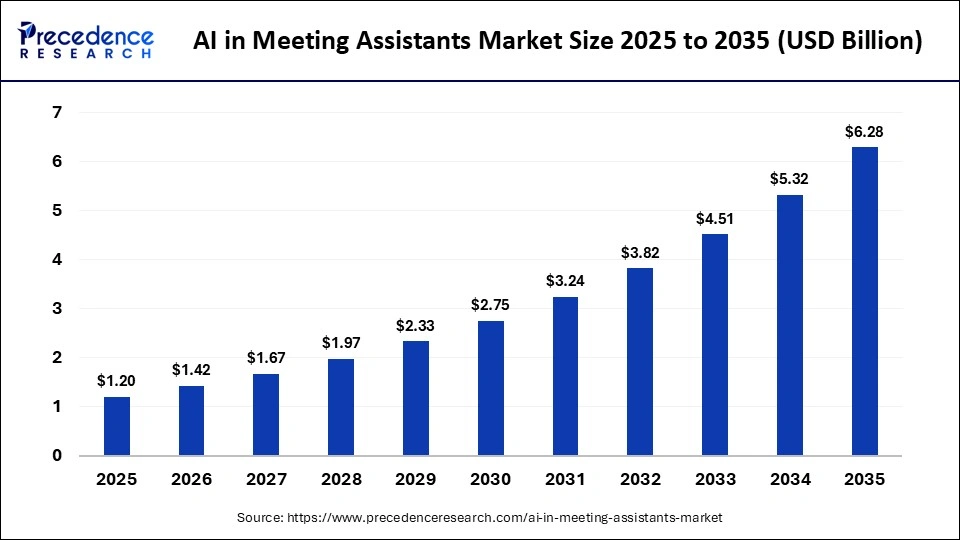
The rise of hybrid and remote work culture, increasing dependence on virtual meetings, and the growing demand for automated meeting summaries, transcription, action-item extraction, and workflow management are among the major factors driving market expansion. Organizations are increasingly seeking solutions that reduce manual note-taking, improve meeting efficiency, and ensure no important information is missed.
Read Also: Wearable AI Market
Quick Insights
- The global AI in meeting assistants market is projected to grow from USD 1.42 billion in 2026 to USD 6.28 billion by 2035.
- North America accounted for the largest market share of 35% in 2025 due to early adoption of advanced AI tools and strong cloud infrastructure.
- Asia Pacific is expected to witness the fastest growth during the forecast period because of increasing digital transformation and remote work adoption.
- Cloud-based deployment dominated the market with a 75% share in 2025 due to its scalability, flexibility, and ease of integration across remote teams.
- The corporate sector remained the largest application segment, accounting for 40% of the market in 2025.
- Large enterprises led the market with a 35% share in 2025 as organizations continue investing heavily in workflow automation and productivity tools.
- Major companies operating in the market include Otter.ai, Fireflies.ai, Rev.com, Deepgram, MeetGeek, and Avoma.
How is AI Transforming the Meeting Assistants Market?
Artificial intelligence is fundamentally changing how meetings are conducted, recorded, and analyzed. AI-powered meeting assistants are no longer limited to simple transcription. They now generate contextual summaries, identify action items, assign tasks, highlight decisions, detect sentiment, and even integrate directly with CRM and project management tools.
Generative AI has significantly enhanced the capabilities of these tools by enabling them to create concise summaries tailored to specific departments, such as sales, legal, or healthcare teams. Organizations are increasingly integrating AI meeting assistants into platforms like Zoom, Microsoft Teams, Google Meet, HubSpot, and Salesforce to automate workflows and improve operational efficiency.
The next generation of AI meeting assistants is expected to include advanced contextual memory, predictive insights, and multilingual real-time collaboration. Industry experts believe that future AI systems will not just summarize conversations but proactively organize and distribute insights across business workflows.
What are the Key Growth Factors Driving the Market?
The rapid expansion of hybrid work environments is one of the strongest growth drivers for the market. Companies are increasingly operating across different geographies and time zones, creating the need for solutions that ensure consistent communication and documentation.
Another major growth factor is the rise of productivity-focused workplace culture. Enterprises are increasingly looking for ways to reduce employee burnout caused by meeting overload and administrative tasks. AI meeting assistants help by reducing time spent on note-taking, documentation, and follow-up tasks.
Advancements in natural language processing, speech recognition, and multilingual translation are also contributing to wider adoption. These technologies are making AI meeting assistants more accurate, context-aware, and valuable across sectors such as healthcare, education, legal, and financial services.
Why are Cloud-Based Meeting Assistants Leading the Market?
The cloud-based segment dominated the market in 2025 with a 75% share due to its ability to support remote teams, provide scalability, and integrate easily with third-party applications. Cloud-based solutions are particularly attractive for enterprises with distributed workforces because they ensure accessibility from any location and device.
By contrast, on-premises solutions are gaining traction among organizations with strict data privacy requirements. Sectors such as healthcare, banking, and legal services are increasingly adopting on-premises deployment models to maintain greater control over sensitive meeting data.
Which Industries are Creating the Strongest Demand?
The corporate sector remains the largest application segment, accounting for 40% of total market revenue in 2025. Businesses are increasingly using AI meeting assistants to automate meeting documentation, improve productivity, and streamline task management.
The education sector is emerging as a strong growth area due to the rise of virtual classrooms and hybrid learning models. AI meeting assistants help students and educators by summarizing discussions, organizing notes, and making learning more accessible.
Healthcare is projected to witness the fastest growth rate as providers increasingly adopt AI tools to reduce administrative burdens and improve documentation accuracy. Legal firms are also rapidly integrating AI assistants to automate meeting records, client communications, and case-related documentation.
What Opportunities Exist for the Future of the Market?
One of the biggest opportunities lies in multilingual meeting intelligence. As businesses expand globally, there is increasing demand for AI assistants that can provide real-time translation, multilingual transcription, and region-specific context.
Another major opportunity is deeper integration with enterprise ecosystems. AI meeting assistants are increasingly being connected to CRM systems, HR software, project management tools, and customer service platforms to create a unified workflow experience.
The rise of “silent” AI assistants that operate in the background without visibly joining meetings is also gaining popularity. Users increasingly prefer solutions that can quietly capture and summarize discussions without disrupting meeting dynamics. Community discussions indicate that users want better context memory, automatic task extraction, and seamless integrations with Slack, Notion, and CRM platforms.
Regional Analysis
North America led the market in 2025, supported by strong cloud infrastructure, high adoption of AI solutions, and the presence of major technology companies. The region is also benefiting from widespread remote work adoption and strong demand for workflow automation tools.
Europe held the second-largest market share due to strict compliance requirements, rapid adoption of remote work technologies, and supportive policies such as the EU AI Act. Countries like Germany are seeing strong growth due to industrial automation initiatives and national AI strategies.
Asia Pacific is expected to grow at the fastest pace during the forecast period because of increasing digitalization, remote work adoption, and rapid growth in small and medium enterprises. Countries like China and India are emerging as key growth engines for the market.
Leading Companies in the Market
Some of the major companies shaping the AI in meeting assistants market include:
- Otter.ai
- Fireflies.ai
- Rev.com
- Fathom
- Deepgram
- MeetGeek
- Avoma
- Miro
- Verbit
- Trello
Challenges and Cost Pressures
Despite strong growth prospects, the market faces challenges related to privacy, compliance, and integration costs. Organizations are becoming increasingly concerned about how sensitive meeting data is stored, processed, and shared.
Companies also face challenges in integrating AI meeting assistants into existing enterprise workflows and ensuring compatibility with multiple communication platforms. Additionally, maintaining high transcription accuracy across languages, accents, and noisy environments remains a challenge for many vendors. User trust, transparency, and ethical AI governance will continue to play an important role in future market adoption.
Case Study: How AI Meeting Assistants are Saving Time for Enterprises
Medium-sized enterprises are increasingly adopting AI meeting assistants to reduce the time spent on manual documentation. Reports indicate that many organizations are saving nearly five to seven hours per employee each week by automating note-taking, summaries, and follow-up tasks. These productivity gains are making AI meeting assistants one of the fastest-growing software categories in enterprise collaboration.
For more insights, request a sample copy or schedule a consultation with the analysts at Precedence Research to explore detailed forecasts, company profiles, and emerging growth opportunities in the AI meeting assistants market.
Get a sample copy: https://www.precedenceresearch.com/sample/8302
For inquiries regarding discounts, bulk purchases, or customization requests, please contact us at [email protected]
