
As artificial intelligence (AI), cloud computing, and hyperscale data centers continue to expand worldwide, reliable power infrastructure has become more important than ever. Every online transaction, AI model, video stream, and enterprise application depends on data centers operating without interruption. Even a few seconds of downtime can result in significant financial losses and operational disruptions.
This growing need for uninterrupted power is driving rapid growth in the Data Center Battery Market. Battery systems are no longer viewed simply as emergency backup solutions-they have become strategic assets that improve energy efficiency, strengthen grid resilience, and support the increasing power demands of AI-driven computing.
What is the Data Center Battery Market Size?
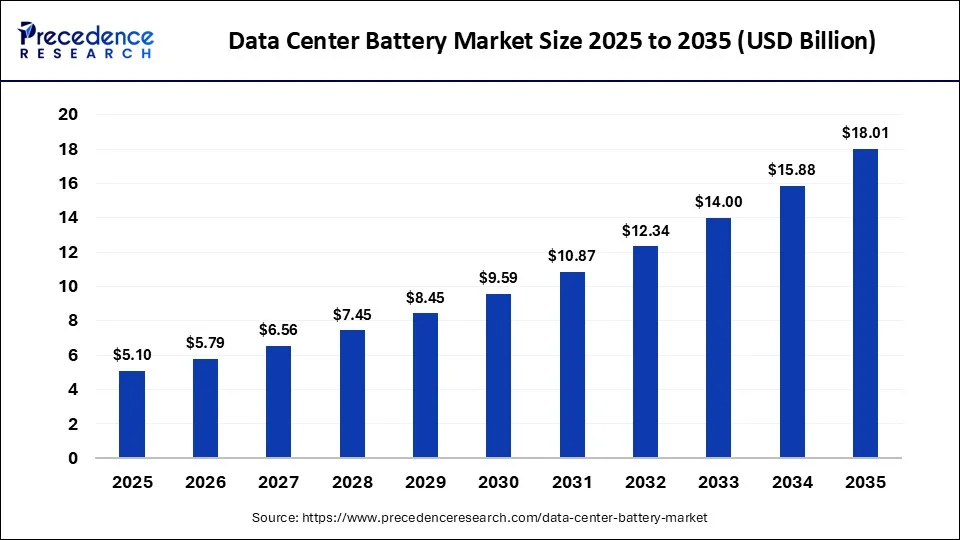
The global data center battery market size accounted for USD 5.10 billion in 2025 and is predicted to increase from USD 5.79 billion in 2026 to approximately USD 18.01 billion by 2035, expanding at a CAGR of 13.45% from 2026 to 2035. The market is driven by the increase in high-density AI and cloud computing workloads, which cause rapid power spikes and demand robust, scalable battery energy storage systems to prevent multi-million dollar outages.
Market Highlights
- North America led the data center battery market by holding a major share of 38% in 2025.
- Asia-Pacific held a 30% share of the market in 2025 and is expected to grow at the fastest CAGR of 16.3% during the projection period.
- By battery type, the lithium-ion batteries segment held a dominant position in the market with a 56% share in 2025.
- By battery type, the sodium-ion batteries segment held a 2% share of the market in 2025 and is expected to grow at the fastest CAGR of 21% during the projection period.
- By data center type, the hyperscale data centers segment dominated the market with a share of 34% in 2025 and is expected to grow at the fastest CAGR of 17% in the coming years.
- By data center type, the colocation data centers segment held the second-largest market share of 29% in 2025.
- By battery capacity, the 100-500 Ah segment held a dominant position in the data center battery market with a 47% share in 2025.
- By battery capacity, the above 500 Ah segment held a 35% share of the market in 2025 and is expected to grow at the fastest CAGR of 16.8% during the projection period.
- By application, the UPS backup power segment dominated the market with a 72% share in 2025.
- By application, the renewable energy integration segment held a 5% share of the market in 2025 and is expected to grow at the fastest CAGR of 20.1% during the projection period.
- By end user, the cloud service providers segment dominated the market with a share of 31% in 2025 and is expected to grow at the fastest CAGR of 16.5% in the coming years.
- By end user, the telecom companies segment held the second-largest market share of 14% in 2025.
What Is a Data Center Battery?
A data center battery is an energy storage system designed to provide backup power whenever the primary electricity supply is interrupted. These batteries work alongside uninterruptible power supply (UPS) systems to ensure servers, networking equipment, and storage systems continue operating until backup generators or alternative power sources become available.
Modern battery technologies also help stabilize power fluctuations, manage peak electricity demand, and improve overall energy efficiency within data center facilities.
Why Is the Data Center Battery Market Growing?
Several powerful trends are accelerating market growth.
AI and High-Performance Computing
Artificial intelligence applications require enormous computing power. Training large language models and running AI workloads consume significantly more electricity than traditional computing tasks.
As AI infrastructure expands, operators need reliable battery systems capable of handling higher power densities while maintaining uninterrupted operations.
Rapid Expansion of Hyperscale Data Centers
Major cloud providers continue investing billions of dollars in hyperscale facilities worldwide. Every new facility requires sophisticated backup power infrastructure capable of supporting thousands of servers around the clock.
This expansion is creating long-term demand for advanced battery technologies.
Growing Cloud Adoption
Businesses continue migrating workloads to cloud platforms, increasing the number and size of enterprise data centers globally. Reliable battery storage remains essential for maintaining service availability and protecting sensitive business operations.
Focus on Sustainability
Many organizations are replacing traditional lead-acid batteries with lithium-ion solutions because they offer:
- Longer operational life
- Faster charging capabilities
- Reduced maintenance
- Higher energy density
- Lower total cost of ownership
- Improved energy efficiency
These benefits align with corporate sustainability initiatives and carbon reduction goals.
Technology Trends Transforming the Industry
The data center battery market is evolving rapidly as operators adopt smarter energy management solutions.
Lithium-Ion Batteries Becoming the Preferred Choice
Lithium-ion batteries are gradually replacing conventional lead-acid systems due to their superior performance, compact design, and longer lifespan. They also occupy less floor space-an important advantage in high-density data centers.
Battery Energy Storage Systems (BESS)
Battery Energy Storage Systems are gaining popularity because they do much more than provide emergency backup.
Modern BESS solutions help operators:
- Manage peak electricity demand
- Improve grid stability
- Reduce energy costs
- Support renewable energy integration
- Increase operational resilience
AI-Based Battery Monitoring
Advanced software now uses artificial intelligence to monitor battery health in real time.
Predictive analytics can identify potential failures before they occur, allowing operators to schedule maintenance proactively and minimize unexpected downtime.
Integration with Renewable Energy
As more data centers incorporate solar and wind energy into their operations, battery storage systems are becoming essential for balancing intermittent renewable power sources.
This integration helps organizations improve energy efficiency while reducing dependence on traditional power grids.
Key Challenges Facing the Market
Although growth opportunities remain strong, several challenges continue influencing market development.
High Initial Investment
Advanced battery technologies require significant upfront capital investment, particularly for hyperscale facilities.
Supply Chain Risks
Battery manufacturing depends on critical raw materials such as lithium, nickel, and cobalt. Global supply chain disruptions and price fluctuations can affect production costs and project timelines.
Thermal Management
As computing densities increase, battery systems must operate efficiently under demanding environmental conditions. Effective thermal management remains essential for ensuring long-term performance and safety.
Regional Market Outlook
North America remains one of the largest markets due to continuous investments in AI infrastructure, cloud computing, and hyperscale data centers. Technology companies are expanding facilities while governments and utilities invest in resilient energy infrastructure.
European countries are focusing on sustainable data centers, renewable energy integration, and stricter environmental regulations, creating new opportunities for advanced battery technologies.
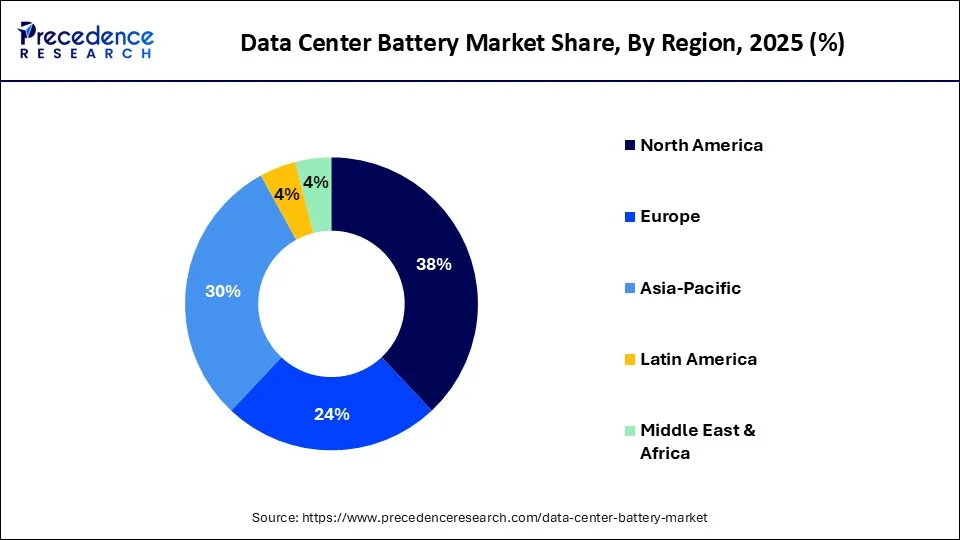
Asia-Pacific is expected to witness substantial growth driven by rapid digital transformation, increasing internet penetration, expanding cloud services, and rising investments in data center construction across countries such as India, China, Japan, and Singapore.
Competitive Landscape
The market continues to evolve as battery manufacturers, UPS providers, and energy storage companies introduce innovative technologies to improve efficiency, reliability, and lifecycle performance.
Companies are investing heavily in:
- Lithium-ion battery development
- Smart battery management software
- AI-powered monitoring systems
- Sustainable energy storage solutions
- Localized battery manufacturing
- Strategic partnerships with cloud providers and hyperscale operators
Future Outlook
The future of the Data Center Battery Market looks exceptionally promising.
As AI adoption accelerates, digital services expand, and enterprises demand higher availability, advanced battery technologies will become an essential component of next-generation data centers.
The market is expected to witness continuous innovation in battery chemistry, intelligent energy management, renewable energy integration, and predictive maintenance. Companies that invest in reliable, efficient, and sustainable battery solutions will be well-positioned to support the rapidly evolving digital economy.
Conclusion
The Data Center Battery Market is becoming a critical pillar of global digital infrastructure. Rising AI workloads, expanding cloud services, and the need for uninterrupted operations are driving demand for advanced energy storage solutions.
From lithium-ion batteries and Battery Energy Storage Systems (BESS) to AI-powered monitoring platforms, the industry is evolving rapidly to meet the challenges of modern computing. As organizations continue investing in resilient, efficient, and sustainable power infrastructure, the data center battery market is expected to play an increasingly important role in shaping the future of connected technologies.
Get Sample Link : https://www.precedenceresearch.com/sample/8537
Recent Developments
- In April 2026, Eaton declared an investment of over $30 million to raise U.S. production of its medium-voltage switchgear, the equipment utilized to protect, control, and isolate electrical equipment in data centers, utility, and industrial power generation and distribution systems.
- In March 2026, Vertiv declared four new or expanding manufacturing facilities in the Americas, growing the firm’s production capacity for infrastructure solutions, power management, and integrated cabinets.
Segments Covered in the Report
By Battery Type
- Lithium-ion Batteries
- Lithium Iron Phosphate (LFP)
- Lithium Nickel Manganese Cobalt Oxide (NMC)
- Other Lithium-ion Chemistries
- Lead-acid Batteries
- Valve-Regulated Lead-Acid (VRLA)
- Absorbent Glass Mat (AGM)
- Gel Batteries
- Flooded Lead-acid Batteries
- Nickel-based Batteries
- Nickel-Cadmium (Ni-Cd)
- Nickel-Metal Hydride (NiMH)
- Sodium-ion Batteries
- Flow Batteries
- Other Battery Technologies
By Data Center Tier
- Tier I
- Tier II
- Tier III
- Tier IV
By Data Center Type
- Enterprise Data Centers
- Colocation Data Centers
- Hyperscale Data Centers
- Edge Data Centers
- Modular Data Centers
By Battery Capacity
- Below 100 Ah
- 100-500 Ah
- Above 500 Ah
By UPS Configuration
- Centralized UPS
- Distributed UPS
- Modular UPS
By Application
- UPS Backup Power
- Energy Storage Systems (ESS)
- Peak Load Management
- Renewable Energy Integration
- Emergency Power Support
By Installation Type
- New Installations
- Replacement and Retrofit
By End User
- Cloud Service Providers
- Telecom Companies
- BFSI
- Government and Defense
- Healthcare
- Manufacturing
- IT and ITES
- Retail and E-commerce
- Energy and Utilities
- Others
By Distribution Channel
- Direct Sales
- System Integrators
- Value-Added Resellers (VARs)
- Electrical Equipment Distributors
By Region
- North America
- Latin America
- Europe
- Asia-pacific
- Middle and East Africa
Also Read Our Latest Article : Disposable Gloves Market

- Polymer Foams Market: Driving Innovation Across Packaging, Automotive, Construction, and Healthcare - July 7, 2026
- Data Center Liquid Cooling Manifolds Market: Enabling the Future of High-Density AI Computing - July 7, 2026
- Data Center Battery Market: Powering the Future of AI-Driven Digital Infrastructure - July 7, 2026