
The U.S. vehicle-to-grid technology market is projected to grow from USD 2.45 billion in 2026 to approximately USD 30.84 billion by 2035, expanding at a remarkable CAGR of 32.49% during the forecast period. The market is witnessing rapid growth due to the increasing adoption of electric vehicles (EVs), modernization of the electric grid, and rising investments in distributed energy resources. Growing renewable energy deployment, supportive federal and state government policies, and the need to improve grid resilience are further accelerating the commercialization of vehicle-to-grid technologies across the United States.
As the U.S. transitions toward a cleaner energy ecosystem, vehicle-to-grid technology is emerging as a critical solution that allows electric vehicles to function as mobile energy storage systems. Through bidirectional charging, EVs can store electricity and return excess energy to the grid during periods of peak demand, supporting grid stability while creating new revenue opportunities for EV owners and fleet operators.
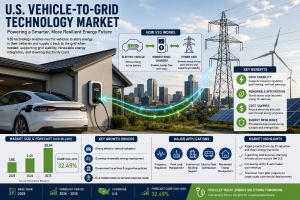
U.S. Vehicle-to-Grid Technology Market Overview
Vehicle-to-grid (V2G) technology is an advanced energy management system that enables electric vehicles to communicate with the power grid through bidirectional charging infrastructure. Unlike conventional EV charging, where electricity flows only from the grid to the vehicle, V2G technology allows stored energy in EV batteries to be discharged back into the grid whenever additional electricity is required. This innovative technology transforms electric vehicles into distributed energy storage assets capable of supporting renewable energy integration, balancing electricity demand, improving grid reliability, and reducing peak electricity costs. V2G is becoming increasingly important as utilities integrate larger volumes of intermittent renewable energy sources such as solar and wind power into the national electricity network.
The U.S. market is benefiting from rapid electric vehicle adoption, expanding charging infrastructure, favorable government policies, and significant investments in smart grid modernization. Utilities, automakers, charging equipment manufacturers, and software providers are working together to commercialize scalable V2G ecosystems capable of supporting residential, commercial, and fleet applications.
As bidirectional charging technologies continue to mature and interoperability standards improve, V2G is expected to become an essential component of the country’s future energy infrastructure.
U.S. Vehicle-to-Grid Technology Market Size & Forecast
| Year | Market Size (USD Billion) |
|---|---|
| 2025 | 1.85 |
| 2026 | 2.45 |
| 2035 | 30.84 |
CAGR (2026–2035): 32.49%
The U.S. vehicle-to-grid technology market is expected to witness exceptional growth throughout the forecast period. Rising EV ownership, increasing deployment of renewable energy, growing demand for distributed energy resources, and widespread investments in bidirectional charging infrastructure are expected to create substantial market opportunities.
As utilities increasingly adopt demand response programs and grid-balancing solutions, V2G technology will play an important role in improving energy efficiency while reducing dependence on fossil-fuel-powered peaking plants.
Download the Sample: https://www.precedenceresearch.com/sample/3738
What is the Role of AI in the U.S. Vehicle-to-Grid Technology Market?
- Artificial Intelligence (AI) is revolutionizing vehicle-to-grid technology by optimizing energy flow, improving grid stability, enhancing battery management, and enabling intelligent decision-making across connected EV networks.
- Modern V2G systems generate massive volumes of real-time data from electric vehicles, charging stations, renewable energy systems, weather forecasts, and electricity markets. AI-powered platforms process these datasets to determine the optimal charging and discharging schedules based on electricity demand, pricing, renewable energy availability, and battery health.
- Machine learning algorithms continuously improve grid forecasting accuracy by predicting electricity demand, renewable energy generation, and battery performance. AI also automates energy trading, supports virtual power plant (VPP) operations, and helps utilities maximize grid efficiency while minimizing operational costs.
- Additionally, AI-enabled predictive maintenance solutions monitor charging infrastructure and battery systems to identify potential failures before they occur, reducing downtime and improving system reliability.
Key Applications of AI in Vehicle-to-Grid Technology
- Smart charging optimization
- Bidirectional energy management
- Battery health monitoring
- Predictive maintenance
- Grid demand forecasting
- Renewable energy integration
- Load balancing
- Dynamic energy pricing optimization
- Virtual power plant (VPP) management
- Demand response automation
- Fleet energy optimization
- Real-time grid analytics
- Cloud-based energy management
- Cybersecurity monitoring
- Automated billing and settlements
Key Growth Drivers Fueling Market Expansion
Rising Electric Vehicle Adoption
- Electric vehicle sales continue to accelerate across the United States as consumers increasingly adopt cleaner transportation alternatives. Every new EV represents a potential distributed energy storage asset capable of participating in grid services, significantly expanding the addressable market for V2G technology.
Rapid Expansion of Renewable Energy
- The increasing deployment of solar and wind energy has created new challenges related to intermittency and grid balancing. V2G enables electric vehicles to store surplus renewable electricity and return it during periods of high demand, improving overall grid flexibility and renewable energy utilization.
Government Incentives and Clean Energy Policies
Federal and state governments continue investing in EV charging infrastructure, smart grids, and clean energy initiatives. Tax incentives, grants, pilot programs, and utility incentives are accelerating commercial deployment of V2G technologies across residential, commercial, and public transportation sectors.
Grid Modernization Initiatives
- Utilities across the U.S. are investing heavily in advanced grid technologies that improve reliability, resiliency, and operational efficiency. Vehicle-to-grid systems complement these modernization efforts by providing flexible energy storage and frequency regulation capabilities.
Declining Battery Costs
- Continuous advancements in battery technology have improved energy density, reduced costs, and increased battery lifespan. These developments make V2G solutions more economically attractive for EV owners, fleet operators, and utility companies.
Increasing Commercial Fleet Electrification
- Public transit agencies, logistics companies, school districts, and commercial fleet operators are electrifying their vehicle fleets. These large-scale fleets provide significant opportunities for V2G deployment due to predictable charging schedules and centralized charging infrastructure.
Government Initiatives Supporting Market Growth
Government support remains one of the strongest catalysts driving the U.S. vehicle-to-grid technology market.
- The Infrastructure Investment and Jobs Act (IIJA) allocated USD 7.5 billion toward expanding EV charging infrastructure nationwide, creating the foundation for future bidirectional charging networks. The U.S. Department of Energy (DOE) continues funding pilot projects that demonstrate the commercial viability of V2G systems for demand response, frequency regulation, and emergency backup power.
- Several states, including California, New York, and Texas, have introduced utility incentive programs, clean transportation initiatives, and renewable energy mandates that encourage deployment of V2G technologies. Electric school buses, municipal fleets, and commercial vehicles are increasingly participating in pilot programs that allow stored battery energy to support local electricity grids.
- These government initiatives are accelerating the transition from demonstration projects to large-scale commercial implementation while supporting national decarbonization goals.
Major Trends Shaping the U.S. Vehicle-to-Grid Technology Market
Expansion of Bidirectional Charging Infrastructure
- Charging infrastructure providers are rapidly deploying bidirectional charging stations capable of enabling two-way electricity flow between electric vehicles and the power grid. These installations are becoming increasingly common across residential, commercial, and fleet charging locations.
Growth of Virtual Power Plants (VPPs)
- Utilities are integrating electric vehicles into virtual power plants that aggregate thousands of distributed batteries to provide grid balancing, peak shaving, and frequency regulation services.
Integration with Renewable Energy
- Vehicle-to-grid systems are increasingly integrated with residential and commercial solar installations, enabling EV batteries to store surplus renewable electricity and deliver it back to the grid when required.
Utility and Automaker Partnerships
- Major automakers, utilities, and charging infrastructure providers are collaborating to develop standardized V2G ecosystems that improve interoperability, accelerate commercialization, and simplify customer adoption.
Commercial Fleet Deployment
- Fleet operators are emerging as one of the largest adopters of V2G technology due to predictable vehicle schedules and centralized charging infrastructure that maximize grid service opportunities.
U.S. Vehicle-to-Grid Technology Market Challenges
- High Infrastructure Investment: Deploying bidirectional charging equipment, smart grid communication systems, and advanced software platforms requires significant capital investment, limiting early adoption in some regions.
- Battery Degradation Concerns: Frequent charging and discharging cycles may impact long-term battery health. Manufacturers continue developing.
- Regulatory and Standardization Challenges: The absence of universally adopted communication protocols between electric vehicles, charging stations, utilities, and grid operators remains a key challenge for the U.S. vehicle-to-grid technology market. Standardized interoperability is essential to ensure that V2G-enabled vehicles can seamlessly connect with different charging networks and utility systems. Industry organizations and regulatory agencies are working to establish common technical standards that will accelerate large-scale commercialization.
- Cybersecurity Risks: As V2G systems rely heavily on cloud computing, IoT connectivity, and real-time data exchange, protecting critical energy infrastructure from cyber threats has become increasingly important. Utilities and technology providers continue investing in advanced cybersecurity solutions to safeguard energy transactions, customer data, and grid operations.
- Limited Consumer Awareness: Although electric vehicle adoption is rising rapidly, many consumers remain unfamiliar with the economic and environmental benefits of vehicle-to-grid technology. Increasing public education, utility incentive programs, and successful pilot projects will be essential for encouraging wider participation.
Why the U.S. Vehicle-to-Grid Technology Market is Growing
The U.S. vehicle-to-grid technology market is experiencing rapid expansion as electric vehicles evolve from simple transportation assets into intelligent energy storage systems capable of supporting the national power grid.
Growing EV adoption, increasing renewable energy deployment, government funding for charging infrastructure, advancements in bidirectional charging technologies, and widespread smart grid modernization are creating strong demand for V2G solutions across residential, commercial, and public sectors.
Furthermore, utilities are increasingly recognizing electric vehicles as valuable distributed energy resources that can improve grid reliability, reduce peak demand, support renewable integration, and lower electricity costs. As interoperability improves and commercial deployments expand, vehicle-to-grid technology is expected to become an integral part of the future U.S. energy ecosystem.
U.S. Vehicle-to-Grid Technology Market by Component Insights
Why Did the Hardware Segment Dominate the Market in 2025?
The hardware segment accounted for the largest market share in 2025 due to the growing deployment of physical infrastructure required to enable bidirectional energy transfer between electric vehicles and the power grid. Essential hardware components such as bidirectional AC/DC chargers, power converters, grid integration equipment, communication modules, and advanced inverters form the backbone of V2G systems.
As utilities and charging network operators expand smart charging infrastructure nationwide, investments in advanced hardware continue to increase. Government incentives supporting EV charging installations and renewable energy integration have further accelerated demand for high-performance V2G hardware solutions.
Why is the Software Segment Expected to Grow at the Fastest Rate?
The software segment is projected to register the fastest CAGR during the forecast period as utilities and energy providers increasingly rely on intelligent platforms to manage millions of connected electric vehicles.
Advanced V2G software enables:
- Real-time energy management
- Battery performance optimization
- Demand response coordination
- Grid balancing
- AI-powered forecasting
- Dynamic electricity pricing
- Predictive maintenance
- Virtual power plant management
The integration of artificial intelligence, cloud computing, and machine learning is significantly improving operational efficiency while maximizing the economic value of distributed energy resources.
Services Segment
- The services segment is expected to witness significant growth owing to rising demand for installation, system integration, maintenance, consulting, software upgrades, and energy management services.
- As V2G deployments become increasingly sophisticated, organizations require specialized expertise to ensure seamless integration between electric vehicles, charging infrastructure, utility networks, and distributed energy resource platforms.
Recent Developments in the U.S. Vehicle-to-Grid Technology Market
- March 2026: Xos announced plans to begin production of new commercial vehicles equipped with built-in vehicle-to-grid (V2G) capability starting in April 2026. The rollout will initially focus on a major electric school bus platform in North America, supporting fleet electrification and grid services.
- February 2026: Tesla unveiled its first U.S. Vehicle-to-Grid initiative, the Powershare Grid Support Program, allowing Cybertruck owners in selected Texas utility territories served by CenterPoint Energy and Oncor to export electricity back to the grid during periods of peak demand while earning electricity bill credits.
- August 2025: Eaton and ChargePoint jointly launched the ChargePoint Express Grid, a high-power DC vehicle-to-everything (V2X) charging solution supporting up to 600 kW charging for passenger electric vehicles and megawatt-scale charging for heavy-duty commercial fleets.
- January 2025: Nuvve Holding Corp. introduced a new portfolio of bidirectional and unidirectional charging systems ranging from 20 kW to 360 kW, specifically designed for commercial fleets, public charging infrastructure, microgrids, and utility-scale energy management applications.
Leading Companies Operating in the U.S. Vehicle-to-Grid Technology Market
Major companies include:
- ABB
- AC Propulsion, Inc.
- Edison International
- EV Grid, Inc.
- Fermata Energy
- Hitachi, Ltd.
- Honda Motor Co., Ltd.
- NRG Energy, Inc.
- Nuvve Holding Corp.
- Wallbox Inc.
These companies continue investing in bidirectional charging technologies, AI-enabled energy management platforms, virtual power plant solutions, strategic partnerships, and large-scale commercial deployment to strengthen their market positions.
Read More: Non-Invasive Prenatal Testing Market
Segments Covered in the Report
By Component Type
Hardware
- Bidirectional Chargers (AC, DC)
- Vehicle-side Bidirectional Electronics
- Grid Integration Hardware
Software
- Smart Charging and Energy Management
- Aggregator / Virtual Power Plant (VPP) Platforms
- Connectivity and Cloud Services
Services
- Installation and Commissioning
- Operation & Maintenance (O&M)
- Energy Trading and Grid Services Revenue
Future Outlook
The U.S. vehicle-to-grid technology market is poised for extraordinary growth through 2035 as electric vehicles become an integral part of the nation’s energy infrastructure.
Advancements in bidirectional charging, artificial intelligence, cloud-based energy management, battery technologies, and smart grid modernization will continue transforming how electricity is generated, stored, and distributed. Increasing renewable energy integration, supportive government policies, expanding EV ownership, and utility investments in distributed energy resources will further accelerate market adoption.
By 2035, the U.S. Vehicle-to-Grid Technology Market is expected to reach USD 30.84 billion, creating significant opportunities for automakers, charging infrastructure providers, software developers, utility companies, renewable energy firms, and investors seeking to capitalize on the transition toward a more resilient, decentralized, and sustainable energy ecosystem.
You can place an order or ask any questions. Please feel free to contact us at sales@precedenceresearch.com | +1 804 441 9344
