
The remote neurological monitoring market is witnessing robust growth driven by the rising prevalence of neurological disorders, advancements in wearable technologies, and increasing adoption of AI-enabled remote patient monitoring solutions. These technologies are transforming the management of conditions such as epilepsy, Parkinson’s disease, Alzheimer’s disease, multiple sclerosis, and stroke.

Remote Neurological Monitoring Market Size and Forecast 2026 to 2035
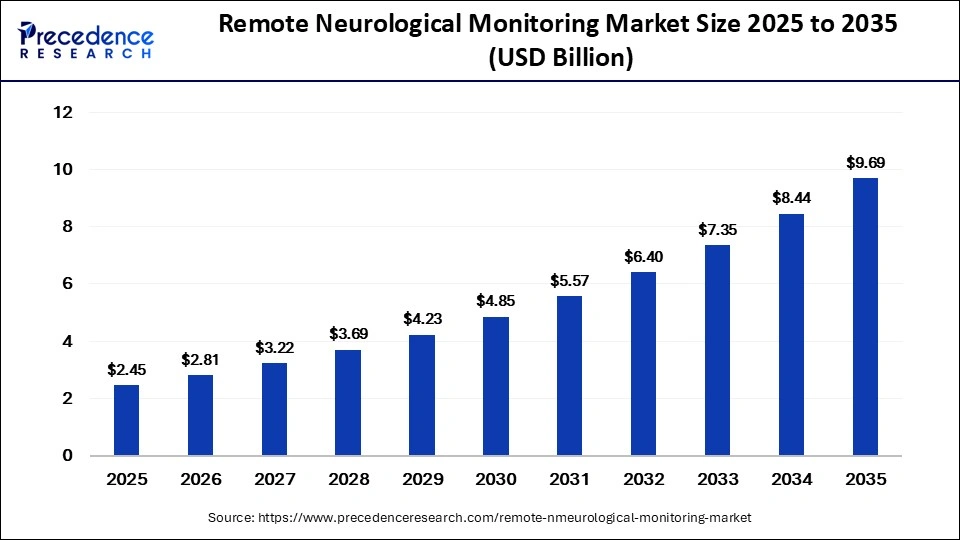
The global remote neurological monitoring market size was calculated at USD 2.45 billion in 2025 and is predicted to increase from USD 2.81 billion in 2026 to approximately USD 9.69 billion by 2035, expanding at a CAGR of 14.80% from 2026 to 2035. The market is driven by the rising integration of artificial intelligence (AI) and cloud analytics, which enable real-time predictive care and also early detection of neurodegenerative diseases outside traditional hospital settings.
Market Highlights
- North America dominated the global remote neurological monitoring market with a share of 39% in 2025.
- Asia-Pacific is expected to grow at the fastest CAGR of 18.2% during the forecast period.
- By product type, the wearable neurological monitoring devices segment led the global market with a share of 34% in 2025 and is expected to grow at the fastest CAGR of 17.2% during the forecast period.
- By product type, the remote EEG monitoring systems market held the second-largest market share of 29% in 2025.
- By monitoring type, the brain activity monitoring segment accounted for a revenue share of 31% in the market in 2025.
- By monitoring type, the Parkinson’s disease monitoring segment is expected to grow at a 16.7% CAGR between 2026 and 2035.
- By technology, the electroencephalography (EEG) segment accounted for a revenue share of 42% in the remote neurological monitoring market in 2025.
- By technology, the AI-enabled neurological analytics segment is expected to grow at the fastest CAGR of 16% between 2026 and 2035.
- By end user, the hospitals segment accounted for a revenue share of 38% in the market in 2025.
- By end user, the home care settings segment is expected to grow at the fastest 19.5% CAGR between 2026 and 2035.
- By application, the epilepsy segment accounted for a revenue share of 29% in the market in 2025.
- By application, the Alzheimer’s disease and dementia segment is expected to grow at the fastest CAGR of 17.4% between 2026 and 2035.
Market Overview
The remote neurological monitoring market is experiencing significant expansion as healthcare providers increasingly adopt digital technologies to enable continuous assessment of neurological conditions outside traditional clinical settings. Growing incidences of Parkinson’s disease, epilepsy, Alzheimer’s disease, multiple sclerosis, and stroke are fueling demand for advanced monitoring systems that support early diagnosis and personalized treatment.
The integration of wearable devices, cloud-based platforms, biosensors, and telehealth services is improving patient outcomes while reducing hospital visits and healthcare costs. Moreover, increasing emphasis on home-based care and remote patient monitoring is expected to further accelerate market growth over the coming years.
Market Trends
Expansion of Wearable Neurological Monitoring Devices
Healthcare companies are developing advanced wearable sensors capable of tracking brain activity, movement disorders, sleep patterns, and seizure episodes in real time.
Growing Adoption of Telemedicine
Telehealth platforms are increasingly integrating neurological monitoring capabilities, enabling physicians to remotely evaluate patients and provide timely interventions.
Rising Demand for Home-Based Healthcare
Patients and healthcare systems are shifting toward home care solutions that offer continuous monitoring while improving convenience and reducing hospitalization expenses.
Increasing Use of Cloud-Based Analytics
Cloud connectivity allows seamless collection and analysis of neurological data, supporting more effective disease management and enhanced patient engagement.
Strategic Collaborations and Innovation
Medical device manufacturers, digital health companies, and AI developers are forming partnerships to accelerate the development of intelligent remote monitoring solutions.
AI Impact on the Remote Neurological Monitoring Market
Artificial intelligence is revolutionizing neurological monitoring by enabling predictive analytics, automated data interpretation, and personalized patient management.
AI-powered algorithms can analyze large volumes of physiological and neurological data to detect abnormalities and identify early warning signs of disease progression. Machine learning models are increasingly being used for seizure prediction, Parkinson’s disease symptom tracking, cognitive decline assessment, and stroke risk analysis.
Key benefits of AI integration include:
- Early disease detection and intervention.
- Real-time analysis of patient data.
- Reduced burden on healthcare professionals.
- Personalized treatment recommendations.
- Improved accuracy and efficiency of neurological assessments.
As AI technologies continue to evolve, they are expected to play a critical role in advancing remote neurological care and improving long-term patient outcomes.
Market Scope
| Report Coverage | Details |
| Market Size in 2025 | USD 2.45 Billion |
| Market Size in 2026 | USD 2.81 Billion |
| Market Size by 2035 | USD 9.69 Billion |
| Market Growth Rate from 2026 to 2035 | CAGR of 14.80% |
| Dominating Region | North America |
| Fastest Growing Region | Asia Pacific |
| Base Year | 2025 |
| Forecast Period | 2026 to 2035 |
| Segments Covered | Product Type, Monitoring Type, Technology, End User, Application, and Region |
| Regions Covered | North America, Europe, Asia-Pacific, Latin America, and Middle East & Africa |
Segment Insights
By Product Type
Wearable Monitoring Devices Segment Dominated the Market
Wearable neurological monitoring devices accounted for the largest market share due to increasing adoption of smart sensors and continuous patient monitoring technologies. These devices provide real-time tracking and facilitate early detection of neurological events.
Software and Analytics Platforms Segment Expected to Grow Rapidly
AI-driven analytics platforms are expected to witness substantial growth owing to rising demand for predictive diagnostics and cloud-based healthcare solutions.
By Application
Epilepsy Monitoring Held the Largest Market Share
The epilepsy monitoring segment dominated the market due to increasing prevalence of seizure disorders and growing demand for continuous electroencephalography (EEG)-based monitoring.
Parkinson’s Disease Monitoring Expected to Register Significant Growth
Advancements in motion sensors and AI-based symptom analysis are supporting the expansion of remote Parkinson’s disease management solutions.
By End User
Hospitals and Specialty Clinics Led the Market
Hospitals and neurological specialty centers accounted for the highest market share due to widespread deployment of remote monitoring technologies for patient management.
Home Healthcare Segment Expected to Expand at a Strong CAGR
Growing preference for home-based treatment and increasing availability of connected medical devices are expected to drive growth in this segment.
Regional Insights
North America accounted for the largest share of the market owing to advanced healthcare infrastructure, strong adoption of digital health technologies, and increasing investments in AI-enabled remote patient monitoring solutions. The United States remains the major contributor to regional growth.
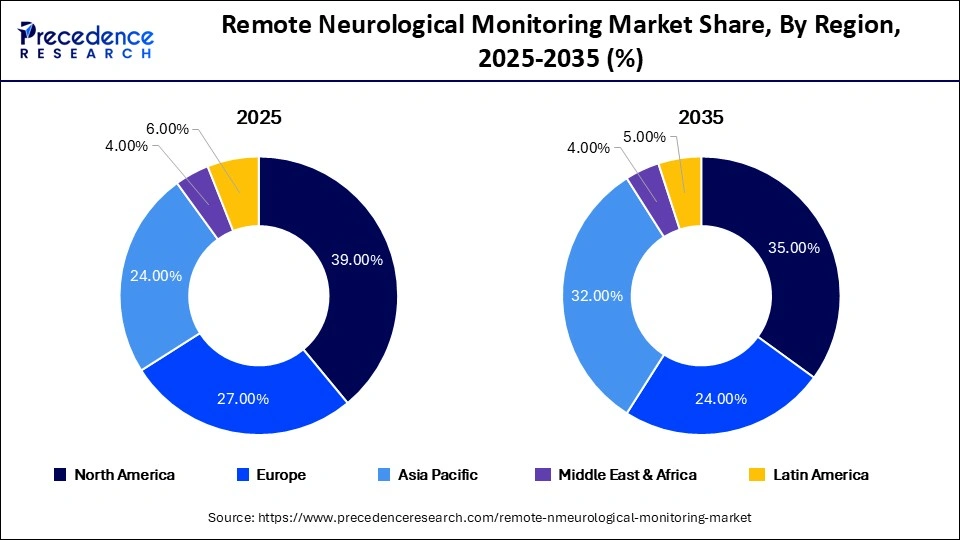
Europe is benefiting from expanding telemedicine initiatives, increasing prevalence of neurological diseases, and favorable healthcare policies supporting digital transformation.
Asia-Pacific is anticipated to register the highest CAGR during the forecast period due to rising healthcare expenditure, increasing aging population, growing awareness regarding neurological disorders, and rapid adoption of telehealth technologies across countries such as China, India, Japan, and South Korea.
These regions are gradually adopting remote patient monitoring solutions, supported by healthcare modernization initiatives and improving access to digital healthcare services.
Conclusion
The remote neurological monitoring market is poised for substantial growth as healthcare systems increasingly embrace digital technologies and AI-powered solutions. Advancements in wearable devices, telemedicine platforms, and predictive analytics are transforming neurological care by enabling continuous monitoring, early diagnosis, and personalized treatment approaches. With rising demand for home-based healthcare and growing investments in connected medical technologies, the market is expected to witness strong expansion worldwide.
Recent Developments
- In June 2026, NordicNeuroLab signed a comprehensive software license along with a distribution agreement with GE HealthCare. The agreement establishes a long-term global framework for the integration, distribution, and even support of NordicNeuroLab’s advanced neuroimaging software within GE HealthCare’s MRI ecosystem.
- In September 2025, Philips and Masimo are extending their partnership in patient monitoring, with a new multi-year agreement programmed to accelerate the adoption of advanced wearable sensors and expand the usage of artificial intelligence (AI) in bedside and remote monitoring technologies.
Segments Covered in the Report
By Product Type
- Wearable Neurological Monitoring Devices
- Remote EEG Monitoring Systems
- Implantable Neurological Monitoring Devices
- Mobile Neurological Monitoring Platforms
- Others
By Monitoring Type
- Brain Activity Monitoring
- Epilepsy Monitoring
- Sleep Disorder Monitoring
- Parkinson’s Disease Monitoring
- Cognitive & Neurodegenerative Disease Monitoring
By Technology
- Electroencephalography (EEG)
- Electromyography (EMG)
- Intracranial Pressure Monitoring
- Neurostimulation-based Monitoring
- AI-enabled Neurological Analytics
By End User
- Hospitals
- Neurology Clinics
- Home Care Settings
- Ambulatory Surgical Centers
- Research Institutes
By Application
- Epilepsy
- Parkinson’s Disease
- Alzheimer’s Disease & Dementia
- Sleep Disorders
- Stroke Rehabilitation
- Others
By Region
- North America
- Latin America
- Europe
- Asia-pacific
- Middle and East Africa
Get Sample Link : https://www.precedenceresearch.com/sample/8480
Also Read Our Latest Article : Wind Turbine Market

- Farm Management Software Market: Digital Agriculture Driving Smarter and More Sustainable Farming - July 9, 2026
- AI in CGT Manufacturing Market: Artificial Intelligence Accelerating the Future of Cell and Gene Therapy Production - July 9, 2026
- 3T MRI System Market: Advanced Imaging Technology Transforming Modern Diagnostics - July 9, 2026