
The U.S. personalized medicine market is undergoing a profound transformation as healthcare providers increasingly move away from conventional one-size-fits-all treatment approaches toward highly individualized therapies. The market size was valued at USD 192.21 billion in 2025 and is projected to grow from USD 207.15 billion in 2026 to approximately USD 427.17 billion by 2035, registering a CAGR of 8.31% during the forecast period.

The growing prevalence of chronic diseases, increasing adoption of genetic testing, rapid advances in next-generation sequencing (NGS), and integration of artificial intelligence into clinical decision-making are among the key factors driving market growth. Precision healthcare is enabling physicians to tailor treatments based on individual genetic profiles, disease biomarkers, lifestyle factors, and molecular characteristics, resulting in improved patient outcomes and reduced adverse drug reactions.
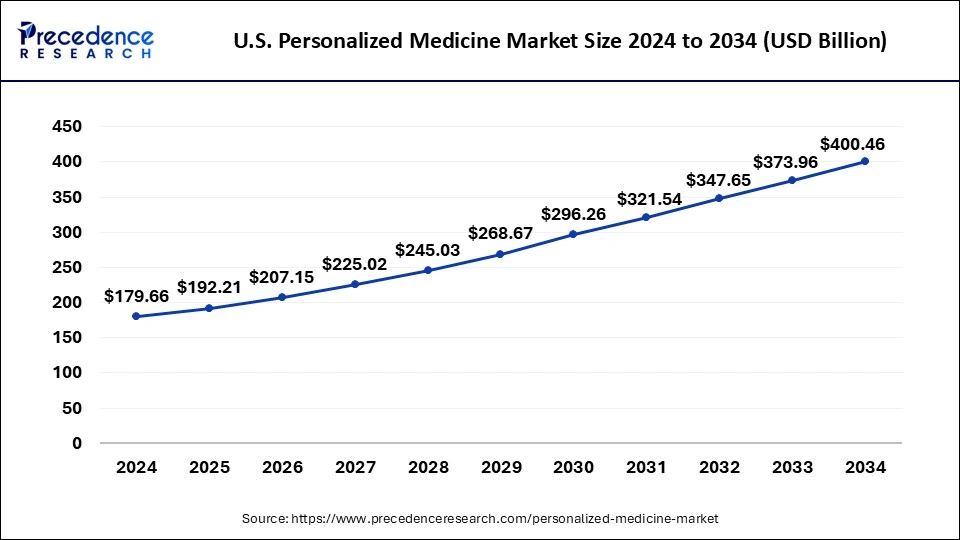
U.S. Personalized Medicine Market Key Metrics
- The U.S. personalized medicine market was valued at USD 192.21 billion in 2025 and is expected to reach USD 427.17 billion by 2035.
- The market is projected to expand at a CAGR of 8.31% between 2026 and 2035.
- Personalized nutrition and wellness emerged as the largest product segment in 2025 owing to growing consumer demand for preventive healthcare and data-driven wellness solutions.
- Personalized medicine therapeutics is anticipated to witness the fastest growth throughout the forecast period due to increasing adoption of targeted biologics and gene therapies.
- Oncology remained the leading application segment in 2025, supported by advances in biomarker-based cancer treatments and precision diagnostics.
- The central nervous system (CNS) segment is expected to register the highest growth rate through 2035.
- Hospitals represented the dominant end-use segment due to their advanced diagnostic capabilities and ability to administer complex precision therapies.
- Research and academic institutes are forecast to experience rapid expansion as government and private investments in multi-omics research continue to increase.
US Personalized Medicine Market Revenue Outlook
| Metric | Value |
|---|---|
| Market Size 2025 | USD 192.21 Billion |
| Market Size 2026 | USD 207.15 Billion |
| Market Size 2035 | USD 427.17 Billion |
| CAGR (2026-2035) | 8.31% |
| Base Year | 2025 |
| Forecast Period | 2026-2035 |
Why Is Personalized Medicine Becoming the Future of Healthcare?
Healthcare systems across the United States are increasingly embracing precision medicine to improve treatment effectiveness while minimizing side effects. Traditional therapies often produce varied outcomes because patients respond differently based on genetic, environmental, and lifestyle factors. Personalized medicine addresses this challenge by leveraging genomics, biomarker testing, and advanced analytics to design individualized treatment plans.
The approach is particularly beneficial in oncology, rare diseases, neurological disorders, and chronic disease management, where targeted interventions can significantly improve survival rates and quality of life. Advances in molecular diagnostics and companion testing are enabling clinicians to identify disease risks earlier and intervene before conditions become severe.
How Is Artificial Intelligence Revolutionizing the U.S. Personalized Medicine Industry?
Artificial intelligence is emerging as one of the most influential technologies in precision healthcare. AI platforms can analyze vast amounts of patient data, including genomic sequences, medical imaging records, electronic health records, laboratory results, and clinical histories, at unprecedented speed and accuracy.
By identifying hidden patterns within these datasets, AI enables physicians to predict disease progression, determine optimal treatment pathways, and personalize drug selection. This significantly reduces trial-and-error prescribing and enhances patient safety.
AI is also accelerating pharmaceutical research and development. Advanced machine learning models help researchers identify therapeutic targets, predict drug efficacy, and optimize clinical trial design. These capabilities are reducing development timelines and enabling faster commercialization of personalized therapies for complex diseases.
What Are the Major Growth Drivers Fueling Market Expansion?
Growing Adoption of Pharmacogenomics and Big Data Analytics
Pharmacogenomics is reshaping how medications are prescribed by linking drug selection and dosage decisions to a patient’s genetic makeup. Healthcare providers now have access to extensive genomic databases and cloud-based analytics platforms that support highly individualized treatment decisions.
The integration of big data analytics allows clinicians to evaluate genetic variations, predict drug metabolism, and reduce adverse reactions. This shift is improving treatment efficacy and creating significant opportunities for pharmaceutical and biotechnology companies.
Rising Burden of Chronic Diseases
The increasing incidence of cancer, cardiovascular disorders, diabetes, neurological conditions, and autoimmune diseases is creating strong demand for personalized treatment approaches. Precision medicine enables earlier diagnosis and more effective disease management, helping reduce long-term healthcare costs.
Expanding Genomic Sequencing Capabilities
The declining cost of DNA sequencing has made genetic testing more accessible than ever before. Increased availability of genomic data is facilitating biomarker discovery, accelerating research, and supporting widespread implementation of personalized healthcare strategies.
What Opportunities Are Emerging in Predictive Diagnostics and Preventive Care?
One of the most significant opportunities in personalized medicine lies in predictive diagnostics. Advanced biomarker testing and liquid biopsy technologies allow healthcare professionals to identify disease risks long before symptoms appear.
This proactive healthcare model enables physicians to initiate preventive interventions and targeted therapies at earlier stages of disease progression. As healthcare systems increasingly focus on prevention rather than treatment, demand for personalized diagnostic solutions is expected to rise substantially.
The future of healthcare is gradually shifting from reactive care to predictive, preventive, and precision-based medicine, creating a strong foundation for long-term market growth.
How Is the FDA Accelerating Precision Medicine Innovation?
The U.S. Food and Drug Administration (FDA) continues to play a crucial role in advancing personalized medicine through supportive regulatory frameworks and expedited approval pathways.
Programs such as Breakthrough Therapy Designation and Orphan Drug Designation are helping companies bring innovative targeted therapies to market faster. These pathways are particularly valuable for treatments addressing rare diseases and genetically defined patient populations.
Recent FDA initiatives have also introduced new guidance designed to accelerate approvals for individualized therapies, including gene-editing technologies and RNA-based treatments for ultra-rare diseases.
US Personalized Medicine Market Segmental Outlook
Product Segment Analysis
Why Did Personalized Nutrition and Wellness Dominate the Market?
The personalized nutrition and wellness segment captured the largest market share in 2025 due to increasing consumer interest in preventive healthcare and lifestyle optimization.
Consumers are increasingly using AI-powered health applications, wearable devices, microbiome analysis, and genetic testing services to create personalized dietary and wellness plans. These technologies provide real-time insights into metabolism, nutrition, and health risks, enabling highly customized interventions.
Why Are Personalized Therapeutics Experiencing Rapid Growth?
Personalized medicine therapeutics is projected to grow at the fastest rate through 2035. The segment benefits from increasing adoption of gene therapies, biologics, companion diagnostics, and genotype-specific treatment approaches.
Healthcare providers are increasingly leveraging genomic information to select optimal therapies and dosage regimens, improving clinical outcomes while minimizing adverse effects.
Application Analysis
Why Does Oncology Continue to Lead the Market?
Oncology remains the largest application segment due to the rapid adoption of biomarker-driven cancer therapies.
Advanced NGS technologies and liquid biopsy solutions are enabling early cancer detection and precise identification of tumor-driving mutations. Pharmaceutical companies are increasingly focusing on targeted therapies that deliver improved efficacy while reducing toxicity.
As personalized oncology treatments continue demonstrating superior outcomes, adoption across hospitals and cancer centers is expected to accelerate further.
Why Is CNS Emerging as a High-Growth Opportunity?
The central nervous system segment is anticipated to record the fastest growth rate during the forecast period.
Advancements in neurogenomics, AI-driven diagnostics, and precision neuroimaging are enabling more accurate diagnosis and treatment of neurological and psychiatric disorders. Personalized therapies are increasingly addressing complex conditions such as Alzheimer’s disease, Parkinson’s disease, depression, and epilepsy.
End-Use Analysis
Why Do Hospitals Dominate Personalized Medicine Adoption?
Hospitals remain the leading end users due to their ability to integrate sophisticated diagnostics, AI-enabled clinical decision support systems, molecular imaging technologies, and multi-omics testing platforms.
Large healthcare institutions are also well-positioned to administer advanced immunotherapies, targeted cancer treatments, and complex precision medicine protocols.
Why Are Research and Academic Institutes Growing Rapidly?
Research institutions are becoming major innovation hubs within the personalized medicine ecosystem.
Increasing public and private funding, combined with advances in genomics, transcriptomics, proteomics, and computational biology, is accelerating biomarker discovery and translational research. These organizations are playing a critical role in bridging laboratory discoveries with clinical applications.
Which States Are Driving Innovation Across the United States?
California and Massachusetts Lead Biotech Innovation
California and Massachusetts remain at the forefront of biotechnology innovation, benefiting from strong venture capital activity, world-class academic institutions, and thriving biotech ecosystems.
New York and Texas Advance AI-Driven Healthcare
Both states are investing heavily in AI-powered healthcare infrastructure and clinical decision-support platforms to improve treatment matching and patient outcomes.
North Carolina and New Jersey Strengthen Manufacturing Capacity
Major pharmaceutical and biotechnology firms are expanding manufacturing operations in these states to support growing demand for precision therapeutics.
Washington and Illinois Expand Genomic Research
Government-backed initiatives and healthcare investments are accelerating adoption of genomic sequencing and liquid biopsy technologies.
Maryland Strengthens Clinical Trial Leadership
Maryland continues to serve as a critical center for clinical research and regulatory collaboration due to its proximity to federal health agencies.
Florida and Arizona Drive Personalized Wellness Adoption
Growing elderly populations and increasing consumer focus on preventive healthcare are fueling demand for personalized nutrition and wellness programs.
U.S. Personalized Medicine Value Chain Analysis
The value chain begins with research and development activities focused on biomarker discovery, genomic target identification, and therapeutic design.
Clinical trials then evaluate safety and efficacy through highly specialized patient cohorts. Following regulatory approval, advanced manufacturing facilities produce customized biologics, gene therapies, and precision therapeutics.
Finally, specialized logistics providers facilitate secure transportation of temperature-sensitive therapies to hospitals and treatment centers.
US Personalized Medicine Market Competitive Landscape: Who Are the Leading Companies?
The U.S. personalized medicine market remains highly competitive and innovation-driven.
Leading companies include:
- Thermo Fisher Scientific
- Illumina
- Johnson & Johnson
- Pfizer
- Roche
- Novartis
- Bristol Myers Squibb
- Guardant Health
- Exact Sciences
- QIAGEN
These companies continue investing heavily in genomic technologies, companion diagnostics, AI integration, and targeted therapeutics to strengthen their competitive positioning.
What Are the Latest Industry Developments?
Tempus AI Launches Digital Pathology Consortium
In June 2026, Tempus AI announced the creation of the IMS Open-Source Consortium in collaboration with major academic medical centers. The initiative seeks to standardize digital pathology workflows and accelerate adoption of AI-powered precision diagnostics.
CTIBIOTECH Expands into North America
In May 2026, CTIBIOTECH launched its U.S. subsidiary in Philadelphia to deliver advanced human tissue bioassays and predictive medicine solutions. The expansion reflects growing demand for next-generation precision healthcare technologies.
Segments Covered in the Report
By Product
- Personalized Medicine Diagnostics
- Genetic Testing
- DTC Diagnostics
- Esoteric Lab Services
- Esoteric Lab Tests
- Personalized Medicine Therapeutics
- Pharmaceutical
- Genomic Medicine
- Medical Devices
- Personalized Medical Care
- Telemedicine
- Health Information Technology
- Personalized Nutrition and Wellness
- Retail Nutrition
- Complementary & Alternative Medicine
By Application
- Oncology
- CNS
- Immunology
- Respiratory
- Liver
- Rhematology
- Others
By End-Use
- Hospitals
- Diagnostic Centers
- Research & Academic Institutes
- Others
Read Also: US Healthcare Cloud Computing Market Size to Attain USD 117.90 Billion by 2035
Get this report to explore global market size, share, CAGR, and trends, featuring detailed segmental analysis and an insightful competitive landscape overview @ https://www.precedenceresearch.com/sample/8464
You can place an order or ask any questions. Please feel free to contact us at [email protected] |+1 804 441 9344

- 360-Degree Camera Market Set for Explosive Growth, Reaching USD 27.21 Billion by 2035 as AI-Powered Imaging and Immersive Content Reshape Digital Experiences - June 30, 2026
- Automotive Transmission Market Size Forecasted to Reach USD 287.55 Billion by 2035 as Demand for Fuel-Efficient and Electrified Vehicles Accelerates - June 29, 2026
- From Memory Enhancement to Alzheimer’s Care: Brain Health Supplements and Therapeutics Market Set for Strong Growth Through 2035 - June 25, 2026