
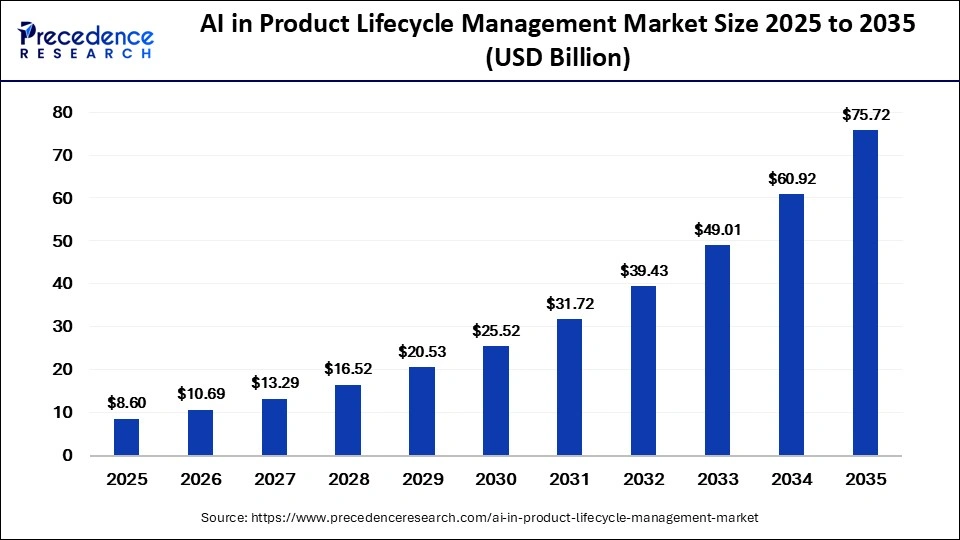
The global AI in Product Lifecycle Management market is projected to grow from USD 10.69 billion in 2026 to USD 75.72 billion by 2035, driven by Industry 4.0 adoption, digital transformation, and AI-powered product innovation.
Read Also: Human Centric Lighting Market
AI in Product Lifecycle Management Market Set for Rapid Growth as Enterprises Accelerate Digital Transformation
Artificial intelligence is rapidly reshaping how organizations design, develop, manufacture, and manage products throughout their lifecycle. As industries increasingly adopt smart manufacturing, digital engineering, and Industry 4.0 technologies, AI-powered Product Lifecycle Management (PLM) solutions are emerging as a critical tool for enhancing efficiency, reducing costs, and accelerating innovation.
The global AI in Product Lifecycle Management market is witnessing remarkable growth, reflecting the rising demand for intelligent systems capable of managing complex product data, optimizing workflows, and improving decision-making across the entire product development process. According to industry estimates, the market is expected to grow from USD 10.69 billion in 2026 to approximately USD 75.72 billion by 2035, expanding at a CAGR of 24.3% during the forecast period.
Why AI is Becoming Essential in Product Lifecycle Management
Traditional PLM systems have long been used to manage product data from concept development to retirement. However, growing product complexity, shorter innovation cycles, and increasing customer expectations are pushing businesses to seek more intelligent solutions.
AI brings advanced capabilities to PLM platforms, including predictive analytics, automated design recommendations, natural language processing, computer vision, and generative design. These technologies enable organizations to automate repetitive tasks, improve collaboration across departments, identify potential product issues early, and optimize resource allocation.
As manufacturers and product developers continue to digitize operations, AI-powered PLM systems are becoming indispensable for maintaining competitiveness and accelerating product innovation.
Industry 4.0 and Smart Manufacturing Fuel Market Expansion
The widespread adoption of Industry 4.0 technologies is one of the most significant drivers of AI integration within PLM platforms. Modern manufacturing environments generate enormous volumes of data from connected machines, sensors, and production systems.
AI enables organizations to analyze this data in real time, generating actionable insights that improve product quality, reduce downtime, and enhance operational efficiency. Intelligent PLM platforms can identify design flaws, predict maintenance requirements, and recommend process improvements before issues escalate into costly failures.
The growing implementation of digital factories, smart production systems, and connected supply chains is expected to create substantial opportunities for AI-enabled PLM solutions over the next decade.
Generative AI is Revolutionizing Product Development
One of the most transformative trends in the market is the rise of generative AI. Unlike traditional AI models that primarily analyze data, generative AI can actively create product designs, engineering specifications, documentation, and simulations based on user prompts.
This capability is significantly reducing product development timelines while enabling engineers to explore multiple design alternatives more efficiently. Companies can accelerate innovation cycles, improve design accuracy, and bring products to market faster than ever before.
Industry analysts expect the generative AI segment to record the fastest growth among all technology categories within AI-powered PLM systems during the forecast period.
Digital Twins and Predictive Analytics Drive Innovation
Digital twin technology has emerged as a powerful application within AI-driven PLM ecosystems. By creating virtual replicas of physical products and processes, organizations can simulate real-world performance and test various scenarios before production begins.
Combined with predictive analytics, digital twins help manufacturers forecast failures, optimize maintenance schedules, improve product reliability, and enhance customer satisfaction. These capabilities are particularly valuable in industries where product complexity and operational risks are high.
The increasing adoption of digital twin technologies is expected to remain a key growth catalyst for the AI in PLM market throughout the coming years.
Cloud-Based PLM Solutions Gain Strong Momentum
Cloud deployment models are rapidly becoming the preferred choice for organizations implementing AI-powered PLM systems. Cloud-based platforms offer greater scalability, flexibility, and accessibility compared to traditional on-premises infrastructure.
Organizations benefit from reduced implementation costs, simplified maintenance, seamless software updates, and improved collaboration among globally distributed teams. Cloud-native AI solutions also enable faster integration with enterprise applications and advanced analytics tools.
As businesses continue embracing digital transformation initiatives, demand for cloud-based AI PLM platforms is expected to grow significantly across industries.
Automotive and Manufacturing Industries Lead Adoption
The automotive sector remains one of the largest adopters of AI-driven PLM technologies due to increasing vehicle complexity, electrification trends, and autonomous mobility development.
Manufacturers are leveraging AI-powered PLM platforms to improve engineering processes, accelerate product launches, and optimize supply chain operations. Similarly, industrial manufacturing companies are investing heavily in intelligent lifecycle management systems to enhance productivity and maintain competitiveness.
Other industries, including aerospace, healthcare, consumer goods, electronics, and semiconductor manufacturing, are also increasing investments in AI-powered lifecycle management technologies.
Asia Pacific Emerges as the Fastest-Growing Regional Market
While North America currently represents the largest market for AI in Product Lifecycle Management, Asia Pacific is projected to experience the fastest growth during the forecast period.
Rapid industrialization, expanding manufacturing capabilities, increasing technology investments, and strong government support for digital transformation are driving adoption across countries such as China, India, Japan, and South Korea.
The region’s growing focus on smart factories, advanced manufacturing, and AI innovation is expected to create significant opportunities for PLM solution providers in the coming years.
Key Challenges Facing Market Participants
Despite strong growth prospects, several challenges remain. Integrating AI technologies into existing PLM environments can be complex and resource-intensive. Many organizations also face difficulties related to data quality, interoperability, cybersecurity, and workforce readiness.
Additionally, the need for specialized expertise and continuous system optimization may increase implementation costs for some enterprises. However, ongoing advancements in cloud computing, AI automation, and low-code development platforms are helping reduce these barriers.
As technology matures, adoption is expected to accelerate across organizations of all sizes.
Future Outlook
The future of Product Lifecycle Management is increasingly intelligent, connected, and data-driven. AI is transforming PLM from a traditional data management tool into a strategic platform that supports innovation, collaboration, and business growth.
With growing investments in generative AI, predictive analytics, digital twins, and cloud-based infrastructure, organizations are unlocking new opportunities to streamline product development and improve operational performance.
As enterprises continue prioritizing digital transformation and smart manufacturing initiatives, the AI in Product Lifecycle Management market is poised for substantial expansion, creating significant opportunities for technology providers, manufacturers, and product innovators worldwide.
For inquiries regarding discounts, bulk purchases, or customization requests, please contact us at [email protected]
