
The global machine automation controller market is projected to grow from USD 52.88 billion in 2026 to USD 112.46 billion by 2035 at a CAGR of 8.72%. Explore market trends, AI-driven automation, segment analysis, regional insights, and leading companies.
Machine Automation Controller Market Size, Share, Trends and Forecast 2026 to 2035
The global machine automation controller market is witnessing strong growth driven by rapid industrial automation, increasing adoption of smart manufacturing technologies, and the rising implementation of Industry 4.0 solutions across industries worldwide. Manufacturers are increasingly integrating advanced machine automation controllers to improve production efficiency, minimize downtime, optimize operational workflows, and reduce labor costs.
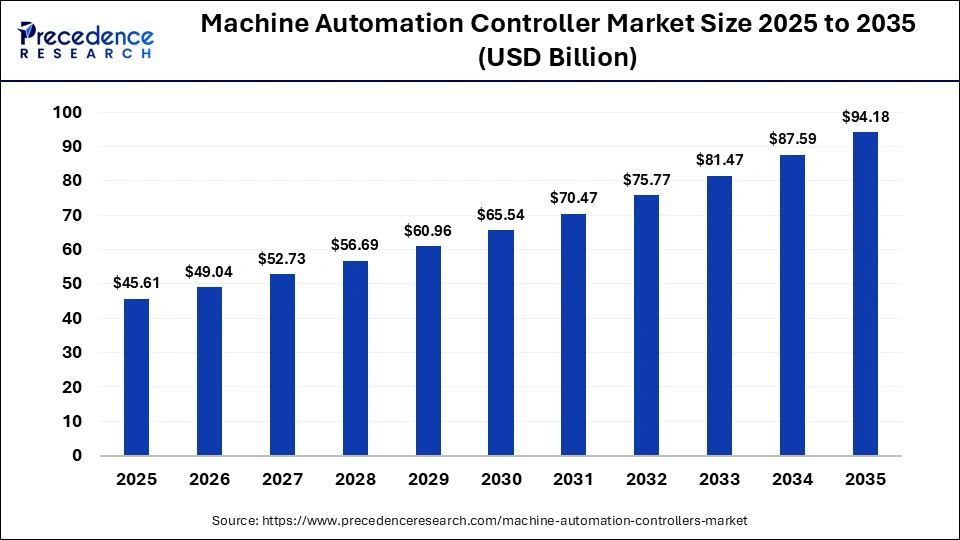
According to recent industry analysis, the global machine automation controller market size was valued at USD 48.63 billion in 2025 and is projected to increase from USD 52.88 billion in 2026 to approximately USD 112.46 billion by 2035, expanding at a CAGR of 8.72% during the forecast period.
The growing demand for programmable automation systems, industrial robotics, AI-powered manufacturing solutions, and real-time industrial monitoring technologies is significantly contributing to market expansion globally.
Read Also: Fantasy Sports Market
Market Overview
Machine automation controllers are advanced industrial control systems designed to automate machinery, production lines, and industrial processes. These controllers monitor equipment performance, process operational data, execute automated commands, and ensure seamless machine-to-machine communication.
Automation controllers are widely used across industries such as:
- Automotive
- Electronics
- Pharmaceuticals
- Food & beverages
- Oil & gas
- Aerospace
- Packaging
- Semiconductor manufacturing
The market is benefiting from several transformative trends, including:
- Rising adoption of Industry 4.0
- Increasing industrial robotics deployment
- Expansion of smart factories
- Growth of Industrial Internet of Things (IIoT)
- AI-based predictive maintenance
- Increasing focus on energy efficiency
North America dominated the global machine automation controller market in 2025, while Asia-Pacific is expected to witness the fastest growth during the forecast period. (precedenceresearch.com)
How AI is Revolutionizing Machine Automation Controllers
Artificial intelligence (AI) is playing a transformative role in modern industrial automation systems. AI-powered automation controllers analyze real-time industrial data, optimize machine performance, and enable predictive maintenance capabilities.
Machine learning algorithms are increasingly being integrated into automation systems for:
- Predictive maintenance
- Real-time fault detection
- Production optimization
- Energy management
- Quality assurance
- Process automation
AI-enabled controllers help manufacturers minimize operational disruptions and improve productivity by identifying equipment anomalies before failures occur.
The integration of AI with industrial automation systems is expected to significantly improve manufacturing efficiency, reduce operational costs, and accelerate digital transformation across industries.
Key Market Drivers
Rising Adoption of Industry 4.0
Industry 4.0 initiatives are significantly driving demand for advanced machine automation controllers worldwide.
Smart manufacturing systems require:
- Real-time industrial monitoring
- Intelligent machine communication
- Data-driven process optimization
- Automated quality control
- Industrial analytics integration
Automation controllers are becoming critical components within connected manufacturing ecosystems.
The increasing deployment of IIoT devices and cloud-connected production systems is further accelerating market growth.
Expansion of Industrial Robotics
The growing use of industrial robots across automotive, electronics, and semiconductor industries is fueling demand for machine automation controllers.
Industrial robots require sophisticated controllers capable of:
- Motion control
- Process synchronization
- Precision automation
- Real-time programming
- Safety monitoring
The automotive sector remains one of the largest adopters of industrial automation systems due to rising vehicle production and electric vehicle manufacturing expansion.
Growing Demand for Smart Factories
Manufacturers are increasingly investing in smart factory infrastructure to improve operational flexibility and reduce production costs.
Smart factories utilize advanced automation technologies such as:
- Programmable logic controllers (PLCs)
- Distributed control systems (DCS)
- Supervisory control and data acquisition (SCADA)
- Human-machine interfaces (HMI)
- Motion control systems
The increasing shift toward connected manufacturing environments is expected to remain a major growth driver over the next decade.
Emerging Market Trends
Increasing Integration of IIoT
The Industrial Internet of Things (IIoT) is rapidly transforming industrial automation ecosystems. Automation controllers are increasingly connected with sensors, cloud platforms, and industrial analytics systems.
IIoT-enabled controllers provide:
- Remote monitoring capabilities
- Real-time operational insights
- Predictive maintenance alerts
- Industrial data analytics
- Enhanced process visibility
The convergence of IIoT and automation technologies is creating highly connected manufacturing environments globally.
Growing Adoption of Edge Computing
Edge computing is emerging as an important trend in industrial automation. Edge-enabled controllers process industrial data locally, reducing latency and improving operational efficiency.
Benefits of edge computing in automation include:
- Faster decision-making
- Reduced cloud dependency
- Improved cybersecurity
- Enhanced real-time processing
The increasing demand for low-latency industrial operations is accelerating edge computing adoption across manufacturing facilities.
Expansion of Energy-Efficient Automation Systems
Manufacturers are increasingly adopting energy-efficient automation systems to reduce operational expenses and achieve sustainability goals.
Advanced automation controllers help optimize:
- Energy consumption
- Resource utilization
- Equipment efficiency
- Production output
Sustainability-focused industrial operations are expected to support long-term market growth.
Market Restraints
High Initial Investment Costs
Implementing advanced automation systems requires significant capital investment in hardware, software, integration services, and employee training.
Small and medium-sized enterprises (SMEs) may face challenges adopting high-cost industrial automation solutions.
Cybersecurity Risks
The growing connectivity of industrial systems increases exposure to cybersecurity threats.
Connected automation systems face risks related to:
- Data breaches
- Malware attacks
- Industrial espionage
- Network vulnerabilities
Manufacturers are increasingly prioritizing industrial cybersecurity solutions to protect critical infrastructure.
Complexity of System Integration
Integrating automation controllers with existing industrial systems can be technically complex and time-consuming.
Compatibility issues between legacy infrastructure and modern automation platforms may delay deployment timelines.
Segment Analysis
Controller Type Insights
Programmable Logic Controllers (PLCs) Dominated the Market
Programmable logic controllers accounted for the largest market share in 2025 due to their widespread use in industrial automation applications. (precedenceresearch.com)
PLCs are widely preferred because of:
- High reliability
- Flexible programming
- Easy integration
- Real-time process control
- Scalability
Distributed Control Systems (DCS)
Distributed control systems are extensively used in large-scale industrial operations such as oil & gas, chemicals, and power generation.
DCS solutions offer:
- Centralized process management
- Advanced analytics
- Process optimization
- High operational reliability
Industry Insights
Automotive Industry Led the Market
The automotive sector accounted for the highest market share in 2025 due to increasing adoption of robotic manufacturing systems and automated assembly lines. (precedenceresearch.com)
Automation technologies help automotive manufacturers improve:
- Production speed
- Precision manufacturing
- Product consistency
- Operational efficiency
Electronics and Semiconductor Industry Growing Rapidly
The electronics and semiconductor industry is expected to witness strong growth due to rising demand for high-precision manufacturing and miniaturized electronic components.
Technology Insights
Motion Control Systems Gaining Traction
Motion control systems are becoming increasingly important for robotic automation, packaging equipment, and semiconductor manufacturing.
These systems enable:
- Precise positioning
- Speed control
- Multi-axis synchronization
- Automated movement coordination
SCADA and HMI Integration Expanding
SCADA and HMI systems are increasingly integrated with automation controllers to improve process visualization and industrial decision-making.
Regional Analysis
North America Dominated the Global Market
North America held the largest market share in 2025 due to strong industrial automation adoption, advanced manufacturing infrastructure, and high investment in smart factory technologies. (precedenceresearch.com)
The United States remains a major contributor due to rapid deployment of:
- AI-powered manufacturing systems
- Industrial robotics
- Cloud-based automation platforms
- IIoT-enabled production facilities
U.S. Market Trends
The U.S. manufacturing sector is increasingly adopting predictive maintenance and AI-driven automation to improve productivity and operational resilience.
Government support for domestic manufacturing and semiconductor production is further driving industrial automation investments.
Asia-Pacific to Witness Fastest Growth
Asia-Pacific is projected to grow at the fastest CAGR during the forecast period due to rapid industrialization, expansion of electronics manufacturing, and increasing smart factory investments. (precedenceresearch.com)
Key growth countries include:
- China
- India
- Japan
- South Korea
China Market Trends
China remains a global manufacturing powerhouse and is heavily investing in factory automation, robotics, and AI-enabled industrial systems.
The country’s “Made in China 2025” initiative continues to accelerate industrial digitalization and smart manufacturing adoption.
Competitive Landscape
The machine automation controller market is highly competitive, with leading industrial automation companies focusing on AI integration, cloud automation, and smart factory solutions.
Key Companies Operating in the Market
- Siemens AG
- Rockwell Automation
- Schneider Electric
- ABB Ltd.
- Mitsubishi Electric
- Omron Corporation
- Honeywell International
- Emerson Electric Co.
- Yokogawa Electric Corporation
- Bosch Rexroth
These companies are increasingly investing in:
- AI-powered industrial automation
- Industrial cybersecurity
- Cloud-based manufacturing systems
- Predictive maintenance technologies
- Edge computing integration
Recent Developments
- Several industrial automation providers are expanding AI-enabled predictive maintenance capabilities to reduce factory downtime and improve operational efficiency.
- Major automation companies are increasingly launching cloud-connected PLC systems integrated with IIoT analytics platforms to support smart manufacturing environments.
- The growing adoption of collaborative robots (cobots) is driving demand for intelligent machine automation controllers capable of supporting human-machine collaboration.
Future Outlook
The future of the machine automation controller market appears highly promising due to accelerating industrial digitalization, increasing robotics deployment, and growing adoption of AI-powered manufacturing technologies.
Emerging innovations in:
- Industrial AI
- Edge computing
- Digital twins
- Smart robotics
- Cloud automation
- Autonomous manufacturing
are expected to reshape industrial production ecosystems globally.
Asia-Pacific is expected to emerge as the strongest growth region due to rapid industrial expansion and increasing government support for smart manufacturing initiatives.
Conclusion
The global machine automation controller market is experiencing strong growth fueled by Industry 4.0 adoption, expansion of industrial robotics, and increasing demand for smart manufacturing technologies.
AI-driven automation, predictive maintenance systems, and IIoT integration are transforming industrial production processes across multiple sectors.
With North America leading the market and Asia-Pacific witnessing rapid industrial growth, the machine automation controller industry is expected to continue expanding steadily through 2035.
Get a Sample Copy: https://www.precedenceresearch.com/sample/8228
For inquiries regarding discounts, bulk purchases, or customization requests, please contact us at [email protected]
