
The global AI IP and licensing market is entering a transformative growth phase as enterprises aggressively commercialize artificial intelligence technologies through structured intellectual property frameworks, licensing agreements, and proprietary model monetization strategies. The rapid rise of generative AI, AI accelerators, neural processing units (NPUs), and large language models (LLMs) is significantly increasing the value of AI-driven intellectual property across industries.
Organizations worldwide are investing heavily in AI model ownership, licensing rights, patent protection, and scalable monetization ecosystems to strengthen competitive positioning and unlock new recurring revenue streams. AI intellectual property has rapidly become one of the most valuable digital assets in sectors including semiconductors, cloud computing, healthcare, automotive, and industrial automation.
According to insights published by Precedence Research, the global AI IP and licensing market size was valued at USD 4.80 billion in 2025 and is projected to increase from USD 5.98 billion in 2026 to approximately USD 42.95 billion by 2035, expanding at a remarkable CAGR of 24.50% during the forecast period.
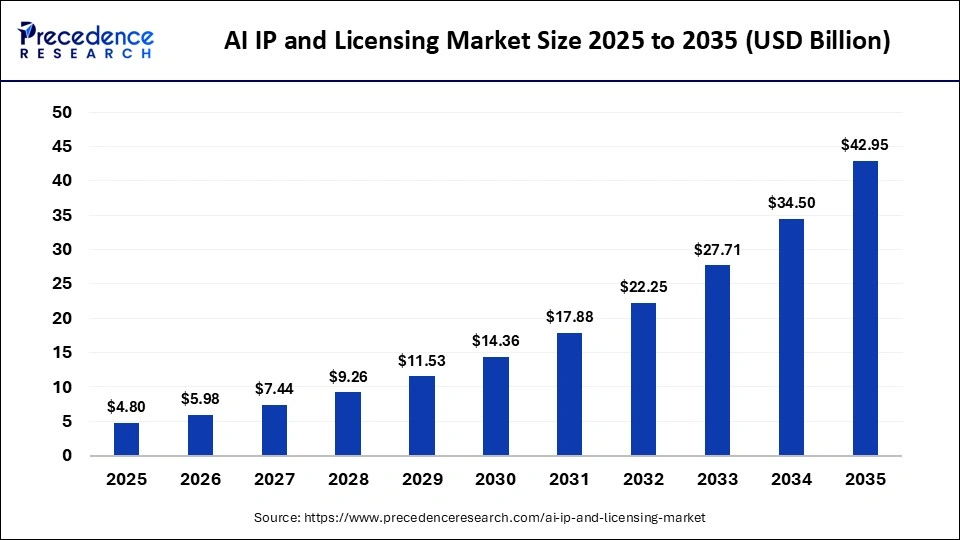
The rapid commercialization of generative AI platforms, cloud-based AI APIs, and processor licensing ecosystems is expected to reshape the future of global AI innovation and digital intellectual property monetization.
Read Also: Project and Portfolio Management Software Market
Quick Insights: Key AI IP and Licensing Market Highlights
- The global AI IP and licensing market is expected to grow from USD 4.80 billion in 2025 to USD 42.95 billion by 2035.
- The market is projected to expand at a CAGR of 24.50% between 2026 and 2035.
- North America dominated the global market with 42% share in 2025.
- Asia Pacific is expected to witness the fastest CAGR during the forecast period.
- The processor IP segment accounted for 45% market share in 2025.
- Cloud-based AI model licensing represented 45% of market revenue in 2025.
- Semiconductor & electronics remained the largest end-use industry with 35% share in 2025.
- API-based AI monetization and AI accelerator licensing are emerging as major industry growth trends.
Market Overview
The AI IP and licensing market involves the development, protection, management, and commercialization of intellectual property related to artificial intelligence technologies such as:
- Algorithms
- Neural networks
- Foundation models
- AI accelerators
- Software architectures
- Training datasets
- Semiconductor designs
- AI APIs
AI intellectual property is increasingly monetized through:
- Licensing agreements
- Subscription-based access
- Royalty models
- API monetization
- Cross-licensing frameworks
- Technology transfer agreements
Businesses increasingly prefer licensed AI technologies because they provide faster deployment, reduced development costs, and scalable innovation capabilities.
The growing enterprise dependence on generative AI, cloud computing, and intelligent automation systems is significantly driving demand for structured AI licensing ecosystems globally.
How is Artificial Intelligence Reshaping the AI IP and Licensing Market?
Artificial intelligence itself is becoming the core catalyst behind the expansion of AI intellectual property ecosystems.
Organizations are aggressively developing proprietary:
- Large language models
- AI chips
- Computer vision systems
- NLP frameworks
- Autonomous driving algorithms
- AI infrastructure platforms
AI-powered licensing automation systems are streamlining:
- Royalty calculations
- Usage tracking
- Contract compliance
- Licensing approvals
- Digital rights management
Advanced AI technologies are also improving patent analytics and intellectual property management by helping organizations identify:
- Patent opportunities
- Licensing risks
- Competitive threats
- Innovation gaps
The growing importance of generative AI ownership is creating entirely new licensing frameworks centered around AI models and API-based services.
Academic researchers are also exploring new royalty frameworks to compensate artists and intellectual property holders for AI-generated content and licensed AI systems.
What are the Major Growth Drivers of the AI IP and Licensing Market?
Why is Generative AI Commercialization Driving Market Expansion?
The explosive growth of generative AI technologies is one of the strongest growth drivers for the market.
Enterprises increasingly seek ownership and monetization rights for:
- Proprietary foundation models
- AI training datasets
- AI-generated content engines
- Domain-specific AI solutions
The commercialization of generative AI platforms is creating strong demand for:
- Patent protection
- Structured licensing frameworks
- API monetization systems
- Royalty-based business models
Global investment in generative AI companies exceeded USD 35 billion in 2025, reflecting growing enterprise interest in AI intellectual property ownership and licensing ecosystems.
How is AI Chip Licensing Fueling Industry Growth?
AI semiconductor innovation is significantly accelerating market expansion.
The growing adoption of:
- AI accelerators
- GPUs
- NPUs
- Edge AI chips
- High-performance processors
is increasing demand for processor intellectual property licensing.
Technology companies increasingly license processor architectures to:
- Reduce development costs
- Accelerate chip innovation
- Enable AI scalability
- Improve energy efficiency
The processor IP segment dominated the market with 45% share in 2025 due to strong demand for AI-capable semiconductor architectures.
The rise of edge computing and autonomous systems is expected to further strengthen AI chip licensing demand worldwide.
Why is API-Based AI Monetization Emerging as a Major Opportunity?
API-based AI delivery models are transforming how organizations monetize artificial intelligence.
Businesses increasingly provide AI capabilities through:
- Cloud APIs
- Subscription services
- Usage-based licensing
- AI-as-a-Service platforms
API monetization allows companies to:
- Generate recurring revenue
- Retain ownership of AI models
- Improve scalability
- Expand enterprise accessibility
The rapid growth of AI-powered automation, analytics, and customer engagement systems is expected to significantly strengthen API-based licensing opportunities over the coming decade.
What Trends are Reshaping the AI IP and Licensing Industry?
Why are Open-Source AI Licensing Models Gaining Attention?
The increasing adoption of open-source AI frameworks is reshaping industry dynamics.
Industry data indicates that approximately 64% of newly released generative AI models in 2025 were open-source, highlighting the growing popularity of collaborative AI ecosystems.
Open-source licensing enables:
- Faster innovation
- Community-driven development
- Reduced entry barriers
- Broader AI accessibility
However, enterprises continue prioritizing proprietary AI models for:
- Competitive differentiation
- Data security
- Commercial exclusivity
- Revenue generation
This balance between open-source innovation and proprietary monetization is expected to remain a defining industry trend.
How are Digital Twins and Intelligent Licensing Systems Transforming the Market?
AI-powered digital twins and intelligent licensing automation systems are emerging as major innovation areas.
Organizations increasingly use AI to automate:
- Licensing approvals
- Royalty management
- Usage tracking
- Contract monitoring
Digital twin technologies are also being integrated with AI licensing ecosystems to optimize predictive modeling and industrial operations.
The growing integration of intelligent automation into licensing frameworks is expected to significantly improve operational efficiency and compliance management.
Segmental Analysis
By IP Type
Why Did Processor IP Dominate the Market?
The processor IP segment dominated the market with 45% share in 2025.
Growth is driven by rising demand for:
- AI accelerators
- GPUs
- NPUs
- Edge AI processors
- High-performance computing systems
Processor licensing enables semiconductor manufacturers to rapidly deploy AI-capable hardware architectures without extensive in-house R&D investments.
The AI algorithm & model licensing segment is expected to witness the fastest growth because of rising demand for:
- Foundation models
- Pre-trained AI systems
- API-based AI services
- Domain-specific AI platforms
By Deployment Model
Why Did Cloud-Based AI Licensing Lead the Market?
The cloud-based AI model licensing segment accounted for 45% market share in 2025.
Cloud-based licensing provides:
- Scalability
- Lower infrastructure costs
- Faster deployment
- Remote accessibility
- Centralized model management
Organizations increasingly adopt AI-as-a-Service platforms to deploy intelligent applications without building proprietary infrastructure.
The hybrid licensing segment is expected to witness strong growth due to rising enterprise demand for:
- Edge-cloud integration
- Flexible AI deployment
- Enhanced data privacy
- Operational efficiency
By Application
Why Did Data Centers & Cloud AI Dominate?
The data centers & cloud AI segment represented 30% of total market share in 2025.
The rapid growth of:
- Generative AI workloads
- Enterprise cloud transformation
- AI analytics platforms
- Real-time processing systems
is significantly increasing demand for licensed AI technologies within data center ecosystems.
The autonomous vehicles segment is expected to witness rapid growth due to rising licensing demand for:
- Perception systems
- Sensor fusion technologies
- Real-time decision-making models
- Autonomous driving AI platforms
By End-Use Industry
Why Did Semiconductor & Electronics Lead the Market?
The semiconductor & electronics segment dominated the market with 35% share in 2025.
Semiconductor companies increasingly integrate licensed AI intellectual property into:
- Smart devices
- Edge computing systems
- AI accelerators
- Consumer electronics
- Industrial hardware
The automotive industry is expected to witness the fastest CAGR because of increasing adoption of:
- ADAS technologies
- Autonomous driving systems
- AI-enabled mobility platforms
Regional Analysis
Why Does North America Dominate the AI IP and Licensing Market?
North America led the market with 42% share in 2025 due to:
- Strong AI innovation ecosystem
- Advanced semiconductor industry
- Large-scale cloud infrastructure
- Robust intellectual property frameworks
The United States remains the global hub for:
- AI research
- Proprietary model development
- Semiconductor licensing
- AI commercialization
Companies including Microsoft, NVIDIA, Google, and IBM continue investing heavily in AI patent portfolios and licensing platforms.
Why is Asia Pacific the Fastest-Growing Region?
Asia Pacific is expected to witness the fastest growth during the forecast period.
Growth drivers include:
- Semiconductor manufacturing expansion
- Digital infrastructure investments
- AI startup ecosystem growth
- Government-backed AI initiatives
China continues leading regional innovation due to strong investments in:
- AI research
- Chip manufacturing
- Smart city projects
- Cloud infrastructure
The World Intellectual Property Organization reported that China accounted for more than 60% of global AI patent applications between 2024 and 2025.
India is also emerging as a rapidly growing AI innovation hub supported by expanding digital infrastructure and startup ecosystems.
AI IP and Licensing Market Value Chain Analysis
The AI IP and licensing value chain includes:
- AI research and development
- Patent creation
- Semiconductor design
- AI model training
- Licensing management
- API commercialization
- Cloud deployment
- Enterprise integration
Technology companies increasingly focus on building vertically integrated AI ecosystems capable of generating long-term recurring licensing revenue.
The growing complexity of generative AI systems is expected to further strengthen structured licensing frameworks globally.
Top Companies in the AI IP and Licensing Market
Several major technology and semiconductor companies are aggressively investing in AI intellectual property ecosystems.
Leading Industry Players
- Alphabet Inc.
- ARM Holdings plc
- NVIDIA Corporation
- Qualcomm Incorporated
- IBM Corporation
- Intel Corporation
- Synopsys, Inc.
- Cadence Design Systems, Inc.
- Graphcore Ltd.
- Tenstorrent Inc.
These companies are focusing on:
- AI accelerator licensing
- Foundation model monetization
- API-based AI delivery
- Edge AI deployment
- Semiconductor innovation
- Cloud-native AI infrastructure
Recent Developments in the Industry
The market is witnessing rapid innovation through:
- AI model commercialization
- Processor licensing
- Generative AI monetization
- AI-as-a-Service ecosystems
- Licensing automation technologies
In December 2025, NVIDIA Corporation and Groq Inc. finalized a USD 20 billion technology licensing agreement focused on AI infrastructure expansion.
In April 2026, BluWave-ai expanded its patent licensing operations after increasing its global patent portfolio.
In March 2026, Panasonic Holdings Corporation launched global licensing for its AI-based visual inspection platform developed in Singapore.
Challenges Impacting Market Growth
Intellectual Property Ownership Disputes
One of the major challenges within the market is the increasing complexity of AI ownership disputes.
Organizations frequently face legal uncertainties regarding:
- Training data ownership
- AI-generated content rights
- Model attribution
- Licensing enforcement
These concerns may slow enterprise adoption of externally licensed AI systems.
Regulatory and Ethical Concerns
Governments worldwide are increasingly introducing regulations related to:
- AI transparency
- Copyright protection
- Data governance
- Ethical AI deployment
Maintaining regulatory compliance while protecting proprietary innovation remains a major industry challenge.
Future Outlook
The future of the AI IP and licensing market will likely be shaped by:
- Generative AI commercialization
- API-based monetization
- AI accelerator innovation
- Cloud-native AI licensing
- Autonomous systems
- Intelligent licensing automation
As enterprises increasingly prioritize AI ownership and scalable monetization strategies, intellectual property frameworks will become central to the future global AI economy.
Organizations capable of balancing innovation, regulation, and commercialization are expected to gain substantial competitive advantages.
Conclusion
The global AI IP and licensing market is entering a period of unprecedented expansion fueled by generative AI growth, semiconductor innovation, API monetization, and enterprise AI adoption.
AI intellectual property is evolving into a strategic business asset capable of generating long-term recurring revenue and competitive differentiation.
As AI ecosystems continue expanding worldwide, structured licensing frameworks and proprietary AI ownership models will become increasingly essential to the future digital economy.
Get a Sample Copy: https://www.precedenceresearch.com/sample/8325
