
The global wearable AI market is entering a transformative phase as consumers, healthcare providers, and enterprises increasingly adopt intelligent wearable devices to improve health monitoring, productivity, and user experience. The market was valued at USD 32.60 billion in 2025 and is projected to grow from USD 39.54 billion in 2026 to nearly USD 224.82 billion by 2035, expanding at a CAGR of 21.30% during the forecast period.
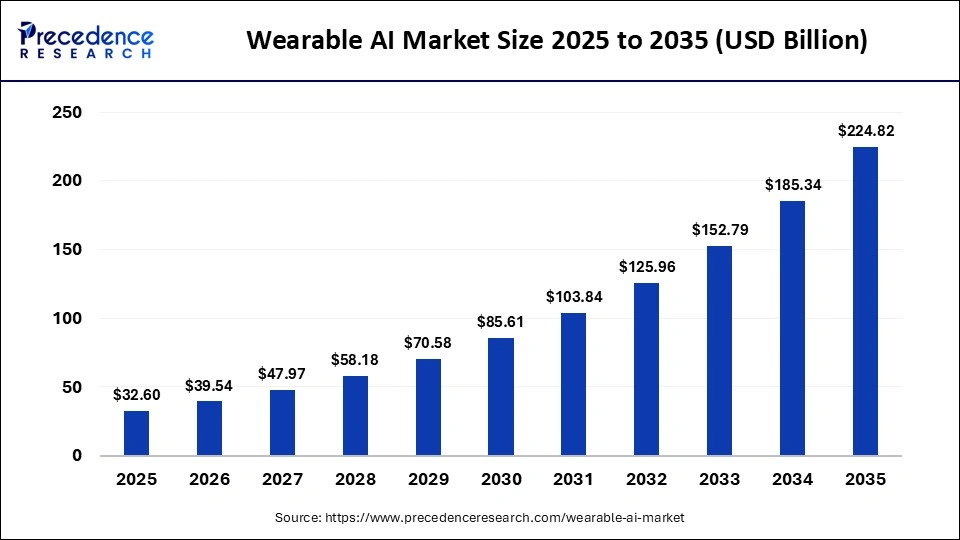
Wearable AI devices are becoming more advanced through the integration of artificial intelligence, machine learning, computer vision, and predictive analytics. These technologies are enabling devices to do much more than track basic activity. Modern wearables can now provide real-time health insights, monitor chronic diseases, predict behavioral patterns, improve athletic performance, and support remote patient monitoring.
Read Also: 5G Customer Premises Equipment Market
How is Artificial Intelligence Transforming the Wearable Technology Industry?
Artificial intelligence is fundamentally changing the way wearable devices interact with users. Traditional wearables mainly focused on collecting raw data such as step counts, sleep duration, or heart rate. However, AI-powered wearables now use predictive analytics, machine learning, and contextual awareness to convert this data into actionable insights.
AI-enabled smartwatches and health wearables can detect irregular heartbeats, monitor oxygen saturation, identify stress levels, predict sleep quality, and recommend lifestyle adjustments. This is making wearable devices essential tools for preventive healthcare and chronic disease management.
In enterprise environments, wearable AI is also supporting worker productivity and safety. Smart glasses and wearable sensors are increasingly being used for remote assistance, industrial training, logistics optimization, and real-time monitoring in manufacturing facilities. As AI becomes more embedded into wearable ecosystems, the industry is moving toward devices that are more intuitive, autonomous, and personalized.
What Are the Major Growth Drivers of the Wearable AI Market?
One of the key drivers of the wearable AI market is the growing demand for real-time health monitoring. Consumers are increasingly seeking devices that can continuously monitor their physical condition and provide insights into their daily wellness routines.
The rising burden of chronic diseases such as diabetes, cardiovascular disorders, obesity, and respiratory illnesses is also encouraging the use of AI-powered wearables. These devices help patients and healthcare providers monitor vital signs remotely and improve early diagnosis.
The increasing adoption of telemedicine and remote patient monitoring is another major factor accelerating demand. Healthcare providers are integrating wearable AI data into patient care systems to improve treatment outcomes and reduce hospitalization rates.
Additionally, technological improvements in sensors, battery performance, miniaturized chipsets, and fast-charging capabilities are making wearables more efficient, lightweight, and user-friendly. Growing smartphone penetration and 5G connectivity are also enhancing device compatibility and performance.
Why Are Smartwatches Leading the Wearable AI Market?
The smartwatch segment accounted for 50% of the wearable AI market in 2025, making it the largest product category. Smartwatches are increasingly being adopted because they combine multiple features such as health tracking, communication, activity monitoring, GPS navigation, and AI voice assistance into a single device.
Consumers are using smartwatches to monitor heart rate, sleep quality, stress levels, blood oxygen, and calorie consumption. These devices are also becoming more useful in healthcare settings due to their ability to support remote patient monitoring and emergency alerts.
At the same time, smart rings and smart glasses are gaining traction as emerging product categories. Smart rings are expected to witness the fastest growth due to their compact size, improved battery performance, and advanced biometric monitoring capabilities. Smart glasses are also becoming increasingly popular in industrial training, remote assistance, and augmented reality applications.
What Makes Healthcare the Largest Application Segment?
Healthcare remained the leading application area for wearable AI in 2025, accounting for 35% of the market. Wearable AI devices are widely used for monitoring chronic diseases, supporting elderly care, tracking vital signs, and enabling early diagnosis.
The integration of AI-powered wearables into healthcare systems is helping physicians make faster and more accurate decisions. Smartwatches, smart rings, and medical-grade wearables are now widely used to monitor heart conditions, diabetes, sleep disorders, and respiratory illnesses.
The fitness and wellness segment is also showing strong growth as more consumers adopt wearable devices to track exercise, diet, sleep, and overall health performance. Meanwhile, sports organizations are increasingly using AI-enabled wearables to improve athlete performance, prevent injuries, and provide real-time analytics.
What Challenges Are Limiting Market Expansion?
Despite strong growth prospects, the wearable AI market faces several challenges. One of the biggest concerns is data privacy and cybersecurity. Since wearable devices collect large volumes of sensitive health and behavioral data, concerns around data breaches and misuse remain high.
Another challenge is device affordability. Advanced AI-powered wearables with premium sensors, longer battery life, and medical-grade features often come with high price tags, which can limit adoption in price-sensitive markets.
Short product life cycles and electronic waste are also becoming major concerns. Millions of wearable devices are discarded each year, creating sustainability challenges related to battery disposal, rare metals, and recycling infrastructure. Experts are increasingly calling for more sustainable design practices, modular components, and improved recycling programs for wearable devices.
What Emerging Trends Are Shaping the Future of Wearable AI?
Several emerging trends are expected to redefine the wearable AI market over the next decade.
One of the biggest developments is the shift toward on-device AI processing. Companies are now focusing on wearables that can run AI functions locally without relying heavily on cloud infrastructure. This improves privacy, speed, and battery efficiency.
Another major trend is the expansion of AI-enabled smart glasses. Wearables are moving beyond fitness tracking toward augmented reality, contextual computing, and hands-free interaction. Smart glasses are expected to become increasingly important in healthcare, logistics, retail, and industrial operations.
AI-powered smart rings are also gaining momentum because of their sleek design and ability to deliver advanced health insights without the bulk of traditional devices.
Additionally, the market is witnessing stronger integration between wearable devices and telemedicine platforms, allowing healthcare providers to access real-time patient data and deliver more personalized care remotely.
Regional Outlook
North America led the wearable AI market in 2025 with a 40% share. The region benefits from high consumer awareness, strong digital infrastructure, widespread smartphone adoption, and growing demand for preventive healthcare solutions. The United States remains the leading contributor due to its advanced healthcare ecosystem and strong investments in AI technologies.
Asia Pacific is expected to witness the fastest growth during the forecast period. Rising disposable incomes, expanding internet access, growing health awareness, and strong government support for digital health are driving demand for wearable AI devices in countries such as China, India, Japan, and South Korea.
Europe is also emerging as an important market due to rising healthcare digitization, increasing demand for smart medical wearables, and strong adoption of AI-enabled consumer electronics.
Leading Companies in the Wearable AI Market
Major companies operating in the wearable AI market include:
- Apple
- Samsung
- Qualcomm
- Meta
- Motorola
- Oura
- EssilorLuxottica
Get Sample Report: https://www.precedenceresearch.com/sample/8298
For inquiries regarding discounts, bulk purchases, or customization requests, please contact us at [email protected]
