
Allergy Rhinitis Drugs Market Size to Surpass USD 21.61 Billion by 2035

What is the Allergy Rhinitis Drugs Market Size in 2026?

The global allergy rhinitis drugs market size was calculated at USD 14.58 billion in 2025 and is predicted to increase from USD 15.17 billion in 2026 to approximately USD 21.61 billion by 2035, expanding at a CAGR of 4.01% from 2026 to 2035. The list of drugs that treat allergic rhinitis is steadily rising, fueled as much by heightened exposure to pollen, urban air pollution, and new-to-the-public awareness of respiratory allergies. This trend is driving demand for antihistamines, corticosteroid nasal sprays, and immunotherapy as branded or generic alternatives.
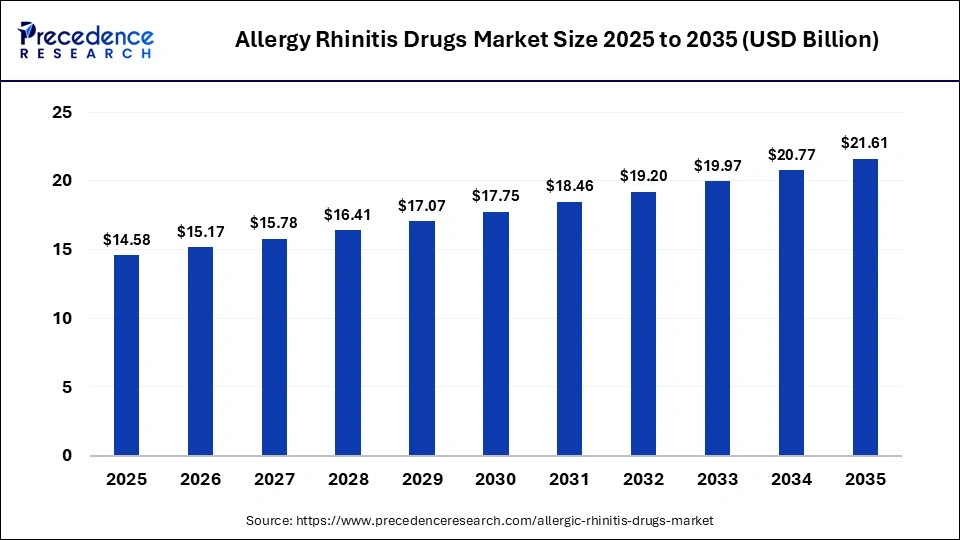
Allergy Rhinitis Drugs Market Size 2025 to 2035

Key Takeaways

  • North America held a major market share of 37% in 2025.
  • Asia-Pacific is expected to host the fastest-growing market in the coming years.
  • By disease type, the perennial allergic rhinitis segment contributed the biggest revenue share of the market in 2025.
  • By disease type, the seasonal allergic rhinitis segment is expected to expand rapidly in the market in the coming years.
  • By treatment type, the antihistamines segment registered its dominance over the global market in 2025.
  • By treatment type, the immunotherapy segment is expected to witness the fastest growth in the market over the forecast period.
  • By drug type, the prescription segment led the market in 2025.
  • By drug type, the OTC segment is expected to grow with the highest CAGR in the market during the studied years.
  • By route of administration, the oral segment contributed the biggest revenue share of the market in 2025.
  • By route of administration, the intravenous segment is expected to be the fastest-growing segment in the market.
Allergy Rhinitis Drugs Market Overview

The allergy rhinitis drugs market focuses on medications used to manage allergic rhinitis, a condition characterized by inflammation of the nasal passages triggered by allergens such as pollen, dust mites, mold, and pet dander. Common symptoms include sneezing, nasal congestion, itching in the nose or throat, and a runny nose (rhinorrhea).

Allergic rhinitis is generally categorized into three types: seasonal allergic rhinitis (hay fever), which occurs during specific pollen seasons; perennial allergic rhinitis, which persists throughout the year; and occupational allergic rhinitis, which results from exposure to allergens in workplace environments.

Treatment options in this market include a wide range of medications such as antihistamines for symptom relief, corticosteroids for reducing inflammation, decongestants for relieving nasal blockage, and immunotherapy for long-term desensitization to allergens. These treatments are administered through various routes, including oral tablets and liquids, intranasal sprays, eye drops for allergy-related eye symptoms, and injectable therapies for more severe cases.

Impact of AI on the Allergy Rhinitis Drugs Market

Artificial intelligence (AI) is increasingly influencing the allergy rhinitis drugs market, particularly in drug discovery and personalized treatment approaches. Pharmaceutical companies are using machine learning algorithms to analyze immune system pathways involved in IgE-mediated allergic reactions, enabling faster identification of potential drug targets for antihistamines and biologic therapies.

AI is also being integrated with environmental and pollen-monitoring data to predict seasonal allergy trends. This allows healthcare providers and digital health platforms to anticipate allergy outbreaks and implement preventive strategies in advance.

Furthermore, AI-driven insights support the development of personalized treatment plans by analyzing patient-specific data, improving therapeutic outcomes, and enhancing overall disease management. As a result, AI is helping to accelerate innovation while enabling more proactive and targeted care in the allergy rhinitis drugs market.

  • Increasing Use of Allergen Immunotherapy: Allergen-specific immunotherapy has been moving slowly but surely from an elite treatment to an integrated treatment in chronic allergic rhinitis. Increased demand for both sublingual tablets and injectable forms enables them to engage directly with the immune system, resulting in enduring symptomatic relief instead of merely temporary relief.
  • Progress in Drug Delivery Systems: The delivery of medications through technologies such as nasal sprays, disintegrating tablets, and inhalation devices is gaining support because of the particular functions they offer, such as a faster onset when we want to achieve relief in this type of allergy. These non-invasive methods contribute to patients’ compliance and to the accurate drug delivery to inflamed nasal tissues.
  • Introduction of Biologics and Personalized Allergy Therapies: A strategy for gradually moving to biologics and personalized medicines is starting to shift the face of drug agents for allergic rhinitis. Biologic treatments, which are geared towards different immune responses, are further studied in patients with inadequate response to a wide range of antihistamine or corticosteroid medications.

Market Scope

Report Coverage Details
Market Size in 2025 USD 14.58 Billion
Market Size in 2026 USD 15.17 Billion
Market Size by 2035 USD 21.61 Billion
Market Growth Rate from 2026 to 2035 CAGR of 4.01%
Dominating Region North America
Fastest Growing Region Asia Pacific
Base Year 2025
Forecast Period 2026 to 2035
Segments Covered Disease Type, Treatment Type, Drug Type, Route Of Administration,, and region
Regions Covered North America, Europe, Asia-Pacific, Latin America, and Middle East & Africa

Regional Insights

North America dominates the allergy rhinitis drugs market due to the high prevalence of allergic conditions and strong awareness among patients. The region benefits from advanced healthcare infrastructure, easy access to over-the-counter and prescription medications, and widespread use of antihistamines and corticosteroids. Increasing environmental pollution and seasonal pollen exposure are further driving demand, while the presence of major pharmaceutical companies supports continuous product innovation.

Europe represents a significant market, driven by rising cases of seasonal allergies and strong healthcare systems. Countries such as Germany, the UK, and France are witnessing increasing adoption of advanced therapies, including immunotherapy and biologics. Government initiatives focused on improving respiratory health and the growing availability of allergy diagnostics are also contributing to market growth.

Asia-Pacific is the fastest-growing region in the allergy rhinitis drugs market due to increasing urbanization, rising pollution levels, and growing awareness of allergic conditions. Countries like China, India, and Japan are experiencing a surge in allergy cases, which is boosting demand for effective treatments. Expanding healthcare infrastructure and increasing access to medications are further supporting market expansion.

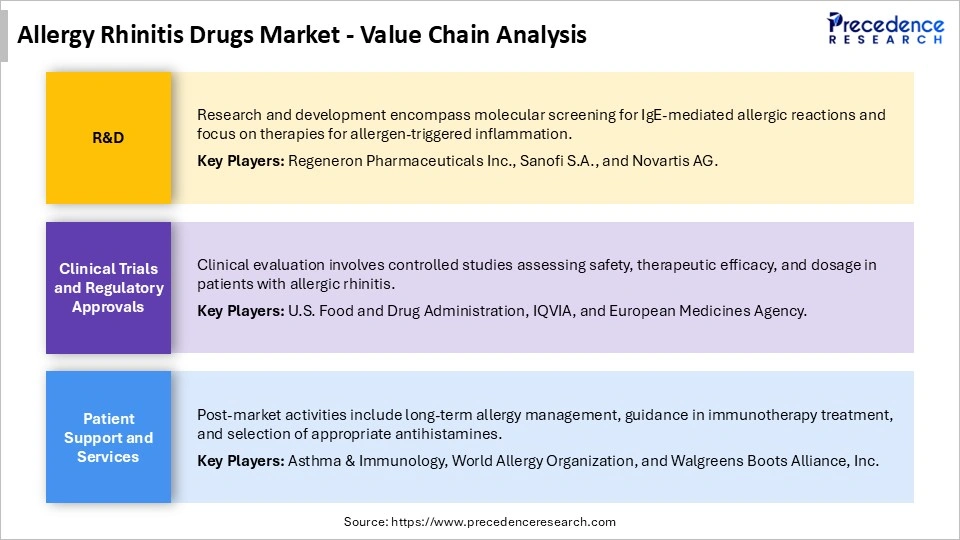
Allergy Rhinitis Drugs Market Value Chain Analysis

Allergy Rhinitis Drugs Market Value Chain Analysis

Allergy Rhinitis Drugs Market Key Players

  • ALK-Abello
  • AstraZeneca plc
  • Apotex Inc
  • Allergy Therapeutics PLC
  • Adamis Pharmaceuticals
  • Bayer
  • Bausch Health
  • Boehringer Ingelheim
  • Dr. Reddy’s Laboratories
  • GlaxoSmithKline
  • Glenmark Pharmaceuticals
  • Johnson & Johnson
  • Merck
  • Mylan (Viatris)
  • Novartis AG
  • Perrigo Company
  • Pfizer Inc
  • Regeneron Pharmaceuticals Inc
  • Sanofi
  • Stallergenes Greer
  • Sun Pharmaceuticals
  • Teva Pharmaceutical Industries
  • Unichem Laboratories
  • Viatris Inc

Recent Developments

  • In February 2026, Regeneron Pharmaceuticals, Inc., and Sanofi S.A. announced that the FDA approved their Dupixent (dupilumab) in the U.S. to relieve allergic fungal rhinosinusitis in patients 6 years or older. This is the first treatment in this category to have approved such a drug, which will facilitate a new breed of biologics for allergic respiratory disorders.
  • In November 2025, Glenmark Pharmaceuticals Ltd. received approval from China’s National Medical Products Administration for its Ryaltris compound nasal spray for moderate-to-severe allergic rhinitis. This product will be sold under a licensing agreement with Grand Pharmaceutical Group Limited in China and will add to Glenmark’s portfolio of products in respiratory therapy across Asia.

Segments Covered in the Report

By Disease Type

  • Perennial Allergic Rhinitis
  • Seasonal Allergic Rhinitis

By Treatment Type

  • Antihistamines
  • Corticosteroids
  • Immunotherapy
  • Decongestants
  • Combination Therapy
  • Other

By Drug Type

  • Prescription
  • OTC

By Route Of Administration

  • Oral
  • Nasal
  • Intravenous
  • Intraocular

By Region

  • North America
  • Latin America
  • Europe
  • Asia-pacific
  • Middle and East Africa
Scroll to Top