
Driven by E-Commerce Boom, AI-Powered Logistics & New Delivery Models, Global Industry Forecast 2026–2035
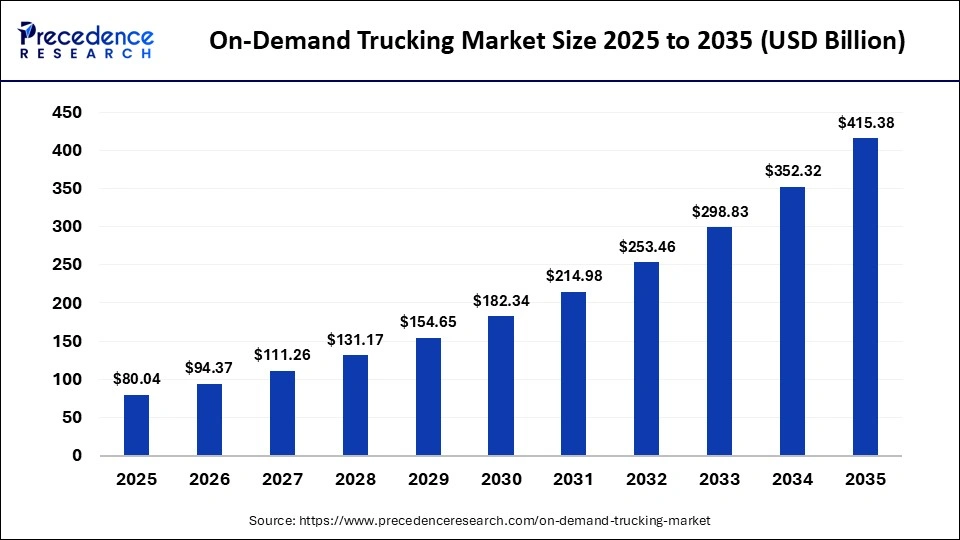
The global on-demand trucking market is on track to skyrocket from an estimated USD 94.37 billion in 2026 to USD 415.38 billion by 2035, achieving a robust CAGR of 17.90% over the forecast period. This explosive growth is underpinned by the rapid expansion of e-commerce, rising demand for instant delivery services, and transformative technology adoption across freight networks
On-Demand Trucking Market Key Points
-
The global on-demand trucking market was valued at USD 80.04 billion in 2025 and is forecast to reach USD 415.38 billion by 2035.
-
Asia Pacific dominated the market in 2025 with a 41% share and remains a key growth engine.
-
North America is projected to show significant CAGR owing to deep e-commerce penetration and logistics investments.
-
By service type, Full Truckload (FTL) is the largest share contributor, while Less Than Truckload (LTL) is the fastest-growing segment.
-
The first mile / last mile delivery segment leads current adoption; same-day delivery shows the quickest growth trajectory.
-
Medium-duty trucks dominate by vehicle type, but light-duty trucks are speeding ahead in CAGR.
On-Demand Trucking Market Valuation & Revenue Table (2025–2035)
| Year | Market Size (USD Billion) |
|---|---|
| 2025 | 80.04 |
| 2026 | 94.37 |
| 2035 | 415.38 |
Forecast period considered: 2026–2035 (CAGR 17.90%).
The Role of AI in On-Demand Trucking
Artificial Intelligence is rapidly becoming a core driver of operational excellence in the on-demand trucking ecosystem. AI-enabled platforms optimize route planning by ingesting real-time GPS, traffic, and weather data — significantly reducing transit times and fuel consumption while improving delivery reliability. AI-based driver assistance systems (ADAS) further enhance safety by monitoring driver behavior and enabling advanced features such as automated lane keeping and collision avoidance.
Beyond logistics execution, AI is transforming administrative workflows. Routine tasks — including freight documentation, rate negotiation, and invoice processing — are increasingly automated, allowing logistics managers to focus on strategic planning and customer engagement. This shift is not only improving efficiency but also enabling smaller carriers to compete with larger logistics providers through intelligent, cost-effective solutions.
On-Demand Trucking Market Growth Drivers
The on-demand trucking market’s growth is fueled by multiple converging trends:
-
E-Commerce Proliferation: Rapid expansion in online retail has created unprecedented demand for flexible and fast delivery services.
-
Digital Freight Marketplaces: Platforms like Uber Freight, Convoy, and Loadsmart enhance visibility and connectivity between shippers and carriers.
-
Consumer Expectations: The push for same-day and next-day delivery is reshaping logistics planning and capacity allocation.
-
Infrastructure Investment: Improved road networks and distribution hubs, particularly in Asia Pacific, boost market penetration.
-
Flexible Service Models: Growth of LTL and intermodal freight options makes on-demand trucking more accessible for small-to-medium shippers.
What’s Driving the Shift Toward On-Demand Trucking?
Why is on-demand trucking seeing unprecedented adoption?
The shift reflects the logistics industry’s response to customer expectations for speed, reliability, and flexibility. Traditional long-term contracts are giving way to dynamic capacity provisioning, supported by digital ecosystems that match freight demand with available trucks in real time. This agile model reduces empty miles, cuts costs, and improves asset utilization — benefits that are particularly strong in e-commerce and retail sectors.
How are regional trends shaping the market?
Asia Pacific leads due to rapid urbanization, digital infrastructure growth, and government investments in AI and automation. North America’s strengths lie in advanced logistics technologies and high consumer spending on digital platforms. Europe, Latin America, and the Middle East & Africa are progressively catching up, driven by rising demand for last-mile services and cross-border connectivity.
On-Demand Trucking Market Segmental Analysis
Service Type Insights
Full truckload (FTL) emerged as the dominant service type, capturing 65% market share in 2025. Its leadership is driven by efficiency, faster transit times, and cost advantages for high-volume shipments. Rapid growth in e-commerce, global trade expansion, and digital freight-matching platforms further strengthened FTL adoption by enabling real-time truck availability and streamlined operations.
The LTL segment is projected to grow at the fastest CAGR as it allows multiple shippers to share truck space, significantly reducing costs. This model is especially attractive for SMEs and regional deliveries, offering flexibility, consolidation efficiency, and improved last-mile economics.
Delivery Type Insights
The first mile / last mile segment held a 45% share in 2025, fueled by surging online shopping and demand for same-day or next-day deliveries. Urbanization and technologies such as AI routing, electric vehicles, and drones have improved delivery speed, flexibility, and cost efficiency, making last-mile logistics critical to on-demand trucking.
Same-day delivery is expected to witness the fastest growth, supported by high urban population density and changing consumer expectations. Retailers increasingly prioritize rapid fulfillment to meet demand for instant convenience and 24-hour delivery cycles.
Freight Type Insights
FTL led the freight type segment with a 50% share in 2025 due to its suitability for large, time-sensitive, and long-distance shipments. Industries such as e-commerce, manufacturing, and retail prefer FTL for secure, direct, and high-speed transportation with minimal handling.
The intermodal segment is expected to grow at the fastest CAGR, combining trucking flexibility with rail efficiency. Businesses favor intermodal logistics for long-haul transport due to reduced fuel costs, lower emissions, and improved reliability through digital tracking platforms.
Vehicle Type Insights
Medium-duty trucks accounted for 40% market share in 2025 as they balance payload capacity and maneuverability. Their lower operating costs, fuel efficiency, and access to urban distribution centers make them ideal for regional and on-demand deliveries.
Light-duty trucks are expected to grow the fastest due to their versatility in urban and suburban deliveries. Their compact size, low maintenance costs, and suitability for last-mile logistics align perfectly with rising e-commerce volumes and smaller shipment sizes.
Location Insights
Domestic operations captured 65% of the market in 2025, driven by booming e-commerce, urban last-mile demand, and short-haul industrial transport. Advanced digital platforms and AI-powered route planning have further improved fleet efficiency and delivery reliability across domestic markets.
International on-demand trucking is forecast to expand at the fastest CAGR, supported by cross-border trade growth and global business expansion. Companies rely on on-demand services for speed, flexibility, and efficient management of complex international logistics.
Industry Vertical Insights
Retail & e-commerce held a 38% share in 2025, supported by fluctuating consumer demand and seasonal sales peaks. The need for flexible, fast, and reliable deliveries has pushed retailers to adopt on-demand trucking over traditional logistics models.
The manufacturing segment is growing due to rising demand for just-in-time deliveries, smaller shipment batches, and lower inventory costs. On-demand trucking helps manufacturers avoid production delays while maintaining lean supply chains.
Regional Insights
The Asia Pacific on-demand trucking market is projected to grow from USD 32.82 billion in 2025 to USD 172.38 billion by 2035, registering a CAGR of 18.04% from 2026 to 2035.
Asia Pacific held a 41% share in 2025, driven by rapid adoption of AI, machine learning, and automation. Investments in autonomous trucking and smart logistics are improving efficiency, reducing costs, and transforming regional freight operations.
China dominates the Asia Pacific market due to rapid urbanization and large-scale investments in highways, ports, and logistics hubs. These developments support efficient last-mile delivery and long-distance freight movement.
North America is expected to grow notably, driven by expanding e-commerce and increasing demand for fast, last-mile delivery solutions. Businesses are rapidly adopting on-demand trucking to meet rising consumer expectations.
The U.S. market benefits from AI-driven freight platforms and digital marketplaces that connect shippers and carriers instantly. Growing reliance on third-party logistics providers further enhances supply chain efficiency and scalability.
Leading Companies in On-Demand Trucking Market
-
C.H. Robinson
-
Convoy
-
DHL Supply Chain
-
Flexport
-
Flock Freight
-
J.B. Hunt Transport
-
Loadsmart
-
Uber Freight
-
XPO Logistics
-
Transfix
-
NEXT Trucking
-
uShip
-
Ninjatruck (Ontruck)
-
Dropoff
-
Cargomatic
Recent innovations include Uber Freight’s Dedicated EV Fleet Accelerator Program aimed at electrifying truck fleets in partnership with Tesla — underscoring the industry’s sustainability push.
Case Study: Autonomous Freight in Action
Transportation innovator Gatik recently secured USD 600 million in contracted revenue for autonomous trucking operations, deploying fully driverless trucks across major retail supply chains — demonstrating how automation can cut delivery costs while enhancing service frequency.
Segments Covered in the Report
By Service Type
- Full Truckload (FTL)
- Less Than Truckload
- Last Mile Delivery
By Delivery Type
- First Mile / Last Mile
- Same Day Delivery
- Standard Delivery
By Freight Type
- FTL
- LTL
- Intermodal
By Vehicle Type
- Medium Duty Trucks
- Light Duty Trucks
- Heavy Duty Trucks
By Location
- Domestic
- International
By Industry Vertical
- Retail & Ecommerce
- Manufacturing
- Healthcare
- Food & Beverage
- Others
By Region
- North America
- Europe
- Asia-Pacific
- Latin America
- Middle East & Africa
Get this report to explore global market size, share, CAGR, and trends, featuring detailed segmental analysis and an insightful competitive landscape overview @ https://www.precedenceresearch.com/sample/7577
You can place an order or ask any questions. Please feel free to contact us at [email protected] |+1 804 441 9344

- ESG Software Market 2025: Comprehensive Company Ecosystem and Revenue Overview - May 20, 2026
- ESG Software Market Surges Toward USD 31.96 Billion by 2035 as AI-Powered Compliance and Sustainability Reporting Transform Global Enterprises - May 20, 2026
- Hematopoietic Stem Cell Transplantation Market Surges Toward USD 24.32 Billion by 2035 as Precision Medicine and AI Reshape Blood Cancer Treatment - May 20, 2026