
The global patient registry software market size reached USD 2.38 billion in 2025 and projects growth to USD 6.78 billion by 2035, fueled by rapid healthcare digitization, rising chronic disease prevalence, and demand for real-world evidence in clinical research. A robust CAGR of 11.04% from 2026 to 2035 underscores the shift toward value-based care and integrated data platforms.
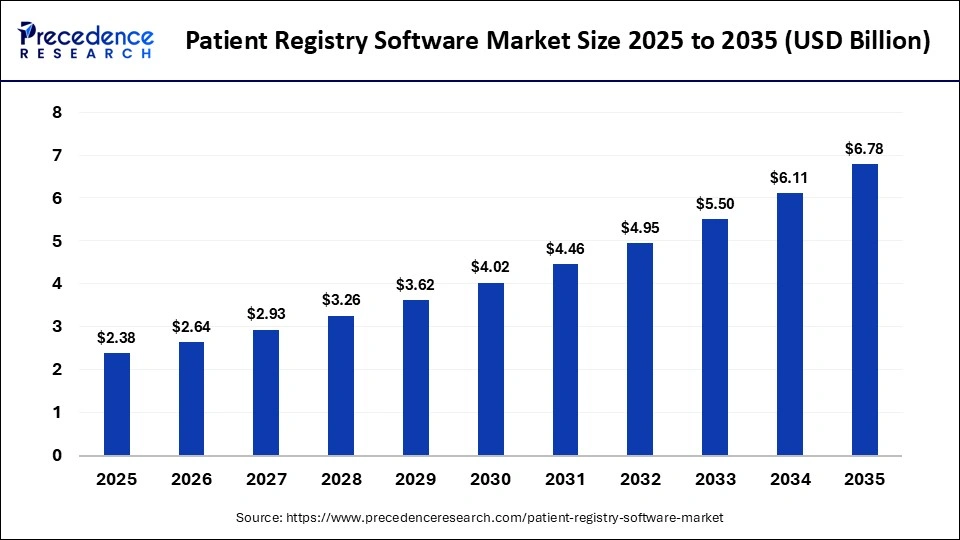
Key drivers include electronic health record adoption, regulatory mandates for post-market surveillance, and AI-enhanced analytics transforming registries into proactive health management tools.
Patient Registry Software Market Key Insights
- North America commands 48.6% market share in 2025, driven by advanced IT infrastructure and EHR integration.
- Asia Pacific surges at the fastest 10.6% CAGR through 2035, boosted by national digital health initiatives in India and China.
- Disease registries lead with 52.4% share, while product registries grow at 9.0% CAGR for clinical trials and regulatory insights.
- Standalone software dominates at 68.5% share; integrated solutions rise at 8.7% CAGR for seamless EHR connectivity.
- Government agencies hold 44.2% end-user share; pharma/biotech firms expand at 9.2% CAGR for drug development data.
- Population health management captures 37.6%; medical research grows at 9.1% CAGR amid real-world evidence needs.
Patient Registry Software Market Scope
| Metric | Value | Notes |
|---|---|---|
| 2025 Market Size | USD 2.38 Billion | Base year |
| 2026 Projected Size | USD 2.64 Billion | Initial growth |
| 2035 Projected Size | USD 6.78 Billion | Forecast peak |
| CAGR 2026-2035 | 11.04% | Overall rate |
| North America 2025 | USD 1.16 Billion (48.6% share) | Dominant region |
| U.S. 2025 | USD 902.21 Million | Key contributor |
Artificial intelligence reshapes patient registry software by automating data ingestion from unstructured sources like clinical notes via natural language processing, slashing manual entry by up to 40% and boosting data accuracy for research. Machine learning identifies cohorts, predicts outcomes, and flags anomalies, turning static repositories into dynamic tools for precision medicine and population health.
AI streamlines workflows like eligibility checks and billing, freeing staff for patient care while enabling real-time analytics for fraud detection and trend forecasting. These innovations align with value-based care, enhancing interoperability with EHRs and supporting regulatory compliance across global ecosystems.
What Fuels Patient Registry Software Market Growth?
Rapid EHR adoption and chronic disease burdens like diabetes and cancer drive demand for longitudinal tracking, with governments funding digital initiatives worldwide. Supportive policies, such as U.S. CMS quality reporting and India’s Ayushman Bharat, accelerate scalable cloud platforms. Advanced tech integration, including AI/ML, further propels 11.04% CAGR by improving outcomes benchmarking and trial recruitment.
What Opportunities and Trends Shape the Market?
Which trends dominate?
Cloud deployment and AI analytics lead, enabling real-time insights and decentralized trials in emerging markets like Asia Pacific.
What opportunities arise?
Interoperability with mobile apps and EHRs expands access, while RWE demand fuels pharma growth at 9.2% CAGR.
How do partnerships drive expansion?
Strategic alliances, like Rymedi and Precision Genetics in 2024, blend blockchain with precision medicine for opioid reduction.
Patient Registry Software Market Segmental Insights
Registry Type Insights
The disease registries segment held the largest share of 52.4% in 2025, driven by the rising prevalence of chronic and rare diseases. These registries help track patient populations, monitor outcomes, and support research initiatives.
The product registries segment is projected to grow at a strong 9.0% CAGR through 2035. These registries help identify eligible patients for clinical trials and generate insights on drug and device safety, aiding regulatory decision-making.
Software Type Insights
The standalone software segment dominated with a 68.5% share due to its widespread use across hospitals, pharmaceutical firms, government bodies, and research centers. It supports chronic disease management, clinical studies, and outcome evaluation.
The integrated software segment is the fastest-growing (CAGR 8.7%), driven by its ability to connect with EHRs and other health IT systems to deliver real-time insights, ensure seamless data flow, and improve compliance.
End-User Industry Insights
Government agencies & public health authorities led the market with a 44.2% share, supported by national health programs, EHR adoption, and growing public health reporting needs. Registry software helps these organizations conduct disease surveillance and manage population health.
The pharmaceutical, biotechnology & medical device companies segment is the fastest-growing (CAGR 9.2%). These companies rely on registry data for real-world evidence, clinical research, and development of advanced drugs and devices.
Functionality Insights
Population health management dominated with a 37.6% share, driven by the shift to value-based care, increased chronic disease burden, and the growing role of AI/ML in analyzing patient populations.
Medical research & clinical studies is the fastest-growing segment, supported by demand for real-world evidence, post-market surveillance, and longitudinal clinical data.
Patient Registry Software Market Regional Insights
North America
The North America patient registry software market was valued at USD 1.16 billion in 2025 and will reach USD 3.30 billion by 2035 (CAGR 11.02%).
North America leads the market with a 48.6% share due to strong healthcare IT infrastructure, high EHR adoption, and strict data security and interoperability standards. Government-backed digital health programs and outcome-based care models further support growth.
United States
The U.S. market size was USD 902.21 million in 2025, projected to reach USD 2,591.96 million by 2035 (CAGR 11.13%).
The U.S. leads global adoption due to strong digital transformation, the presence of major vendors (Oracle, IBM, IQVIA, Health Catalyst, etc.), and a focus on real-world evidence, advanced analytics, and cloud-based registry platforms.
In 2025, Oracle modernized EHR systems with AI-powered, voice-first tools to improve clinician workflow and enhance data accessibility.
Asia Pacific
Asia Pacific is the fastest-growing region (CAGR ~9%), fueled by national digital health missions, rising EHR adoption, and the need for structured disease tracking. Chronic disease burden, including cancer and CVD, drives demand for long-term registries.
AI, machine learning, and cloud technologies are increasingly integrated to enable automated data capture and predictive insights.
India
India’s market is growing steadily due to expanding EHR usage, rising public health programs, and greater emphasis on data-driven decision-making.
Government initiatives like the Ayushman Bharat Digital Mission are building the digital foundation needed for nationwide registry adoption and interoperability.
Europe
Europe is seeing significant growth driven by increased reliance on real-world evidence, strict regulatory frameworks, and rising chronic disease prevalence.
AI and ML are transforming registry analytics, while EU-level digital health policies support standardization, post-market surveillance, and long-term outcomes tracking.
Germany
Germany is emerging as a key growth market due to strong digital health policies, cloud-based IT modernization, and demand for patient-centric, interoperable data platforms.
Chronic and rare disease burdens are leading to the creation of specialized registries to support clinical research and value-based care.
Patient Registry Software Market Top Companies
- IBM Corporation
- IQVIA Holdings Inc.
- Health Catalyst Inc.
- Oracle Corporation
- UnitedHealth Group/Optum
- Conduent Inc.
- Elekta
- Dacima Software Inc.
- ImageTrend Inc.
- Global Vision Technologies Inc.
- Syneos Health Inc.
- Medidata Solutions (Dassault Systemes)
- Phoenix Health/Veradigm
- ESO Solutions
- MRO/FIGmd Inc.
Recent Breakthroughs
-
Registry Partners launched RegiHealth in May 2025, optimizing hospital registries via surveys and action plans.
-
Oracle’s August 2025 voice-first EHR integrates AI for labs/meds access, cutting clinician busywork.
-
Galvanize Therapeutics enrolled first patient in PROPEL Registry (August 2025) for PEF ablation safety.
Case Study: Innovasis BioBase Registry
U.S. spinal implant firm Innovasis deployed RAYLYTIC’s UNITY platform in 2018, collecting outcomes/images from 50+ sites for 2,000+ patients. AI image analysis measured fusion rates, generating quarterly reports that cut missing data and proved device efficacy. Outcomes included scalable routine integration and actionable RWE for regulatory/quality use.
Get this report to explore global market size, share, CAGR, and trends, featuring detailed segmental analysis and an insightful competitive landscape overview @ https://www.precedenceresearch.com/sample/7288
You can place an order or ask any questions. Please feel free to contact us at [email protected] |+1 804 441 9344

- ESG Software Market 2025: Comprehensive Company Ecosystem and Revenue Overview - May 20, 2026
- ESG Software Market Surges Toward USD 31.96 Billion by 2035 as AI-Powered Compliance and Sustainability Reporting Transform Global Enterprises - May 20, 2026
- Hematopoietic Stem Cell Transplantation Market Surges Toward USD 24.32 Billion by 2035 as Precision Medicine and AI Reshape Blood Cancer Treatment - May 20, 2026