
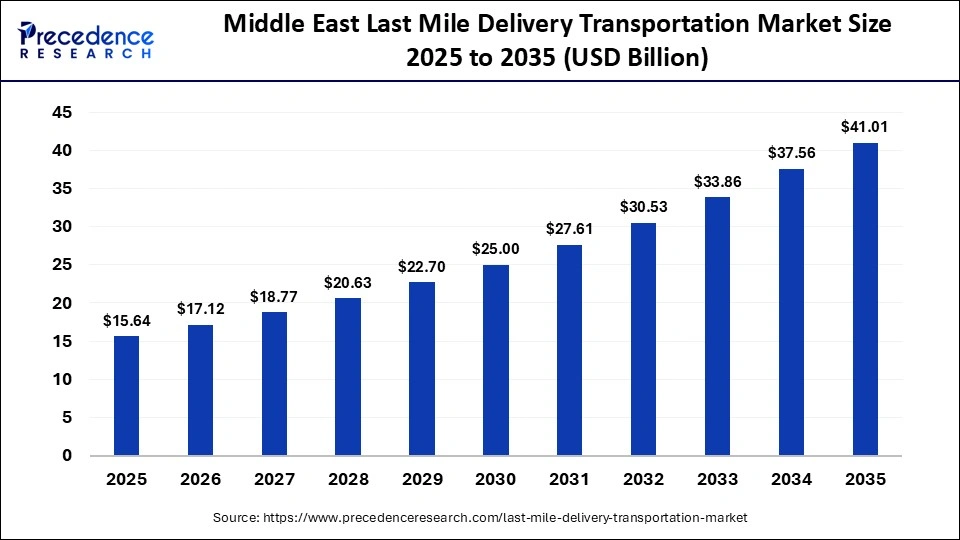
The Middle East last mile delivery transportation market size reached USD 15.64 billion in 2025 and projects growth to USD 41.01 billion by 2035, expanding at a compound annual growth rate (CAGR) of 10.12% from 2026 to 2035.
Booming e-commerce penetration, rapid urbanization in GCC cities, and adoption of smart logistics technologies drive this acceleration, as retailers invest in micro-fulfillment centers and real-time tracking to meet consumer demands for speed and reliability. Cross-border trade and food delivery platforms further amplify parcel volumes, reshaping urban logistics networks across the region.
Get this report to explore global market size, share, CAGR, and trends, featuring detailed segmental analysis and an insightful competitive landscape overview @ https://www.precedenceresearch.com/sample/7274
Middle East Last Mile Delivery Transportation Market Key Insights
- The UAE commanded 38.5% market share in 2025, leading regional dominance fueled by advanced infrastructure and high e-commerce adoption.
- B2C services captured 54.4% share, growing at 9.7% CAGR due to smartphone proliferation and direct-to-consumer trends.
- Motorcycles and scooters held 39.7% of vehicle type share for their traffic agility, while drones and autonomous vehicles promise 9.4% CAGR amid smart city initiatives.
- Standard delivery led modes at 43.2%, but on-demand/instant delivery surges at 9.8% CAGR from quick-commerce demands.
- E-commerce drove 42.5% of applications, with food and grocery fastest at 9.6% CAGR.
Artificial intelligence revolutionizes Middle East last mile delivery through predictive forecasting, route optimization, and precise delivery windows, as seen in DHL’s machine learning tools that cut fuel use and enhance planning. Aramex’s April 2025 partnership with Shipsy integrates AI orchestration for same-day services and territory efficiency, accelerating urban operations.
Platforms like Jahez and The Chefz in Saudi Arabia leverage AI route planning to slash times by 20%, while STC Logistics Cloud uses telematics for predictive maintenance. These advancements position AI as a cornerstone for sustainable, customer-centric logistics amid rising e-commerce pressures.
Key Growth Drivers
E-commerce explosion in GCC nations, coupled with urban population booms, propels demand for efficient last-mile networks, as consumers favor home deliveries via mobile apps. Government-backed smart city programs, like Saudi Vision 2030, fund digital infrastructure and logistics hubs, enabling GPS tracking and EV adoption. Rising digital payments and cross-border trade intensify parcel volumes, prompting investments in automation to cut costs and boost reliability.
What Emerging Opportunities Shape the Market?
On-demand delivery thrives from food and grocery apps, with hyper-local centers enabling instant fulfillment in dense cities like Dubai and Riyadh.
How do trends like drone corridors influence growth?
Saudi Arabia’s drone tests and UAE’s robot pilots, including Dubai’s RTA-Kiwibot trials, promise emission-free urban deliveries.
What sustainability trends dominate?
EV fleets from Emirates Post and Aramex hybrids reduce fuel by 30%, aligning with green mandates.
Market Scope
| Report Coverage | Details |
|---|---|
| Market Size in 2025 | USD 15.64 Billion |
| Market Size in 2026 | USD 17.12 Billion |
| Market Size by 2035 | USD 41.01 Billion |
| CAGR 2026-2035 | 10.12% |
| Base Year | 2025 |
| Forecast Period | 2026-2035 |
| Dominating Country | UAE |
| Fastest Growing Country | Saudi Arabia |
Segmentation Spotlight
- Service Type: B2C leads at 54.4% share from e-commerce surge and urban lifestyles, outpacing B2B and C2C with 9.7% CAGR for express needs.
- Vehicle Type: Motorcycles/scooters rule 39.7% for cost-effective traffic navigation, while drones/autonomous vehicles accelerate at 9.4% CAGR via GCC pilots.
- Mode of Delivery: Standard holds 43.2% for affordability, but on-demand grows fastest at 9.8% from quick-commerce.
- Technology Type: Route optimization/tracking dominates 32.4% for ROI gains, with autonomous/EV at 9.4% CAGR.
- Application: E-commerce claims 42.5%, food/grocery surges 9.6% CAGR.
Regional Dynamics
UAE dominates with robust e-commerce and December 2025’s USD 46 billion road investments easing urban logistics.
Saudi Arabia grows fastest via Vision 2030, JD Logistics’ JoyExpress launch, and 50 million Q2 packages. Egypt emerges with 50% online shoppers and Cairo’s density, bolstered by Egypt Post.
Top Companies
- Aramex
- DHL
- FedEx
- Amazon Logistics
- SMSA Express
- Fetchr
- FODEL
- Noon Delivery
- Talabat
- Careem/Careem NOW
- HungerStation
- Mrsool
- Zajil Express
- Barq Express
- Tawseel
Breakthroughs
- November 2025’s 7X-Zelostech AutoLogiX for Level-4 autonomy;
- June 2025’s USD 571 million UAE-Saudi infra boost
- April 2025 Quiqup Saudi expansion; Dubai robot trials by Talabat-Carrefour.
Segments Covered in the Report
By Service Type
- B2C
- B2B
- C2C
By Vehicle Type
- Motorcycles/Scooters
- Light Commercial Vehicles (LCVs)
- Heavy Commercial Vehicles (HCVs)
- Drones
- Autonomous Ground Vehicles
By Mode of Delivery
- Standard Delivery
- Express Delivery
- On-Demand/Instant Delivery
- Click-and-Collect/Parcel Lockers
By Technology Type
- Route Optimization & TMS
- Real-Time Tracking & Visibility
- Autonomous Delivery Systems
- Electric Vehicle & Telematics Solutions
By Application/End-Use Industry
- E-commerce
- Food & Grocery
- Healthcare & Pharmaceuticals
- Mail & Documents
- Others
By Country
- Saudi Arabia
- United Arab Emirates (UAE)
- Qatar
- Kuwait
- Oman
- Bahrain
- South Africa
- Egypt
- Rest of MEA
You can place an order or ask any questions. Please feel free to contact us at [email protected] |+1 804 441 9344

- ESG Software Market 2025: Comprehensive Company Ecosystem and Revenue Overview - May 20, 2026
- ESG Software Market Surges Toward USD 31.96 Billion by 2035 as AI-Powered Compliance and Sustainability Reporting Transform Global Enterprises - May 20, 2026
- Hematopoietic Stem Cell Transplantation Market Surges Toward USD 24.32 Billion by 2035 as Precision Medicine and AI Reshape Blood Cancer Treatment - May 20, 2026