
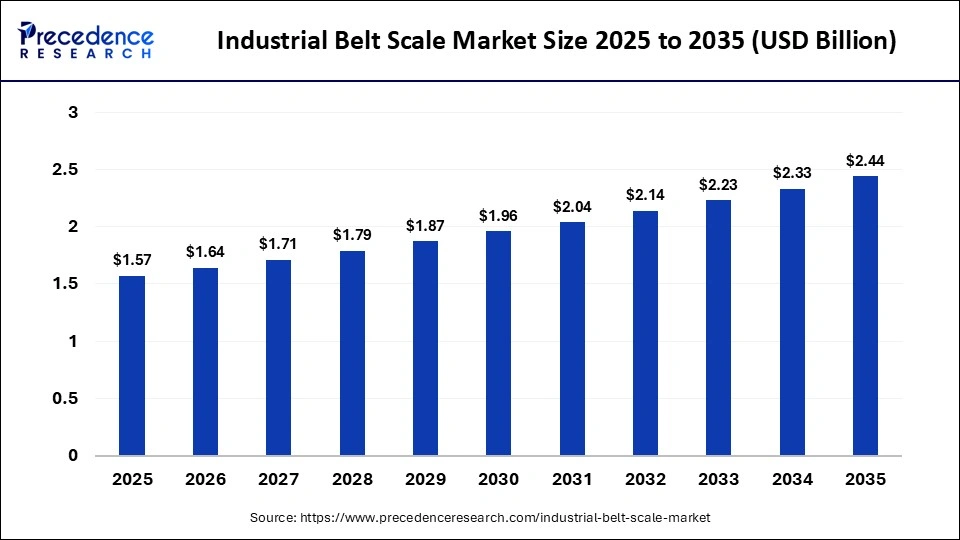
The global industrial belt scale market is projected to reach USD 2.44 billion by 2035, expanding at a robust compound annual growth rate (CAGR) of approximately 5.2% from 2025 onward. Key drivers include rising demand for precise bulk material handling in mining, cement, and logistics sectors, fueled by automation and real-time monitoring needs. This growth reflects industries’ push for efficiency amid expanding infrastructure in Asia Pacific and beyond.
Industrial Belt Scale Market Key Insights
The market stood at around USD 1.5 billion in 2024, with projections hitting USD 2.44 billion by 2035. Asia Pacific commands the largest share due to rapid industrialization in mining and manufacturing hubs like China and India. Leading players such as Mettler Toledo, Avery Weigh-Tronix, and Rice Lake Weighing Systems dominate with innovative IoT-integrated solutions. Multi-idler belt scales lead segmentation, offering superior accuracy in high-volume operations.
| Year | Market Size (USD Billion) | CAGR (2025-2035) |
|---|---|---|
| 2024 | 1.5 | – |
| 2025 | 1.6 | 5.2% |
| 2035 | 2.44 | 5.2% |
Artificial intelligence enhances industrial belt scales by enabling predictive maintenance and real-time data analytics, reducing downtime in harsh environments like mining. AI algorithms process weight fluctuations and conveyor vibrations to optimize material flow, cutting waste by up to 15% in cement plants.
Integrated with IoT, AI-driven scales forecast equipment failures and automate inventory tracking, boosting operational efficiency across logistics. These advancements position AI as a game-changer for precision weighing in high-throughput industries.
What Fuels Market Growth?
Rising automation in bulk handling industries drives demand, as belt scales ensure accurate measurement amid surging production volumes. Stringent regulatory compliance for material accuracy in food processing and chemicals further accelerates adoption. Infrastructure booms in emerging markets amplify this momentum.
What Opportunities and Trends Shape the Future?
How is digitalization reshaping belt scales?
IoT integration delivers real-time insights, enabling remote monitoring and data-driven decisions in mining operations.
What trends dominate high-precision segments?
Multi-idler scales gain traction for stability in long conveyors, supporting Industry 4.0 transitions.
Where do sustainability trends open doors?
Energy-efficient designs reduce power consumption, aligning with green manufacturing mandates.
Industrial Belt Scale Market Segment Insights
Idler / Scale Type Insights
The single-idler belt scale segment held 36.8% of the market in 2025, driven by its cost-effectiveness, simple mechanics, and suitability for low-volume material tracking. It provides reliable real-time data for operations in mining, agriculture, and cement industries, where efficiency is prioritized over ultra-high accuracy.
The multi-idler segment is expected to grow at a 5.5% CAGR, supported by its superior accuracy, stable performance, and ability to handle large material volumes. Its seamless integration with IoT, SCADA, smart manufacturing, and predictive maintenance makes it essential for data-driven operations and preventing costly downtimes.
Technology Insights
Electronic load-cell systems dominated with 52.3% share in 2025, thanks to their real-time monitoring, precision, and efficiency. Industries such as mining, logistics, and manufacturing rely on them to meet compliance and productivity requirements. Companies like ABB, Metso, and Yamato continue to enhance this technology with innovative solutions.
Smart and IoT-enabled belt scales are growing at a 5.6% CAGR, driven by their ability to deliver accurate data, improve energy management, and connect directly with ERP and plant automation systems. These solutions optimize belt speed, material flow, and overall output.
Conveyor Belt Width Insights
Conveyor belts in the 500–1200 mm range held 45.8% share in 2025, primarily for their versatility, stable material flow, and compatibility with a wide variety of industrial applications. They minimize spillage and provide a balanced solution for both capacity and space efficiency.
Belts below 500 mm are growing at 5.8% CAGR due to increased adoption in precision industries such as electronics, pharmaceuticals, and robotics. These sectors require controlled flow rates and high accuracy to protect delicate components and meet quality standards.
End User Insights
Mining accounted for 35.8% of the market in 2025, driven by the need for continuous material flow, energy efficiency, worker safety, and reduced downtime. Belt scales are widely used in surface mining, underground mining, crushing, and screening applications.
Logistics and warehousing are growing at a 5.7% CAGR, enabled by automation, improved productivity, accurate shipping cost calculation, and real-time process visibility—all without interrupting material flow.
Application Insights
Process control held 42.3% share in 2025, as continuous material flow is essential for product consistency across industries. Belt scales help maintain uniform output and significantly reduce downtime through stable, reliable monitoring.
Blending and batching applications are growing at a 5.8% CAGR, supported by their ability to precisely monitor multiple materials, maintain flow rates, and ensure high product quality.
Regional Insights
The Asia Pacific market is projected to reach USD 1,107.76 million by 2035, up from USD 711.21 million in 2025. Holding 45.3% share in 2025, the region leads due to rapid industrialization, automation adoption, and major investments in manufacturing and logistics infrastructure.
Japan is a key contributor, driven by the demand for accurate bulk material handling in mining, steel, cement, and food processing. Companies like Siemens, Merrick, and Yamato lead advancements integrating IoT and digital load-cell technologies. Strict industrial safety regulations further support adoption.
North America’s growth is supported by stringent regulations, demand for precise inventory control, and rising investments in mining, construction, and logistics. The surge in e-commerce and adoption of AI, IoT, and predictive maintenance technologies are also major contributors.
The U.S. leads with strong emphasis on automation, regulatory compliance, and real-time monitoring across industries. Trends such as IoT smart belts, AI analytics, and predictive maintenance are helping reduce losses and improve operational continuity.
Europe’s market expands steadily with industrial automation, strict safety rules, and a strong base of established manufacturers. The integration of advanced technologies continues to push demand for precision belt-scale systems.
The UK’s growth is driven by automation adoption, compliance with quality regulations, and expansion of renewable energy and infrastructure projects. Biomass and waste-to-energy facilities increasingly require reliable weighing systems.
The MEA region is expanding due to industrial growth, increased exports of high-tech equipment, and adoption of IoT- and AI-integrated weighing systems. Industry 4.0 initiatives and regulatory improvements also support market development.
South Africa stands out due to its strong manufacturing base, technological innovation, and sustainability goals. The region is adopting energy-efficient belt scale systems to meet performance and safety standards while improving operational efficiency.
Challenges Amid Cost Pressures
High initial costs for advanced models deter small-scale adopters, especially in developing regions. Harsh environments cause belt wear, demanding frequent maintenance that inflates operational expenses. Supply chain disruptions for sensors add volatility.
Industrial Belt Scale Market Companies
- Schenck Process
- Siemens
- Thermo Fisher Scientific
- Mettler-Toledo
- Rice Lake Weighing Systems
- Merrick Industries
- Thayer Scale
- Tecweigh/Tecnetics Industries
- Yamato Scale
- Minebea Intec
- Bizerba
- Kanawha Scales & Systems
- Sensortechnik
- JENIKE & JOHANSON
- Belt-Way Scale
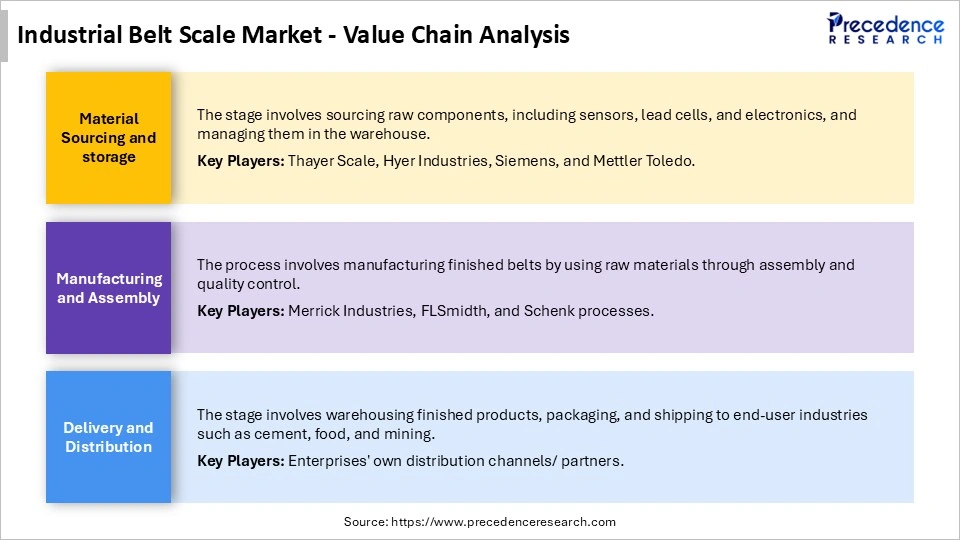
Industrial Belt Scale Market Value Chain
Segments Covered in the Report
By Idler/Scale Type
- Single-Idler
- Multi-Idler
- Dual-Idler
- Triple-Idler
- Fixed-Frame Belt Scale
- Modular Belt Scale
By Technology
- Electronic Load-Cell Belt Scales
- Smart/IoT-Enabled Belt Scales
- Mechanical Belt Scales
- Hybrid Digital-Mechanical
By Conveyor Belt Width
- Below 500 mm
- 500-1200 mm
- 1200-2000 mm
- Above 2000 mm
By End-Use Industry
- Mining
- Cement
- Steel & Metallurgy
- Aggregates & Quarrying
- Power Generation
- Food & Beverage
- Fertilizers & Chemicals
- Logistics & Warehousing
- Ports & Bulk Terminals
By Application
- Process Control
- Loadout/Load Verification
- Inventory & Stockpile Management
- Production Monitoring
- Blending/Batching
By Region
- North America
- Europe
- Asia-Pacific
- Latin America
- Middle East and Africa
Get this report to explore global market size, share, CAGR, and trends, featuring detailed segmental analysis and an insightful competitive landscape overview @ https://www.precedenceresearch.com/sample/7232
You can place an order or ask any questions. Please feel free to contact us at [email protected] |+1 804 441 9344

- ESG Software Market 2025: Comprehensive Company Ecosystem and Revenue Overview - May 20, 2026
- ESG Software Market Surges Toward USD 31.96 Billion by 2035 as AI-Powered Compliance and Sustainability Reporting Transform Global Enterprises - May 20, 2026
- Hematopoietic Stem Cell Transplantation Market Surges Toward USD 24.32 Billion by 2035 as Precision Medicine and AI Reshape Blood Cancer Treatment - May 20, 2026