
Robust Demand for Ferroalloys and Automation Drives Global SAF Expansion
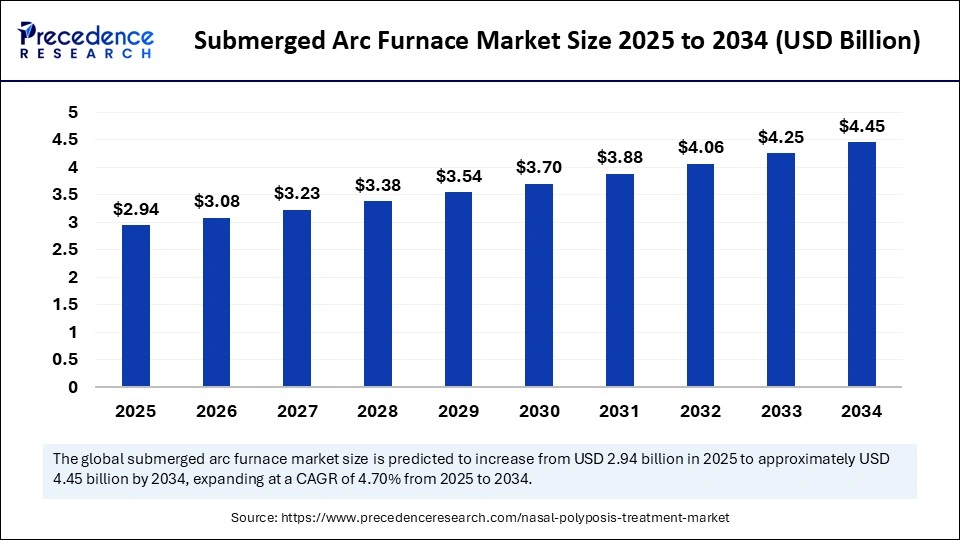
The global submerged arc furnace (SAF) market is projected to soar from USD 2.94 billion in 2025 to an impressive USD 4.45 billion by 2034, expanding at a steady CAGR of 4.7%. This sustained growth is propelled by surging steel production, rising infrastructure investment, demand for high-quality ferroalloys, and relentless technological innovation across industrial regions. Asia Pacific leads with nearly half the global share, while Latin America is poised for the fastest regional expansion.
Momentum in Metallurgy: What Fuels the Market’s Rise?
The submerged arc furnace industry stands at the heart of “green steel” and alloy manufacturing revolutions. Increasing calls for energy-efficient, cleaner metallurgical processes have pushed operators globally to adopt advanced SAFs enhanced with AI controls, digital twins, and automation.
Rapid industrialization in Asia Pacific and ambitious modernization goals in Europe and Latin America are further accelerating adoption, as is the automotive sector’s thirst for specialty metals linked to electric vehicle and renewable energy programs. The market is set to benefit from steady infrastructure investments and the conversion of old furnace fleets into state-of-the-art production centers.
Submerged Arc Furnace Market Key Points
-
Market Value: Submerged arc furnace industry to reach USD 4.45 billion by 2034, rising from USD 2.94 billion in 2025.
-
Regional Leader: Asia Pacific boasts the largest share with 47% of the market in 2024 and is forecasted to exceed USD 2.11 billion by 2034.
-
Regional Hotspot: Latin America expected to post the fastest CAGR of 16% through 2034, fueled by major infrastructure and metallurgical investments.
-
Top Furnace Type: AC submerged arc furnaces continue to dominate with a 53% global share in 2024, supported by broad industry utility.
-
Growth Standouts: DC submerged arc furnaces and silicon metal production exhibit remarkable CAGRs of 20% and 25% respectively, underlining their rising application across electric vehicles and solar manufacturing.
-
Automation Shift: The semi-automatic operation segment looks to expand quickly, with increasing digitalization and smart monitoring adoption.
-
Major Players: Siemens AG, Xian Abundance Electric Technology, Hammers Industries, Tata Steel Processing, Tenova, Paul Wurth, Electrotherm, Outotec (Metso Outotec), DOSHI Technologies, Yueda Stainless Steel, and DongXong all play crucial roles in shaping the current market landscape.
Submerged Arc Furnace Market Revenue Breakdown Table (2025-2034)
| Year | Market Size (USD Billion) | CAGR (%) | Dominant Region | Fastest Growing Region |
|---|---|---|---|---|
| 2025 | 2.94 | 4.7 | Asia Pacific | Latin America |
| 2026 | 3.08 | 4.7 | Asia Pacific | Latin America |
| 2034 | 4.45 | 4.7 | Asia Pacific | Latin America |
| Segment | 2024 Share (%) | Fastest Segment CAGR (%) |
|---|---|---|
| AC Furnaces | 53 | — |
| DC Furnaces | 20 | 20 |
| Ferroalloys | 38 | — |
| Silicon Metal | — | 25 |
| 200-500 tonnes | 35 | — |
| Above 500 tonnes | 22 | 22 |
| Manual Operation | 50 | — |
| Semi-Auto Mode | 18 | 18 |
Recent years have seen a paradigm shift in how submerged arc furnaces are managed, driven by the integration of AI-powered automation and digital twin technology. AI systems now allow operators to fine-tune arc control, optimize energy consumption, and prevent breakdowns through predictive maintenance. With electrode management and heat recovery strategies now governed by data-driven algorithms, both energy use and emissions are seeing dramatic improvements.
Digital twins—virtual replicas of physical furnaces—let manufacturers simulate performance, optimize process variables in real time, and train staff safely outside of “hot” environments. The convergence of these digital strategies is delivering far greater consistency in alloy quality and is significantly increasing furnace lifespans. Industry leaders such as Siemens and Xian Abundance Electric Technology have launched suites of AI-driven tools for real-time process optimization, arc stability, and maintenance diagnostics—a clear sign of where the industry is heading next.
What Drives Submerged Arc Furnace Market Growth?
Why is demand for SAFs accelerating across global markets?
Global steel consumption is climbing in tandem with population growth, infrastructure spending, and increasing automotive and electronic manufacturing. SAFs allow for highly efficient production of critical ferroalloys and specialty metals, which are central to these sectors.
How are sustainability objectives impacting the market?
Sustainability mandates and stricter environmental standards have catalyzed investment in newer, cleaner SAF technologies. Firms across Europe, Asia, and Latin America increasingly invest in furnaces that feature low-emission designs, renewable energy integration, and sophisticated heat recovery, all aligned with international carbon-neutrality goals.
What Key Opportunities or Trends Are Emerging in the SAF Market?
Where are the most exciting growth opportunities?
The fastest growth segments include DC submerged arc furnaces—highly prized for better energy efficiency and reduced electrode consumption—and silicon metal production, essential for electronics and solar panel growth. Latin America and Asia Pacific, with their ambitious infrastructure projects and modernization programs, also represent major expansion opportunities.
What are the leading technological trends to watch?
Automation, digitalization, and the adoption of AI process controls are at the forefront. The move toward semi-automatic and fully-automatic operation modes is quickening, offering improved safety, operational transparency, and lower labor dependency. Partnerships between global OEMs and local steel giants are speeding up the transfer of best practices in furnace management.
Submerged Arc Furnace Market Regional and Segmental Analysis
-
Asia Pacific: Remains the linchpin of industry growth, accounting for 47% of the global market. China and India’s large-scale urbanization and renewable energy agendas drive massive investments in advanced SAF technologies.
-
Europe: Emphasizes modernization for energy efficiency and lower emissions, with Germany setting the pace for “green metallurgy” and digital controls in precision engineering.
-
Latin America: Poised for breakout growth, led by Brazilian investments in sustainable furnace retrofits and alloy output to support electric vehicle proliferation.
-
North America & Middle East/Africa: Also see rising demand, particularly where new infrastructure or steel capacity upgrades are required.
Leading Segments
-
AC furnaces remain dominant due to their cost efficiency and adaptability, but DC furnaces are quickly catching up in advanced markets.
-
Ferroalloy production stands as the top application, while silicon metal smelting enjoys the fastest uptick.
-
Manual operation retains a large base in emergent markets, even as digital and semi-automatic systems rapidly gain favor globally.
Which Companies Are Driving Innovation in the SAF Market?
Recently Mentioned Companies:
-
Siemens AG (notable for AI-driven automation and energy management)
-
Xian Abundance Electric Technology (leading in high-current power systems and digital controls)
-
Hammers Industries, YUEDA Stainless Steel, DOSHI Technologies, Tata Steel Processing, DongXong, Paul Wurth (SMS Group), Electrotherm, and Outotec (Metso Outotec).
Latest Breakthroughs:
-
Siemens’ 2025 rollout of an AI-based process optimization platform.
-
Thyssenkrupp Industrial’s $850M high-tech facility opened in Duisburg, Germany in July 2025.
-
Tenova’s advanced arc furnace installation at Tata Steel’s Port Talbot set to go online in 2027.
-
Metso Outotec’s delivery of dual submerged arc furnaces to FACOR, strengthening capacity in India.
What Challenges and Cost Pressures Threaten Market Momentum?
The SAF market continues to grapple with input cost volatility (especially for graphite electrodes and refractory materials), high capital intensity for advanced installations, and energy price fluctuations. Smaller operators often find the complexity of full automation a barrier. Regulatory demands on emissions and the need for continuous upgrades raise compliance costs. Strategic after-market services—such as predictive maintenance, electrode optimization, and digital retrofitting—are emerging as solutions for cost containment and operational continuity.
Case Study: Brazil’s Leap Forward in Green Smelting
Brazil’s major steel groups have recently retrofitted submerged arc furnaces with digital controls and modern emission systems. These upgrades, aimed at supplying growing EV and infrastructure markets, have reduced both energy intensity and carbon footprints, while increasing throughput. The focus on digital monitoring supports proactive maintenance and fuels strategic capacity expansion—demonstrating the power of smart metallurgy in fast-developing economies.
Get this report to explore global market size, share, CAGR, and trends, featuring detailed segmental analysis and an insightful competitive landscape overview @ https://www.precedenceresearch.com/sample/7113
You can place an order or ask any questions. Please feel free to contact us at [email protected] |+1 804 441 9344

- ESG Software Market 2025: Comprehensive Company Ecosystem and Revenue Overview - May 20, 2026
- ESG Software Market Surges Toward USD 31.96 Billion by 2035 as AI-Powered Compliance and Sustainability Reporting Transform Global Enterprises - May 20, 2026
- Hematopoietic Stem Cell Transplantation Market Surges Toward USD 24.32 Billion by 2035 as Precision Medicine and AI Reshape Blood Cancer Treatment - May 20, 2026