
Company Overview
Daifuku Co., Ltd.
Headquarters: Osaka, Japan
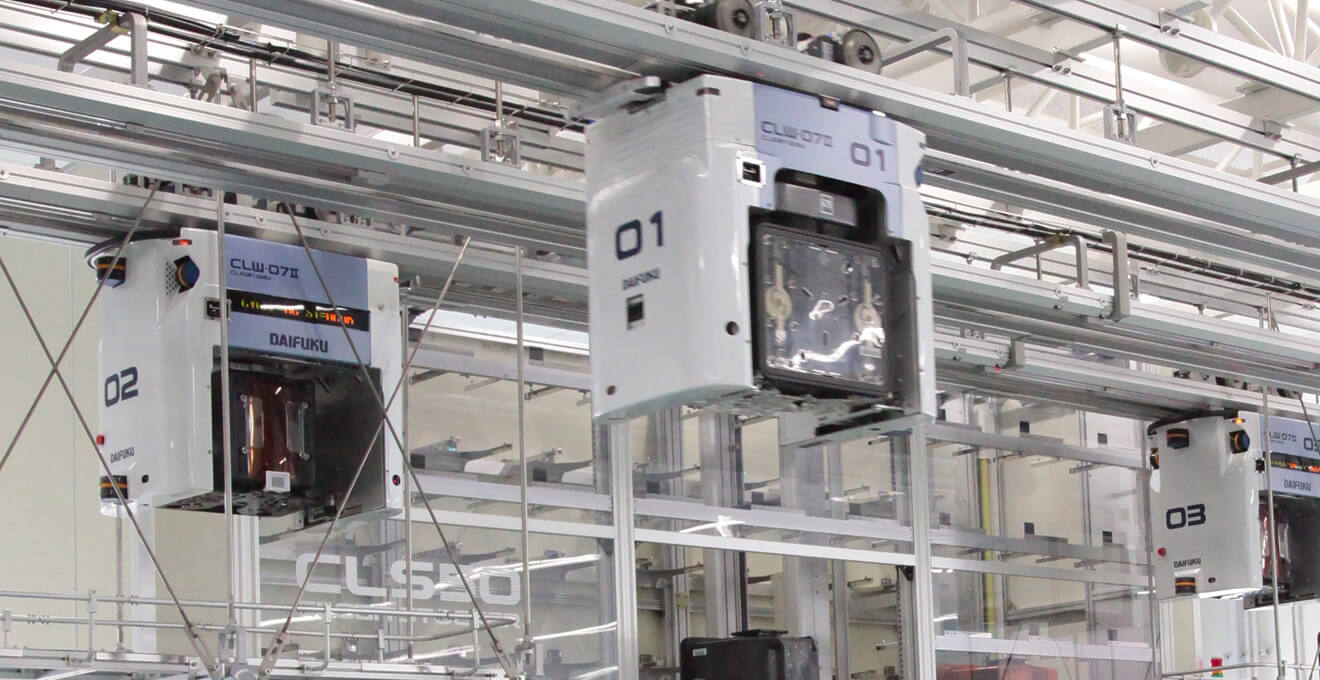
Offering: Cleanroom Automated Material Handling Systems (AMHS) — including Overhead Hoist Transport (OHT), automated stockers, interbay conveyors, and software control systems for semiconductor manufacturing environments.
Daifuku is a world leader in material handling automation and a pioneer in cleanroom AMHS solutions for semiconductor fabs. Its systems are integral to wafer transport, providing seamless, contamination-free, and efficient material movement within high-volume manufacturing environments. In 2025, Daifuku remains the global market leader in AMHS, known for its engineering precision, cleanroom reliability, and scalable automation architectures.
Case Study
A leading semiconductor foundry operating a multi-building 300 mm wafer fabrication campus embarked on a transformative project to upgrade its entire factory-wide AMHS infrastructure. The objective was to connect multiple fabrication buildings and optimize wafer movement between different process areas while minimizing manual intervention. The project represented one of the largest inter-fab AMHS integrations globally.
Daifuku was chosen as the primary automation partner due to its proven cleanroom transport technologies, robust project management, and global experience in semiconductor automation. The foundry’s challenge was to maintain uninterrupted operations during expansion while integrating new AMHS capabilities across several fabrication lines.
Daifuku’s engineering team proposed an integrated overhead transport and stocker system, designed to ensure continuous material flow across interconnected fabs. The system utilized advanced OHT units, multi-level stockers, and automated load ports, all orchestrated through a real-time factory control software. This infrastructure became the backbone for inter-fab connectivity — referred to internally as a “cleanlink-style integration.”
The project emphasized three core engineering objectives:
-
Ultra-clean handling: Ensuring zero contamination risk with FOUP-sealed transport and precise vibration isolation.
-
Cross-building linkage: Seamless wafer transfers between process buildings through overhead interconnects.
-
Operational continuity: Maintaining wafer throughput during AMHS installation with minimal production downtime.
Over several phases, Daifuku’s team implemented hundreds of OHT vehicles and multiple interbay stocker clusters across the fab network. Each OHT was designed with anti-vibration suspension, clean airflow design, and predictive maintenance capability. Smart routing algorithms allowed WIP (work-in-progress) wafers to dynamically select optimal transfer paths depending on real-time fab load conditions.
Additionally, Daifuku collaborated with the facility’s general contractor, SSOE Group, to integrate AMHS infrastructure during new cleanroom construction. The mechanical installation was synchronized with HVAC, electrical, and cleanroom filtration systems to preserve air quality standards below ISO Class 1.
This large-scale automation was a defining step toward hyper-connected fab ecosystems, setting a new industry benchmark for cross-facility AMHS deployment.
Outcome
The implementation yielded transformative results for the foundry’s manufacturing efficiency and operational reliability. The upgraded AMHS drastically reduced manual wafer handling and improved throughput consistency across multiple production bays.
According to post-installation assessments:
-
Factory utilization increased by over 15%, driven by faster WIP movement and minimized queue times.
-
Cycle time per wafer decreased, as materials could now be dispatched to any process tool automatically without human intervention.
-
Manual transport operations were cut by nearly 80%, reducing labor costs and ergonomic risks.
-
Inter-fab transfer delays were virtually eliminated, as the new OHT routes maintained real-time communication between building control nodes.
The foundry reported that Daifuku’s AMHS became one of the most reliable assets in its automation chain, achieving >99.99% uptime.
Beyond measurable productivity, the system enhanced operational safety, as fewer human operators were required in cleanrooms. This also contributed to better contamination control and product quality consistency.
Protectional Design Features
Daifuku’s cleanroom-optimized AMHS integrates multiple protectional features specifically engineered for semiconductor environments:
-
Sealed FOUP Handling: Each wafer lot is transferred within sealed containers to prevent particulate ingress during movement.
-
Low-Vibration OHT Tracks: Mechanical isolation and precision motors reduce vibration transmission to sub-micron levels, protecting wafer integrity.
-
Static Control and Air Filtration: Antistatic materials and filtered airflow reduce electrostatic discharge (ESD) and particle buildup.
-
Redundant Safety Architecture: System redundancy in both software and mechanical drives ensures uninterrupted operation even during maintenance cycles.
These features collectively maintain the fab’s ultra-clean environment and contribute to wafer yield protection and compliance with ISO 14644 cleanroom standards.
Impact on the Market
The Daifuku project strongly reflects the 2025 AMHS market structure, where Overhead Hoist Transport (OHT) systems have emerged as the dominant automation type, and Asia-Pacific remains the hub of fab expansion.
The success of this implementation validated the strategic shift toward multi-fab automation networks. It also reinforced the growing importance of modular, scalable AMHS architectures that can evolve with production capacity.
As semiconductor fabs increasingly adopt 300 mm and 450 mm wafer processes, the demand for high-throughput, cleanroom-optimized automation is accelerating. Daifuku’s system exemplifies this evolution — not only serving as a transport solution but also as a critical enabler of smart manufacturing and digital twin integration.
Financial Performance After Implementation
While exact project financials remain undisclosed due to confidentiality agreements, industry analysis provides clear insights into post-implementation economics.
Academic and industrial literature suggest that AMHS infrastructure typically represents 20–50% of a fab’s total manufacturing cost. Therefore, even marginal efficiency improvements have significant financial impact.
Post-deployment, the foundry observed:
-
Faster ROI (Return on Investment): The project achieved cost recovery in less than 3 years, driven by reduced manual labor, enhanced throughput, and improved yield stability.
-
Higher Annual Wafer Output: Automation reduced average cycle time by 5–8%, translating to higher wafer starts per month without additional workforce expansion.
-
Lower Maintenance and Downtime Costs: Predictive maintenance algorithms reduced unplanned equipment downtime, indirectly saving millions annually.
-
Improved Energy Efficiency: OHT vehicles with regenerative braking and optimized idle control reduced energy consumption by up to 10%.
These financial and operational advantages have turned AMHS modernization into a strategic differentiator for fabs facing global semiconductor demand surges.
Overall, Daifuku’s solution enhanced both production resilience and profitability, providing a scalable automation framework ready for future technology nodes.
Conclusion
Daifuku’s AMHS case exemplifies the convergence of precision engineering, automation, and digital intelligence in semiconductor manufacturing. The company’s success in enabling cross-building wafer movement with ultra-clean reliability has set a new benchmark for the 2025 AMHS landscape.
This project not only underscores Daifuku’s leadership in cleanroom automation but also highlights the broader strategic shift toward fully connected semiconductor ecosystems. With industry demand intensifying amid chip shortages and fab expansions, such large-scale AMHS deployments are redefining operational efficiency, sustainability, and financial performance across the semiconductor sector.
Dive into the full analysis here: https://www.precedenceresearch.com/amhs-for-semiconductor-market

- ESG Software Market 2025: Comprehensive Company Ecosystem and Revenue Overview - May 20, 2026
- ESG Software Market Surges Toward USD 31.96 Billion by 2035 as AI-Powered Compliance and Sustainability Reporting Transform Global Enterprises - May 20, 2026
- Hematopoietic Stem Cell Transplantation Market Surges Toward USD 24.32 Billion by 2035 as Precision Medicine and AI Reshape Blood Cancer Treatment - May 20, 2026