
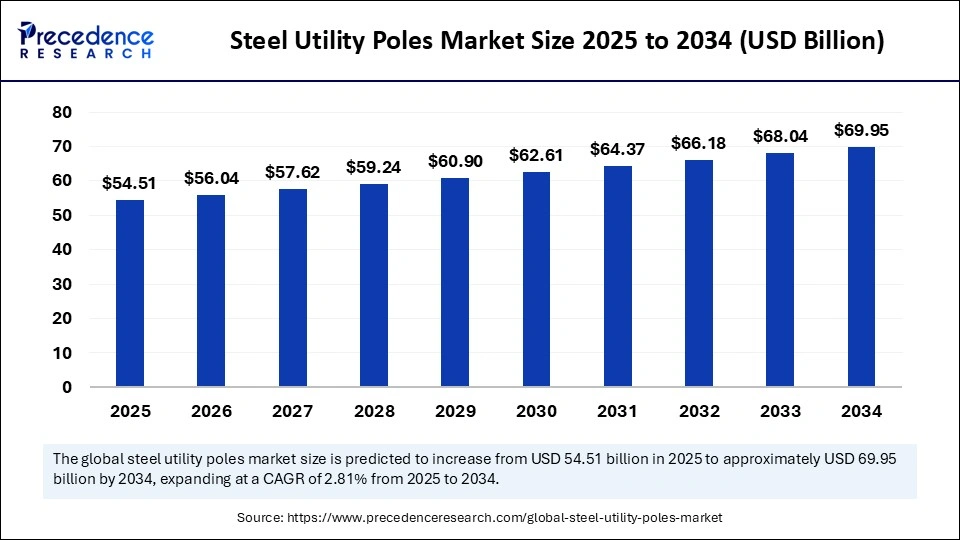
The global steel utility poles market is on a steady growth path, poised to increase from a valuation of USD 54.51 billion in 2025 to USD 69.95 billion by 2034, growing at a CAGR of 2.81%. This growth is largely driven by rapid urbanization, smart city initiatives, grid modernization efforts, expansion in telecommunications, and renewable energy integration into power grids.
Steel Utility Poles Market Key Insights
-
The market was valued at USD 54.51 billion in 2025 and is forecasted to reach USD 69.95 billion by 2034.
-
North America dominated in 2024, accounting for 40.50% of the market share.
-
Asia Pacific is the fastest-growing region, expected to expand at a CAGR of 7.50% through 2034.
-
Tubular steel poles led in design types with 38% market share in 2024.
-
Galvanized steel poles were the preferred coating type, holding 40% of the market in 2024.
-
Power utilities accounted for 45% of the market by end user in 2024, followed by growing contributions from renewable energy developers at a 7% CAGR.
-
Direct burial/embedded poles installation type dominated with 37% market share in 2024, while anchor-bolted poles are fast gaining.
What Is Driving Steel Utility Poles Market Growth?
The increasing demand for more robust, durable infrastructure to support electricity transmission, distribution, and telecom networks is the core driver. The shift towards renewable energy sources like solar and wind power requires expanded and modernized grids, further fueling steel utility pole installations. Additionally, urbanization and smart city projects demand poles that support integrated smart technologies, such as communication networks and IoT devices.
Role of Artificial Intelligence in Market Evolution
Artificial Intelligence (AI) is revolutionizing the steel utility poles sector by enhancing production efficiency and product reliability. AI-driven automated quality control uses machine vision to detect micro-defects in steel early in the manufacturing process. This reduces waste and improves product consistency.
AI also optimizes energy consumption during production, contributing to sustainability goals. Furthermore, predictive maintenance powered by AI helps in monitoring pole conditions and identifying maintenance needs before failures occur, thereby improving lifecycle management and cost-efficiency.
Market Scope
| Report Coverage | Details |
| Market Size in 2025 | USD 54.51 Billion |
| Market Size in 2026 | USD 56.04 Billion |
| Market Size by 2034 | USD 69.95 Billion |
| Market Growth Rate from 2025 to 2034 | CAGR of 2.81% |
| Dominating Region | North America |
| Fastest Growing Region | Asia Pacific |
| Base Year | 2024 |
| Forecast Period | 2025 to 2034 |
| Segments Covered | Type, End User, Coating, Installation Type, and Region |
| Regions Covered | North America, Europe, Asia-Pacific, Latin America, and Middle East & Africa |
What Are the Recent Market Opportunities and Trends?
How is Urbanization Impacting the Market?
Rapid urbanization, especially in the Asia Pacific, is pushing the demand for space-efficient and aesthetically pleasing monopoles that fit densely populated areas with limited space.
What Role Do Renewable Energy Projects Play?
Renewable developers require strong and corrosion-resistant poles to support infrastructure in remote, harsh environments, driving innovation in steel coating technologies and structural designs.
Are Smart Utility Poles Becoming Common?
Integration with smart grid technologies and IoT applications in utility poles is an emerging trend, supported by increasing AI deployments for maintenance and monitoring.
Challenges and Cost Pressures
Despite robust demand, manufacturers face challenges including fluctuating raw material prices like iron ore and steel, supply chain disruptions, and the need to balance cost-efficiency with increasingly stringent environmental and safety regulations. The integration of advanced coatings and AI adds upfront costs, though these are offset by long-term operational savings.
Regional and Segmentation Analysis
North America leads the global market due to significant investments in electric grid modernization and renewable energy expansion. The U.S. alone is projected to grow from USD 17.12 billion in 2025 to USD 21.49 billion by 2034.
Asia Pacific is the fastest-growing region, led by China’s massive infrastructure build-out and supportive government policies targeting carbon neutrality. In Europe, countries like Germany focus on replacing aging infrastructure with resilient steel poles aligned with rigorous environmental standards.
By type, tubular steel poles dominate due to their high strength-to-weight ratio and versatility, while monopoles are gaining traction for urban deployment.
Galvanized coatings protect steel poles in harsh environments, maintaining longevity and reducing maintenance costs. Power utilities drive the largest end-user demand, but renewable energy developers show the fastest growth rates, reflecting the global energy transition.
Top Companies in the Steel Utility Poles Market
Tier I: Industry Leaders
These companies are the dominant players in the global steel utility poles market, collectively holding approximately 40–50% of the market share.
- Valmont Industries, Inc.: A major manufacturer of steel utility poles, Valmont operates globally with a significant presence in North America, Europe, and Asia.
- Meyer Utility Structures (Arcosa, Inc.): Part of Arcosa, Meyer Utility Structures is a leading provider of steel utility poles and transmission structures in North America.
- KEC International Limited: An Indian multinational company, KEC International is a key player in the manufacturing and supply of steel utility poles, especially in the Asia-Pacific region.
- TAPP, Inc.: A significant manufacturer of steel utility poles, TAPP serves various markets, including North America and Asia.
- DAJI Towers: Based in China, DAJI Towers is a prominent producer of steel utility poles, catering to both domestic and international markets.
Tier II: Regional Leaders
These companies have a strong regional presence and contribute significantly to the market but hold a smaller share compared to Tier I companies.
- Nucor Corporation: A leading steel producer in the U.S., Nucor manufactures steel utility poles and has a substantial market share in North America.
- Jindal Power Limited: An Indian company involved in the manufacturing of steel utility poles, Jindal Power Limited serves the domestic market and exports to neighboring countries.
- Skipper Limited: Based in India, Skipper Limited is a significant player in the steel utility poles market, serving both domestic and international markets.
- Nanjing Daji Group: A Chinese company specializing in the production of steel utility poles, Nanjing Daji Group caters to the domestic market and exports globally.
Tier III: Emerging and Niche Players
These companies are emerging players or operate in niche markets, contributing to the overall market but with a smaller share.
- Henan Dingli Power Equipment Co., Ltd.: A Chinese company specializing in power equipment, including steel utility poles, serving the domestic market.
- Zhejiang Debao Tower Manufacturing Co., Ltd.: Based in China, Zhejiang Debao manufactures steel utility poles and transmission towers, catering to both domestic and international markets.
- Changshu Fengfan Electric Power Equipment Co., Ltd.: A Chinese manufacturer of electric power equipment, including steel utility poles, serving various markets.
- Nello Corporation: An American company involved in the manufacturing of steel utility poles, serving the North American market.
- Omega Company for Luminaires, Poles & Galvanizing: Based in the Middle East, Omega Company specializes in the production of steel utility poles and related infrastructure.
Get this report to explore global market size, share, CAGR, and trends, featuring detailed segmental analysis and an insightful competitive landscape overview @ https://www.precedenceresearch.com/sample/7037
You can place an order or ask any questions. Please feel free to contact us at [email protected] |+1 804 441 9344

- ESG Software Market 2025: Comprehensive Company Ecosystem and Revenue Overview - May 20, 2026
- ESG Software Market Surges Toward USD 31.96 Billion by 2035 as AI-Powered Compliance and Sustainability Reporting Transform Global Enterprises - May 20, 2026
- Hematopoietic Stem Cell Transplantation Market Surges Toward USD 24.32 Billion by 2035 as Precision Medicine and AI Reshape Blood Cancer Treatment - May 20, 2026