
The global commerce cloud market is on a remarkable growth trajectory, with its size recorded at USD 17.83 billion in 2024 and projected to soar to approximately USD 139.49 billion by 2034, reflecting a compound annual growth rate (CAGR) of 22.84% from 2025 through 2034.
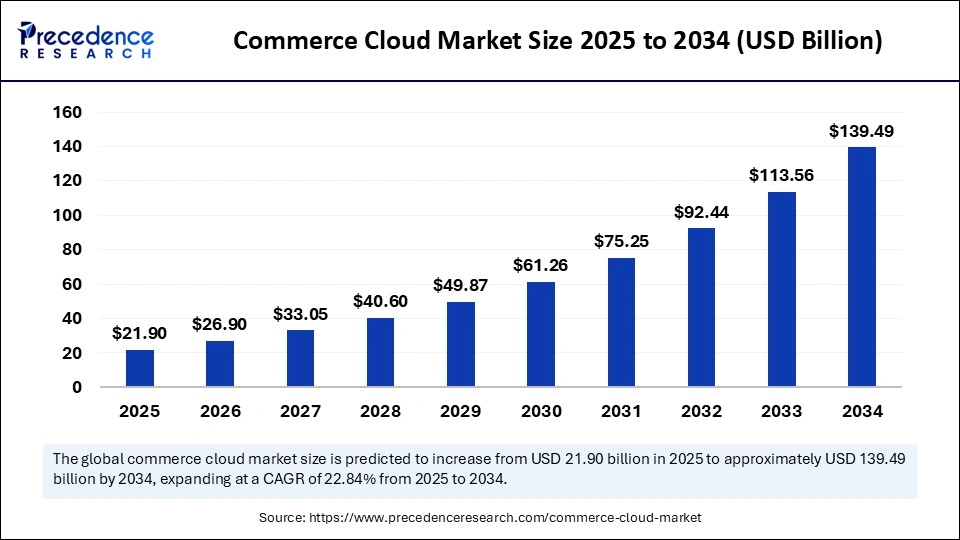
This significant rise hinges on the widespread adoption of internet services, smartphones, and cloud-based e-commerce platforms, which empower businesses to create seamless, scalable, and personalized online shopping experiences.
Commerce Cloud Market Key Highlights
-
The market reached USD 17.83 billion in 2024 and is expected to hit USD 21.90 billion by 2025.
-
North America dominates the market, holding a 37% share in 2024.
-
Asia Pacific is the fastest-growing region, fueled by digitalization and rising internet penetration.
-
Leading commerce cloud providers include AWS, Microsoft Azure, Google Cloud Platform, Alibaba Cloud, Salesforce, SAP, and Adobe.
-
The B2C business model accounted for the largest segment in 2024 with a 46% market share.
-
The public cloud deployment model leads with 60% market share, while hybrid cloud shows the fastest growth rate.
-
The U.S. market alone stood at USD 4.62 billion in 2024, growing at a CAGR of 23.09%.
Revenue Breakdown Insights
| Segment | Market Share / Growth Detail |
|---|---|
| Public Cloud Deployment | Largest share: 60% in 2024 |
| Hybrid Cloud Deployment | Fastest CAGR forecast |
| E-commerce Platforms | Dominant with 28% market share |
| Personalization & Recommendation | Fastest growing segment |
| B2C Business Model | Largest share: 46% |
| Marketplaces | Fastest anticipated CAGR |
| Large Enterprises | Largest organizational segment: 52% |
| SMBs | Fastest growing organizational segment |
| Retail & E-Commerce Industry | Largest vertical: 34% |
| Food & Grocery Segment | Fastest CAGR expected |
| Subscription/SaaS Pricing Model | Largest share: 55% |
| Usage-Based Pricing Model | Fastest CAGR anticipated |
AI’s Transformative Role in Commerce Cloud
Moreover, AI-enabled search tools enhance accuracy by understanding user intent, even correcting errors or ambiguous terms, facilitating smoother shopping journeys. Behavioral analytics driven by AI allows segmentation of consumers into targeted groups, enabling tailored promotions and marketing campaigns, thereby driving revenue and fostering long-term customer loyalty.
What Factors Are Driving Commerce Cloud Market Growth?
The explosive growth of the commerce cloud market is largely driven by increasing internet penetration and the ubiquity of smartphones, making online shopping accessible and user-friendly globally.
Cloud platforms provide businesses with rich consumer data and behavioral insights, enabling them to adapt swiftly to market trends and demands. Additionally, the adoption of omnichannel commerce—a unified approach integrating online and offline consumer touchpoints—enhances customer experience by offering seamless shopping journeys and consolidated inventory management.
Why Is Omnichannel Commerce Such a Game Changer?
Omnichannel commerce solves the challenge of managing multiple sales channels by providing a consistent and unified platform that integrates digital and physical retail spaces. This convergence allows businesses to synchronize inventory, streamline purchasing processes, and offer personalized consumer engagement across websites, social media, and mobile applications. The commerce cloud facilitates this integration through robust cloud infrastructures, proving indispensable in today’s retail ecosystem.
How Do Deployment Models Affect Market Dynamics?
Public cloud deployment holds the largest share due to its scalability and ability to handle fluctuating e-commerce traffic efficiently. It enables retailers to quickly adapt to changing demand without overspending on resources. In contrast, hybrid cloud models offer a combination of scalability and enhanced security, appealing to businesses needing to maintain sensitive data onsite while leveraging public cloud flexibility, thus showing rapid growth potential.
In What Ways Do Business Models Influence Commerce Cloud Adoption?
The Business-to-Consumer (B2C) model commands the largest market footprint, driven by rising mobile commerce and consumer demand for convenience and personalization. Marketplaces and subscription-based models are expanding swiftly, reflecting new trends toward recurring revenue streams and multichannel consumer engagement.
Regional and Segment Highlights
North America maintains dominance due to its advanced digital infrastructure, rapid cloud adoption, and the presence of key players such as Salesforce, IBM, and Oracle, who continuously innovate commerce cloud solutions. The U.S. market exemplifies this trend with robust growth driven by strong government support and a mature e-commerce ecosystem.
Asia Pacific, led by countries like Japan, India, and China, is the fastest growing region, bolstered by rising internet penetration, digital payment adoption, and increased consumer spending. Emerging technologies like 5G, IoT, and AI/ML further accelerate cloud commerce adoption in this region.
Segmentation Analysis:
-
By Deployment: Public cloud leads, hybrid cloud grows fast.
-
By Core Solutions: Storage, servers, networking ensure security and scalability.
-
By Business Model: B2C largest; marketplaces grow rapidly.
-
By Organization Size: Large enterprises hold majority while SMBs grow rapidly.
-
By Industry Vertical: Retail and e-commerce dominate; food & grocery grows fast.
-
By Pricing Model: Subscription leads; usage-based pricing grows quickly.
-
By Region: North America dominant; Asia Pacific fastest growing.
Commerce Cloud Market Companies
- Salesforce Commerce Cloud
- Adobe Commerce (Magento)
- SAP Commerce Cloud
- Oracle Commerce Cloud/NetSuite Suite Commerce
- Shopify Plus
- BigCommerce
- commerce tools
- Elastic Path
- VTEX
- Mirakl
- Spryker
- Kibo Commerce
- HCL Commerce
- IBM Digital Commerce
- OroCommerce
- Optimizely (Episerver) Commerce
- Intershop
- Shopware
- Shift4Shop
- Sitecore Experience Commerce
Challenges and Cost Pressures
Despite its bright prospects, the commerce cloud market faces challenges including dependency on vendor ecosystems like Salesforce, which can limit integration flexibility. Additionally, the necessity for stable internet connectivity poses adoption barriers in remote or underserved regions. Automation may reduce personal touch, which remains vital for trust-building with some consumer segments. Cost pressures arise from maintaining high scalability and security standards, alongside ongoing platform optimization needs.
Case Study: Leading Retailer Transforms Experience with Commerce Cloud
A major U.S. retailer adopted a commerce cloud solution integrating AI-driven personalization and hybrid cloud deployment. This transition led to a 35% increase in online sales within the first year, enhanced customer engagement with tailored marketing campaigns, and streamlined inventory management across online and physical stores. The unified platform enabled rapid scaling during seasonal peaks without compromising service quality.
Get this report to explore global market size, share, CAGR, and trends, featuring detailed segmental analysis and an insightful competitive landscape overview @ https://www.precedenceresearch.com/sample/6855
You can place an order or ask any questions. Please feel free to contact us at [email protected] |+1 804 441 9344

- ESG Software Market 2025: Comprehensive Company Ecosystem and Revenue Overview - May 20, 2026
- ESG Software Market Surges Toward USD 31.96 Billion by 2035 as AI-Powered Compliance and Sustainability Reporting Transform Global Enterprises - May 20, 2026
- Hematopoietic Stem Cell Transplantation Market Surges Toward USD 24.32 Billion by 2035 as Precision Medicine and AI Reshape Blood Cancer Treatment - May 20, 2026