
Smart Home Payments Market Companies
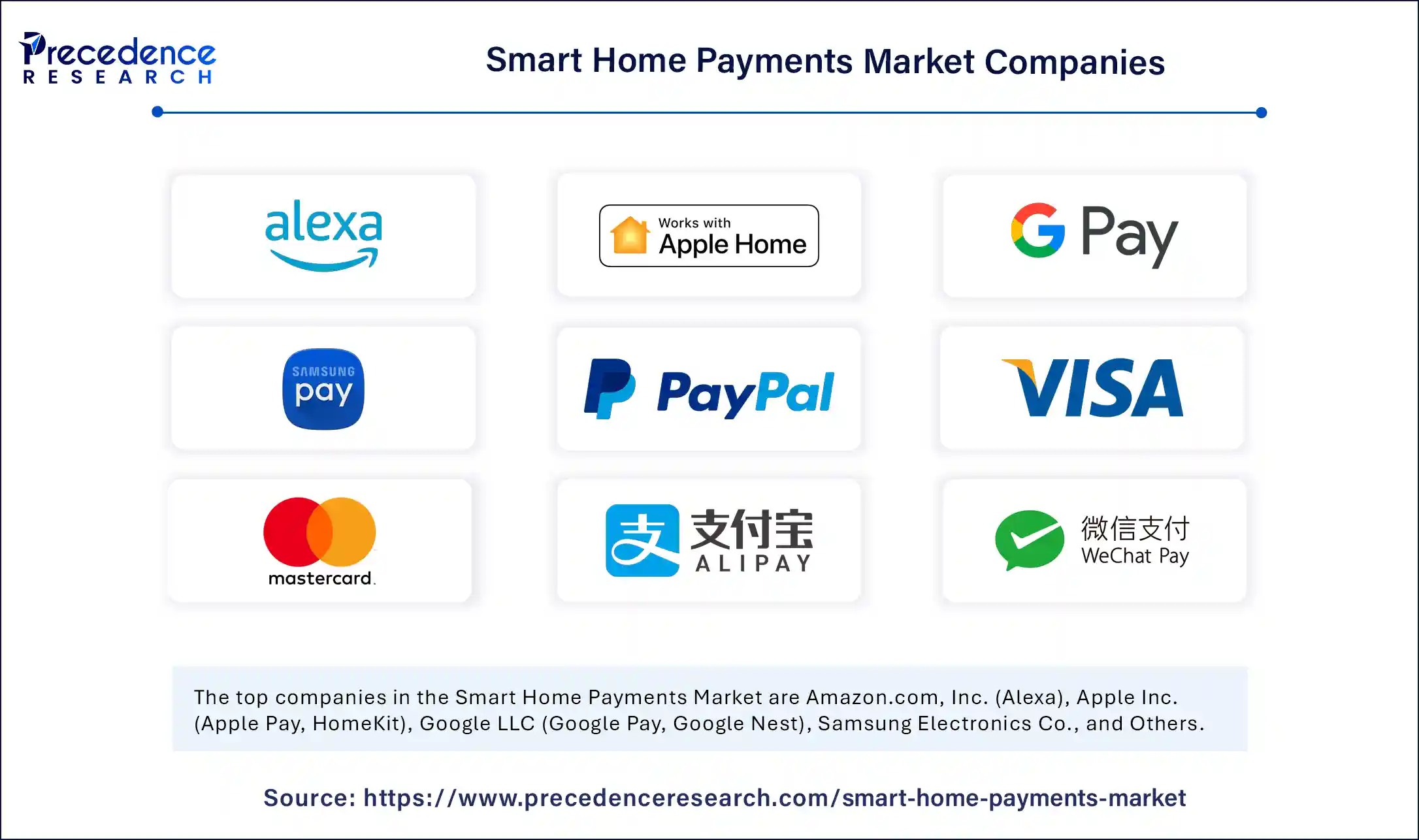
- Amazon.com, Inc. (Alexa)
- Apple Inc. (Apple Pay, HomeKit)
- Google LLC (Google Pay, Google Nest)
- Samsung Electronics Co., Ltd. (Samsung Pay, SmartThings)
- PayPal Holdings, Inc.
- Visa Inc.
- Mastercard Incorporated
- Alibaba Group (Alipay)
- Tencent Holdings Ltd. (WeChat Pay)
- Xiaomi Corporation
- LG Electronics Inc.
- IBM Corporation
- Microsoft Corporation
- Stripe, Inc.
- Square, Inc. (Block, Inc.)
- NXP Semiconductors
- Qualcomm Technologies, Inc.
- Honeywell International Inc.
- Philips (Signify N.V.)
- Huawei Technologies Co., Ltd.
1. Amazon.com, Inc. (Alexa)
Headquarters: Seattle, Washington, USA
Product Offerings related to Smart Home Payments:
-
Alexa Voice Shopping: Users can make purchases on Amazon using voice commands through Alexa-enabled devices (Echo speakers, Fire TV, etc.). This includes reordering past purchases, buying digital content, and even physical goods.
-
Alexa Pay (Indirect): While not a standalone payment service like Apple Pay or Google Pay, Alexa facilitates payments through linked Amazon accounts and stored payment methods.
-
Smart Home Device Integration: Alexa acts as a central hub, integrating with numerous smart home devices (lights, thermostats, locks) that might eventually facilitate in-app or voice-activated service payments (e.g., paying for a smart security monitoring service).
-
Amazon One: A palm recognition service used in Amazon Go stores and some third-party locations, which could extend to smart home-related services or deliveries.
Market Share & Estimated Revenue (Smart Home Payments Segment):
-
Direct revenue from Alexa-specific smart home payments is not typically broken out. However, Alexa’s significant market share in the smart speaker segment (a primary interface for voice payments) drives substantial e-commerce transactions through Amazon’s platform. Amazon’s overall e-commerce revenue is vast, with Alexa playing a key role in customer engagement and frictionless purchasing.
Recent Developments, Partnerships, or Innovations:
-
Continuous expansion of Alexa’s capabilities, including new payment integrations with third-party skills.
-
Partnerships with device manufacturers to embed Alexa, broadening the reach of voice shopping.
-
Focus on improving natural language understanding for more intuitive voice transactions.
Competitive Positioning and Strategic Focus:
-
Strong Ecosystem Play: Leverages its massive e-commerce platform, Prime subscription, and dominant smart speaker presence to drive frictionless payments.
-
Voice-First Strategy: Aims to make purchasing as simple as speaking a command, integrating payments into daily routines.
-
Broad Device Interoperability: Positions Alexa as the central voice assistant for a wide range of smart home devices, extending its payment potential.
Key Customers or Industries Served:
-
Amazon Prime members and general Amazon customers.
-
Users of Alexa-enabled smart home devices.
-
Third-party developers building Alexa skills that might include transactional elements.
2. Apple Inc. (Apple Pay, HomeKit)
Headquarters: Cupertino, California, USA
Product Offerings related to Smart Home Payments:
-
Apple Pay: Apple’s mobile payment service, widely used for in-app purchases, online shopping, and contactless payments. In the smart home context, Apple Pay can be used for:
-
Purchasing smart home devices and services within apps (e.g., subscribing to a smart camera’s cloud storage).
-
Potentially, future integrations for transactional smart home services (e.g., paying for a smart energy service or smart appliance features directly).
-
-
HomeKit: Apple’s framework for controlling smart home accessories. While not directly a payment platform, HomeKit provides the secure and integrated environment where future payment-enabled smart home services could operate, utilizing Apple Pay for transactions.
-
Wallet App: Stores credit/debit cards, loyalty cards, and potentially smart home-related passes or tickets.
Market Share & Estimated Revenue (Smart Home Payments Segment):
-
Apple Pay’s overall transaction volume is significant globally. Revenue specific to smart home transactions is not disclosed but is a subset of their broader services revenue, which is a major growth driver for Apple.
Recent Developments, Partnerships, or Innovations:
-
Continuous expansion of Apple Pay availability to new banks and countries.
-
Enhanced HomeKit security and interoperability (e.g., Matter support).
-
Focus on user privacy and security for all transactions, including those in the smart home ecosystem.
Competitive Positioning and Strategic Focus:
-
Premium Ecosystem: Leverages its loyal user base and reputation for security and privacy.
-
Seamless Integration: Aims for effortless payments within its closed ecosystem.
-
Privacy-Centric: Emphasizes user data protection as a core differentiator for its payment services.
-
Device as a Hub: iPhones, iPads, and HomePods serve as central controllers for HomeKit, making them potential points of payment initiation.
Key Customers or Industries Served:
-
Apple device users (iPhone, iPad, Apple Watch, Mac).
-
Users of HomeKit-compatible smart home devices and services.
3. Google LLC (Google Pay, Google Nest)
Headquarters: Mountain View, California, USA
Product Offerings related to Smart Home Payments:
-
Google Pay: Google’s mobile payment service, supporting in-app, online, and contactless payments. In the smart home, Google Pay can be used for:
-
Purchasing smart home devices and subscriptions within the Google Home app or partner apps.
-
Facilitating voice-activated purchases through Google Assistant (e.g., reordering groceries, digital content).
-
-
Google Nest: A suite of smart home devices (thermostats, cameras, speakers, displays) and services. The Google Home app acts as a central control and potential payment interface for Nest devices and associated subscriptions (e.g., Nest Aware).
-
Google Assistant: Enables voice-activated payments and transactions across Google’s ecosystem and integrated third-party services.
Market Share & Estimated Revenue (Smart Home Payments Segment):
-
Google Pay’s overall transaction volume is substantial. Revenue from smart home-specific payments is integrated into Google’s broader services and hardware revenue. Google Assistant and Nest devices contribute significantly to user engagement and potential for transactional activities.
Recent Developments, Partnerships, or Innovations:
-
Unified Google Pay experience across different Google products.
-
Continuous improvement in Google Assistant’s transactional capabilities and integration with e-commerce partners.
-
Expansion of Nest product line and integration with various smart home standards (e.g., Matter).
Competitive Positioning and Strategic Focus:
-
AI and Assistant-Driven: Leverages its AI prowess to provide intuitive voice-activated payments and services.
-
Open Ecosystem (Android): Benefits from the vast reach of Android devices.
-
Hardware-Software Integration: Combines Nest hardware with Google Assistant and Google Pay for a cohesive smart home experience.
Key Customers or Industries Served:
-
Android smartphone users.
-
Users of Google Nest devices and Google Assistant.
-
Merchants and service providers integrating with Google Pay and Google Assistant.
4. Samsung Electronics Co., Ltd. (Samsung Pay, SmartThings)
Headquarters: Suwon, Gyeonggi Province, South Korea
Product Offerings related to Smart Home Payments:
-
Samsung Pay: Samsung’s mobile payment service, compatible with NFC and MST (Magnetic Secure Transmission) for wider acceptance. Within the smart home context, Samsung Pay can be used for:
-
In-app purchases related to smart home devices or services via the SmartThings app.
-
Potentially, direct payments from smart appliances (e.g., ordering groceries from a smart refrigerator, though this is nascent).
-
-
SmartThings: Samsung’s IoT platform for connecting and controlling smart home devices. SmartThings acts as the central hub where services and features could be paid for using Samsung Pay.
-
Bixby: Samsung’s voice assistant, which can facilitate payments through Samsung Pay on compatible devices (smartphones, smart TVs, Family Hub refrigerators).
Market Share & Estimated Revenue (Smart Home Payments Segment):
-
Samsung Pay has a strong global presence, especially in markets where MST provides an advantage. Revenue from smart home payments specifically is not disclosed but is part of Samsung’s broader mobile and electronics divisions.
Recent Developments, Partnerships, or Innovations:
-
Expansion of Samsung Pay to new markets and integration with more banks.
-
Continuous development of the SmartThings platform, enhancing interoperability.
-
Innovations in smart appliances (e.g., Family Hub refrigerators with screens and Bixby integration) hint at future direct smart home payment capabilities.
Competitive Positioning and Strategic Focus:
-
Hardware Dominance: Leverages its vast range of consumer electronics and appliances (smartphones, TVs, refrigerators) to create a connected smart home ecosystem.
-
Broad Payment Acceptance: Samsung Pay’s MST capability offers a competitive edge in certain retail environments.
-
Comprehensive Ecosystem: Aims to connect all aspects of a user’s digital and physical life through SmartThings and Samsung devices.
Key Customers or Industries Served:
-
Owners of Samsung smartphones and other Samsung smart devices.
-
Users of the SmartThings platform.
5. PayPal Holdings, Inc.
Headquarters: San Jose, California, USA
Product Offerings related to Smart Home Payments:
-
PayPal Digital Wallet: A widely accepted online payment method. In the smart home context, PayPal is used for:
-
Purchasing smart home devices and subscriptions from online retailers.
-
Paying for smart home services (e.g., security monitoring, energy management subscriptions) via linked accounts.
-
-
Venmo (Owned by PayPal): While primarily P2P, Venmo could be used for splitting costs related to shared smart home services or devices among housemates.
-
Braintree (Owned by PayPal): A payment gateway for businesses, used by many smart home device manufacturers and service providers to accept payments from their customers.
Market Share & Estimated Revenue (Smart Home Payments Segment):
-
PayPal’s role in smart home payments is largely as an underlying payment rail or a convenient checkout option for smart home-related purchases. Direct revenue from smart home payments is not broken out but is a component of its vast e-commerce transaction volume.
Recent Developments, Partnerships, or Innovations:
-
Continuous expansion of its merchant network and global reach.
-
Focus on checkout innovation and ease of use.
-
Integration with various platforms and digital wallets.
Competitive Positioning and Strategic Focus:
-
E-commerce Leader: Benefits from its strong brand recognition and established trust in online payments.
-
Payment Agnostic: Acts as a neutral payment facilitator, integrating with various platforms and devices rather than owning a specific smart home ecosystem.
-
Developer-Friendly: Braintree enables smart home companies to easily integrate payment processing.
Key Customers or Industries Served:
-
Consumers making online purchases related to smart homes.
-
Merchants (including smart home device manufacturers and service providers) accepting online payments.
6. Visa Inc.
Headquarters: San Francisco, California, USA
Product Offerings related to Smart Home Payments:
-
Payment Network and Cards: Visa operates one of the largest payment networks globally. Visa cards (credit, debit, prepaid) are the fundamental instruments used for smart home payments:
-
Purchasing smart home devices online or in-store.
-
Subscribing to smart home services (e.g., security, cloud storage, premium features) charged monthly or annually.
-
Underlying payment method for digital wallets like Apple Pay, Google Pay, Samsung Pay used in smart home contexts.
-
-
Visa Token Service (VTS): Enhances security by replacing sensitive card data with unique tokens, crucial for IoT and connected device payments.
-
Future IoT Payment Initiatives: Visa is actively exploring and investing in technologies that enable direct payments from connected devices and smart appliances, such as “connected car commerce” which can be extended to the smart home.
Market Share & Estimated Revenue (Smart Home Payments Segment):
-
Visa is a payment network, not a direct smart home payment provider. However, a significant portion of all smart home-related transactions globally are likely processed over the Visa network. Its revenue comes from interchange fees and processing fees.
Recent Developments, Partnerships, or Innovations:
-
Continued investment in tokenization and security for digital payments.
-
Research and development into IoT payments, collaborating with automakers, appliance manufacturers, and payment technology companies.
-
Focus on expanding digital payment acceptance globally.
Competitive Positioning and Strategic Focus:
-
Global Network Infrastructure: Provides the foundational rails for smart home payments.
-
Security and Trust: Emphasizes the security and reliability of its network.
-
Facilitator and Enabler: Partners with banks, merchants, and technology companies to facilitate digital payments, including those in the smart home.
Key Customers or Industries Served:
-
Financial institutions (issuers and acquirers).
-
Merchants, e-commerce platforms, and smart home service providers.
-
Consumers (as cardholders).
7. Mastercard Incorporated
Headquarters: Purchase, New York, USA
Product Offerings related to Smart Home Payments:
-
Payment Network and Cards: Similar to Visa, Mastercard provides the network infrastructure for credit, debit, and prepaid cards used in smart home payments:
-
Purchasing devices and subscribing to services.
-
Underlying payment method for digital wallets.
-
-
Mastercard Digital Enablement Service (MDES): Mastercard’s tokenization platform, critical for securing payments made from connected devices and smart home applications.
-
IoT Payment Solutions: Mastercard is actively involved in developing and piloting solutions for secure payments from IoT devices, including smart home appliances. This includes initiatives like “connected car commerce” that can inform smart home strategies.
Market Share & Estimated Revenue (Smart Home Payments Segment):
-
Mastercard is a key payment network, and a substantial volume of smart home-related transactions occur over its network. Revenue is derived from interchange and processing fees.
Recent Developments, Partnerships, or Innovations:
-
Ongoing development and deployment of tokenization technology.
-
Collaborations with various industries (automotive, retail, tech) to enable secure IoT payments.
-
Focus on enhancing digital payment experiences and security.
Competitive Positioning and Strategic Focus:
-
Global Network Infrastructure: A primary competitor to Visa, providing widespread acceptance.
-
Innovation in Digital and IoT Payments: Actively investing in future-proofing payments for connected devices.
-
Security and Trust: Prioritizes secure transaction processing.
Key Customers or Industries Served:
-
Financial institutions.
-
Merchants and smart home service providers.
-
Consumers (as cardholders).
8. Alibaba Group (Alipay)
Headquarters: Hangzhou, Zhejiang, China
Product Offerings related to Smart Home Payments:
-
Alipay: China’s dominant digital payment platform, with over a billion users. In the smart home context, Alipay is crucial for:
-
Purchasing smart home devices through Alibaba’s e-commerce platforms (Taobao, Tmall).
-
Paying for smart home services, utilities, and subscriptions through the Alipay app (often integrated into various smart living apps in China).
-
Potential for direct payments from smart home devices integrated with Alipay’s ecosystem (e.g., smart mirrors, smart speakers in China).
-
-
IoT Solutions: Alibaba Cloud and various Alibaba subsidiaries are developing IoT platforms that could incorporate payment functionalities, particularly for smart city and smart living applications.
Market Share & Estimated Revenue (Smart Home Payments Segment):
-
Alipay holds a dominant share in digital payments in China. Revenue specific to smart home payments is integrated into its vast financial services and e-commerce segments. Its penetration into Chinese smart homes is significant due to its pervasive ecosystem.
Recent Developments, Partnerships, or Innovations:
-
Continuous expansion of Alipay’s services beyond payments, including lifestyle features.
-
Partnerships with device manufacturers and service providers to integrate Alipay.
-
Focus on smart city initiatives and IoT development.
Competitive Positioning and Strategic Focus:
-
Ecosystem Powerhouse: Leverages its massive e-commerce, cloud, and logistics infrastructure.
-
Dominant in China: Unparalleled reach and integration in the Chinese market.
-
All-in-One Lifestyle App: Aims to be the central platform for all aspects of a user’s life, including smart home interactions and payments.
Key Customers or Industries Served:
-
Consumers in China and increasingly Southeast Asia.
-
Merchants and service providers operating within Alibaba’s ecosystem.
-
Smart home device manufacturers targeting the Chinese market.
9. Tencent Holdings Ltd. (WeChat Pay)
Headquarters: Shenzhen, Guangdong, China
Product Offerings related to Smart Home Payments:
-
WeChat Pay: The other dominant digital payment platform in China, integrated within the WeChat “super app.” In the smart home, WeChat Pay is used for:
-
Purchasing smart home devices and services through mini-programs or official accounts within WeChat.
-
Paying for utilities, property management fees, and various smart living services that accept WeChat Pay.
-
Potential for integration with smart home devices that leverage the WeChat ecosystem for control and payments.
-
-
WeChat Mini Programs: Small applications within WeChat that can be developed by smart home companies to offer services and accept payments.
Market Share & Estimated Revenue (Smart Home Payments Segment):
-
WeChat Pay, alongside Alipay, dominates digital payments in China. Revenue from smart home payments is integrated into Tencent’s vast fintech and social media revenues. Its integration into daily life makes it a significant player for smart home transactions in China.
Recent Developments, Partnerships, or Innovations:
-
Continuous expansion of WeChat Pay’s acceptance and features.
-
Growth of the mini-program ecosystem, attracting various service providers.
-
Focus on social commerce and integrated digital living.
Competitive Positioning and Strategic Focus:
-
Social Dominance: Leverages WeChat’s immense social media user base and “super app” status.
-
Comprehensive Digital Lifestyle: Aims to integrate all aspects of a user’s digital life, including smart home interactions and payments.
-
Mini-Program Ecosystem: Provides a flexible platform for smart home companies to offer services and payments.
Key Customers or Industries Served:
-
Consumers in China and increasingly Southeast Asia.
-
Merchants and service providers utilizing the WeChat ecosystem.
-
Smart home device manufacturers targeting the Chinese market.
10. Xiaomi Corporation
Headquarters: Beijing, China
Product Offerings related to Smart Home Payments:
-
Mi Pay: Xiaomi’s mobile payment service, primarily available in China and India, used for in-app and contactless payments. It can be used for purchasing Xiaomi smart home devices and potentially services.
-
Xiaomi IoT Platform: A vast ecosystem of smart home devices (ranging from smart bulbs and cameras to air purifiers and robot vacuums) and the Mi Home app. While direct payments from devices are nascent, the app facilitates purchases of devices and associated services.
-
AI Speaker (e.g., Xiao AI Speaker): Similar to Alexa and Google Assistant, Xiaomi’s AI speakers enable voice control and potentially voice commerce within their ecosystem.
Market Share & Estimated Revenue (Smart Home Payments Segment):
-
Xiaomi is a leading smart home device manufacturer globally. Revenue from smart home payments is not a distinct reported segment but contributes to its overall IoT and lifestyle product revenue. Its competitive pricing and broad product range drive significant adoption.
Recent Developments, Partnerships, or Innovations:
-
Rapid expansion of its IoT product portfolio.
-
Focus on affordability and interoperability within its ecosystem.
-
Continuous development of Mi Pay and AI voice assistants.
Competitive Positioning and Strategic Focus:
-
Affordable Smart Home Ecosystem: Offers a wide range of competitively priced smart home devices.
-
Integrated Ecosystem: Aims to provide a seamless experience across its hardware and software.
-
High Volume Strategy: Focuses on selling a large volume of devices, creating a broad user base for potential payment services.
Key Customers or Industries Served:
-
Consumers seeking affordable and integrated smart home solutions, particularly in Asia.
-
Developers building for the Xiaomi IoT platform.
11. LG Electronics Inc.
Headquarters: Seoul, South Korea
Product Offerings related to Smart Home Payments:
-
ThinQ AI Platform: LG’s AI-powered platform connecting its smart home appliances (refrigerators, washing machines, TVs, air conditioners). While not a direct payment service, ThinQ provides the ecosystem where future payments for services (e.g., smart appliance maintenance, ordering consumables, subscriptions for premium features) could be facilitated.
-
LG Pay: LG’s mobile payment service (now largely integrated with Shinhan Pay in Korea), primarily used for general mobile payments. Its role in smart home is indirect, as a method for purchasing LG smart appliances or associated services through mobile.
-
WebOS (for Smart TVs): LG smart TVs often include app stores and payment integrations for digital content or smart home-related subscriptions.
Market Share & Estimated Revenue (Smart Home Payments Segment):
-
LG is a major player in home appliances and consumer electronics. Revenue from direct smart home payments is minimal and not a disclosed segment. Its contribution is more in enabling the infrastructure for future payments related to its appliances and services.
Recent Developments, Partnerships, or Innovations:
-
Continuous development of the ThinQ AI platform for better connectivity and intelligence in appliances.
-
Partnerships to integrate third-party services into its smart appliances.
-
Focus on smart kitchens and connected living experiences.
Competitive Positioning and Strategic Focus:
-
Appliance Integration: Leverages its strong position in home appliances to drive smart home adoption.
-
AI and Connectivity: Aims to make appliances more intelligent and interconnected, paving the way for service-oriented payments.
-
User Experience: Focuses on intuitive control and management of smart devices.
Key Customers or Industries Served:
-
Consumers purchasing LG smart appliances and electronics.
-
Users interested in connected kitchen and laundry solutions.
12. IBM Corporation
Headquarters: Armonk, New York, USA
Product Offerings related to Smart Home Payments:
-
Blockchain Solutions (e.g., IBM Blockchain Platform): While not a direct consumer payment provider, IBM offers blockchain-based solutions that could underpin secure, decentralized payment systems for IoT and smart home devices. This is more about infrastructure for B2B or specialized smart home services.
-
IBM Watson IoT Platform: Provides tools and services for connecting, managing, and analyzing data from IoT devices. This platform could be used by smart home service providers to build payment-enabled solutions.
-
Enterprise Solutions: IBM provides consulting and technology solutions to banks, payment processors, and large enterprises, which could include developing secure payment infrastructures for their smart home initiatives.
Market Share & Estimated Revenue (Smart Home Payments Segment):
-
IBM’s role is largely infrastructural and B2B. It doesn’t have a direct consumer-facing smart home payment product. Its revenue contribution is through providing technology and services to companies involved in the smart home payments space.
Recent Developments, Partnerships, or Innovations:
-
Continued development in enterprise blockchain and AI for IoT.
-
Focus on cloud-based solutions and hybrid cloud strategies for data management.
Competitive Positioning and Strategic Focus:
-
Enterprise-Grade Technology: Provides robust and secure backend infrastructure for smart home payment solutions.
-
AI and Blockchain Leader: Leverages its expertise in these advanced technologies to build future-proof payment systems.
-
Consultative Approach: Partners with businesses to develop customized solutions.
Key Customers or Industries Served:
-
Financial institutions, payment processors, large smart home device manufacturers, and service providers (B2B).
13. Microsoft Corporation
Headquarters: Redmond, Washington, USA
Product Offerings related to Smart Home Payments:
-
Azure IoT Platform: Provides cloud services for connecting, managing, and analyzing data from IoT devices. Smart home device manufacturers and service providers can build their payment-enabled solutions on Azure.
-
Microsoft Wallet/Payments (Indirect): While Microsoft has had various payment initiatives, its direct consumer payment presence is less prominent than competitors. However, its operating systems (Windows, Xbox) and platforms (Microsoft Store) facilitate digital purchases that might include smart home software or subscriptions.
-
Microsoft Teams/Cortana (Limited Smart Home Integration): Cortana once had broader smart home integration, but its focus has shifted. Teams might integrate with smart building solutions for enterprise, potentially involving internal billing.
Market Share & Estimated Revenue (Smart Home Payments Segment):
-
Microsoft’s role in smart home payments is primarily as a cloud infrastructure provider. Revenue is indirect, through Azure services utilized by smart home companies.
Recent Developments, Partnerships, or Innovations:
-
Continuous enhancement of Azure IoT capabilities, focusing on security, scalability, and AI integration.
-
Investment in mixed reality (e.g., HoloLens) which could interact with smart home environments in the future.
Competitive Positioning and Strategic Focus:
-
Cloud Infrastructure Leader: Provides a powerful and secure cloud platform for building smart home applications, including payment components.
-
Enterprise Focus: Strong position in enterprise software and services, which can extend to smart building management and related payment solutions.
-
Developer Ecosystem: Attracts developers to build on its platforms.
Key Customers or Industries Served:
-
Smart home device manufacturers, service providers, and smart building integrators utilizing Azure.
-
Businesses developing IoT solutions.
14. Stripe, Inc.
Headquarters: San Francisco, California, USA
Product Offerings related to Smart Home Payments:
-
Payment Processing Platform: Stripe provides a comprehensive suite of APIs and tools for online payment processing. This is crucial for:
-
Smart home device manufacturers selling products directly online.
-
Smart home service providers (e.g., security monitoring, smart energy management, subscription services) to accept recurring payments.
-
Subscription management (Stripe Billing) is particularly relevant for recurring smart home service fees.
-
-
Stripe Connect: Enables platforms to facilitate payments between users, potentially useful for marketplaces selling smart home services or devices.
Market Share & Estimated Revenue (Smart Home Payments Segment):
-
Stripe is a leading payment processor for online businesses globally. While it doesn’t have a direct “smart home payments” segment, a significant portion of its processed volume likely comes from companies in the smart home sector.
Recent Developments, Partnerships, or Innovations:
-
Continuous expansion of its global payment methods and features.
-
Focus on developer experience and ease of integration.
-
Innovation in subscription management and fraud prevention.
Competitive Positioning and Strategic Focus:
-
Developer-Centric: Offers highly flexible and well-documented APIs, making it a favorite for tech-savvy businesses.
-
Global Reach: Supports a wide array of currencies and payment methods.
-
Comprehensive Platform: Provides tools for not just payments, but also billing, fraud, and financial reporting.
Key Customers or Industries Served:
-
Smart home device startups and established manufacturers selling online.
-
Smart home service providers offering subscriptions.
-
E-commerce businesses in the smart home sector.
15. Square, Inc. (Block, Inc.)
Headquarters: San Francisco, California, USA
Product Offerings related to Smart Home Payments:
-
Square Payments Ecosystem: Primarily known for its POS hardware and software for small businesses. In the smart home context, its relevance is more indirect:
-
Retailers selling smart home devices might use Square for in-store payments.
-
Home service providers (e.g., smart home installation, maintenance, cleaning services) could use Square to accept payments on-site.
-
-
Cash App (Owned by Block): While primarily a P2P and consumer finance app, it could be used for splitting costs related to smart home purchases or services among household members.
-
Developer APIs: Square offers APIs for payment processing that could be integrated by smart home businesses, though this is less common than Stripe for pure online subscriptions.
Market Share & Estimated Revenue (Smart Home Payments Segment):
-
Block’s revenue from direct smart home payments is not disclosed and is largely incidental to its core small business and consumer finance operations.
Recent Developments, Partnerships, or Innovations:
-
Expansion of its small business ecosystem with banking and lending services.
-
Focus on cryptocurrency integration (e.g., Bitcoin in Cash App).
Competitive Positioning and Strategic Focus:
-
Small Business Empowerment: Aims to provide easy-to-use payment and business management tools for small and micro-businesses.
-
Integrated Solutions: Offers hardware, software, and financial services in one package.
Key Customers or Industries Served:
-
Small retailers selling smart home products.
-
Local service providers (electricians, smart home installers) accepting payments on-site.
16. NXP Semiconductors
Headquarters: Eindhoven, Netherlands
Product Offerings related to Smart Home Payments:
-
Secure Elements and Microcontrollers: NXP is a leading provider of secure elements (chips that protect cryptographic keys and sensitive data) and microcontrollers crucial for:
-
Secure Payment Terminals: Components used in POS terminals that process payments for smart home devices.
-
Secure IoT Devices: Embedded in smart home devices themselves to enable secure authentication, data encryption, and potentially secure direct payment capabilities (e.g., a smart appliance that could initiate a payment).
-
NFC Technology: A key enabler for contactless payments, which could eventually extend to smart home interactions (e.g., tapping a phone to a smart lock to pay for temporary access).
-
-
Processor Solutions: Provides processors for smart home hubs and gateways, ensuring the secure handling of data for potential payment transactions.
Market Share & Estimated Revenue (Smart Home Payments Segment):
-
NXP’s revenue comes from selling semiconductor components. It’s an upstream provider, not a direct payment service. Its contribution to smart home payments is foundational, by providing the hardware security and processing power required for secure transactions at the device level.
Recent Developments, Partnerships, or Innovations:
-
Continuous innovation in secure embedded solutions for IoT and automotive.
-
Focus on advanced connectivity (e.g., Wi-Fi 6, Matter support).
-
Development of secure processors for edge computing.
Competitive Positioning and Strategic Focus:
-
Security at the Edge: Specializes in providing hardware-level security for connected devices, a critical aspect for trusted smart home payments.
-
Embedded Solutions Leader: Dominant in providing chips for various embedded applications, including smart home.
-
Enabler for IoT: Plays a foundational role in enabling the secure and connected smart home ecosystem.
Key Customers or Industries Served:
-
Smart home device manufacturers (e.g., makers of smart locks, security cameras, hubs).
-
Payment terminal manufacturers.
-
Automotive and industrial IoT sectors.
17. Qualcomm Technologies, Inc.
Headquarters: San Diego, California, USA
Product Offerings related to Smart Home Payments:
-
Snapdragon Processors (IoT and Mobile): Qualcomm’s processors power a vast number of smartphones and increasingly IoT devices. These processors provide the computational power and connectivity for:
-
Mobile payments (Apple Pay, Google Pay, Samsung Pay) used to purchase smart home items.
-
Smart home hubs and devices (e.g., smart displays, advanced security cameras) that might integrate payment capabilities.
-
-
Connectivity Solutions (Wi-Fi, Bluetooth, 5G): Crucial for connecting smart home devices and enabling communication for payment transactions.
-
Security Features (Qualcomm Secure Processor): Built-in hardware security features within their chips protect sensitive data and cryptographic operations, essential for secure payments from devices.
Market Share & Estimated Revenue (Smart Home Payments Segment):
-
Qualcomm is a chip manufacturer. Its revenue is from selling processors and modems. Like NXP, its role is foundational, enabling smart home payment capabilities through its hardware.
Recent Developments, Partnerships, or Innovations:
-
Expansion of its IoT chipset portfolio for various smart home applications.
-
Leadership in 5G technology, which will enhance connectivity and speed for IoT devices.
-
Focus on AI at the edge for smarter device interactions.
Competitive Positioning and Strategic Focus:
-
Connectivity and Processing Power: Provides high-performance, power-efficient processors and advanced connectivity solutions.
-
End-to-End IoT Solutions: Offers a broad range of platforms for IoT, from edge to cloud.
-
Hardware Security: Integrates robust security features into its chips, supporting secure transactions.
Key Customers or Industries Served:
-
Smartphone manufacturers.
-
Smart home device manufacturers (e.g., smart speakers, hubs, security cameras).
-
Automotive and industrial IoT companies.
18. Honeywell International Inc.
Headquarters: Charlotte, North Carolina, USA
Product Offerings related to Smart Home Payments:
-
Smart Home Security and Automation Systems: Honeywell offers comprehensive smart home security systems (e.g., Resideo products, formerly part of Honeywell). Payments here relate to:
-
Subscriptions for professional monitoring services.
-
Purchasing smart security devices (cameras, sensors, smart thermostats).
-
-
Smart Thermostats: Honeywell’s smart thermostats can be managed via apps, and while not direct payment portals, they can be part of broader energy management systems that might eventually integrate payment for energy-saving services.
-
Building Management Systems (BMS): For commercial smart buildings, Honeywell provides BMS that can integrate billing and payment for energy consumption, facility services, etc. (more B2B than direct consumer smart home).
Market Share & Estimated Revenue (Smart Home Payments Segment):
-
Honeywell is a long-standing player in home security and building technologies. Revenue from smart home-related payments is mainly from security monitoring subscriptions and device sales.
Recent Developments, Partnerships, or Innovations:
-
Continued development in smart security and comfort solutions for homes and buildings.
-
Focus on integration and user experience for its smart home platforms.
Competitive Positioning and Strategic Focus:
-
Trusted Brand in Security: Strong reputation in home security, building on decades of experience.
-
Professional Installation & Monitoring: Often targets customers seeking comprehensive, professionally managed smart home security.
-
Energy Management: Focuses on solutions that save energy and improve comfort.
Key Customers or Industries Served:
-
Homeowners, particularly those seeking professional security monitoring.
-
Builders and property managers for smart home/building installations.
19. Philips (Signify N.V.)
Headquarters: Eindhoven, Netherlands (Signify)
Product Offerings related to Smart Home Payments:
-
Philips Hue Smart Lighting: While primarily known for smart lighting, Philips Hue offers an ecosystem controlled via its app or smart assistants. Payments here are indirect:
-
Purchasing Hue bulbs, light strips, and accessories.
-
Potential for future premium features or subscription services related to advanced lighting scenes or energy optimization, which would be paid for via standard payment methods.
-
-
Smart Home Ecosystem Integration: Hue integrates with major smart home platforms (Alexa, Google Home, Apple HomeKit), allowing for voice-controlled purchases via those platforms if they offer them.
Market Share & Estimated Revenue (Smart Home Payments Segment):
-
Signify (the company behind Philips Hue) is the global leader in smart lighting. Revenue from direct smart home payments is negligible, as its business model is hardware sales. Payments are typically for the products themselves or associated smart home hubs.
Recent Developments, Partnerships, or Innovations:
-
Continuous innovation in smart lighting features and energy efficiency.
-
Expansion of its product line and integration with new smart home standards (e.g., Matter).
Competitive Positioning and Strategic Focus:
-
Dominant in Smart Lighting: Strong brand recognition and product quality in the smart lighting segment.
-
Ecosystem Compatibility: Ensures broad compatibility with other major smart home platforms.
-
User Experience: Focuses on ease of use and rich lighting experiences.
Key Customers or Industries Served:
-
Consumers interested in smart lighting solutions.
-
Smart home enthusiasts and integrators.
20. Huawei Technologies Co., Ltd.
Headquarters: Shenzhen, Guangdong, China
Product Offerings related to Smart Home Payments:
-
Huawei Pay: Huawei’s mobile payment service, primarily available in China and some international markets. It can be used for purchasing devices and potentially smart home services within the Huawei ecosystem.
-
HarmonyOS (Hongmeng OS): Huawei’s operating system designed for various devices, including smart home products. HarmonyOS aims to create a “super device” experience where payments for services or content could be seamlessly integrated across connected devices.
-
AI Speaker and Smart Screens: Huawei offers smart speakers and displays that integrate its voice assistant, which can potentially facilitate

- ESG Software Market 2025: Comprehensive Company Ecosystem and Revenue Overview - May 20, 2026
- ESG Software Market Surges Toward USD 31.96 Billion by 2035 as AI-Powered Compliance and Sustainability Reporting Transform Global Enterprises - May 20, 2026
- Hematopoietic Stem Cell Transplantation Market Surges Toward USD 24.32 Billion by 2035 as Precision Medicine and AI Reshape Blood Cancer Treatment - May 20, 2026