
What is the Parkinson’s Disease Biomarkers Market Size in 2026?
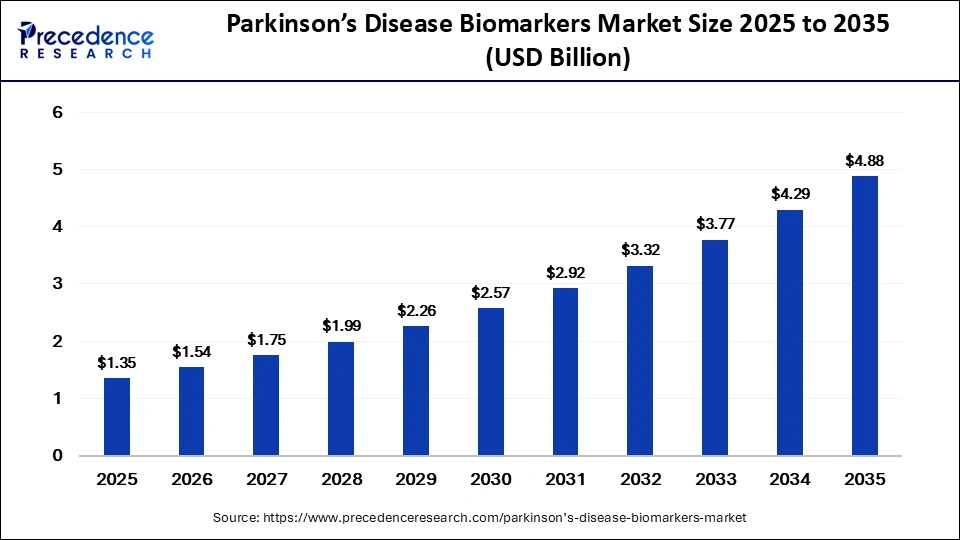
The global parkinsons disease biomarkers market size accounted for USD 1.35 billion in 2025 and is predicted to increase from USD 1.54 billion in 2026 to approximately USD 4.88 billion by 2035, expanding at a CAGR of 13.80% from 2026 to 2035. The market is driven by the rising demand for early diagnosis and disease-modifying therapies.
Key Takeaways
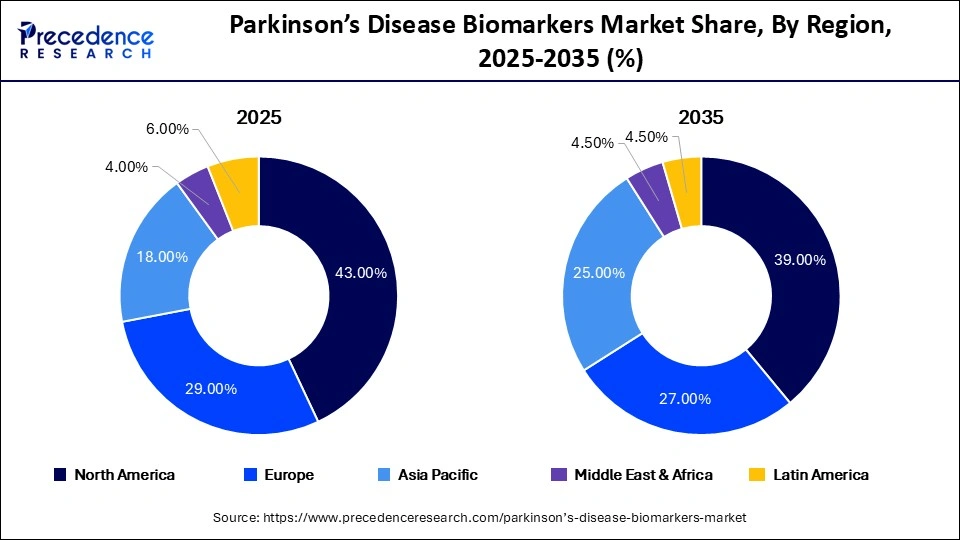
- North America dominated the global market with a share of 43% in 2025.
- Asia-Pacific is expected to grow at the fastest CAGR of 17.2% during the forecast period.
- By biomarker type, the molecular biomarkers segment contributed 38% revenue share in 2025.
- By biomarker type, the genetic biomarkers held 18% of the Parkinson’s disease biomarkers market share in 2025 and is expected to grow at the fastest CAGR of 15% in the coming years.
- By technology, the immunoassays segment accounted for a revenue share of 28% in the market in 2025.
- By technology, the AI-based biomarker analysis segment held 5% share and is expected to grow at the highest CAGR 22% between 2026 and 2035.
- By application, the early diagnosis segment led the global market with a share of 36% in 2025 and is expected to grow at the fastest CAGR of 16.5% between 2026 and 2035.
- By end-use, the hospitals segment accounted for a revenue share of 38% in the market in 2025.
- By end-use, the diagnostic laboratories segment held a market share of 26% in 2025 and is expected to grow at the fastest CAGR of 15.5% between 2026 and 2035.
Market Overview
The Parkinson’s disease biomarkers market is gaining significant momentum as healthcare providers and researchers increasingly focus on early diagnosis, disease monitoring, and personalized treatment strategies for neurodegenerative disorders. Biomarkers in Parkinson’s disease are measurable biological indicators that help detect and track disease progression. These biomarkers include misfolded alpha-synuclein proteins identified in cerebrospinal fluid, blood samples, skin biopsies, and other biological specimens. They play a crucial role in improving diagnostic accuracy, monitoring therapeutic responses, supporting clinical trials, and accelerating the development of disease-modifying therapies. Traditionally, Parkinson’s disease diagnosis has relied heavily on neurological examinations, patient symptom history, and responsiveness to dopamine-based therapies. However, biomarker-based diagnostics are transforming the clinical landscape by enabling more objective and earlier disease detection.
Impact of AI-Driven Innovations on the Parkinson’s Disease Biomarkers Market
Artificial intelligence (AI) and machine learning technologies are significantly transforming the Parkinson’s disease biomarkers market by enhancing diagnostic precision, enabling real-time monitoring, and accelerating biomarker discovery. AI-powered systems can analyze large volumes of patient data collected from smartphones, wearable devices, imaging systems, and voice recognition technologies to detect subtle motor and non-motor symptoms associated with Parkinson’s disease.
Machine learning algorithms are increasingly being used to assess gait abnormalities, tremors, sleep breathing patterns, speech changes, and movement irregularities that may appear years before clinical diagnosis. These advanced technologies help clinicians identify early disease indicators with greater accuracy and efficiency. AI-driven innovations are also supporting the discovery of novel molecular signatures and improving patient stratification in clinical trials, ultimately contributing to faster drug development and improved patient outcomes.
Emerging Trends in the Parkinson’s Disease Biomarkers Market
The market is witnessing strong growth due to rising investments in neurological research and increasing collaborations between pharmaceutical companies, biotechnology firms, and research institutions focused on neurodegenerative disease diagnostics. Companies are allocating substantial resources toward the development of advanced biomarker technologies to improve early detection and disease management capabilities.
A major trend shaping the market is the growing preference for minimally invasive diagnostic techniques, particularly blood-based biomarkers. These next-generation diagnostic approaches offer convenient, cost-effective, and patient-friendly alternatives to traditional cerebrospinal fluid testing methods. The introduction of innovative blood-based biomarkers is revolutionizing the Parkinson’s disease diagnostic ecosystem by enabling earlier detection and continuous disease monitoring.
In addition, the growing global burden of Parkinson’s disease is increasing demand for more reliable and accurate diagnostic tools, accelerating the adoption of biomarker-based testing solutions across healthcare systems worldwide. Biomarkers are also becoming increasingly important in clinical trials for disease-modifying therapies, as they provide objective methods for patient selection, treatment monitoring, target engagement evaluation, and efficacy assessment. These advancements are expected to drive substantial market growth over the coming years.
| Report Attribute | Details |
|---|---|
| Market Valuation (2025) | USD 1.35 Billion |
| Estimated Market Size (2026) | USD 1.54 Billion |
| Projected Market Size (2035) | USD 4.88 Billion |
| Forecast CAGR (2026–2035) | 13.80% |
| Leading Regional Market | North America |
| Highest Growth Region | Asia Pacific |
| Historical/Base Year | 2025 |
| Forecast Timeline | 2026 to 2035 |
| Market Segmentation | Biomarker Type, Technology, Application, End User, and Geography |
| Geographic Coverage | North America, Europe, Asia Pacific, Latin America, and Middle East & Africa |
Regional Insights
North America dominated the Parkinson’s disease biomarkers market in 2025 and is expected to maintain its leading position throughout the forecast period. The region benefits from advanced healthcare infrastructure, strong investments in neurological research, and the presence of leading biotechnology and diagnostics companies such as F. Hoffmann-La Roche Ltd., Abbott Laboratories, and Thermo Fisher Scientific.
The United States represents the largest contributor within the region due to the growing prevalence of Parkinson’s disease, increasing adoption of precision medicine, and rising demand for early diagnostic technologies. In addition, government funding for neuroscience research and the growing integration of artificial intelligence in biomarker discovery are supporting market expansion. The increasing number of clinical trials focused on neurodegenerative diseases is also accelerating the adoption of biomarker-based diagnostics across hospitals and research institutions.
Europe held the second-largest share of the Parkinson’s disease biomarkers market owing to strong healthcare systems, increasing aging population, and extensive neurological research activities across countries such as Germany, the United Kingdom, France, and Switzerland. The region has witnessed growing collaborations between academic institutions, pharmaceutical companies, and diagnostic technology providers to develop advanced biomarker testing solutions.
The rising focus on early disease diagnosis and personalized treatment strategies is driving the adoption of blood-based biomarkers and neuroimaging technologies. Furthermore, supportive regulatory frameworks and investments in healthcare innovation are contributing to the market’s steady growth across Europe.
Asia Pacific is expected to register the fastest growth during the forecast period due to increasing healthcare expenditure, expanding diagnostic infrastructure, and rising awareness regarding neurodegenerative diseases. Countries such as China, Japan, India, and South Korea are witnessing significant growth in neurological research and biomarker-based diagnostic adoption.
Japan remains a major market within the region due to its rapidly aging population and strong emphasis on neurological healthcare innovation. Meanwhile, China and India are emerging as high-growth markets driven by improving healthcare access, growing investments in biotechnology, and increasing collaborations between global and regional healthcare companies. The rising adoption of AI-powered diagnostic tools and wearable monitoring technologies is further supporting market expansion across Asia Pacific.
Latin America is experiencing gradual growth in the Parkinson’s disease biomarkers market due to improving healthcare infrastructure and increasing awareness regarding neurological disorders. Brazil and Mexico are among the leading contributors in the region, supported by expanding healthcare investments and growing access to diagnostic technologies.
The market growth is also being supported by rising partnerships between international diagnostics companies and regional healthcare providers aimed at improving neurological disease diagnosis and treatment capabilities.
The Middle East & Africa region is anticipated to witness moderate growth during the forecast period. Increasing government focus on healthcare modernization, rising investments in medical technologies, and improving diagnostic facilities are contributing to market development.
Countries such as the UAE, Saudi Arabia, and South Africa are gradually adopting advanced neurological diagnostic technologies and biomarker-based testing solutions. However, limited awareness, shortage of specialized healthcare professionals, and restricted access to advanced diagnostic infrastructure in some developing economies may restrain market growth to a certain extent.
Parkinson’s Disease Biomarkers Market Companies
- F. Hoffmann-La Roche Ltd.
- Bio-Rad Laboratories
- Thermo Fisher Scientific
- Abbott Laboratories
- Quanterix
- Siemens Healthineers
- GE HealthCare
- PerkinElmer
- Sysmex Corporation
- Biogen Inc.
- Pfizer Inc.
- Novartis AG
- Quest Diagnostics
- Labcorp
- Proteome Sciences
Recent Developments
- In April 2026, Biognosys Group and The Michael J. Fox Foundation for Parkinson’s Research (MJFF) announced a collaboration to develop sensitive and quantitative biomarker assays for Parkinson’s disease. The partnership supports MJFF’s LRRK2 Investigative Therapeutics Exchange (LITE), a global initiative designed to accelerate the development of therapies and biomarkers targeting leucine-rich repeat kinase 2 (LRRK2). (Source: https://clpmag.com)
- In November 2025, CND Life Sciences, Inc. (CND) announced that its Syn-One Biomarker Services had been used to measure and quantify a reduction in the deposition of abnormal alpha-synuclein in a Phase 2 clinical trial sponsored by ABLi Therapeutics for its lead investigational Parkinson’s disease (PD) treatment, risvodetinib.(Source: https://www.prnewswire.com)
Segments Covered in the Report
By Biomarker Type
- Molecular Biomarkers
- Alpha-synuclein
- DJ-1 Protein
- Tau Protein
- Neurofilament Light Chain (NfL)
- Imaging Biomarkers
- PET Imaging
- MRI Biomarkers
- SPECT Imaging
- Genetic Biomarkers
- LRRK2 Mutation
- GBA Mutation
- SNCA Gene
- Biochemical Biomarkers
- Cerebrospinal Fluid (CSF) Biomarkers
- Blood-based Biomarkers
- Salivary Biomarkers
By Technology
- Immunoassays
- Molecular Diagnostics
- Proteomics
- Genomics
- Neuroimaging Technologies
- AI-based Biomarker Analysis
By Application
- Early Diagnosis
- Disease Progression Monitoring
- Drug Discovery & Development
- Personalized Medicine
- Clinical Research
By End-use
- Hospitals
- Diagnostic Laboratories
- Academic & Research Institutes
- Specialty Neurology Clinics
- Pharmaceutical & Biotechnology Companies
By Region
- North America
- Latin America
- Europe
- Asia-pacific
- Middle and East Africa
Get Sample Link: https://www.precedenceresearch.com/sample/8424
Read Out Latest Article : Parkinson’s Disease Biomarkers Market Key Players

- Farm Management Software Market: Digital Agriculture Driving Smarter and More Sustainable Farming - July 9, 2026
- AI in CGT Manufacturing Market: Artificial Intelligence Accelerating the Future of Cell and Gene Therapy Production - July 9, 2026
- 3T MRI System Market: Advanced Imaging Technology Transforming Modern Diagnostics - July 9, 2026